
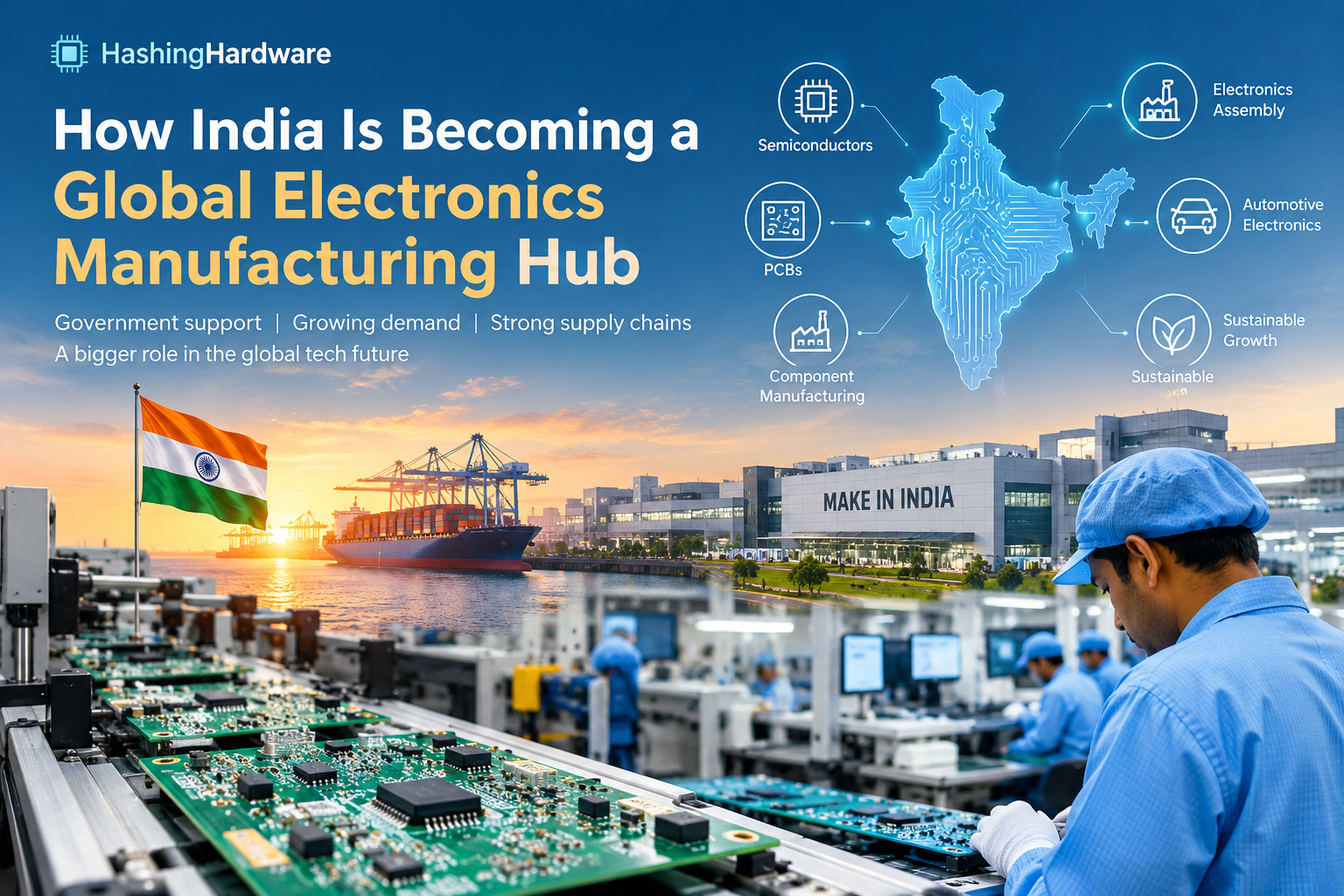
India is rapidly changing its position in the global electronics industry. For years, the country was known mainly as a large consumer market for smartphones, computers, appliances, and other electronic products. Today, however, India is becoming an important destination for electronics manufacturing.
Smartphones are already a major part of this growth. At the same time, companies are expanding into components, printed circuit boards, semiconductor packaging, automotive electronics, telecom equipment, and other hardware sectors.
So, what is driving this transformation?
The answer is a combination of government initiatives, a large workforce, growing domestic demand, supply-chain diversification, infrastructure investment, and increasing interest from global technology companies.
Why India Is Becoming Important for Electronics Manufacturing
The global electronics industry has traditionally depended heavily on manufacturing centers in East Asia. China, Taiwan, South Korea, Japan, and Vietnam have developed strong electronics ecosystems over several decades.
However, companies are now looking to diversify their manufacturing operations.
This shift creates an opportunity for India.
India has three major advantages: a huge domestic market, a large workforce, and an expanding manufacturing ecosystem. In addition, government policies are encouraging companies to produce more electronics within the country.
As a result, India is moving beyond simply assembling imported components.
The long-term goal is to develop a broader electronics ecosystem that includes component manufacturing, design, assembly, testing, packaging, logistics, and research and development.
Government Support Is Accelerating Growth
One of the biggest reasons behind India’s electronics manufacturing growth is government support.
Programs such as the Production Linked Incentive (PLI) scheme have encouraged companies to increase domestic production. The government has also introduced initiatives aimed at developing semiconductor and electronics manufacturing capabilities.
These programs are important because building a modern electronics ecosystem requires significant investment.
Factories need advanced machinery. Manufacturers need skilled workers. Suppliers need reliable logistics. Companies also need testing facilities and access to components.
Therefore, financial incentives can help reduce some of the initial risks associated with setting up manufacturing operations.
Smartphone Manufacturing Is Leading the Way
Smartphones are one of the clearest examples of India’s manufacturing transformation.
Large global brands and electronics manufacturing companies have expanded production in India. At the same time, domestic demand for smartphones has created a strong local market.
This creates an important advantage.
Companies can manufacture products close to a large customer base while also developing capabilities that can support exports.
However, smartphone manufacturing is only the beginning.
The same manufacturing infrastructure can support other product categories, including tablets, laptops, wearables, networking equipment, consumer electronics, and automotive electronics.
From Assembly to a Complete Electronics Ecosystem
Assembly is an important first step, but it is not the entire manufacturing process.
A mature electronics industry needs many layers.
These include:
- Semiconductor manufacturing and packaging
- PCB manufacturing
- PCB assembly
- Component production
- Display manufacturing
- Battery production
- Mechanical parts
- Connectors and cables
- Sensors
- Power electronics
- Testing and quality control
- Logistics and supply-chain services
India is gradually developing capabilities across these areas.
This matters because local suppliers can reduce transportation time and supply-chain risks.
Moreover, when component suppliers operate near final-product manufacturers, companies can improve production efficiency.
The Growing Role of Semiconductor Manufacturing
Semiconductors are at the center of modern electronics.
Every smartphone, laptop, vehicle, server, industrial machine, and AI system depends on semiconductor technology.
India has historically had strong semiconductor design capabilities. Many global semiconductor companies have engineering and research teams in the country.
Now, the focus is expanding toward semiconductor manufacturing, assembly, testing, and packaging.
This is a significant development.
India does not need to build every type of semiconductor immediately. Instead, developing a strong ecosystem around semiconductor packaging, testing, design, and specialized manufacturing can provide a foundation for future growth.
Why Semiconductor Packaging Matters
A semiconductor chip is not ready for use immediately after fabrication.
It needs to be packaged, tested, and connected to the outside world.
Advanced packaging is becoming increasingly important because modern processors are becoming more complex.
Technologies such as chiplets and high-bandwidth memory are also increasing the importance of advanced packaging.
For more information about this trend, see our article on chiplets and modern chip design.
India’s PCB Manufacturing Opportunity
Printed circuit boards are another important part of the electronics supply chain.
A PCB connects electronic components and allows them to communicate and receive power. Almost every modern electronic product contains one or more PCBs.
However, PCB manufacturing requires specialized equipment, materials, chemicals, testing systems, and skilled workers.
As electronics production increases in India, demand for locally manufactured PCBs and assembled circuit boards should also grow.
This creates opportunities for manufacturers involved in:
- PCB fabrication
- SMT assembly
- Component sourcing
- PCB testing
- Prototyping
- Quality inspection
- Electronics contract manufacturing
For companies developing new hardware products, choosing the right components is also critical. You can learn more in our guide to choosing the right components for a hardware product.
Supply-Chain Diversification Is a Major Opportunity
Another major factor is the changing global supply chain.
Many technology companies learned important lessons from supply-chain disruptions during the COVID-19 pandemic. Component shortages, shipping delays, factory shutdowns, and geopolitical tensions showed companies the risks of depending too heavily on a single manufacturing location.
Consequently, businesses are increasingly considering a China-plus-one strategy.
India is one of the countries benefiting from this approach.
Vietnam, Mexico, Thailand, Malaysia, and other manufacturing regions are also competing for investment. Therefore, India must continue improving infrastructure, skills, logistics, and manufacturing efficiency.
A Large Workforce Gives India an Advantage
Electronics manufacturing requires people with many different skills.
Factories need engineers, technicians, quality-control specialists, machine operators, software developers, supply-chain professionals, and production managers.
India already has a large engineering and technical workforce.
However, the next challenge is developing more specialized manufacturing skills.
Training programs will become increasingly important as factories adopt advanced automation, robotics, artificial intelligence, and precision manufacturing equipment.
Automation Is Changing Indian Factories
Modern electronics factories are becoming increasingly automated.
Machines can place components on PCBs, inspect solder joints, test products, move materials, and monitor production lines.
Artificial intelligence can also help manufacturers detect defects and predict equipment failures.
This means India’s electronics manufacturing industry will not simply depend on low-cost labor.
Instead, future competitiveness will increasingly depend on automation, engineering expertise, quality, productivity, and supply-chain efficiency.
Electronics Manufacturing and the Automotive Industry
The growth of electric vehicles is creating another opportunity.
Modern vehicles contain a large number of electronic systems. These include battery management systems, motor controllers, sensors, infotainment systems, cameras, radar systems, connectivity modules, and power electronics.
As India’s automotive industry moves toward electric and software-defined vehicles, demand for automotive electronics is likely to increase.
This could create new opportunities for Indian electronics manufacturers.
AI Hardware Could Create the Next Manufacturing Wave
Artificial intelligence is creating demand for new types of hardware.
AI servers require powerful processors, high-bandwidth memory, advanced networking, efficient power systems, and sophisticated cooling.
At the edge, AI-enabled devices need processors with dedicated neural processing capabilities.
For example, modern laptops increasingly include NPUs designed to accelerate AI workloads locally.
Read more about this trend in our article on why modern laptops are adding NPUs.
As AI hardware demand grows, India could become an important location for design, assembly, testing, and eventually more advanced manufacturing activities.
Challenges India Still Needs to Solve
Despite strong progress, India still faces challenges.
Component Dependence
A manufacturing ecosystem cannot depend heavily on imported components forever.
Local production of components such as displays, batteries, PCBs, connectors, sensors, and semiconductor-related products will be important.
Infrastructure
Reliable electricity, transportation, ports, industrial parks, and high-speed logistics are essential for electronics manufacturing.
Even a small delay in component delivery can affect an entire production line.
Skilled Workforce
India has a large talent pool, but advanced manufacturing requires specialized skills.
Therefore, technical education and industry-focused training will become increasingly important.
Manufacturing Costs
India must remain competitive against established electronics manufacturing centers.
Lower production costs alone are not enough. Manufacturers also need high productivity, consistent quality, reliable suppliers, and efficient logistics.
Sustainability Will Become More Important
As electronics production increases, so will electronic waste.
Manufacturers will need to think about the entire product lifecycle.
This includes responsible sourcing, energy-efficient production, repairability, recycling, and end-of-life management.
India’s growing electronics industry therefore creates an opportunity to build a more sustainable manufacturing ecosystem from the beginning.
Responsible recycling can also recover valuable materials from discarded electronics.
What the Future Could Look Like
India’s electronics manufacturing journey is still developing.
The country has already demonstrated that it can produce large volumes of consumer electronics. The next stage is to build deeper capabilities in components, semiconductors, PCBs, advanced packaging, automotive electronics, and industrial hardware.
At the same time, India’s engineering talent can help connect manufacturing with product design and research.
This combination could be extremely valuable.
Instead of simply becoming a place where products are assembled, India has the opportunity to become a complete electronics technology ecosystem.
Final Thoughts
India is becoming an increasingly important player in global electronics manufacturing.
Government incentives, rising domestic demand, global supply-chain diversification, manufacturing investment, and a large technical workforce are all contributing to this transformation.
However, the biggest opportunity lies beyond final assembly.
The development of semiconductors, PCBs, components, advanced packaging, automation, AI hardware, automotive electronics, and sustainable recycling could determine how competitive India becomes over the next decade.
The journey is not finished. Yet, the direction is clear.
India is moving from being one of the world’s biggest electronics markets toward becoming one of its important electronics manufacturing centers.
For the global hardware industry, that could be one of the most important manufacturing shifts of the coming decade.