
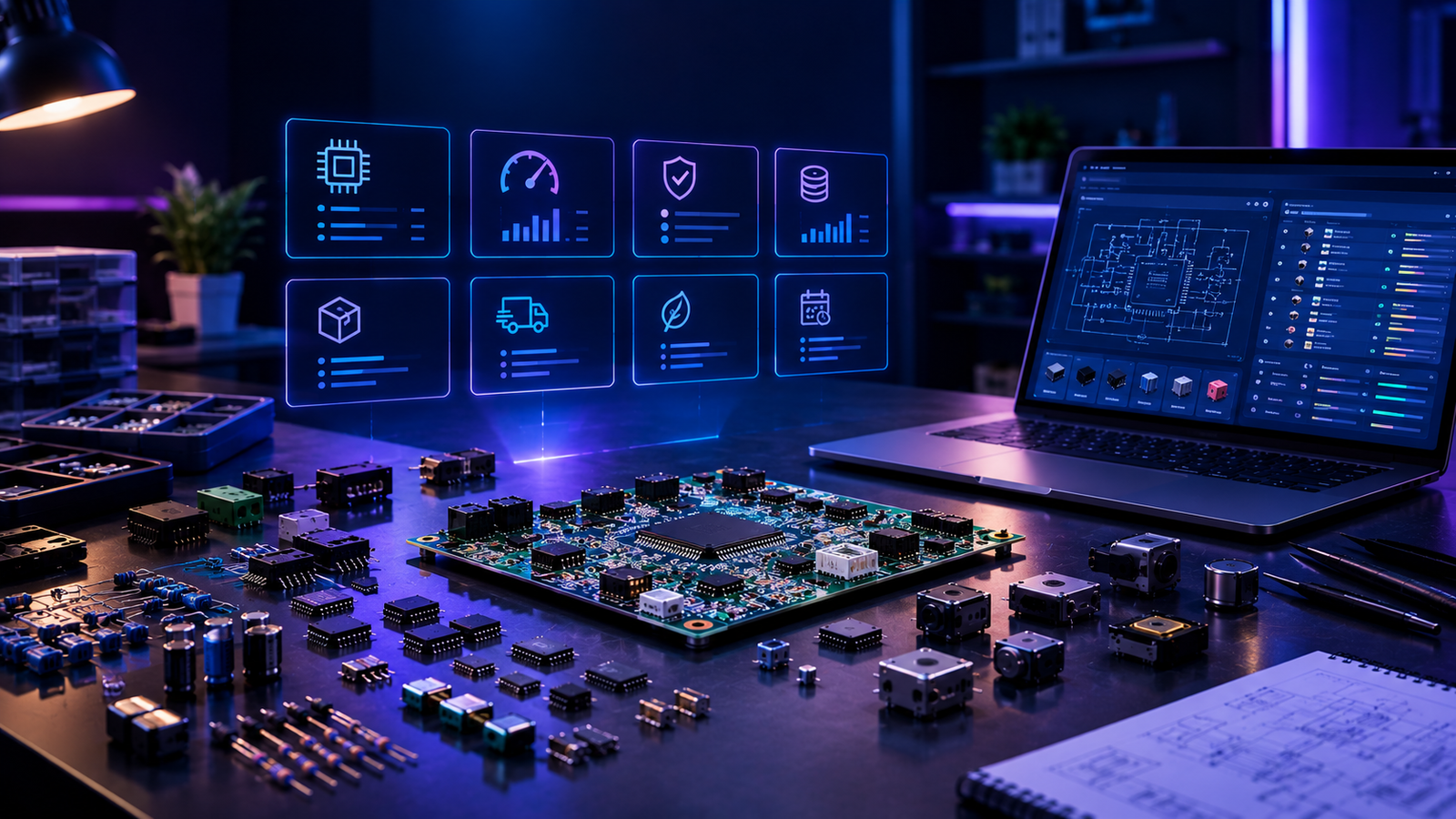
Choosing components is one of the most important decisions in hardware product development.
A component does more than perform a specific electrical function. It can affect product cost, reliability, power consumption, manufacturing, availability, certification, and long-term support.
For that reason, hardware teams should not select components based only on datasheet specifications or unit price.
The right component must fit the entire product strategy.
Start With Product Requirements
Before comparing components, define what the product needs to achieve.
Start with questions such as:
- What will the product do?
- What environment will it operate in?
- What voltage and current does it require?
- What temperature range must it support?
- How much power can it consume?
- What communication interfaces are required?
- What certifications apply?
- How long should the product remain available?
These requirements create a technical baseline for component selection.
For example, a battery-powered IoT device may prioritize low power consumption. An industrial controller may prioritize temperature tolerance and long-term availability.
Therefore, there is no universally “best” component.
There is only the component that best fits the application.
Evaluate Electrical Performance
Electrical specifications are the first major filter.
Depending on the component, engineers may need to evaluate:
- Voltage range
- Current capacity
- Frequency
- Accuracy
- Efficiency
- Switching speed
- Signal levels
- Power consumption
- Thermal characteristics
- Interface compatibility
A component should provide enough performance for the application without being unnecessarily over-specified.
Choosing a component with specifications far beyond the actual requirement can increase cost without providing meaningful benefits.
Consider the Operating Environment
The environment can dramatically change component requirements.
A device used indoors may operate under relatively stable conditions. An industrial product may face heat, humidity, vibration, dust, or electrical noise.
Therefore, component selection should consider environmental conditions from the beginning.
Important factors can include:
- Operating temperature
- Storage temperature
- Humidity
- Vibration
- Shock
- Dust exposure
- Corrosive environments
- Electromagnetic interference
The component must continue to perform reliably within the conditions defined for the product.
Balance Cost and Performance
Unit price matters, especially for products manufactured at scale.
However, choosing the cheapest component is not always the best way to reduce product cost.
A low-cost component can create additional expenses through:
- Higher failure rates
- More supporting components
- Difficult assembly
- Additional testing
- Lower production yield
- Supply problems
- Future redesigns
Industry guidance increasingly treats component selection as a broader cost and risk decision rather than a simple price comparison.
Therefore, engineers should evaluate the total cost of ownership rather than only the purchase price.
Check Component Availability
Availability is just as important as technical performance.
A component may perfectly match the design but still become a production bottleneck if suppliers cannot provide enough units.
Before approving a part, review:
- Current stock
- Lead time
- Production capacity
- Distributor availability
- Supplier reliability
- Minimum order quantities
- Regional availability
- Expected production volumes
Availability should also be monitored throughout the product lifecycle.
Recent sourcing guidance recommends applying sourcing checks at the schematic stage and tracking component lifecycle status to prevent late redesigns.
Plan for Second Sources
A single-source component creates additional supply risk.
If the manufacturer stops production, changes pricing, or experiences supply constraints, the entire product can be affected.
Whenever practical, identify alternative components early.
However, a second source should not be selected based only on similar part numbers.
Engineers should verify:
- Pin compatibility
- Electrical characteristics
- Package dimensions
- Thermal behavior
- Firmware requirements
- Performance differences
- Certification requirements
A substitute that looks compatible on paper may still require design changes.
Review Lifecycle Status
Electronic components have product lifecycles.
A part may move from active production to mature status and eventually reach end-of-life.
For long-term products, this matters greatly.
Lifecycle planning can help teams identify components that may become difficult to source in the future. Current sourcing guidance recommends monitoring lifecycle status across the BOM rather than waiting for an obsolete part to create a redesign.
For products expected to remain in the market for several years, lifecycle information should be part of the component approval process.
Think About Manufacturing
Component selection also affects manufacturing.
Package size, footprint, placement requirements, soldering process, inspection, and assembly complexity can all influence production.
For example, a component may offer excellent electrical performance but require a package that is difficult to assemble or inspect.
Therefore, engineers should discuss important component decisions with manufacturing teams early.
This is especially important before the design moves into high-volume production.
Consider Compliance and Certification
Some products must meet specific regulatory or industry requirements.
Depending on the application, components may need to support requirements related to:
- Safety
- Electromagnetic compatibility
- Environmental regulations
- Reliability
- Industry certifications
Compliance should not be treated as an afterthought.
Selecting suitable components early can simplify later testing and certification work.
Create a Component Selection Matrix
A component selection matrix can make technical decisions more objective.
For each candidate, compare:
| Criteria | What to Evaluate |
|---|---|
| Performance | Meets technical requirements |
| Cost | Unit and supporting costs |
| Availability | Stock and lead time |
| Reliability | Expected operating life |
| Lifecycle | Active, mature, or EOL |
| Manufacturing | Package and assembly suitability |
| Compliance | Required certifications |
| Supplier | Stability and support |
| Alternatives | Second-source availability |
This approach makes trade-offs easier to identify.
It also creates a useful record for future design reviews.
Avoid Selecting Components Too Early
Hardware teams sometimes choose components before the system requirements are clear.
That can lock the design into unnecessary constraints.
Instead, define the architecture and requirements first. Then evaluate components against those requirements.
A recent hardware feasibility guide similarly recommends balancing technical performance, cost, availability, lifecycle status, and production scalability during component selection.
This approach gives engineers more flexibility and reduces the risk of expensive redesigns.
Final Thoughts
Choosing components is not simply about finding parts that work.
The right component should support performance, reliability, cost, manufacturing, availability, compliance, and long-term product support.
For hardware startups, these decisions can have a major impact on time to market and production risk.
By evaluating components from both an engineering and business perspective, teams can create products that are easier to manufacture, easier to support, and more resilient as they scale.