
The computing industry is approaching a critical technological crossroads. For decades, advances in semiconductor technology have been driven by transistor miniaturization, enabling faster processors, higher memory densities, and more powerful computing systems. However, as traditional silicon-based electronics approach physical scaling limits, researchers are exploring alternative technologies capable of delivering greater performance, lower energy consumption, and improved computational efficiency.
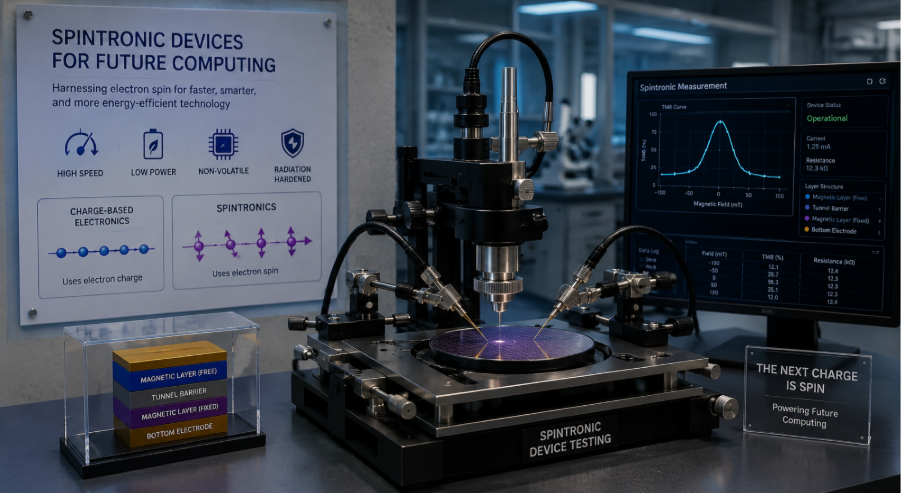
One of the most promising emerging technologies is spintronics, short for spin electronics. Unlike conventional electronic devices that rely solely on the charge of electrons, spintronic devices utilize both the charge and the intrinsic spin of electrons to process and store information. This additional degree of freedom opens the door to faster, more energy-efficient, and non-volatile computing architectures that could redefine the future of information technology.
From next-generation memory systems and artificial intelligence accelerators to quantum-inspired computing platforms, spintronic devices are positioned to become a key component of future computing infrastructures.
What Is Spintronics?
Spintronics is a branch of electronics that exploits the quantum mechanical property known as electron spin.
Electrons possess two important characteristics:
- Electrical charge
- Spin
Electron spin can exist in two primary states:
- Spin-up
- Spin-down
These spin states can represent binary information similarly to traditional digital logic:
- Spin-up = 1
- Spin-down = 0
Unlike conventional electronics that depend entirely on charge movement, spintronic devices manipulate spin states to store and process data.
Why Spintronics Matters
Modern computing systems face several challenges:
- Rising power consumption
- Heat generation
- Memory bottlenecks
- Scaling limitations
- Data movement inefficiencies
Spintronics offers solutions to many of these problems.
Key Advantages of Spintronic Devices
Lower Power Consumption
Spin-based operations require significantly less energy than charge-based switching.
Non-Volatile Storage
Data can remain stored even when power is removed.
Faster Data Access
Spintronic memory technologies offer extremely low access latency.
Reduced Heat Generation
Less energy dissipation results in improved thermal efficiency.
Higher Durability
Many spintronic devices support virtually unlimited read/write cycles.
Improved Integration
Spintronics can combine memory and logic functions in a single architecture.
The Science Behind Electron Spin
Electron spin is a quantum property that creates a tiny magnetic moment.
This means every electron behaves like a miniature magnet.
When many electron spins align:
- Magnetic fields are generated
- Information can be stored magnetically
Spintronic devices manipulate these magnetic properties to perform computing operations.
Magnetic Tunnel Junctions (MTJs)
Magnetic Tunnel Junctions are fundamental building blocks of modern spintronic memory.
Structure:
- Magnetic layer
- Thin insulating barrier
- Magnetic layer
The resistance of the junction changes based on spin alignment.
MTJs form the core of advanced spintronic memory technologies.
Giant Magnetoresistance (GMR)
GMR is a phenomenon where electrical resistance changes dramatically in response to magnetic fields.
Benefits include:
- High sensitivity
- Fast response
- Efficient magnetic detection
GMR revolutionized hard disk storage technologies by enabling much higher data densities.
Tunnel Magnetoresistance (TMR)
TMR occurs in magnetic tunnel junctions.
Compared to GMR, TMR provides:
- Higher sensitivity
- Better signal quality
- Improved memory performance
TMR-based devices are widely used in modern spintronic research.
Spintronic Memory Technologies
Memory is one of the most promising applications of spintronics.
Magnetoresistive RAM (MRAM)
MRAM stores information using magnetic states rather than electrical charge.
Advantages include:
- Non-volatility
- High endurance
- Fast operation
- Low power consumption
Unlike conventional RAM, MRAM retains data even when power is removed.
Spin-Transfer Torque MRAM (STT-MRAM)
STT-MRAM uses spin-polarized currents to switch magnetic states.
Benefits:
- Lower power consumption
- Faster write operations
- Better scalability
Applications include:
- Embedded memory
- Industrial systems
- Aerospace electronics
Spin-Orbit Torque MRAM (SOT-MRAM)
SOT-MRAM represents a next-generation evolution of MRAM.
Advantages:
- Faster switching
- Improved reliability
- Higher endurance
Potential applications include:
- AI accelerators
- High-performance computing
- Data centers
Spintronic Logic Devices
Beyond memory, spintronics can perform computational operations.
Spin-based logic devices offer:
- Reduced energy consumption
- Integrated memory and processing
- Faster information transfer
These devices may eventually replace portions of traditional CMOS logic circuits.
Spin-Wave Computing
Spin waves are collective oscillations of magnetic moments.
Instead of moving electrical charge, information is transmitted through magnetic wave propagation.
Benefits include:
- Extremely low energy consumption
- Minimal heat generation
- High computational efficiency
Spin-wave computing remains an active research area for future processors.
Spintronics in Artificial Intelligence
Artificial intelligence workloads require enormous computational resources.
Spintronic devices can improve AI systems by providing:
- Faster memory access
- Lower energy consumption
- Reduced data movement
Potential applications include:
- Neural network accelerators
- Edge AI processors
- Machine learning inference systems
Neuromorphic Computing with Spintronics
Neuromorphic computing attempts to mimic the structure and behavior of biological brains.
Spintronic devices are attractive for neuromorphic systems because they offer:
- Memory retention
- Analog behavior
- Energy efficiency
Spintronic neurons and synapses may enable highly efficient brain-inspired computers.
Data Center Applications
Modern data centers consume vast amounts of electricity.
Spintronic technologies can help reduce:
- Memory power consumption
- Cooling requirements
- Infrastructure costs
Benefits include:
- Improved efficiency
- Higher performance
- Reduced environmental impact
Edge Computing Applications
Edge devices often operate under strict power constraints.
Spintronic memory provides:
- Instant startup
- Low standby power
- Reliable operation
Potential use cases include:
- Industrial IoT
- Autonomous systems
- Smart sensors
- Wearable electronics
Quantum Computing Connections
Although spintronics and quantum computing are distinct technologies, they share common principles involving electron spin manipulation.
Researchers are investigating:
- Spin-based qubits
- Quantum spin devices
- Hybrid quantum-spintronic architectures
These technologies may contribute to future quantum information systems.
Manufacturing Challenges
Despite significant promise, spintronics faces several engineering challenges.
Material Complexity
Spintronic devices require highly specialized magnetic materials.
Challenges include:
- Material uniformity
- Magnetic stability
- Fabrication precision
Integration with CMOS
Most computing systems are built using CMOS technology.
Integrating spintronic components with existing semiconductor processes remains complex.
Scaling Limitations
Although spintronics offers excellent scalability potential, manufacturing nanoscale magnetic structures requires advanced fabrication techniques.
Thermal Stability
Magnetic states must remain stable under varying operating temperatures.
Engineers must carefully design materials and device structures to ensure reliability.
Research Areas Driving Innovation
Several research fields are accelerating spintronic development.
Advanced Magnetic Materials
New materials improve:
- Spin efficiency
- Device performance
- Reliability
Spin-Orbit Effects
Enhanced control of magnetic states enables faster switching.
Topological Materials
These materials may enable highly efficient spin transport.
Hybrid Architectures
Combining spintronics with conventional electronics creates more practical computing systems.
Future Applications of Spintronic Devices
Spintronics has the potential to impact many industries.
Artificial Intelligence
Energy-efficient AI acceleration.
Autonomous Vehicles
Reliable low-power processing systems.
Data Centers
Reduced operating costs and energy consumption.
Consumer Electronics
Faster and more efficient memory systems.
Aerospace Systems
Radiation-resistant memory technologies.
Industrial Automation
Long-life embedded computing platforms.
Future of Spintronic Computing
As conventional transistor scaling slows, alternative computing paradigms are becoming increasingly important.
Future computing platforms may integrate:
- Spintronic memory
- Spin-based processors
- Neuromorphic architectures
- Quantum-inspired systems
The convergence of these technologies could dramatically improve computational efficiency while reducing energy requirements.
Educational Importance
Spintronics sits at the intersection of multiple disciplines:
- Physics
- Electronics engineering
- Materials science
- Computer architecture
- Nanotechnology
Understanding spintronic principles is becoming increasingly valuable for future hardware engineers and researchers.
Conclusion
Spintronic devices represent one of the most exciting frontiers in modern computing technology. By utilizing the spin of electrons in addition to their charge, spintronics offers a pathway toward faster, more energy-efficient, and non-volatile computing systems capable of overcoming many limitations of traditional semiconductor architectures.
From advanced memory technologies such as MRAM to future AI accelerators and neuromorphic processors, spintronics has the potential to transform the way information is stored, processed, and transmitted. While significant manufacturing and integration challenges remain, ongoing research continues to push the boundaries of what spin-based computing can achieve.
As the demand for high-performance and energy-efficient computing continues to grow, spintronic devices may play a central role in shaping the next generation of intelligent hardware systems and computational architectures.