
The development of autonomous vehicles represents one of the most ambitious technological challenges of the modern era. Self-driving cars must continuously perceive their environment, process massive amounts of sensor data, make intelligent decisions, and execute actions in real time—all while ensuring passenger safety and operational reliability. Achieving this level of performance requires more than powerful software algorithms; it demands a tightly integrated approach where hardware and software are designed together from the beginning. e
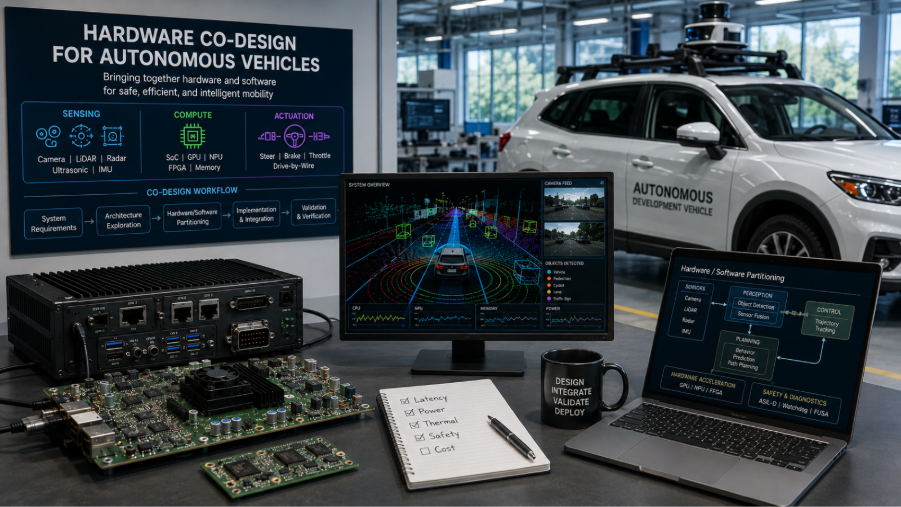
This approach is known as Hardware Co-Design. Rather than developing hardware and software independently, hardware co-design optimizes both simultaneously to maximize performance, efficiency, safety, and scalability. In autonomous vehicles, where milliseconds can determine critical outcomes, co-design has become a fundamental engineering strategy for building next-generation intelligent transportation systems.
What Is Hardware Co-Design?
Hardware co-design is an engineering methodology in which hardware architecture and software systems are developed together as a unified solution.
Traditional development often follows:
- Hardware development
- Software development
- System integration
In contrast, co-design involves:
- Defining system requirements
- Simultaneously optimizing hardware and software
- Continuous integration and validation
This approach enables better system-level performance and efficiency.
Why Autonomous Vehicles Need Hardware Co-Design
Autonomous vehicles must process enormous amounts of information every second.
These systems handle:
- Sensor fusion
- Object detection
- Path planning
- Vehicle control
- Safety monitoring
- Communication systems
Each task imposes demanding requirements on hardware resources.
Without co-design:
- Power consumption increases
- Processing delays occur
- Hardware becomes over-engineered
- Software optimization becomes difficult
Co-design ensures optimal balance between computational capability and system efficiency.
The Autonomous Vehicle Computing Challenge
Modern autonomous vehicles function as mobile supercomputers.
A typical autonomous system may process data from:
- Cameras
- LiDAR sensors
- Radar systems
- Ultrasonic sensors
- GPS receivers
- Inertial Measurement Units (IMUs)
Together these sensors can generate multiple gigabytes of data every second.
The challenge is processing this information with:
- Low latency
- High reliability
- Minimal power consumption
Key Components of Autonomous Vehicle Hardware
Sensor Systems
Sensors provide environmental awareness.
Cameras
Cameras capture visual information including:
- Road markings
- Traffic signs
- Pedestrians
- Vehicles
Advantages:
- High-resolution data
- Rich visual context
Challenges:
- Lighting sensitivity
- Weather limitations
LiDAR
LiDAR creates detailed three-dimensional maps using laser pulses.
Benefits:
- Accurate distance measurement
- High spatial resolution
- Reliable object detection
Challenges:
- Cost
- Environmental interference
Radar
Radar systems detect objects using radio waves.
Advantages:
- Long-range detection
- All-weather operation
- Velocity measurement
Ultrasonic Sensors
Used for:
- Parking assistance
- Near-field obstacle detection
- Low-speed navigation
Sensor Fusion Hardware
No single sensor provides complete environmental awareness.
Sensor fusion combines information from multiple sources to improve accuracy.
Dedicated hardware accelerates:
- Data synchronization
- Sensor calibration
- Object tracking
- Environmental modeling
AI Processing Hardware
Artificial intelligence is central to autonomous driving.
AI workloads include:
- Image recognition
- Object classification
- Behavioral prediction
- Path optimization
These tasks require specialized computing hardware.
CPUs
Central Processing Units manage:
- System coordination
- Vehicle control logic
- Operating system tasks
Advantages:
- Flexibility
- General-purpose computing
GPUs
Graphics Processing Units accelerate:
- Deep learning inference
- Parallel processing
- Computer vision algorithms
GPUs are widely used for autonomous perception systems.
AI Accelerators
Dedicated AI processors optimize:
- Neural network execution
- Matrix computations
- Machine learning inference
Benefits include:
- Lower power consumption
- Faster AI performance
- Reduced latency
FPGAs
Field Programmable Gate Arrays provide:
- Hardware flexibility
- Real-time processing
- Reconfigurable acceleration
Applications include:
- Sensor processing
- Safety systems
- Communication interfaces
Hardware Co-Design Principles
Workload Analysis
The first step in co-design is understanding system workloads.
Engineers evaluate:
- Computational complexity
- Memory requirements
- Real-time constraints
This information guides hardware selection and optimization.
Hardware-Software Partitioning
Tasks are divided between:
- Hardware acceleration
- Software execution
Examples:
Hardware:
- Neural network inference
- Signal processing
Software:
- Decision making
- Vehicle behavior planning
Proper partitioning improves efficiency.
Memory Optimization
Autonomous systems require rapid access to large datasets.
Memory design considerations include:
- Bandwidth
- Latency
- Cache efficiency
- Storage architecture
Optimized memory systems reduce processing bottlenecks.
Real-Time Processing Requirements
Autonomous vehicles operate in dynamic environments.
Critical decisions often must occur within milliseconds.
Examples:
- Emergency braking
- Obstacle avoidance
- Lane correction
Co-designed systems ensure deterministic performance under real-time constraints.
Power Efficiency Optimization
Power consumption directly affects:
- Vehicle range
- Thermal management
- Battery utilization
Hardware co-design minimizes energy usage by:
- Reducing redundant computations
- Optimizing data movement
- Accelerating critical workloads
Communication Infrastructure
Autonomous vehicles contain multiple computing modules that must communicate efficiently.
High-Speed Internal Networks
Used to connect:
- Sensors
- Processors
- Controllers
Requirements include:
- Low latency
- High bandwidth
- Reliability
Vehicle-to-Everything (V2X)
Future vehicles may communicate with:
- Other vehicles
- Infrastructure
- Traffic systems
- Cloud platforms
Hardware must support secure and reliable communication.
Safety-Critical System Design
Safety is the highest priority in autonomous vehicles.
Hardware co-design plays a major role in achieving safety goals.
Redundancy
Critical systems often include backup components.
Examples:
- Multiple sensors
- Duplicate processors
- Secondary power systems
Redundancy improves fault tolerance.
Fault Detection
Hardware continuously monitors:
- Sensor health
- Processor operation
- Communication links
Rapid fault detection improves system reliability.
Functional Safety
Autonomous systems must continue operating safely even during failures.
Safety mechanisms include:
- Error correction
- Watchdog monitoring
- Emergency control systems
Thermal Management
High-performance computing generates significant heat.
Thermal challenges include:
- AI processing workloads
- Dense electronics
- Continuous operation
Solutions include:
- Heat sinks
- Liquid cooling systems
- Intelligent power management
Effective thermal design ensures stable operation.
Digital Twins in Co-Design
Digital twins are virtual models of physical systems.
Engineers use digital twins to:
- Simulate vehicle behavior
- Test hardware configurations
- Optimize software performance
This reduces development costs and accelerates innovation.
Edge Computing for Autonomous Vehicles
Autonomous vehicles function as edge computing platforms.
Benefits include:
- Reduced cloud dependency
- Lower latency
- Improved reliability
Hardware co-design enables efficient local processing of massive sensor datasets.
Artificial Intelligence and Co-Design
AI models are increasingly influencing hardware architecture.
Engineers optimize hardware specifically for:
- Neural network structures
- Machine learning workloads
- Autonomous driving algorithms
This creates highly efficient AI computing platforms.
Challenges in Hardware Co-Design
System Complexity
Autonomous vehicles integrate:
- Sensors
- AI systems
- Control modules
- Communication networks
Managing this complexity is challenging.
Cost Constraints
Advanced hardware increases manufacturing costs.
Engineers must balance:
- Performance
- Reliability
- Affordability
Rapid Technology Evolution
AI algorithms evolve quickly.
Hardware must remain adaptable to future software improvements.
Validation Requirements
Autonomous systems require extensive testing.
Validation includes:
- Simulation
- Real-world driving
- Safety certification
Testing can be time-consuming and expensive.
Future Trends in Autonomous Vehicle Co-Design
Several emerging technologies are shaping the future.
AI-Specific Silicon
Future processors will be increasingly optimized for:
- Deep learning
- Sensor fusion
- Autonomous decision-making
Neuromorphic Computing
Brain-inspired architectures may improve:
- Energy efficiency
- Pattern recognition
- Real-time learning
In-Memory Computing
Processing data directly within memory can reduce:
- Latency
- Energy consumption
- Data movement bottlenecks
Advanced Sensor Integration
Future sensors may provide:
- Higher resolution
- Greater accuracy
- Improved environmental awareness
Quantum-Inspired Optimization
Quantum-inspired algorithms may enhance:
- Route planning
- Traffic optimization
- Decision-making systems
Educational Importance
Hardware co-design combines multiple engineering disciplines:
- Computer engineering
- Embedded systems
- Electronics
- Artificial intelligence
- Robotics
- Automotive engineering
Understanding co-design principles is becoming increasingly important for future autonomous vehicle engineers.
Conclusion
Hardware co-design is a foundational technology for autonomous vehicles, enabling the seamless integration of sensing, computation, communication, and control systems. By developing hardware and software together, engineers can achieve the performance, efficiency, safety, and reliability required for real-world autonomous driving.
As artificial intelligence, advanced sensors, and edge computing continue to evolve, co-design methodologies will become even more critical. Future autonomous vehicles will rely on highly optimized hardware architectures tailored specifically for AI-driven mobility, creating transportation systems that are safer, smarter, and more efficient.
The future of autonomous driving is not solely a software challenge or a hardware challenge—it is the result of designing both as one intelligent, unified system.