
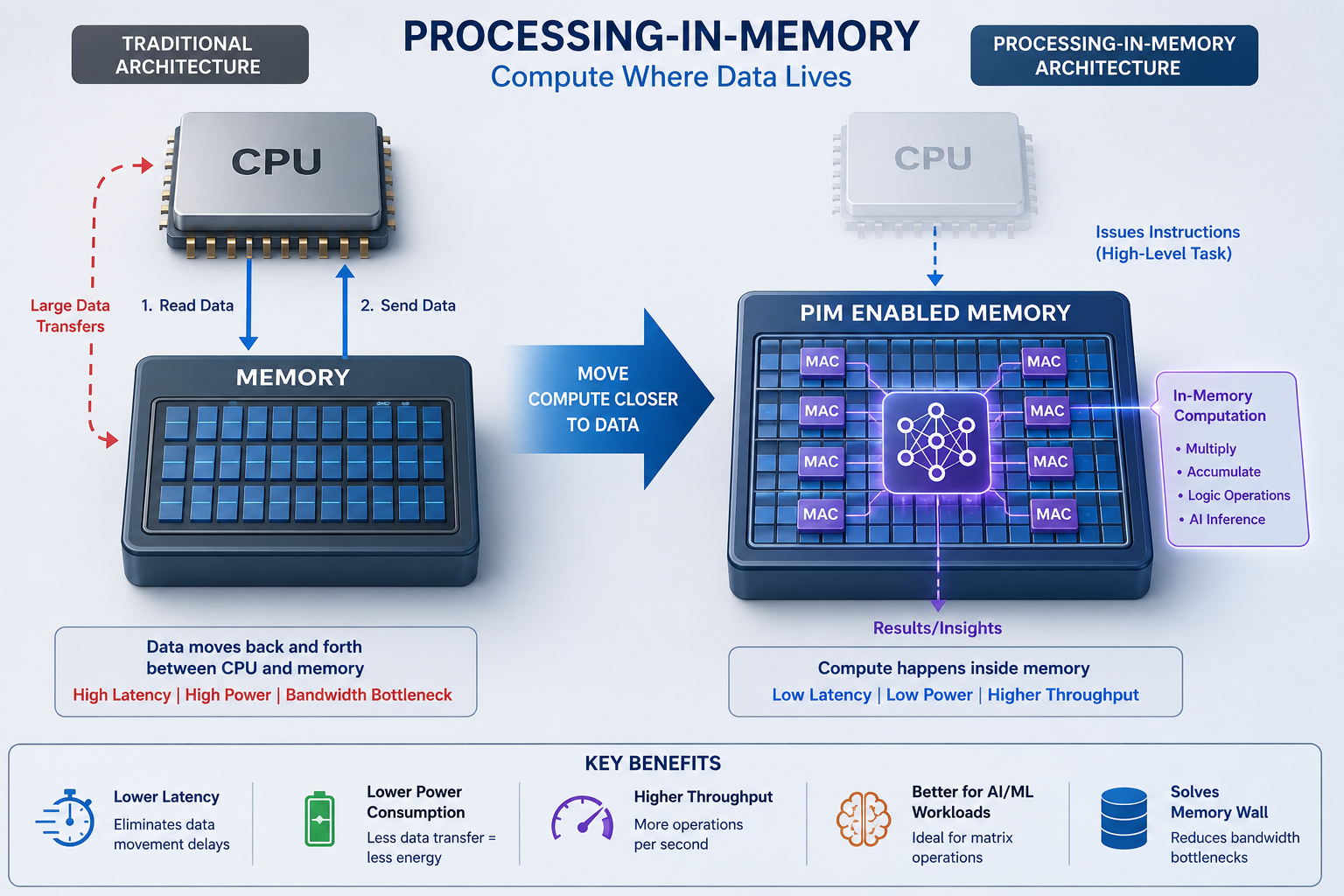
Processing-in-Memory (PIM) offers a new way to solve this long-standing problem. Instead of repeatedly transferring data between memory and the processor, PIM allows certain computations to take place directly inside or very close to the memory itself. By reducing unnecessary data movement, systems can process information faster while consuming less energy.
As a result, PIM is emerging as a key technology for modern AI infrastructure, data centers, edge computing devices, and scientific research. In this guide, you’ll discover what Processing-in-Memory is, how it works, why it matters, and how it is shaping the future of intelligent computing.
What Is Processing-in-Memory (PIM)?
Processing-in-Memory (PIM) is a computer architecture that combines memory storage with computing capabilities. Unlike traditional systems, where memory only stores data and the processor performs all calculations, PIM enables certain operations to run directly within or near memory chips.
In a conventional computer, every calculation follows the same basic pattern:
- Data is stored in memory.
- The processor requests the required data.
- Memory transfers the data to the processor.
- The processor performs the calculation.
- The results are written back to memory.
Although this process happens in fractions of a second, it repeats billions of times during demanding workloads. Consequently, the constant transfer of information consumes significant time and energy.
PIM changes this workflow by moving selected computations closer to where the data already exists. Instead of transferring massive datasets across the memory bus, memory devices perform supported operations locally and send only the final results to the processor.
This architectural improvement reduces latency, lowers power consumption, and improves overall system efficiency without replacing the CPU.
Why the CPU-Memory Bottleneck Exists
One of the biggest challenges in modern computer architecture is the growing performance gap between processors and memory.
Today’s CPUs can execute billions of instructions every second. However, retrieving information from memory takes much longer than performing the actual calculations. Therefore, processors frequently remain idle while waiting for data transfers to finish.
This limitation is known as the CPU-memory bottleneck or the memory wall.
A typical computing task involves several steps:
- Data is stored in system memory.
- The CPU requests specific information.
- Memory retrieves the requested data.
- The information travels across the memory bus.
- The CPU processes the data.
- Results are written back into memory.
While each transfer appears insignificant, AI applications perform these operations billions of times every second. As a result, even small delays accumulate into major performance losses.
Furthermore, moving data often consumes more energy than performing the calculations themselves. This means that modern systems not only become slower but also less energy-efficient as workloads grow.
Applications most affected by this bottleneck include:
- Artificial intelligence and deep learning
- Large language models (LLMs)
- Scientific simulations
- Big data analytics
- Financial modeling
- Database management systems
- Real-time recommendation engines
Because these workloads continuously access large datasets, reducing data movement has become just as important as increasing processor speed.
How Processing-in-Memory Works
Processing-in-Memory addresses the memory bottleneck by allowing supported computations to occur directly where data is stored.
Instead of sending every piece of information to the CPU, memory chips include specialized logic capable of handling repetitive, data-intensive operations. Consequently, only processed results need to travel back to the processor, dramatically reducing memory traffic.
Depending on the hardware design, these computing elements may be integrated:
- Inside DRAM chips
- Alongside memory controllers
- Within High Bandwidth Memory (HBM) stacks
- Near emerging non-volatile memory technologies
Because computations occur much closer to stored data, systems spend less time waiting for transfers and more time performing useful work.
For example, imagine an AI model that needs to multiply millions of numbers stored in memory. In a traditional system, every value must first travel to the CPU or GPU before calculations begin. However, a PIM-enabled memory device can execute much of that work internally and send back only the completed output.
This significantly reduces communication overhead and improves processing efficiency.
Operations Commonly Performed in PIM
Not every computation is suitable for execution inside memory. Instead, PIM focuses on repetitive operations that require frequent access to large datasets.
Common examples include:
- Matrix multiplication
- Vector processing
- Data filtering
- Search operations
- Pattern matching
- Data aggregation
- Simple arithmetic calculations
- Neural network inference tasks
These operations are widely used in AI, machine learning, scientific computing, and database processing. Therefore, moving them closer to memory can deliver substantial improvements in speed and energy efficiency.
Why Processing-in-Memory Matters for AI
Artificial intelligence relies heavily on memory bandwidth rather than raw processor speed alone.
Modern neural networks often contain billions of parameters that must be accessed repeatedly during both training and inference. Consequently, processors spend a significant amount of time waiting for data instead of performing calculations.
Processing-in-Memory helps solve this challenge by reducing unnecessary data transfers. As a result, AI accelerators can complete more work in less time while consuming less power.
Moreover, PIM supports several AI applications, including:
- Large language models (LLMs)
- Computer vision
- Natural language processing
- Speech recognition
- Recommendation systems
- Autonomous driving
- Robotics
- Healthcare diagnostics
As AI models continue to increase in size and complexity, reducing memory latency will become increasingly important. For this reason, many semiconductor companies are actively investing in PIM-enabled hardware for future AI platforms.
In the next section, we’ll explore the biggest advantages of Processing-in-Memory and examine why it is transforming cloud computing, high-performance computing, and next-generation AI systems.
8 Benefits of Processing-in-Memory (PIM)
As artificial intelligence, cloud computing, and data-intensive applications continue to evolve, reducing the CPU-memory bottleneck has become a top priority for hardware designers. Processing-in-Memory (PIM) addresses this challenge by bringing computation closer to stored data. Consequently, systems can process information more efficiently while using less energy.
Below are eight key reasons why PIM is transforming modern computing.
1. Reduces Data Movement
One of the greatest advantages of PIM is its ability to reduce unnecessary data transfers.
In traditional computer architectures, data constantly travels between memory and the processor for every calculation. Although each transfer takes only a short time, billions of these operations occur every second in AI and analytics workloads. As a result, data movement becomes a major performance bottleneck.
PIM minimizes these transfers by allowing supported computations to occur directly within or near memory. Therefore, processors receive only the final results instead of entire datasets.
This approach reduces latency, lowers communication overhead, and improves overall system performance.
2. Improves AI and Machine Learning Performance
Artificial intelligence workloads rely heavily on rapid access to large amounts of data.
For example, training a large language model (LLM) requires repeated processing of billions of parameters. Likewise, computer vision and recommendation systems continuously perform matrix multiplications and vector operations.
Because PIM handles many of these repetitive tasks closer to memory, AI accelerators spend less time waiting for data. Consequently, training and inference become faster and more efficient.
As AI models continue to grow, reducing memory delays will become increasingly important for maintaining performance.
3. Lowers Power Consumption
Energy efficiency is one of the biggest challenges facing modern data centers.
Interestingly, transferring data between memory and processors often consumes more energy than the calculations themselves. Therefore, reducing data movement can significantly lower overall power usage.
PIM addresses this issue by processing data where it is stored, eliminating many unnecessary memory transfers. As a result, servers generate less heat, consume less electricity, and require less cooling.
These benefits are especially valuable for cloud providers operating thousands of AI servers around the clock.
4. Accelerates High-Performance Computing
High-performance computing (HPC) systems solve some of the world’s most complex scientific problems.
Researchers use these systems for applications such as:
- Climate modeling
- Weather forecasting
- Molecular simulations
- Genomics research
- Space exploration
- Nuclear physics
These workloads process enormous datasets that require constant communication between processors and memory.
With PIM, many memory-intensive calculations can occur directly inside memory devices. Consequently, simulations complete faster while reducing communication delays between system components.
5. Enhances Big Data Analytics
Modern businesses analyze massive volumes of structured and unstructured data every day.
Financial institutions detect fraud in real time, retailers generate personalized recommendations, and healthcare organizations analyze medical records to improve patient outcomes.
Traditionally, searching, filtering, and processing these datasets requires continuous data movement between memory and processors.
PIM streamlines this process by performing many repetitive operations closer to the data itself. Therefore, organizations can complete analytics tasks faster while improving resource utilization.
6. Enables Faster Edge AI
Edge computing allows devices to process information locally instead of relying entirely on cloud servers.
Examples include:
- Autonomous vehicles
- Smart surveillance cameras
- Industrial robots
- IoT sensors
- Medical monitoring devices
- Smart home systems
These devices often operate with limited power and hardware resources. Consequently, minimizing unnecessary memory transfers is essential.
PIM enables faster local processing while reducing energy consumption and latency. Furthermore, processing data on the device improves privacy because sensitive information does not always need to be sent to the cloud.
7. Improves Memory Bandwidth Utilization
Memory bandwidth is a limited resource in every computing system.
When processors repeatedly request large amounts of information, available bandwidth quickly becomes saturated. This slows performance across CPUs, GPUs, and AI accelerators.
PIM reduces this pressure by completing many operations within memory itself. As a result, bandwidth becomes available for other critical tasks, improving system responsiveness and enabling better multitasking.
This benefit is particularly important in AI training clusters, where multiple processors share the same memory resources.
8. Supports the Next Generation of Computer Architecture
Modern computing is moving toward increasingly specialized hardware.
Instead of relying solely on faster CPUs, today’s systems combine multiple accelerators designed for different workloads. PIM fits naturally into this trend by handling memory-intensive operations more efficiently.
Researchers are integrating PIM with technologies such as:
- High Bandwidth Memory (HBM)
- AI accelerators
- Neural Processing Units (NPUs)
- Chiplet architectures
- Data center accelerators
- Emerging memory technologies
Together, these innovations are helping build faster, more scalable, and more energy-efficient computing platforms.
Real-World Applications of Processing-in-Memory
Although PIM is still an emerging technology, it is already finding practical applications across several industries.
Artificial Intelligence
AI workloads involve repeated matrix operations and constant access to large datasets. PIM reduces memory delays, making model training and inference faster.
Cloud Data Centers
Cloud providers process enormous amounts of information every second. By minimizing data movement, PIM improves server efficiency while reducing operating costs and power consumption.
High-Performance Computing
Scientific research, engineering simulations, and supercomputers benefit from faster memory access, enabling more complex calculations to finish in less time.
Financial Services
Banks and trading platforms analyze vast streams of market data. PIM accelerates analytics and supports faster decision-making for fraud detection, risk assessment, and algorithmic trading.
Healthcare
Medical imaging, genomics, and AI-assisted diagnostics generate large datasets that benefit from faster memory processing and lower latency.
Edge Computing
Smart cameras, autonomous vehicles, and industrial automation systems require real-time decision-making. PIM helps these devices process information locally without relying on constant cloud communication.
Challenges of Processing-in-Memory
Despite its many advantages, PIM also presents several challenges.
First, software must be redesigned to take advantage of memory-based computing. Many existing applications are optimized for traditional CPU architectures and cannot immediately benefit from PIM hardware.
Second, integrating processing logic into memory chips increases design complexity. Manufacturers must carefully balance performance, power efficiency, manufacturing cost, and reliability.
In addition, not every workload is suitable for execution inside memory. General-purpose processors remain essential for complex control logic, operating systems, and application management.
Therefore, PIM should be viewed as a complementary technology rather than a replacement for CPUs or GPUs.
The Future of Processing-in-Memory
Industry interest in Processing-in-Memory continues to grow as AI workloads become more demanding.
Major semiconductor companies are actively developing memory-centric architectures to improve AI performance and energy efficiency. At the same time, researchers are exploring new memory technologies that integrate computing capabilities directly into storage devices.
Future computing platforms are expected to combine:
- CPUs for general-purpose processing
- GPUs for parallel computing
- NPUs for AI inference
- PIM for memory-intensive workloads
This heterogeneous approach allows each processor to perform the tasks it handles most efficiently.
Moreover, PIM is expected to play an increasingly important role in cloud computing, autonomous systems, robotics, cybersecurity, and scientific research. As organizations process ever-larger datasets, reducing data movement will become just as important as increasing processor performance.
If you’d like to learn about another breakthrough technology improving AI efficiency, read our guide on AI Memory Compression: The Hidden Technology Making Models Faster.
Frequently Asked Questions
What is Processing-in-Memory (PIM)?
Processing-in-Memory (PIM) is a computer architecture that performs selected computations directly inside or near memory. By reducing the amount of data transferred between memory and the processor, PIM improves performance, lowers latency, and reduces power consumption.
How does Processing-in-Memory work?
Instead of sending every piece of data to the CPU or GPU, PIM integrates specialized computing logic within or alongside memory devices. These memory units perform supported operations—such as matrix multiplication, vector processing, and data filtering—before sending only the processed results to the processor.
Why is the CPU-memory bottleneck a problem?
Modern processors can execute instructions much faster than memory can supply data. Consequently, CPUs and GPUs often remain idle while waiting for information to arrive. This delay, known as the CPU-memory bottleneck, limits performance and increases energy consumption, especially in AI and data-intensive workloads.
What are the benefits of Processing-in-Memory?
PIM offers several important advantages, including:
- Reduced data movement
- Lower latency
- Improved AI and machine learning performance
- Better memory bandwidth utilization
- Lower power consumption
- Faster scientific computing
- Enhanced cloud and edge computing efficiency
- Improved scalability for future computing systems
Where is Processing-in-Memory used?
Processing-in-Memory is becoming increasingly valuable in industries that process large amounts of data, including:
- Artificial intelligence and machine learning
- High-performance computing (HPC)
- Cloud data centers
- Big data analytics
- Financial services
- Healthcare and medical imaging
- Autonomous vehicles
- Robotics
- Edge AI and IoT devices
Does Processing-in-Memory replace CPUs or GPUs?
No. PIM is designed to complement traditional processors rather than replace them. CPUs continue handling operating systems and general-purpose tasks, while GPUs accelerate parallel workloads. PIM focuses on memory-intensive operations, reducing data transfers and improving overall system efficiency.
What is the difference between Processing-in-Memory and Near-Memory Computing?
Although the terms are sometimes used interchangeably, they are not identical.
- Processing-in-Memory (PIM): Computation occurs directly inside memory chips.
- Near-Memory Computing (NMC): Computation takes place in specialized logic located next to the memory.
Both approaches aim to reduce data movement and overcome the CPU-memory bottleneck.
Is Processing-in-Memory the future of AI hardware?
Many researchers and semiconductor companies believe so. As AI models continue to grow in size and complexity, moving massive amounts of data between processors and memory becomes increasingly inefficient. PIM provides a practical solution by bringing computation closer to stored data, making it a promising technology for future AI platforms.
Conclusion
Modern computing is becoming increasingly data-driven, and traditional processor-centric architectures are struggling to keep pace with the demands of artificial intelligence, cloud computing, and high-performance applications. As datasets continue to expand, reducing unnecessary data movement has become just as important as increasing processor speed.
Processing-in-Memory (PIM) addresses this challenge by enabling selected computations to take place directly inside or near memory. As a result, systems can reduce latency, improve memory bandwidth utilization, lower power consumption, and accelerate AI workloads without replacing existing CPUs or GPUs.
Although the technology is still evolving, industry adoption is growing rapidly. Semiconductor manufacturers, cloud providers, and research organizations are investing in memory-centric architectures to support the next generation of intelligent computing systems. Furthermore, advances in High Bandwidth Memory (HBM), chiplet designs, and AI accelerators are expected to make PIM an even more important component of future hardware platforms.
For organizations building AI infrastructure or developing data-intensive applications, Processing-in-Memory represents a significant step toward faster, more scalable, and more energy-efficient computing.