
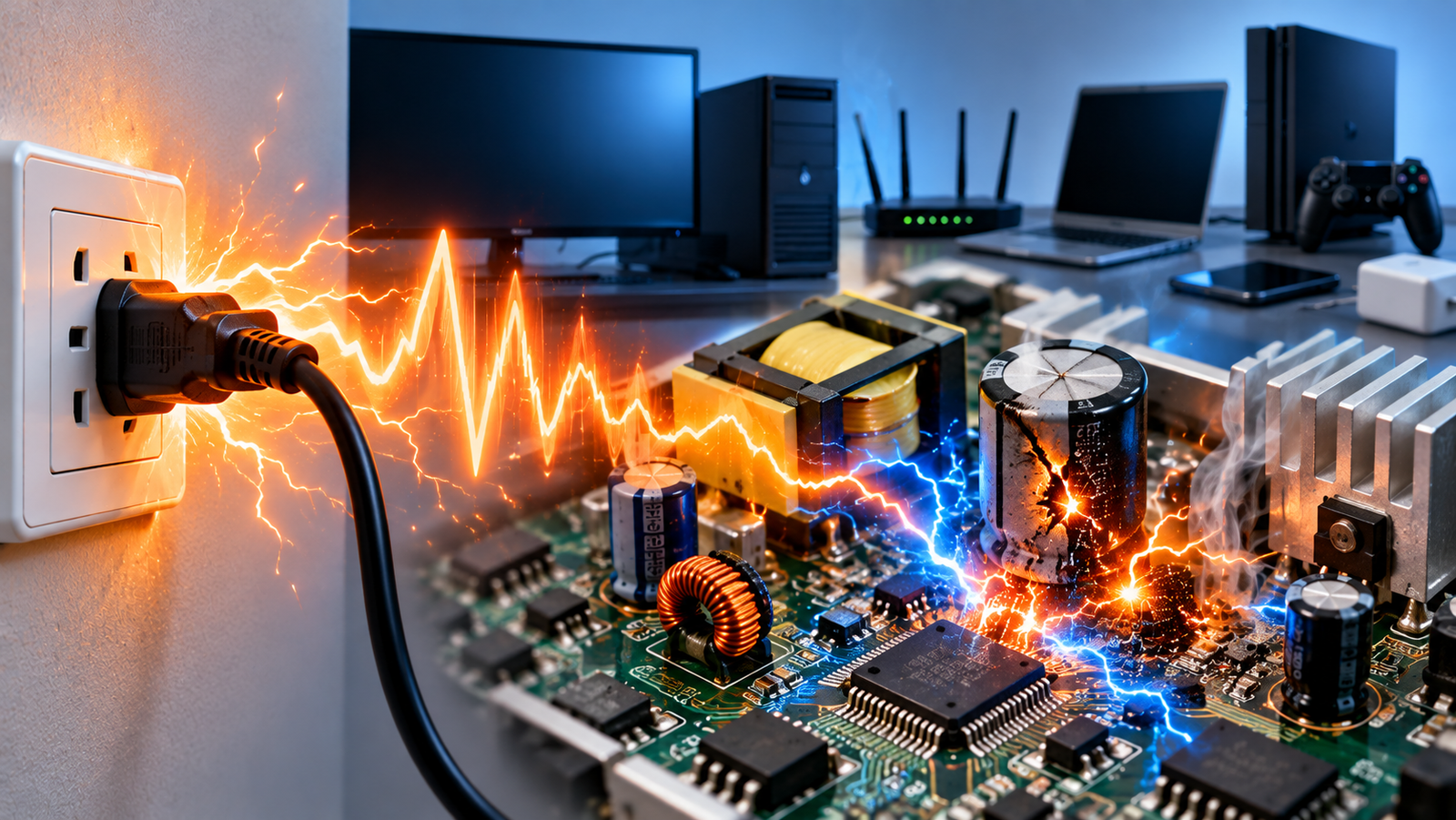
Imagine watching television when the screen suddenly goes black. Your computer shuts down, the lights flicker, and a charger stops working. Everything was operating normally a moment ago, but now one or more electronic devices may have suffered damage.
What causes this to happen?
One possible cause is a power surge—a sudden increase in electrical voltage that can overwhelm the protective components inside electronic devices.
Modern electronics contain delicate circuits designed to operate within specific voltage limits. When the incoming voltage rises unexpectedly, these circuits must handle electrical energy they were not designed to withstand for long periods. Depending on the surge’s intensity and duration, the result can range from temporary disruption to permanent component failure.
Understanding what happens inside electronics during a sudden power surge helps explain why devices sometimes fail without warning and how you can protect them.
In this article, we will explore how power surges affect electronic circuits, which components are most vulnerable, what causes surge damage, and how to reduce the risk.
What Is a Power Surge?
A power surge is a brief increase in electrical voltage above the level a device is designed to handle.
In a typical household, electrical equipment receives power at a relatively stable voltage. Electronic circuits use power supplies and voltage-regulation components to convert that electricity into the lower, more stable voltages required by processors, memory, sensors, and other components.
A surge temporarily disrupts these conditions.
For example, a device might normally receive a supply near its rated voltage, but a transient event can cause the voltage to rise sharply for a very short period.
Even if the surge lasts only microseconds, it can damage sensitive components if the voltage and available energy exceed their protection limits.
The important point is that a power surge does not need to last long to cause damage. Its effect depends on the voltage level, duration, energy, current path, and the device’s protective design.
Power Surge vs. Power Outage
A power surge and a power outage are different electrical events.
| Feature | Power Surge | Power Outage |
|---|---|---|
| What happens? | Voltage rises above the expected level | Power supply is interrupted |
| Main risk | Electrical overstress and component damage | Unexpected shutdown and possible data loss |
| Typical effect | Damaged components or disrupted operation | Devices turn off or restart |
| Possible causes | Lightning-related disturbances, switching events, or electrical faults | Grid failures, damaged lines, or scheduled interruptions |
| Protection | Surge protective devices and suitable circuit protection | Backup power systems such as UPS units |
A device can also experience other power-quality problems, including voltage dips, brownouts, and electrical noise. Each affects electronic equipment differently.
What Causes a Sudden Power Surge?
Power surges can originate inside a building or from external electrical events. Identifying the source helps explain how the surge reaches a device and which components may be affected.
1. Lightning Strikes
Lightning is one of the most powerful natural sources of electrical surges.
When lightning strikes a power line or occurs nearby, it can induce a sudden voltage increase in electrical wiring. That surge may travel through power lines and reach connected equipment.
A direct lightning strike can create extreme electrical conditions, while nearby strikes can also affect electronics without hitting a building directly. The National Institute of Standards and Technology (NIST) explains how lightning-related surges can enter household electrical systems. NIST
2. Switching Electrical Equipment On or Off
Electrical equipment does not always draw power smoothly when its operating state changes.
Motors, transformers, and other inductive loads can produce transient voltages when switched. These events may affect nearby circuits or the electrical supply.
For example, switching a large motor can create a brief electrical disturbance that reaches sensitive equipment connected to the same electrical system. electrical.theiet.org
3. Electrical Faults
Faults in wiring, power distribution equipment, or electrical connections can cause abnormal voltage conditions.
A loose connection or damaged circuit may also produce intermittent problems, although not every electrical fault is a power surge.
These situations require careful diagnosis because the symptoms can resemble surge damage.
4. Power Restoration After an Interruption
When electricity returns after an outage, connected equipment may experience changes in the supply voltage.
However, not every power restoration produces a damaging surge. The actual risk depends on the electrical conditions, switching events, and the protection installed in the system.
If devices repeatedly restart or behave abnormally when power returns, the electrical supply and connected equipment should be checked.
What Happens Inside Electronics During a Power Surge?
To understand surge damage, it helps to follow the path electricity takes through a typical electronic device.
A desktop computer, television, router, or gaming console usually contains a power supply that converts incoming electricity into the lower DC voltages required by its internal circuits.
A simplified power path looks like this:
Electrical Outlet → Power Supply → Voltage Regulation → Electronic Components
Each stage has a specific job. A surge can affect one or more of these stages, depending on its intensity and the device’s protective design.
Let’s examine what happens inside.
1. The Input Protection Circuit Faces the Surge
Many electronic devices contain protective components near their power input.
These components help limit dangerous voltage transients before they reach sensitive circuitry.
One commonly used component is the metal oxide varistor (MOV).
Under normal conditions, an MOV presents high electrical resistance. When the voltage rises beyond its designed operating range, its resistance drops, allowing it to divert surge current through an alternate path.
This helps limit the voltage reaching downstream components.
However, an MOV has limits. Repeated or severe surges can degrade it, and a surge that exceeds its ratings may overwhelm the protection circuit. TI E2E
Other designs may use transient-voltage-suppression diodes, gas-discharge tubes, or combinations of protective components.
What happens next?
- If the protection circuit handles the event, the device may continue working normally.
- If the protection circuit is partially damaged, the device may still work but have reduced protection against future surges.
- If the surge exceeds the circuit’s capabilities, damaging voltage may reach the power supply or internal electronics.
2. The Power Supply Struggles to Maintain Stable Voltage
The power supply converts incoming electrical power into the voltages required by the device.
For example, a computer’s power supply provides regulated DC power to its motherboard, processor, storage devices, and other components.
A sudden surge can stress the power supply’s input components, switching circuitry, and insulation.
If the surge exceeds the power supply’s protection limits, several outcomes are possible:
- The power supply shuts down.
- A protective fuse opens.
- A protective component becomes damaged.
- The power supply stops delivering stable output voltage.
- Excessive voltage reaches downstream circuits.
A well-designed power supply can withstand specified transient conditions, but no design can guarantee protection against every possible electrical event.
3. Capacitors Experience Electrical Stress
Capacitors store electrical energy and help smooth voltage fluctuations in electronic circuits.
They are commonly used in power supplies, voltage regulators, and filtering circuits.
During a surge, a capacitor may experience a voltage higher than its rated limit.
If the stress is severe enough, the capacitor’s dielectric material can break down, causing leakage, short circuits, or other forms of failure.
Repeated electrical stress can also shorten the life of some components.
Not every surge damages capacitors, but they are among the components designers must consider when evaluating transient protection.
4. Semiconductor Components Can Be Damaged
Modern electronics rely heavily on semiconductor devices, including:
- Microprocessors
- Memory chips
- Power transistors
- Voltage regulators
- Integrated circuits
- Communication controllers
These components contain microscopic structures designed to operate within defined electrical limits.
A sufficiently severe voltage transient can create excessive electric fields or current inside a semiconductor device.
This may damage internal junctions, cause leakage, or produce a short circuit.
In some cases, the component fails immediately. In others, electrical stress weakens the device and contributes to a failure that appears later.
Indian Railways’ technical guidance on surge protection notes that semiconductor junctions are particularly susceptible to surge damage and that failures may be immediate or become apparent over time. Indian Railways
5. Circuit Boards and Electrical Connections May Overheat
A high-energy surge can also cause excessive current to flow through circuit paths.
If the current exceeds what a trace, connector, or component can withstand, localized heating may occur.
Severe events can damage:
- Printed circuit board traces
- Connectors
- Input terminals
- Protective components
- Insulation
- Nearby components affected by heat
In extreme cases, electrical arcing or fire can occur.
This is one reason surge protection should be considered part of a broader electrical safety strategy rather than simply a way to prevent expensive electronics from breaking.
Can a Power Surge Damage Electronics in Microseconds?
Yes. A sufficiently severe transient can damage vulnerable electronics very quickly.
Some electrical surges have very short durations, but their fast voltage rise can still expose components to electrical stress beyond their ratings.
The damage depends on more than how long the surge lasts.
Important factors include:
- Peak voltage
- Surge current
- Energy delivered
- Rise time
- Duration
- Circuit impedance
- Quality of the protective design
A short, high-voltage transient may damage a sensitive semiconductor even if the device appears to be operating normally before the event.
Conversely, a surge that is effectively limited by the device’s protection circuitry may cause no noticeable damage.
Duration alone does not determine whether a power surge is dangerous.
Which Electronic Components Are Most Vulnerable?
Different components respond to electrical transients in different ways.
| Component | Role in Electronics | Possible Effect of a Surge |
|---|---|---|
| MOV | Limits transient voltage | Degradation or failure after excessive stress |
| Capacitor | Stores charge and filters voltage | Dielectric breakdown or reduced reliability |
| Diode | Controls current flow | Junction damage |
| Voltage regulator | Maintains stable voltage | Failure or unstable output |
| Microprocessor | Executes instructions | Electrical damage or unexpected operation |
| Memory chip | Stores data | Data corruption or permanent component damage |
| Power transistor | Controls electrical power | Overheating or semiconductor failure |
| Circuit board trace | Carries electrical current | Localized heating or damage |
These are possible outcomes, not guaranteed results. The actual effect depends on the circuit design, surge characteristics, and the protection available.
What Happens to Different Devices During a Power Surge?
Not every electronic device responds to a power surge in the same way. Its power supply, internal components, connected cables, and protection mechanisms all influence the outcome.
Desktop Computers and Laptops
Computers contain sensitive processors, memory, storage, and power-management circuits.
A surge may damage the desktop power supply or affect other components if the protective measures are insufficient.
Laptops commonly use an external power adapter, which provides an additional stage between the electrical outlet and the laptop. However, the adapter does not guarantee complete protection against every surge.
Possible symptoms include:
- The computer fails to turn on.
- The power adapter stops working.
- The computer restarts unexpectedly.
- The battery stops charging.
- The device works intermittently.
A sudden shutdown can also result from an ordinary power interruption, so these symptoms alone do not confirm surge damage.
Televisions and Gaming Consoles
Televisions and gaming consoles contain power supplies, processors, memory, display circuitry, and communication interfaces.
A severe surge may damage the power supply or affect internal electronics.
Possible symptoms include a blank screen, failure to start, unexpected restarts, or loss of network connectivity.
Devices connected to external equipment may also have additional paths through which a transient can enter.
Wi-Fi Routers and Networking Equipment
Routers, modems, and network switches are vulnerable because they connect to multiple systems.
A router may be connected to:
- An electrical outlet
- An Ethernet cable
- A fiber or cable modem
- Telephone or other communication lines
A surge entering through a connected line may affect communication circuitry even when the main power input has some protection.
The Institution of Engineering and Technology notes that surge protection may be needed for different incoming services, not just the electrical supply. electrical.theiet.org
Chargers and Power Adapters
Chargers convert incoming electrical power into a suitable output for phones, tablets, and other devices.
A surge can damage the charger’s input protection or power-conversion circuitry.
In some cases, the charger fails before the connected device is affected. In other cases, the charger may continue operating despite internal damage.
If a charger becomes unusually hot, produces a burning smell, makes abnormal noises, or shows physical damage, stop using it and replace it with a suitable certified product.
Smart Home Devices and IoT Equipment
Smart devices often contain low-voltage electronic circuits, wireless communication modules, and sensors.
Examples include:
- Smart bulbs
- Security cameras
- Smart speakers
- Connected thermostats
- Home automation controllers
A surge can affect their power supplies, control circuits, or communication interfaces.
Because these devices may remain connected continuously, suitable electrical protection is important.
Can a Power Surge Cause Data Loss?
Yes, but the outcome depends on the type of device and what was happening when the electrical disturbance occurred.
A power interruption or surge-related shutdown can interrupt a file write, software update, or database operation.
This may result in:
- Unsaved work being lost
- Corrupted files
- Damaged file-system information
- Interrupted software updates
- Storage devices becoming unavailable
A surge does not automatically erase a hard drive or solid-state drive. Data loss is more likely when the event interrupts an operation or physically damages hardware.
For example, if a computer loses power while writing important information, a file may be incomplete even if the storage device itself remains functional.
Regular backups are essential because electrical protection cannot guarantee that data will never be lost.
For computers used for important work, a suitable uninterruptible power supply (UPS) can also help prevent sudden shutdowns during power interruptions.
However, a UPS is not automatically a complete surge-protection solution. Its protection capabilities depend on the model and its specifications.
Why Do Some Devices Survive a Power Surge While Others Fail?
Two devices connected to the same electrical supply may respond differently to the same event.
This happens because their designs, component ratings, and protective mechanisms can vary significantly.
1. Quality of the Power Supply
A well-designed power supply includes components selected to withstand specified electrical disturbances.
It may also include protection mechanisms that disconnect power or limit transient voltage.
2. Built-In Surge Protection
Some devices include dedicated transient-protection components at their inputs.
Others rely primarily on their power supply’s internal protection.
The effectiveness of these designs depends on the type and severity of the surge.
3. Surge Intensity
A small transient may be handled without noticeable effects.
A more severe event may exceed the protective components’ ratings and damage internal circuitry.
4. Electrical Grounding and Installation
Proper grounding, bonding, wiring, and coordinated surge protection help reduce electrical risks.
However, grounding alone does not eliminate every surge hazard.
5. Previous Electrical Stress
Some surge-protection components can degrade after repeated or severe events.
A device that survived earlier surges may not retain its original protection if its protective components have deteriorated.
The National Institute of Standards and Technology explains that electrical surges are an unavoidable consideration in electrical systems and recommends practical measures to reduce the risk of equipment damage. NIST
How Do Surge Protection Devices Work?
A surge protection device (SPD) helps protect electrical systems and connected equipment from transient overvoltages.
Its exact operation depends on its design.
Some protective components limit the voltage by providing a lower-impedance path for surge current. Others use different mechanisms to reduce the transient reaching protected equipment.
When the surge passes, a properly functioning protective device should return to its normal operating state if its design supports that behavior.
Surge protection can be installed at different points in an electrical system.
Whole-Home Surge Protection
A whole-home SPD is installed at an appropriate point in the electrical installation by a qualified electrician.
It provides a layer of protection against certain surges entering through the electrical supply.
Point-of-Use Surge Protectors
These devices are installed near equipment, such as computers, televisions, and networking devices.
They provide an additional layer of protection close to the equipment being protected.
Coordinated Protection
For sensitive electronics, a layered approach may be appropriate.
This can combine protection at the building’s electrical entrance with suitable protection closer to individual devices.
The devices must be selected and installed correctly. The Institution of Engineering and Technology describes different SPD types and emphasizes the importance of coordinating protective devices where multiple stages are used. electrical.theiet.org
Important: No surge protector guarantees protection against every electrical event, especially a severe or direct lightning strike.
How Can You Tell If a Device Has Suffered Surge Damage?
A power surge may leave visible evidence, but damage is not always obvious.
After a suspected surge, look for warning signs such as:
- The device no longer powers on.
- A fuse or protective device has tripped.
- The power adapter has stopped working.
- The device repeatedly restarts.
- Ports or connected interfaces no longer function.
- There is a burning smell or visible scorching.
- The device behaves unpredictably after power returns.
These symptoms can also have other causes, including ordinary component failure.
If you suspect electrical damage, disconnect the equipment if it is safe to do so and avoid opening the device yourself.
Do not touch exposed wiring, damaged electrical connections, or equipment that is wet or visibly burned.
If a device is hot, smoking, sparking, or producing a burning smell, keep away from it and seek appropriate electrical assistance. If there is an immediate fire or electrical hazard, contact emergency services.
A qualified technician can inspect the equipment and determine whether the power supply, protective circuitry, or other components require repair or replacement.
How to Protect Electronics From Sudden Power Surges
Preventing surge damage requires more than buying a single protective accessory. A combination of electrical safety measures, suitable protection devices, and good maintenance practices provides a stronger defense.
1. Install a Suitable Surge Protector
Use a reputable surge protector with appropriate ratings and safety certifications for your location.
Check its specifications rather than assuming that every power strip provides surge protection.
Replace protective devices when required by the manufacturer’s instructions, particularly after an event that may have exceeded their ratings.
2. Consider Whole-Home Surge Protection
A qualified electrician can assess whether a whole-home surge protection device is appropriate for your electrical installation.
This can provide another layer of defense against certain incoming surges.
3. Maintain Proper Earthing
Proper earthing and bonding are important parts of electrical safety and surge protection.
Have a qualified electrician inspect the installation if you suspect an earthing problem.
Never attempt to modify household wiring without the appropriate qualifications.
4. Use a UPS for Critical Equipment
A suitable UPS can provide temporary backup power during an outage and help prevent abrupt shutdowns.
Some models also provide surge protection, but the level of protection varies. Check the product specifications to understand what the UPS can and cannot protect against.
5. Protect Data Lines as Well as Power Lines
Computers, routers, and other connected devices may receive electrical transients through communication cables.
Where appropriate, use compatible surge protection for network and other incoming lines. Ensure that any protection is suitable for the connected equipment and installation.
6. Take Precautions During Thunderstorms
If a thunderstorm is approaching, disconnect sensitive equipment before the storm arrives, provided it is safe to do so.
Once lightning is nearby or thunder is audible, do not handle plugs, electrical cords, or connected equipment to disconnect them. Lightning can travel through electrical and communication systems. CDC
7. Back Up Important Data
Keep important files backed up to a separate storage device or a suitable cloud service.
Backups cannot prevent hardware damage, but they can reduce the consequences of data loss.
Frequently Asked Questions
1. What happens inside electronics during a sudden power surge?
A surge exposes electronic components to a temporary increase in voltage. Protective circuits may limit the disturbance, but a severe surge can damage power supplies, capacitors, semiconductor junctions, and circuit-board connections.
2. Can a power surge permanently damage electronics?
Yes. If the voltage or energy exceeds a device’s protective limits, components may fail permanently. The damage can affect the power supply, control circuitry, or other internal components.
3. Can a power surge damage a device even if it is turned off?
Yes, in some circumstances. A device connected to electrical wiring or other conductive connections may still be exposed to a surge, even when its normal operating functions are switched off. The level of risk depends on the device and how it is connected.
4. Can a power surge damage a computer’s motherboard?
Yes. A sufficiently severe surge can damage the power supply or, if the protective measures are insufficient, reach the motherboard and affect its voltage regulators, integrated circuits, or other components.
5. Do surge protectors prevent all electrical damage?
No. Surge protectors reduce the risk from specified transient events, but their effectiveness depends on their ratings, installation, condition, and the severity of the surge. They cannot guarantee protection against every electrical event.
6. Can a power surge destroy data on an SSD?
A surge does not automatically erase an SSD. However, an electrical disturbance can interrupt writing operations or damage the drive’s controller or other hardware, potentially making data inaccessible.
7. How can I tell whether my electronics were damaged by a power surge?
Possible signs include failure to power on, repeated restarts, nonfunctional ports, or a damaged power adapter. However, these symptoms are not proof of surge damage. A qualified technician can inspect the equipment.
Conclusion
A sudden power surge can affect electronics in ways that are not immediately visible.
When voltage rises beyond a device’s expected operating range, protective circuits attempt to limit the disturbance. If those protections are insufficient, electrical stress can reach the power supply, capacitors, semiconductor components, and circuit-board connections.
The consequences range from temporary interruptions to permanent hardware failure and data loss.
The key to protecting electronics is understanding that surge damage depends on both the electrical event and the device’s ability to withstand it.
Suitable surge protection, proper earthing, a correctly selected UPS, regular data backups, and safe electrical practices can reduce the risks.
As electronic devices become increasingly important in homes, offices, and industrial environments, understanding how power surges affect internal circuits is essential for improving equipment reliability and protecting valuable data.