
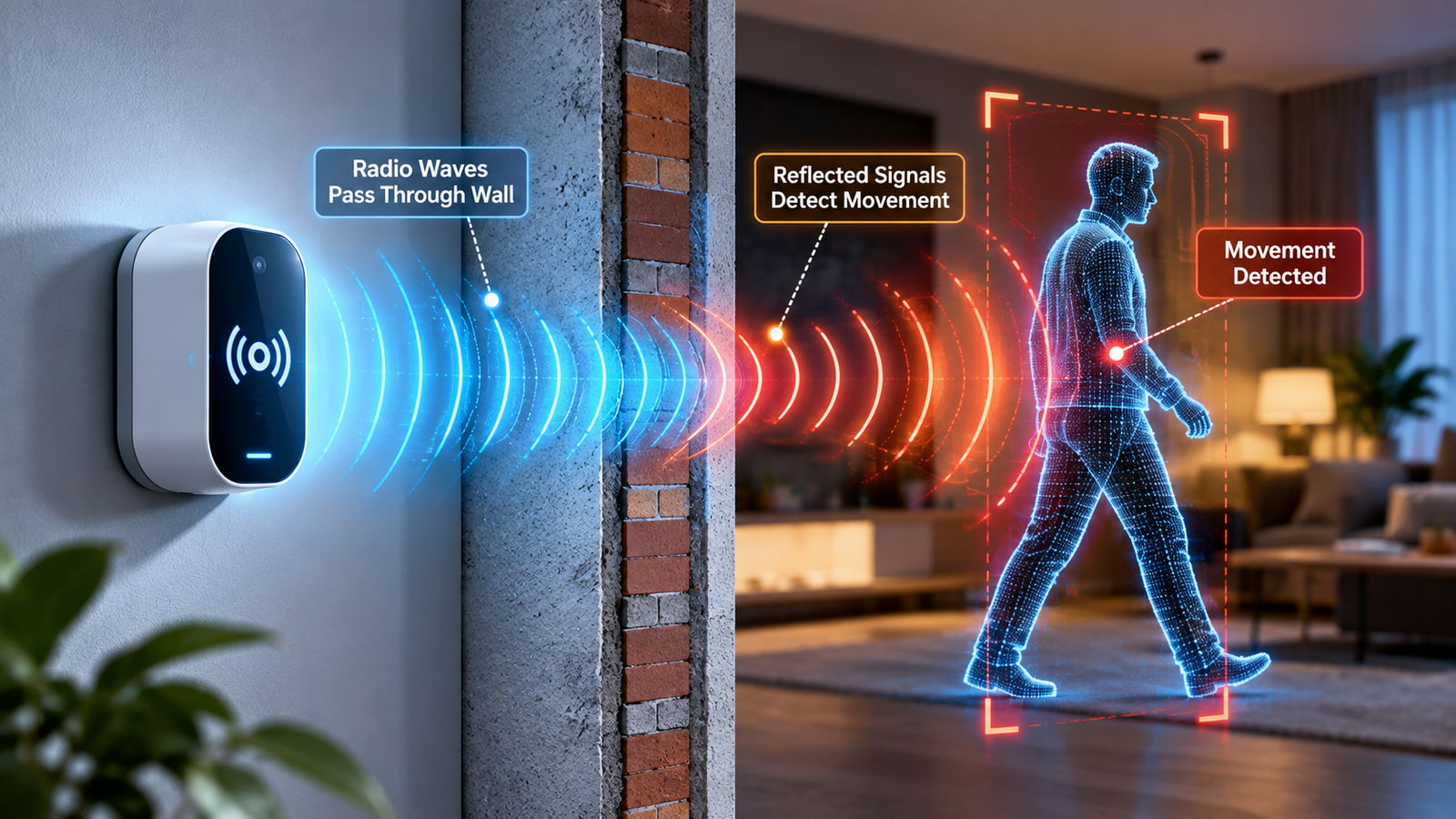
Imagine a smart sensor that can detect movement even when a person is on the other side of a wall. Unlike a camera, it does not need a clear view. Instead, some advanced sensors use radio-frequency signals and radar technology to detect changes in their surroundings.
This technology is often called through-wall sensing or through-barrier sensing. It has applications in smart buildings, industrial automation, emergency response, security research, and occupancy detection. NIST has demonstrated radar-based systems that can detect movement behind materials such as drywall and other nonmetal barriers.
But how can a sensor detect movement when the wall blocks its view?
The answer lies in electromagnetic waves, reflections, and signal processing.
What Is Through-Wall Movement Detection?
Through-wall movement detection is a sensing technique that uses electromagnetic signals to detect activity behind a physical barrier.
Unlike a traditional camera, the sensor does not depend on visible light. Instead, it transmits radio-frequency energy and analyzes the signals that return after interacting with objects.
When a person moves behind a wall, their body changes the way the electromagnetic signal is reflected.
The sensor can analyze these changes to estimate information such as:
- Presence
- Movement
- Distance
- Direction of movement
- Location
- In some systems, very small body movements
NIST describes through-barrier sensing systems based on Doppler radar that can detect and locate targets behind nonmetal barriers.
How Does a Smart Sensor See Through a Wall?
The sensor does not literally “see” through the wall in the same way a camera sees an object.
Instead, it works more like radar.
A simplified process looks like this:
Sensor → Radio Signal → Wall → Object → Reflected Signal → Sensor → Signal Processing → Movement Detection
The sensor sends electromagnetic energy toward an area.
Some of that energy can pass through the wall. When it reaches an object, part of the signal is reflected.
The sensor receives the returning signal and analyzes how it has changed.
Those changes provide information about what is happening behind the barrier.
The Role of Radio Waves
Radio waves are electromagnetic waves that can travel through some materials.
This is why radio-based technologies can behave differently from visible-light technologies.
A wall that completely blocks a camera’s view may not completely block certain radio-frequency signals.
However, not every radio frequency passes through every wall equally well.
The material, thickness, structure, moisture content, and frequency of the signal can all affect the result.
NIST notes that lower-frequency electromagnetic signals generally provide greater penetration through nonmetal barriers, although this can come with lower spatial resolution.
This creates an important engineering trade-off:
Better penetration does not automatically mean better imaging or precision.
How Radar Detects Movement
Radar stands for Radio Detection and Ranging.
A radar sensor sends electromagnetic signals into an environment and analyzes their reflections.
When an object is stationary, the reflected signal has certain characteristics.
When the object moves, those characteristics change.
The sensor can use these changes to determine whether movement is occurring.
One important principle is the Doppler effect.
When an object moves toward or away from a radar sensor, the frequency of the reflected signal changes.
This change is called a Doppler shift.
By analyzing the shift, radar systems can estimate movement and velocity.
NIST describes Doppler radar as a method for detecting motion by analyzing changes in reflected microwave signals.
What Is Doppler Radar?
Doppler radar is particularly useful when the goal is to determine whether something is moving.
For example, imagine a person walking behind a wall.
As the person moves:
- The sensor transmits a signal.
- The signal interacts with the wall and the person.
- Some energy returns toward the sensor.
- Movement changes the reflected signal.
- The sensor detects those changes.
- Signal-processing algorithms estimate the movement.
The system does not need to identify every visual detail of the person.
Instead, it can focus on changes in the electromagnetic reflections.
Can Sensors Detect Small Movements?
Yes.
Some radar systems are sensitive enough to detect very small movements.
Human beings constantly make small movements, even when they appear to be standing still.
These can include:
- Breathing
- Small body movements
- Hand movements
- Head movements
- Fidgeting
Modern mmWave radar sensors can detect very small changes in a scene. Texas Instruments describes mmWave radar systems capable of detecting micro-motions such as breathing and small head movements in appropriate applications.
Research from NIST has also examined through-wall detection of motion associated with respiration and other human movements.
This does not mean every smart sensor can detect breathing through every wall.
Performance depends heavily on the sensor, environment, wall material, distance, signal characteristics, and processing algorithms.
What Is mmWave Radar?
mmWave means millimeter-wave technology.
It refers to radio frequencies from approximately 30 GHz to 300 GHz, corresponding to wavelengths from about 1 to 10 millimeters.
mmWave radar is increasingly used in applications such as:
- Smart buildings
- Occupancy detection
- Industrial automation
- Automotive systems
- Gesture recognition
- People counting
- Presence detection
These sensors can provide information about an object’s:
- Range
- Velocity
- Angle
Texas Instruments describes FMCW mmWave radar as a technology that can measure range, velocity, and angle of arrival.
How FMCW Radar Measures Distance
Many modern radar sensors use a technique called FMCW, or Frequency-Modulated Continuous Wave radar.
Instead of simply sending a single pulse and waiting for an echo, an FMCW radar continuously changes the frequency of its transmitted signal in a controlled way.
The sensor compares the transmitted signal with the received reflection.
This difference provides information about the distance to an object.
A simplified process is:
Transmit signal → Reflection → Receive signal → Compare signals → Calculate range
FMCW radar can also provide velocity and angle information when combined with appropriate antenna and signal-processing techniques.
Why Can Radar Work Through Some Walls?
The answer is related to electromagnetic wave propagation.
Different materials interact with electromagnetic waves in different ways.
Materials such as:
- Drywall
- Wood
- Some plastics
- Glass
can allow certain radio-frequency signals to pass through with varying levels of attenuation.
NIST has demonstrated radio-based sensing through materials including concrete, drywall, wood, and glass in research environments.
However, this does not mean radar can effortlessly pass through every wall.
What Materials Make Detection More Difficult?
The wall itself can be one of the biggest limitations.
Performance can be affected by:
- Reinforced concrete
- Metal structures
- Metal insulation
- Thick masonry
- Multiple walls
- Moisture
- Dense construction materials
Metal can be especially challenging because it can strongly reflect or block certain electromagnetic signals.
This is why through-wall radar is generally more effective with nonmetal barriers than with heavily reinforced or metallic structures.
NIST specifically distinguishes through-barrier sensing of nonmetal barriers and studies how different wall structures affect detection performance.
How Does the Sensor Separate Real Movement From Noise?
Detecting a reflection is only the beginning.
A smart sensor must determine whether the change represents meaningful movement.
The environment may contain many sources of unwanted signals.
For example:
- Fans may move air.
- Curtains may move.
- Machines may vibrate.
- Furniture may reflect signals.
- Multiple people may be present.
- Other electronic systems may create interference.
Signal-processing algorithms help separate meaningful movement from background activity.
The sensor can analyze patterns across:
- Time
- Distance
- Velocity
- Angle
- Signal strength
This allows the system to identify changes that are more likely to represent actual movement.
Can One Sensor Detect Multiple People?
Some advanced radar systems can detect and track multiple people within an area.
Multiple antennas and advanced signal processing can help estimate the positions and movement of different targets.
For example, modern mmWave radar systems can provide range, velocity, and angle information that can be used to track people in defined areas.
However, accuracy depends on the sensor design and environment.
Two people standing very close together may be more difficult to distinguish than two people separated by a larger distance.
Through-Wall Detection Is Not the Same as X-Ray Vision
One of the biggest misconceptions about this technology is that it provides X-ray-like vision.
It does not.
Radar-based sensors generally detect electromagnetic reflections and movement patterns.
They do not automatically produce a normal visual image of everything behind a wall.
Some advanced systems can generate representations or images from radar measurements, but these are fundamentally different from ordinary photographs.
NIST’s m-WIDAR research, for example, demonstrated radar-based imaging of objects and people through walls using radio signals.
The result depends on the sensing method, frequency, antenna configuration, signal processing, and environment.
Where Are Through-Wall Sensors Used?
Through-wall sensing can have legitimate applications in several industries.
Smart Buildings
Smart buildings can use radar sensors to detect occupancy.
Instead of relying only on cameras, a building system can use radar-based presence detection to help control:
- Lighting
- Heating
- Cooling
- Ventilation
- Energy usage
This can improve automation while reducing dependence on visual monitoring.
Emergency Response
Through-wall sensing can be useful during emergency situations.
For example, responders may need to determine whether people are present behind a barrier or inside a damaged structure.
NIST identifies emergency response and locating people behind barriers or rubble as applications of through-barrier radar technology.
Industrial Automation
Factories can use radar-based sensing for:
- Presence detection
- Equipment monitoring
- Automated doors
- Safety systems
- Zone monitoring
Radar has an advantage in some environments because it can continue sensing when cameras are affected by darkness, smoke, or changing lighting conditions.
Healthcare and Assisted Living
Radar sensing can support non-contact monitoring applications.
For example, radar can potentially detect movement or changes in occupancy without requiring a person to wear a device.
This can be useful in assisted-living environments and other applications where continuous contact with a wearable device may not be practical.
However, healthcare applications require careful validation, privacy protection, and appropriate safety controls.
Why Use Radar Instead of a Camera?
Radar and cameras solve different problems.
| Feature | Camera | Radar Sensor |
|---|---|---|
| Requires visible light | Usually | No |
| Works in darkness | Limited without additional hardware | Generally yes |
| Detects movement | Yes | Yes |
| Provides visual images | Yes | Not in the conventional sense |
| Can detect through some barriers | No | Yes |
| Privacy concerns | Often higher | Can be lower in some applications |
| Measures velocity | Indirectly | Directly measurable with radar processing |
| Works through certain drywall | No | Some systems can |
Radar does not necessarily replace cameras.
Instead, the two technologies can complement each other.
A smart building, for example, might use cameras for visual verification and radar for privacy-preserving occupancy detection.
What Are the Main Limitations?
Through-wall sensing is powerful, but it is not magic.
Several limitations need to be considered.
Wall Material
Different materials attenuate electromagnetic signals differently.
Wall Thickness
Thicker barriers can reduce the strength of the signal reaching the target and returning to the sensor.
Distance
Detection performance can decrease as the target becomes farther away.
Multiple Objects
Furniture, walls, equipment, and people can create complex reflections.
Signal Interference
Other radio-frequency sources can affect measurements.
Resolution
A system that detects movement may not provide enough information to identify detailed features.
NIST research highlights the trade-off between penetration and spatial resolution: lower frequencies can penetrate nonmetal barriers more effectively, but they generally provide lower spatial resolution.
How Smart Sensors Turn Signals Into Useful Information
The raw reflected signal is not usually useful by itself.
The sensor needs signal processing.
A simplified pipeline is:
Radio Signal → Reflection → Receiver → Signal Processing → Feature Extraction → Movement Detection
The system can analyze the received signal to estimate characteristics such as:
- Range
- Velocity
- Direction
- Angle
- Presence
- Movement patterns
Machine-learning techniques can also be incorporated into some sensing systems to classify activity or improve detection.
The exact algorithms vary between products and applications.
Privacy and Security Considerations
Any technology capable of detecting activity through a barrier raises legitimate privacy questions.
Smart sensors can collect information about:
- Presence
- Movement
- Occupancy
- Activity patterns
Organizations using these systems should therefore consider:
- User consent
- Data minimization
- Secure data storage
- Access controls
- Appropriate retention periods
- Transparent usage policies
The goal should be to use sensing technology for legitimate purposes while minimizing unnecessary collection of personal information.
What Is the Future of Through-Wall Sensing?
Through-wall sensing is likely to continue developing as radar hardware and signal-processing techniques improve.
Future systems may become better at:
- Detecting small movements
- Tracking multiple targets
- Improving location estimates
- Reducing false detections
- Operating with lower power
- Integrating with smart-building systems
- Combining radar with other sensors
Research is also exploring increasingly sophisticated radar imaging and measurement techniques.
NIST continues to study through-barrier sensing and imaging, including measurement methods and representative wall structures for evaluating system performance.
Frequently Asked Questions
Can a sensor really detect movement through a wall?
Yes. Certain radar-based sensors can detect movement behind some nonmetal barriers by analyzing reflected electromagnetic signals.
Can radar detect a person through a wall?
Some specialized radar systems can detect and locate people behind certain walls or barriers. Performance depends on the wall, sensor, distance, and environment.
Can mmWave radar see through walls?
Some mmWave radar systems can sense through certain materials, but penetration varies by frequency and material. It should not be considered equivalent to seeing through walls like a camera.
Can radar detect breathing through a wall?
Specialized radar systems can detect very small periodic movements associated with respiration under suitable conditions. NIST has researched motion detection involving respiration behind barriers.
Do smart sensors use cameras to detect movement through walls?
No. Radar-based through-wall sensors use electromagnetic signals rather than visible-light cameras.
Does every wall allow radar signals to pass through?
No. Wall material, thickness, moisture, reinforcement, and frequency can significantly affect signal penetration and detection quality.
Is through-wall sensing the same as X-ray technology?
No. Radar uses electromagnetic radio-frequency signals and analyzes their reflections. It does not work like an X-ray imaging system.
Conclusion
Smart sensors can detect movement through some walls because electromagnetic signals can interact with objects behind certain nonmetal barriers.
Radar sensors transmit radio-frequency energy and analyze the returning reflections. Changes in those reflections can reveal movement, distance, velocity, and sometimes other information about a target.
Technologies such as Doppler radar and FMCW radar make it possible to analyze movement in increasingly sophisticated ways. Modern systems can even detect very small movements under suitable conditions.
However, through-wall sensing has clear limitations. Wall construction, signal frequency, distance, interference, and environmental conditions all affect performance.
The technology is therefore best understood not as “seeing through walls,” but as using electromagnetic sensing and signal processing to detect changes behind a barrier.
As smart buildings, industrial automation, emergency response systems, and privacy-conscious sensing continue to develop, radar-based sensors could become an increasingly important part of the next generation of intelligent environments.