
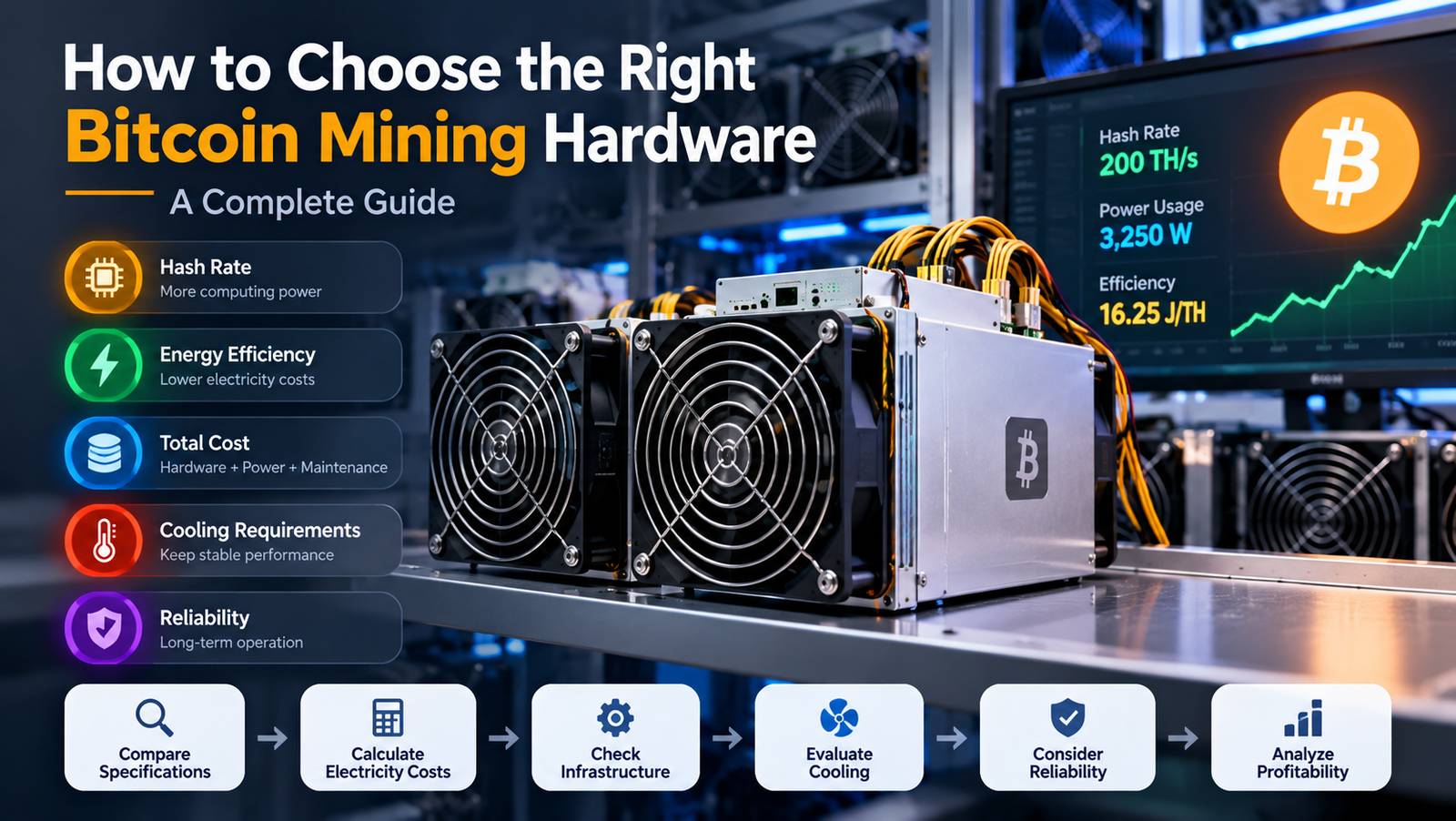
Bitcoin mining hardware plays a critical role in determining mining performance, electricity consumption, and operational costs. Choosing the right equipment can help miners improve efficiency, manage expenses, and build a reliable mining setup.
However, selecting a Bitcoin miner involves more than comparing processing power or purchasing the latest machine. Factors such as hash rate, power efficiency, electricity costs, cooling requirements, and hardware reliability all influence long-term performance.
For beginners, the number of available mining devices can make the decision confusing. Experienced miners also need to evaluate whether upgrading their existing equipment makes financial and operational sense.
So, how do you choose the right Bitcoin mining hardware?
The best approach is to compare equipment based on its technical specifications, operating costs, installation requirements, and expected performance.
In this guide, we will explain the main factors to consider when choosing Bitcoin mining hardware, compare common hardware options, and discuss how to evaluate equipment before investing.
1. Understand How Bitcoin Mining Hardware Works
Bitcoin mining is the process of using computing power to participate in Bitcoin’s proof-of-work system.
Miners repeatedly calculate cryptographic hashes while searching for a result that satisfies the network’s difficulty target. Mining contributes to transaction processing and helps secure the Bitcoin network.
The amount of hashing work a device can perform per second is called its hash rate.
Modern Bitcoin mining primarily uses specialized machines known as Application-Specific Integrated Circuits (ASICs).
Unlike general-purpose computers, ASIC miners are designed specifically to perform the hashing calculations used by Bitcoin mining.
A typical mining setup includes:
- ASIC mining hardware
- A suitable power supply
- Cooling and ventilation
- A reliable internet connection
- Mining software or firmware
- A mining pool connection, if pool mining is used
- Electrical infrastructure capable of supporting the equipment
Understanding these components helps you evaluate the complete cost of operating a miner rather than focusing only on the purchase price.
3. Compare Hash Rate and Energy Efficiency
Two specifications are especially important when comparing Bitcoin mining hardware: hash rate and energy efficiency.
What Is Hash Rate?
Hash rate measures how many hashing calculations a miner performs per second.
It is commonly expressed in terahashes per second (TH/s).
A higher hash rate means the machine performs more hashing work. However, higher hash rate does not automatically mean higher profitability because electricity consumption and hardware costs also matter.
What Is Energy Efficiency?
Mining efficiency describes how much electrical energy a miner uses to perform its hashing work.
It is commonly measured in joules per terahash (J/TH).
A lower J/TH value generally indicates better energy efficiency.
For example, consider two hypothetical mining machines:
| Specification | Miner A | Miner B |
|---|---|---|
| Hash rate | 200 TH/s | 200 TH/s |
| Power consumption | 3,000 W | 4,000 W |
| Energy efficiency | 15 J/TH | 20 J/TH |
Both machines provide the same hash rate, but Miner A consumes less electricity.
At continuous operation, Miner A uses approximately 72 kWh per day, while Miner B uses 96 kWh per day.
That is a difference of 24 kWh daily.
Over time, this difference can significantly affect operating costs.
When comparing mining equipment, examine both hash rate and energy efficiency rather than choosing a machine based on its headline performance alone.
4. Calculate Electricity Costs Before Buying
Electricity is one of the most important ongoing expenses in Bitcoin mining.
Even a powerful ASIC miner may be economically unsuitable if its electricity consumption is too expensive to support.
Before purchasing hardware, calculate how much electricity it will use and estimate the associated cost.
Use this formula:
Daily Electricity Cost = Power Consumption (kW) × Operating Hours × Electricity Rate
For example, consider a miner that consumes 3.5 kW and operates continuously.
Its daily electricity consumption is:
3.5 kW × 24 hours = 84 kWh per day.
If electricity costs ₹8 per kWh, the estimated daily electricity cost is:
84 × ₹8 = ₹672 per day.
This example excludes cooling, hosting, maintenance, and other operating expenses.
Actual costs will depend on the miner’s power consumption, operating time, and electricity tariff.
Calculate the Full Operating Cost
Electricity is not the only expense to consider.
Include the following when evaluating mining hardware:
- Purchase price
- Shipping and import costs, where applicable
- Electricity consumption
- Cooling and ventilation
- Hosting charges, if applicable
- Maintenance and repairs
- Mining pool fees
- Downtime and hardware depreciation
Bitcoin mining revenue also changes with Bitcoin’s market price, network difficulty, transaction fees, and your share of the network’s total hash rate. Therefore, no mining machine guarantees a profit.
5. Choose Hardware That Matches Your Budget
The most expensive mining machine is not necessarily the best choice for every operation.
Your budget should cover both the equipment and the infrastructure required to operate it safely.
For Beginners
If you are new to Bitcoin mining, start by understanding the full cost of ownership.
Consider the purchase price, expected electricity expenses, installation requirements, and available maintenance support.
Avoid committing to expensive equipment before checking whether your operating costs are sustainable.
For Small Mining Operations
If you plan to operate several machines, compare their combined power requirements, cooling needs, and maintenance costs.
A machine that works well individually may require substantial electrical or cooling upgrades when deployed in larger numbers.
For Professional Mining Operations
Large-scale operations need to evaluate hardware at the fleet level.
Important considerations include:
- Total installed hash rate
- Average energy efficiency
- Electricity contracts
- Cooling infrastructure
- Hardware availability
- Repair and replacement procedures
- Expected uptime
- Expansion capacity
The objective is to choose equipment that fits the operation’s financial and infrastructure requirements, rather than simply maximizing the number of machines.
6. Check Power Requirements and Electrical Compatibility
Before purchasing a Bitcoin miner, verify that your installation can safely support it.
ASIC miners can draw substantial amounts of electrical power and may require specific voltage, current capacity, connectors, and circuit protection.
Check the manufacturer’s specifications for:
- Rated power consumption
- Input voltage
- Required electrical connections
- Power supply compatibility
- Circuit capacity
- Operating temperature range
Consult a qualified electrician to confirm that your electrical installation can support the equipment’s continuous load.
Never select mining hardware based on hash rate alone without checking its electrical requirements.
Planning for electrical capacity before purchasing equipment can help prevent costly installation problems.
7. Consider Cooling, Ventilation, and Noise
Bitcoin mining hardware generates heat while operating.
If heat is not removed effectively, a miner may experience thermal throttling, reduced stability, or unexpected shutdowns. Excessive temperatures can also accelerate component wear.
Cooling requirements should therefore be part of the hardware selection process.
Air-Cooled Miners
Air-cooled miners use fans to move air through the machine and remove heat.
They are relatively straightforward to deploy when the installation provides adequate airflow and temperature control.
However, they can produce substantial heat and noise.
Before choosing an air-cooled miner, consider:
- Room ventilation
- Ambient temperature
- Airflow paths
- Dust accumulation
- Fan maintenance
- Noise restrictions
Liquid-Cooled Miners
Some mining systems use liquid cooling to transfer heat away from components.
These systems may suit specialized installations designed for liquid cooling, but they can require additional infrastructure, maintenance, and investment.
The appropriate cooling method depends on the miner’s design and the operating environment.
For either approach, verify the manufacturer’s cooling requirements before installation.
8. Evaluate Hardware Reliability and Manufacturer Support
Mining hardware must operate reliably to deliver its expected performance.
A machine that frequently stops working may produce less mining revenue while continuing to incur infrastructure and maintenance costs.
Before purchasing equipment, investigate the manufacturer’s reputation and support arrangements.
Consider these factors:
Warranty coverage: Understand the warranty period, exclusions, and claim process.
Repair availability: Check whether replacement components and qualified technicians are accessible.
Firmware support: Verify whether the manufacturer provides appropriate updates and technical documentation.
Operating conditions: Confirm the recommended temperature, humidity, and maintenance requirements.
Expected service life: Evaluate the hardware’s condition, age, operating history, and expected remaining useful life.
No mining device operates indefinitely without maintenance. Reliable support can make a significant difference to the long-term cost of operating a mining fleet.
9. Should You Buy New or Used Bitcoin Mining Hardware?
Both new and used mining equipment have advantages and disadvantages.
The right choice depends on the purchase price, hardware condition, efficiency, warranty, and expected operating costs.
| Factor | New Hardware | Used Hardware |
|---|---|---|
| Purchase price | Generally higher | May be lower |
| Hardware condition | Usually unused | Depends on operating history |
| Warranty | May include manufacturer coverage | Coverage may be limited or unavailable |
| Energy efficiency | Depends on the model | Older models may be less efficient |
| Maintenance risk | Depends on product quality | May be higher if the machine is worn |
| Resale value | Depends on market demand | Depends on age, condition, and demand |
What to Check Before Buying Used Equipment
Request the exact model and serial number, verify its authenticity, and inspect its operating condition.
Where possible, review:
- Reported hash rate
- Power consumption
- Fan operation
- Error logs
- Hash board condition
- Repair history
- Warranty status
- Firmware authenticity
Be cautious of sellers who cannot demonstrate that the equipment works as advertised.
A low purchase price does not necessarily make a used miner economical. Higher electricity consumption, repair expenses, and downtime can outweigh the initial savings.
10. Decide Whether to Mine Independently or Join a Mining Pool
After choosing your hardware, consider how you will participate in Bitcoin mining.
Solo Mining
Solo miners attempt to find valid blocks independently.
The potential reward can be substantial if a miner finds a block, but the probability of doing so depends on its share of the network’s total hash rate.
For an individual miner with a small share of network hash rate, rewards can be highly unpredictable.
Pool Mining
A mining pool combines the hash rate of multiple participants.
Participants contribute hashing work and receive payouts according to the pool’s payout method and applicable rules.
Pool mining can provide more frequent, smaller payouts than solo mining, although fees and payout structures vary.
When evaluating a pool, consider:
- Pool fees
- Payout method
- Minimum payout threshold
- Payment history
- Server availability
- Geographic server options
- Transparency of reported performance
Your choice of mining pool does not eliminate hardware or electricity costs. Include pool fees and expected downtime when estimating operating results.
11. Compare Expected Mining Revenue and Profitability
Before investing in Bitcoin mining hardware, estimate whether its potential revenue can cover the total operating cost.
Mining profitability depends on several changing factors:
- Hardware hash rate
- Energy efficiency
- Electricity price
- Bitcoin market price
- Network difficulty
- Mining pool fees
- Equipment uptime
- Cooling and maintenance expenses
Use a reputable mining profitability calculator to estimate potential revenue based on your hardware specifications and operating conditions.
Run multiple scenarios rather than relying on a single estimate.
For example, consider what happens if electricity prices increase, mining revenue decreases, or the equipment experiences unexpected downtime.
Treat profitability calculations as estimates, not guarantees. Actual results may differ significantly from projections.
12. Bitcoin Mining Hardware Selection Checklist
Before making your final decision, review this checklist.
| Requirement | What to Check |
|---|---|
| Hash rate | Does the machine meet your performance requirements? |
| Energy efficiency | Is its J/TH rating competitive for your operating costs? |
| Electricity | Can you afford the expected power consumption? |
| Budget | Does the purchase price fit your available capital? |
| Electrical infrastructure | Can your installation safely support the miner? |
| Cooling | Is sufficient ventilation or suitable cooling available? |
| Noise | Is the operating noise acceptable for your location? |
| Reliability | Is the equipment supported and serviceable? |
| Warranty | Are warranty terms and repair options clear? |
| Profitability | Have you calculated costs under different scenarios? |
| Scalability | Can your infrastructure support future expansion? |
| Security | Can you protect the miner, its management interface, and associated accounts? |
Evaluating these factors together will help you make a more informed hardware decision.
Frequently Asked Questions
1. What is the best hardware for Bitcoin mining?
ASIC miners are the standard choice for dedicated Bitcoin mining. The best model depends on its hash rate, energy efficiency, purchase price, electricity costs, and operating requirements.
2. Can you mine Bitcoin with a regular computer?
A regular computer can perform Bitcoin’s hashing calculations, but CPUs and GPUs are generally unsuitable for competitive Bitcoin mining compared with specialized ASIC hardware.
3. What does J/TH mean in Bitcoin mining?
J/TH stands for joules per terahash. It measures the energy required to perform a terahash of hashing work. A lower value generally indicates better energy efficiency.
4. Is a higher hash rate always better?
No. A higher hash rate increases the amount of hashing work performed, but it may also require more electricity and a larger investment. Compare hash rate with energy efficiency and total operating costs.
5. How much electricity does a Bitcoin miner use?
Electricity consumption varies by model. A miner rated at 3,500 watts consumes approximately 3.5 kWh per hour at its rated power draw. Continuous operation would use approximately 84 kWh per day, excluding additional cooling or facility consumption.
6. Is used Bitcoin mining hardware worth buying?
Used hardware can offer a lower purchase price, but its condition, efficiency, warranty, and repair history must be considered. Compare its total expected operating cost with that of a new machine before deciding.
7. How can I estimate Bitcoin mining profitability?
Estimate mining revenue using the machine’s hash rate and current network conditions, then subtract electricity, pool fees, cooling, maintenance, hosting, and other applicable costs. Include hardware depreciation and initial investment when evaluating the overall economics.
Conclusion
Choosing the right Bitcoin mining hardware requires more than comparing machine prices or selecting the highest hash rate.
You need to evaluate energy efficiency, electricity costs, cooling requirements, electrical compatibility, reliability, and expected operating expenses.
ASIC miners provide specialized hardware for Bitcoin mining, but their economic suitability depends on the conditions in which they operate.
Before purchasing equipment, compare specifications, calculate electricity costs, evaluate support options, and test profitability assumptions under different scenarios.
The best Bitcoin mining hardware is not necessarily the most powerful or the cheapest. It is the equipment that best fits your operating requirements, available infrastructure, and financial constraints.
A careful selection process can help you avoid unsuitable purchases, manage operating expenses, and build a more reliable mining operation.