
Introduction
Choosing the right electronic components is essential for building reliable electronic products. Engineers must consider performance, quality, availability, cost, and long-term reliability when selecting components for a design.
However, sourcing components can be challenging. Original components may be expensive or difficult to obtain, while compatible alternatives can offer greater flexibility and lower costs. But are compatible electronic components always a suitable replacement?
The answer depends on the application, technical specifications, operating conditions, and quality requirements.
In this guide, we explain the differences between original and compatible electronic components, their advantages and limitations, and how engineers can select the right option for their projects.
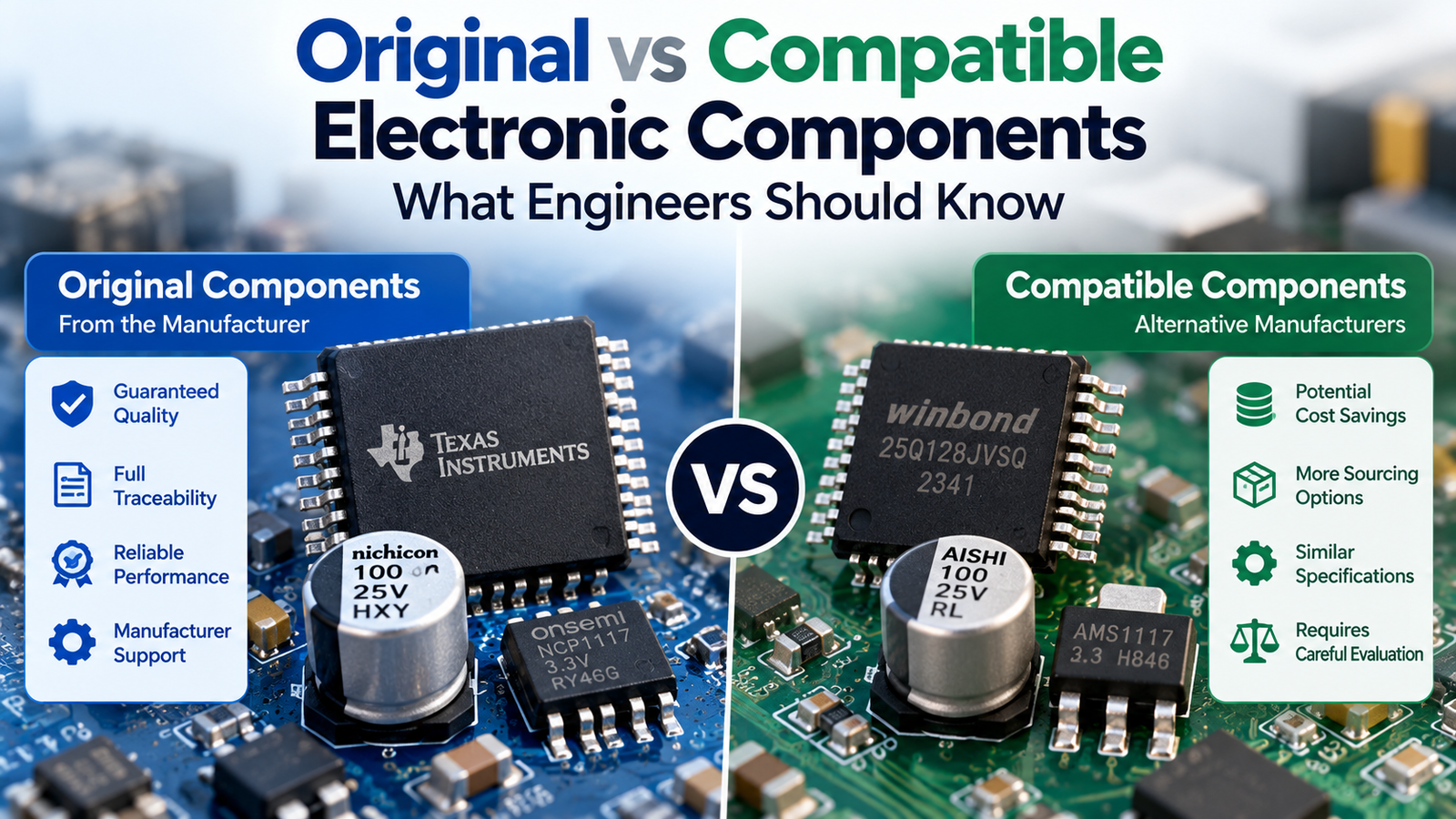
What Are Original Electronic Components?
Original electronic components are parts manufactured by the original component manufacturer (OCM) or obtained through its authorized distribution channels.
Examples include microcontrollers, resistors, capacitors, integrated circuits, connectors, sensors, and power management devices.
These components are designed and manufactured according to the specifications established by their manufacturers.
Key characteristics of original components
- Manufacturer specifications: Technical parameters are documented in the official datasheet.
- Traceability: Authorized supply chains can provide documentation about component origin and procurement.
- Quality assurance: Components are manufactured under the manufacturer’s established quality processes.
- Technical support: Manufacturers may provide application notes, design tools, and engineering assistance.
- Lifecycle information: Product status and availability information may help engineers plan future production.
Original components are often preferred for safety-critical applications, complex designs, and products that require strict quality control.
However, original components can sometimes have longer lead times, higher prices, or limited availability.
What Are Compatible Electronic Components?
Compatible electronic components are alternative parts designed to perform the same or a similar function as another component.
They may be manufactured by a different company and can sometimes replace the original component without major changes to the design.
For example, a compatible voltage regulator might provide the same nominal output voltage as the original device. However, its current capacity, thermal performance, package, or protection features may differ.
An important distinction: A compatible component is not necessarily counterfeit. It may be a legitimate product from another manufacturer. However, compatibility must be verified rather than assumed.
Key characteristics of compatible components
- Potential cost savings: Some alternatives are available at lower prices.
- Supply flexibility: Alternative manufacturers may offer additional sourcing options.
- Different specifications: Electrical characteristics and performance may vary.
- Possible design changes: Some replacements require adjustments to the PCB or supporting circuitry.
- Independent qualification: Engineers may need to perform additional testing before approving the component.
Compatible components can be useful when the original part is unavailable, expensive, or approaching the end of its product lifecycle.
Original vs Compatible Electronic Components: Key Differences
Understanding the differences helps engineers make informed purchasing and design decisions.
| Comparison Factor | Original Components | Compatible Components |
|---|---|---|
| Manufacturer | Original component manufacturer | Alternative manufacturer |
| Cost | May be higher | May be lower |
| Availability | Depends on manufacturer and supply conditions | May provide additional sourcing options |
| Technical specifications | Defined in the original manufacturer’s datasheet | Must be checked against the alternative manufacturer’s datasheet |
| Quality assurance | Covered by the manufacturer’s quality processes | Depends on the alternative manufacturer’s processes |
| Traceability | Supported through appropriate authorized channels | Depends on the supplier and procurement channel |
| Design changes | Usually unnecessary when using the specified part | May be required |
| Performance | Established by the manufacturer’s specifications and applicable testing | Must be evaluated for the intended application |
| Long-term availability | Depends on product lifecycle and supply conditions | Depends on the alternative manufacturer’s lifecycle |
| Qualification effort | Depends on the project requirements | May require additional validation |
Neither option is automatically better in every situation. The correct choice depends on the component’s function and the consequences of failure.
Are Compatible Components Always Drop-In Replacements?
No. Two components can have similar specifications without being fully interchangeable.
Engineers should evaluate more than the component’s part number, package, or primary function.
A replacement may fit the PCB but still behave differently under real operating conditions.
1. Electrical characteristics
Check the complete electrical specifications, including:
- Operating voltage and current
- Input and output characteristics
- Power consumption
- Switching frequency
- Timing requirements
- Leakage current
- Tolerance and accuracy
- Protection features
For example, two voltage regulators may support the same output voltage but differ in dropout voltage, transient response, or maximum output current.
These differences can affect system stability.
2. Package and pin configuration
A compatible component may use the same package dimensions but have a different pin assignment.
Engineers should verify:
- Package dimensions
- Pinout and pin functions
- PCB footprint compatibility
- Thermal pad requirements
- Recommended land pattern
A pinout mismatch can damage the component or connected circuitry.
3. Thermal performance
Thermal characteristics are particularly important in power electronics, industrial equipment, and compact devices.
Compare the maximum operating temperature, junction temperature limits, thermal resistance, and heat dissipation requirements.
A component that performs well in a laboratory test may overheat in an enclosed product or under continuous high-load operation.
4. Timing and signal integrity
Digital components, memory devices, communication interfaces, and high-speed circuits may have strict timing requirements.
Engineers should review propagation delay, setup and hold times, signal levels, input capacitance, and other interface characteristics where applicable.
Even small differences can affect system performance.
5. Environmental and reliability requirements
Products used in vehicles, factories, medical equipment, and outdoor environments may require components that meet specific environmental or reliability standards.
Check the relevant temperature range, vibration requirements, humidity resistance, qualification status, and applicable industry standards.
Do not assume that a compatible component meets the same requirements simply because it performs the same basic function.
Advantages of Using Original Electronic Components
Original components offer several benefits, particularly when engineering teams need predictable performance and documented sourcing.
Better supply-chain traceability
Purchasing through authorized distribution channels can help engineers establish component provenance and maintain procurement records.
This is important when investigating failures or meeting customer and regulatory requirements.
Manufacturer documentation
Original component manufacturers typically provide datasheets and may offer reference designs, application notes, simulation models, and technical support.
These resources can simplify design verification and troubleshooting.
Established design compatibility
If a circuit was designed and validated using a specific component, continuing to use that component can reduce the need for additional qualification work.
This is especially useful for mature products with established production processes.
Consistent engineering requirements
Original components can simplify compliance documentation and quality management when the product specification explicitly requires a particular manufacturer or part number.
However, using an original component does not eliminate the need for proper storage, handling, assembly, and testing.
Advantages of Using Compatible Electronic Components
Compatible components can provide practical alternatives when engineers evaluate them carefully.
1. Potential cost reduction
Alternative manufacturers may offer components at lower prices.
For products manufactured in large quantities, even a small difference in unit cost can influence the total production budget.
However, engineers should also consider testing expenses, redesign work, qualification costs, and potential failure-related losses.
2. Improved sourcing flexibility
An alternative component can provide another procurement option when the original part has a long lead time or limited availability.
This can help engineering and purchasing teams reduce dependence on a single source.
3. Support for redesigns
During a redesign, engineers may identify alternative components with suitable specifications, improved availability, or features better suited to the application.
A carefully evaluated replacement may also help address obsolete components.
4. More options for product development
Compatible components can expand the choices available during prototyping and early-stage development.
Engineers can compare technical specifications and evaluate different solutions before selecting the most appropriate component.
The key is to validate the alternative before approving it for production.
Original, Compatible, and Counterfeit Components: Understand the Difference
These three categories should not be treated as interchangeable.
Original components are products from the specified manufacturer.
Compatible components are legitimate alternatives designed to provide the same or a similar function. Their suitability depends on verified specifications and application requirements.
Counterfeit components are parts misrepresented as genuine products or as having an origin, identity, or specification that they do not actually possess.
Counterfeit components may contain incorrect markings, reused parts, altered identification, or performance characteristics that differ from the claimed specifications.
Why counterfeit components are dangerous
Counterfeit parts can create several risks:
- Unexpected electrical failures
- Inconsistent product quality
- Reduced operating life
- Unreliable performance under stress
- Product recalls and warranty claims
- Safety and compliance concerns
A low-cost component is not automatically counterfeit, and an expensive component is not automatically genuine.
Engineers and procurement teams should evaluate the supplier, documentation, traceability, and inspection results rather than relying on price alone.
How to Select the Right Electronic Component
A structured evaluation process helps engineers choose between original components and compatible alternatives.
Step 1: Define the application requirements
Identify the component’s role in the circuit and document the required electrical, mechanical, thermal, and environmental characteristics.
Consider whether the product is a prototype, consumer device, industrial system, or safety-critical application.
Step 2: Compare datasheets
Review the original component’s datasheet alongside the proposed replacement’s datasheet.
Compare minimum, typical, and maximum values wherever relevant. Pay attention to operating conditions and test methods, because specifications may not be directly comparable.
Step 3: Verify the manufacturer and supplier
Check the manufacturer’s identity, product documentation, and supply-chain information.
Where traceability is important, request appropriate documentation, such as certificates of conformity or lot identification records, as applicable.
Prioritize authorized distributors or suppliers with verifiable sourcing practices.
Step 4: Evaluate lifecycle and availability
Confirm whether the original component is active, approaching end of life, or discontinued.
For alternatives, review expected availability and the manufacturer’s product lifecycle information.
A replacement that is inexpensive today may create sourcing difficulties later if it is not available throughout the product’s intended production period.
Step 5: Perform engineering validation
Test the proposed replacement under representative operating conditions.
Depending on the application, validation may include:
- Electrical performance testing
- Thermal testing
- Functional testing
- Environmental testing
- Electromagnetic compatibility testing
- Reliability testing
- Manufacturing and assembly checks
The required tests depend on the design and the consequences of component failure.
Step 6: Document the approval
Maintain a record of the approved part number, manufacturer, supplier, datasheet revision, test results, and any design changes.
For production hardware, use an established component approval or engineering change process.
This makes future audits, troubleshooting, and procurement decisions easier.
When Should Engineers Choose Original Components?
Original components are often the preferred choice when:
- The design requires a specific manufacturer or part number.
- Failure could create significant safety or financial consequences.
- The component is difficult to validate independently.
- Strict traceability or customer requirements apply.
- The existing design has already been qualified with the original part.
- Manufacturer-specific features are essential to the application.
For these situations, the additional cost may be justified by reduced qualification effort and better control over sourcing.
When Should Engineers Consider Compatible Components?
Compatible components may be suitable when:
- The original part is unavailable or discontinued.
- A legitimate alternative meets all critical specifications.
- The engineering team can perform appropriate validation.
- The application permits component substitutions.
- Supply-chain flexibility is a priority.
- The total cost remains attractive after testing and qualification expenses.
A compatible component should be approved based on evidence, not simply because its advertised specifications appear similar.
Common Mistakes to Avoid When Replacing Electronic Components
Even experienced teams can overlook important details during component substitution.
Choosing based only on price
A lower unit price does not guarantee a lower total cost. Consider qualification, manufacturing yield, reliability, and warranty implications.
Comparing only headline specifications
Two components with the same voltage rating or current rating may differ in other critical characteristics.
Always review the complete datasheets.
Ignoring pin compatibility
Similar package dimensions do not guarantee identical pin assignments or PCB compatibility.
Skipping validation tests
A replacement that works on a development board may behave differently under production loads, temperature extremes, or electrical transients.
Buying from unverified suppliers
Poor sourcing practices can expose manufacturers to counterfeit, damaged, improperly stored, or incorrectly represented components.
Overlooking product lifecycle requirements
A component substitution should support both current production and the product’s expected future needs.
Frequently Asked Questions
1. What is the difference between original and compatible electronic components?
Original components come from the specified manufacturer, while compatible components are alternatives from other manufacturers that may perform the same or a similar function. Compatibility must be verified against the design requirements.
2. Are compatible electronic components reliable?
They can be reliable when produced by reputable manufacturers and selected for the correct application. Reliability depends on component quality, specifications, manufacturing processes, handling, and validation.
3. Are compatible components counterfeit?
No. Compatible components can be legitimate products from alternative manufacturers. Counterfeit components are misrepresented products whose identity, origin, or specifications cannot be trusted.
4. Can engineers replace original components without changing the PCB?
Sometimes. A replacement may fit the existing footprint and use the same pinout, but engineers must also verify electrical, thermal, timing, and mechanical compatibility.
5. How can engineers verify electronic component quality?
Engineers can review datasheets, supplier qualifications, traceability records, relevant conformity documentation, and inspection results. They can also conduct electrical, functional, thermal, and reliability tests appropriate to the application.
6. Are original electronic components always more expensive?
Not always. Prices depend on the manufacturer, component type, order quantity, availability, and market conditions. Compare total procurement and qualification costs rather than unit price alone.
7. What should engineers do when an original component is discontinued?
Identify possible alternatives, compare their specifications, evaluate lifecycle availability, perform the required validation, and document the approved replacement before introducing it into production.
Conclusion
Selecting between original and compatible electronic components requires a balance between cost, performance, quality, availability, and reliability.
Original components can simplify sourcing verification and reduce qualification effort when they match an established design. Compatible components can offer valuable alternatives when the original part is expensive, unavailable, or discontinued.
However, a compatible component should never be approved on price or basic specifications alone. Engineers should verify the datasheet, confirm supplier credibility, evaluate the operating conditions, and complete the necessary testing.
By following a structured component selection process, engineering teams can reduce sourcing risks, maintain product quality, and make informed decisions throughout the hardware development lifecycle.