
Introduction
Artificial intelligence is changing how computers process information, recognize patterns, and make decisions. However, modern AI systems can require significant computing power, memory bandwidth, and energy.
As AI applications become more advanced, hardware engineers are exploring new architectures that can process information more efficiently. One promising approach is neuromorphic computing.
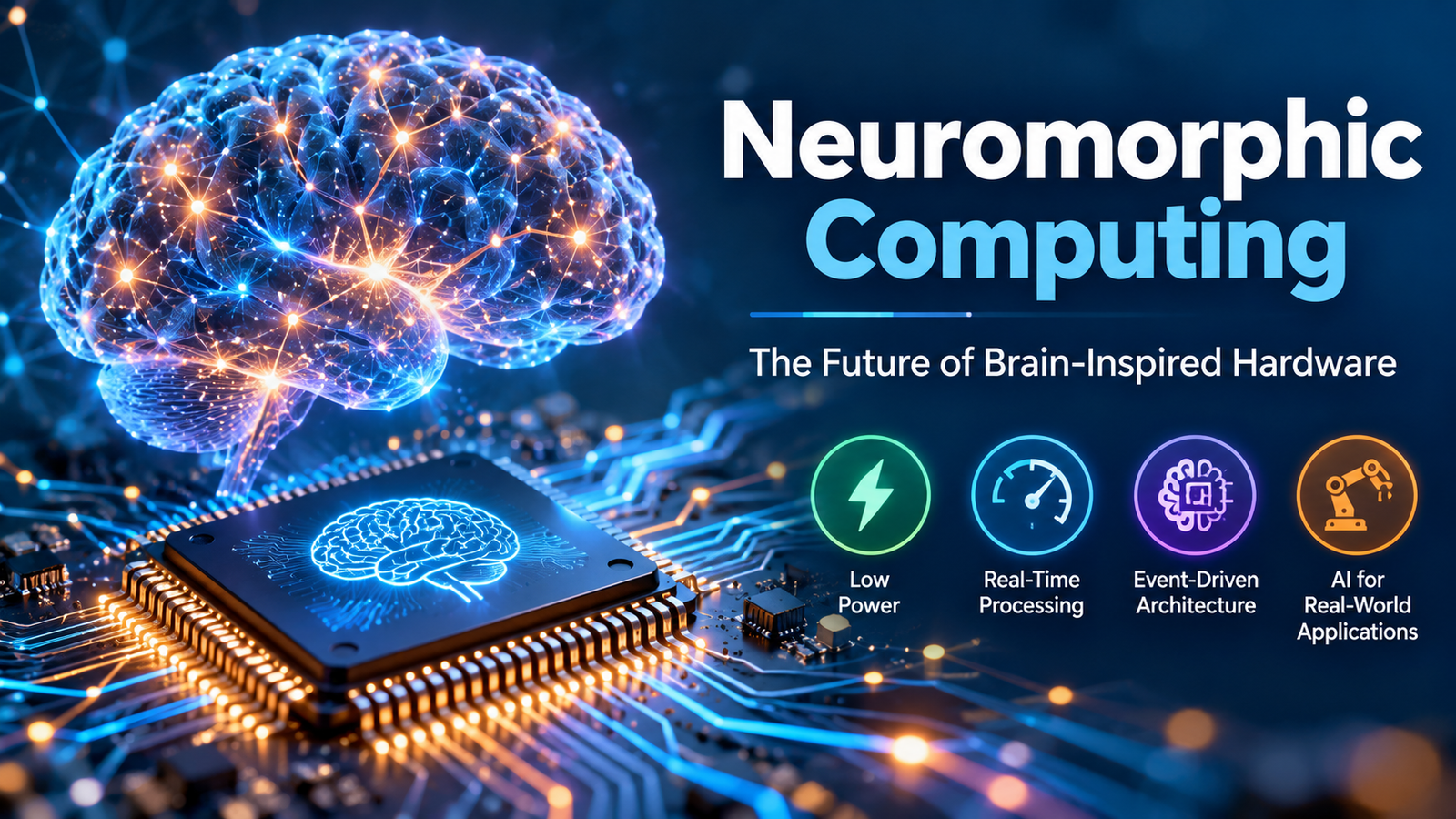
Neuromorphic computing is a technology inspired by the structure and functioning of the human brain. It uses specialized hardware to imitate selected characteristics of biological neurons and synapses.
Unlike conventional computing architectures, neuromorphic systems can combine memory and computation more closely. Many also use event-driven processing, allowing them to respond to incoming signals without continuously processing unchanged information.
These features make neuromorphic computing an interesting option for applications that require low latency, efficient sensor processing, and fast responses.
From intelligent robots to battery-powered sensors, brain-inspired hardware could influence the next generation of computing devices.
In this article, we explain how neuromorphic computing works, explore its hardware components, examine real-world applications, and discuss the advantages and challenges of this emerging technology.
What Is Neuromorphic Computing?
Neuromorphic computing is a computing approach that takes inspiration from the human nervous system.
The human brain contains billions of neurons connected through synapses. These neurons communicate through electrical and chemical signals, allowing the brain to process information and respond to its surroundings.
Neuromorphic hardware imitates selected aspects of this biological process using electronic circuits, specialized processors, and computational models.
Instead of relying entirely on conventional processor architectures, these systems can use artificial neurons and synapses to process information in brain-inspired ways.
The objective is not to reproduce the entire human brain inside a computer. Instead, engineers aim to build hardware that performs specific computational tasks efficiently.
For example, a neuromorphic system could process signals from a motion sensor, identify a significant change, and trigger an appropriate response.
This approach is particularly relevant to robotics, edge artificial intelligence, intelligent sensors, and other applications that need to process information as events occur.
How Does Neuromorphic Computing Work?
To understand neuromorphic computing, it helps to examine the main principles behind its hardware architecture.
Three important concepts are artificial neurons, artificial synapses, and event-driven processing.
1. Artificial Neurons
Biological neurons receive signals from other neurons. When their activity reaches a particular threshold, they can generate an electrical impulse called a spike.
Neuromorphic hardware can reproduce similar behavior using electronic circuits or mathematical models.
An artificial neuron receives input signals, processes them, and generates an output according to its activation rules.
Thousands or millions of these computational units can be connected to form a network.
These networks are used to investigate brain-inspired approaches to pattern recognition, sensory processing, and decision-making.
2. Artificial Synapses
In the brain, synapses connect neurons and influence how signals pass between them.
Neuromorphic systems represent these connections using electronic circuits, digital memory, or specialized devices.
The strength of a connection can represent a numerical weight that influences the processing of incoming information.
Researchers are also investigating devices such as memristors that could help combine memory and computation within the same hardware structure.
This approach may reduce the need to move information repeatedly between separate memory and processing units.
However, practical implementation depends on factors such as device reliability, manufacturing consistency, and circuit design.
3. Event-Driven Processing
Many conventional computing systems process information through clock-driven operations or scheduled computational steps.
Neuromorphic systems can instead use event-driven processing, where computation and communication occur in response to relevant events.
Consider a security camera monitoring an empty room.
If the scene remains unchanged, an event-based vision system may produce relatively little new data. When movement occurs, the system can process the resulting events.
This approach can reduce unnecessary computation for suitable workloads.
However, the actual energy savings depend on the processor, sensor, software, and overall system architecture.
4. Parallel Processing
The brain processes information through large networks of interconnected neurons.
Neuromorphic processors can also support parallel computation across many interconnected computational units.
This can be useful when a task involves multiple signals or requires continuous interaction with the environment.
For example, a robot may need to process visual events and motion signals while adjusting its movements.
A suitable neuromorphic architecture could support parts of this processing in parallel.
Neuromorphic Computing vs. Traditional Computing
Traditional processors and neuromorphic hardware are designed around different computational principles.
CPUs provide general-purpose computing, while GPUs excel at many highly parallel numerical workloads. Neuromorphic processors are designed for brain-inspired computation, often involving spikes and event-driven communication.
The following table highlights their main differences.
| Feature | Traditional Computing | Neuromorphic Computing |
|---|---|---|
| Architecture | Conventional processor and memory structures | Brain-inspired networks of artificial neurons and synapses |
| Processing | Often instruction-driven or clock-driven | Often event-driven |
| Memory and computation | Frequently separated | Can be closely integrated |
| Communication | Depends on processor architecture | Often uses event-based communication |
| Energy efficiency | Depends on the workload and hardware | Can be favorable for suitable event-driven workloads |
| Programming | Mature development tools and frameworks | More specialized development tools |
| Typical applications | General computing, databases, graphics, and AI | Specialized AI, sensory processing, robotics, and research |
An important point is that neuromorphic computing is not automatically more efficient than traditional computing.
Its advantages depend on how closely the workload matches the architecture.
For example, conventional GPUs remain highly effective for training many large neural networks. Neuromorphic processors may be more suitable for certain sparse, event-driven tasks.
Choosing the right hardware requires evaluating performance, energy consumption, accuracy, and development complexity.
Key Hardware Components Behind Neuromorphic Computing
Neuromorphic computing combines semiconductor technology, specialized circuits, memory devices, and communication networks.
Understanding these components helps explain how brain-inspired concepts are implemented in physical hardware.
1. Neuromorphic Processors
Neuromorphic processors are specialized chips designed to implement brain-inspired computational models.
They may contain artificial neurons, synaptic connections, and communication circuits that process information using spikes or other event-based signals.
One example is Intel’s Loihi family of neuromorphic research processors.
These processors support research into event-driven neural networks and specialized computing applications.
Neuromorphic processors are being explored for sensory processing, robotics, adaptive systems, and other tasks that may benefit from their architecture.
2. Memristors and Emerging Memory Devices
Memory technology is an important area of neuromorphic hardware research.
A memristor is an electronic device whose resistance depends on its history of electrical excitation.
Researchers are investigating whether memristors can represent synaptic weights and support computation within memory structures.
This could help reduce data movement between memory and processing units.
Other technologies under investigation include phase-change memory and ferroelectric devices.
However, challenges involving device variability, reliability, manufacturing, and circuit integration must be addressed before these approaches can be widely deployed.
3. CMOS Technology
Complementary metal-oxide-semiconductor, or CMOS, technology is widely used to manufacture integrated circuits.
Many neuromorphic processors use CMOS circuits to implement artificial neurons, synapses, communication networks, and control logic.
Depending on the architecture, these circuits may use digital processing, analog processing, or a combination of both.
Digital circuits can provide predictable and programmable behavior. Analog circuits can reproduce certain neural dynamics efficiently but may require additional attention to noise, calibration, and manufacturing variations.
CMOS technology provides an established manufacturing foundation for many neuromorphic hardware designs.
4. Event-Based Sensors
Sensors can also play an important role in neuromorphic systems.
Conventional cameras typically capture complete images at regular intervals. Event-based cameras instead report changes in brightness at individual pixels.
This allows them to capture motion and rapid changes with high temporal resolution.
When combined with suitable processing hardware, event-based sensors can reduce the amount of redundant visual information that needs to be processed.
Potential applications include robotic vision, industrial inspection, motion tracking, and autonomous systems.
5. Interconnects and Communication Networks
Neuromorphic processors can contain large networks of interconnected computational units.
These units must exchange information efficiently.
The interconnect architecture determines how events travel between neurons, how the system scales, and how communication affects latency and power consumption.
As neuromorphic systems grow, efficient communication becomes increasingly important.
Poorly designed interconnects can introduce bottlenecks that reduce the benefits of parallel processing.
Major Applications of Neuromorphic Computing
Neuromorphic computing has potential applications across several industries.
Its most promising uses often involve continuous sensing, rapid responses, or workloads where unnecessary computation can be avoided.
1. Edge AI and Smart Devices
Edge AI processes information locally on a device instead of sending every input to a remote cloud server.
This can reduce network dependence and support faster responses.
Neuromorphic hardware may be useful in battery-powered devices that continuously monitor sensor inputs.
Potential applications include:
- Smart environmental sensors
- Wearable electronics
- Intelligent security devices
- Embedded AI systems
- Low-power monitoring equipment
For example, a smart sensor could monitor its surroundings and activate additional processing only when it detects a meaningful change.
This could help reduce energy consumption when the input remains unchanged for long periods.
2. Robotics and Autonomous Systems
Robots must interpret information from cameras, motion sensors, and other inputs while interacting with their surroundings.
They also need to respond quickly when conditions change.
Neuromorphic processors can support event-driven sensory processing and certain types of low-latency control.
Potential applications include obstacle detection, motion tracking, robotic navigation, and adaptive control.
For example, a robot using an event-based camera could detect rapid movement and process the resulting signals to support a quick response.
A complete robotic system still requires suitable sensors, control algorithms, actuators, and safety mechanisms. Neuromorphic hardware is one possible component of that system.
3. Industrial Automation
Factories use sensors to monitor equipment, detect faults, and maintain production quality.
Neuromorphic computing could help process changing sensor signals in applications that require rapid responses.
Possible use cases include:
- Detecting unusual vibration patterns
- Identifying sudden changes in machine operation
- Monitoring industrial equipment
- Processing event-based machine vision data
- Supporting real-time fault detection
For example, an industrial monitoring device could analyze vibration events and flag unusual activity for further investigation.
Before deployment, engineers would need to validate the system’s accuracy and reliability against established monitoring methods.
4. Healthcare and Biomedical Research
Biomedical systems frequently process signals from the human body.
Examples include electrical signals from the brain, heart, and muscles.
Neuromorphic approaches are being investigated for neural signal processing, brain-computer interfaces, and compact biomedical devices.
Their ability to process streams of events may be useful when a device needs to analyze signals continuously while operating within strict power constraints.
Potential applications include neural interface research, wearable monitoring systems, and assistive technologies.
These applications still require appropriate clinical validation, safety testing, and privacy protections. Neuromorphic hardware alone does not guarantee improved medical outcomes.
5. Smart Cameras and Computer Vision
Computer vision systems often process large amounts of visual data.
For some tasks, processing every pixel in every frame can create unnecessary computational work.
Event-based vision combined with neuromorphic processing offers an alternative for applications that focus on changes in a scene.
Possible applications include:
- Motion detection
- Object tracking
- High-speed visual analysis
- Robotic navigation
- Industrial inspection
The benefits depend on the sensor, processing architecture, and specific visual task.
6. Intelligent Sensors and Sensor Fusion
Many intelligent devices combine information from multiple sensors.
For example, an autonomous robot may use cameras, accelerometers, gyroscopes, and distance sensors to understand its environment.
Neuromorphic systems could help process these streams and identify meaningful patterns as they occur.
This approach is particularly relevant when sensor inputs are continuous but important events are relatively infrequent.
Combining sensing and processing more closely may also reduce data movement in appropriately designed systems.
Advantages of Neuromorphic Computing
Neuromorphic computing offers several potential advantages for specialized workloads.
Lower Energy Consumption for Suitable Tasks
Event-driven systems can avoid processing inputs that do not require a response.
When the workload is sparse and the hardware is well matched to the task, this approach can reduce energy consumption.
However, the total energy use also depends on sensors, memory, communication, and other system components.
Low-Latency Processing
Some neuromorphic architectures can process incoming events without waiting for a complete frame or a large batch of data.
This can support fast responses in robotics, sensor processing, and other time-sensitive applications.
Actual latency depends on the complete system, not just the processor.
Parallel Computation
Neuromorphic hardware can implement many interconnected computational units that operate in parallel.
This can benefit applications that naturally map to distributed neural processing.
Reduced Data Movement
Conventional computing architectures often move information between processing units and memory.
Neuromorphic designs can place memory and computation closer together, potentially reducing data movement and associated energy costs.
Potential for Adaptive Processing
Some neuromorphic systems support learning mechanisms that adjust connection strengths in response to activity.
This creates opportunities for research into adaptive systems that respond to changing inputs.
However, online learning is not automatically supported by every neuromorphic processor. The available capabilities depend on the hardware and software implementation.
Challenges and Limitations of Neuromorphic Computing
Despite its potential, neuromorphic computing faces several challenges before it can become a widely adopted computing platform.
1. Limited Software Ecosystems
Traditional computing benefits from mature programming languages, libraries, development tools, and deployment platforms.
Neuromorphic systems often require specialized programming frameworks and computational models.
Developers may need to redesign algorithms as spiking neural networks or adapt existing models to the target architecture.
This can increase development time and make applications more difficult to maintain.
2. Hardware and Software Compatibility
Not every AI model can run efficiently on neuromorphic hardware.
Many conventional deep learning systems rely on dense numerical operations that map well to GPUs and other accelerators.
Neuromorphic processors are often better suited to particular event-driven or spike-based workloads.
Converting an existing model does not guarantee better performance or lower energy consumption.
3. Training and Learning Difficulties
Training spiking neural networks can be more complicated than training conventional artificial neural networks.
The timing of spikes introduces additional considerations for learning algorithms.
Hardware-supported learning also varies between platforms.
Researchers continue to investigate methods that make neuromorphic systems easier to train, deploy, and evaluate.
4. Manufacturing and Integration Challenges
Emerging memory devices and specialized circuits introduce manufacturing challenges.
Engineers must consider device variability, reliability, process compatibility, testing, and packaging.
Integrating large networks of artificial neurons and synapses into practical systems also requires careful design.
These issues can affect production costs and commercial scalability.
5. Benchmarking and Standardization
Comparing neuromorphic systems can be difficult because different platforms may use different neuron models, workloads, precision levels, and measurement methods.
A fair comparison should evaluate the complete system while performing equivalent tasks.
Important measurements include:
- Accuracy
- Energy consumption
- Processing latency
- Throughput
- Memory requirements
- Development and deployment costs
Standardized evaluation methods can help organizations determine whether neuromorphic hardware provides a meaningful advantage for their applications.
Neuromorphic Computing vs. CPU vs. GPU
Neuromorphic processors, CPUs, and GPUs can serve different roles within a computing system.
| Feature | CPU | GPU | Neuromorphic Processor |
|---|---|---|---|
| Primary purpose | General-purpose computing | Parallel numerical computation | Brain-inspired computation |
| Main strength | Flexibility and control | Matrix operations and parallel workloads | Sparse, event-driven processing |
| AI applications | Control, preprocessing, and general tasks | Training and inference for many AI models | Specialized inference and sensory processing |
| Programming tools | Mature and widely available | Mature AI and parallel computing frameworks | More specialized frameworks |
| Energy efficiency | Depends on workload | Depends on workload and utilization | Can be favorable for suitable workloads |
| Typical use cases | Computers, servers, and embedded systems | AI servers, graphics, and scientific computing | Specialized AI, robotics, and research |
These processors are not necessarily competitors in every application.
A future intelligent device could combine a CPU for general control, a GPU or AI accelerator for dense neural network operations, and a neuromorphic processor for specialized sensor processing.
The best architecture depends on the workload, performance requirements, power budget, and development costs.
The Future of Neuromorphic Computing
Research into neuromorphic computing continues to explore new processor architectures, electronic materials, sensors, and learning methods.
Several developments could influence its future.
More Efficient Neuromorphic Chips
Researchers are exploring ways to improve neuron density, synaptic connectivity, and energy efficiency.
Advances in chip design and semiconductor manufacturing could make specialized neuromorphic systems more practical for a wider range of applications.
Integration With Edge AI
Edge devices increasingly need to process information locally while meeting power, size, and latency constraints.
Neuromorphic hardware could become useful in applications where event-driven processing offers a clear advantage.
Potential areas include smart sensors, wearable devices, industrial monitoring, and robotics.
Advances in Memory Technology
Memristors and other emerging electronic devices could enable new approaches to storing and processing information.
However, manufacturing consistency, reliability, and integration remain important research challenges.
Hybrid Computing Architectures
Neuromorphic processors may be integrated with conventional CPUs, GPUs, and AI accelerators.
This approach would allow each processor type to handle the workloads for which it is best suited.
Rather than replacing traditional computing, neuromorphic hardware could become a specialized component in a broader computing ecosystem.
Improved Development Tools
More mature software frameworks, standardized benchmarks, and easier integration with existing AI systems could lower the barriers to adoption.
These improvements would help developers evaluate neuromorphic computing using practical performance and cost measurements.
Overall, neuromorphic computing has promising research directions, but widespread adoption will depend on demonstrated advantages in real-world applications.
Frequently Asked Questions About Neuromorphic Computing
1. What is neuromorphic computing in simple terms?
Neuromorphic computing is a computing approach inspired by the human brain. It uses specialized hardware that imitates selected properties of neurons and synapses to process information.
2. How does neuromorphic computing work?
Neuromorphic systems use artificial neurons, synaptic connections, and specialized communication methods to process information. Many use spikes and event-driven computation to respond to incoming signals.
3. What are neuromorphic chips used for?
Neuromorphic chips are being explored for robotics, edge AI, intelligent sensors, event-based vision, industrial monitoring, and biomedical research.
4. Can neuromorphic computing reduce AI energy consumption?
It can reduce energy consumption for certain workloads, particularly when event-driven processing avoids unnecessary computation. However, savings depend on the model, processor, workload, and complete system configuration.
5. What is the role of memristors in neuromorphic computing?
Memristors are electronic devices being researched for applications such as representing synaptic weights. They may help integrate memory and computation, although manufacturing consistency and system integration remain challenges.
6. Is neuromorphic computing better than GPU computing?
Neither is universally better. GPUs are effective for many conventional AI training and inference workloads. Neuromorphic processors may offer advantages for specialized event-driven tasks. The best choice depends on the application.
7. Is neuromorphic computing commercially available?
Neuromorphic research platforms and specialized hardware are available, but adoption varies by application. The software ecosystem and commercial deployment options are less mature than those of conventional CPU and GPU computing.
8. What skills are useful for working with neuromorphic hardware?
Useful skills include computer architecture, digital electronics, semiconductor fundamentals, embedded systems, neural networks, signal processing, and programming. Familiarity with spiking neural networks and specialized development tools can also help.
Conclusion
Neuromorphic computing represents an important direction in the development of specialized computing hardware.
By drawing inspiration from biological neurons and synapses, engineers are exploring new ways to process information with less unnecessary computation, lower latency, and improved energy efficiency for suitable workloads.
The technology has potential applications in robotics, edge AI, intelligent sensors, industrial automation, and biomedical research.
However, challenges involving software development, training, hardware integration, manufacturing, and benchmarking must still be addressed.
For hardware engineers and technology developers, understanding neuromorphic computing provides valuable insight into emerging processor architectures and future AI infrastructure.
The future of computing may not depend on a single processor architecture. Instead, it may combine traditional CPUs, GPUs, specialized AI accelerators, and neuromorphic processors to solve different problems efficiently.
For Hashing Hardware, neuromorphic computing is a valuable topic because it connects semiconductor engineering, emerging memory technologies, embedded systems, and next-generation artificial intelligence.
References and Further Reading
For additional technical information, explore these resources:
- Intel Labs — Neuromorphic Computing Research
- IBM — What Is Neuromorphic Computing?
- National Institute of Standards and Technology (NIST) — Neuromorphic Computing
- Nature — Towards Spike-Based Machine Intelligence With Neuromorphic Computing