
Introduction
Artificial intelligence is changing the way computer hardware is designed. Modern AI systems process enormous datasets and perform billions of calculations. However, powerful processors alone cannot guarantee high performance. They also need fast and efficient memory to supply data continuously.
This is where HBM vs DDR5 memory becomes an important comparison for AI hardware engineers, data center operators, and system designers.
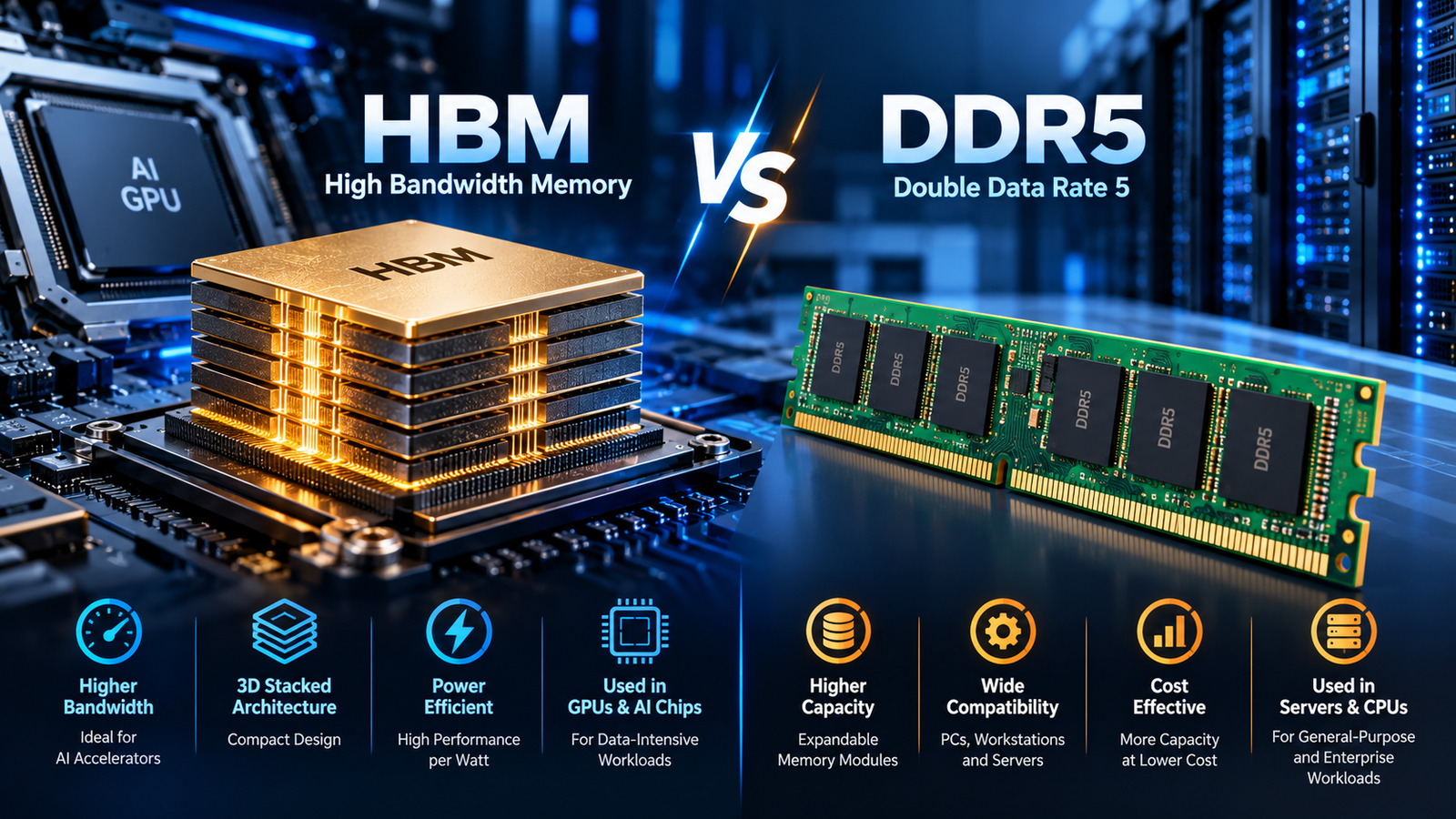
High Bandwidth Memory (HBM) is designed to deliver extremely high memory bandwidth for GPUs and AI accelerators. In contrast, DDR5 is widely used in desktop computers, workstations, and enterprise servers that require flexible memory capacity.
Both technologies play important roles in modern computing. However, they differ in architecture, bandwidth, capacity, power efficiency, cost, and applications.
In this guide, we will explain how HBM and DDR5 work, compare their key features, and explore which memory technology is better suited to different AI workloads.
What Is HBM (High Bandwidth Memory)?
High Bandwidth Memory, commonly known as HBM, is a specialized DRAM technology designed to move large amounts of data between memory and processors at very high speeds.
Unlike conventional memory modules, HBM stacks multiple DRAM dies vertically. These dies communicate through thousands of connections called Through-Silicon Vias (TSVs).
The stacked design creates a very wide data interface. HBM is also integrated close to the GPU or AI accelerator using advanced packaging technologies.
As a result, it can deliver extremely high bandwidth within a relatively compact physical footprint.
Key Features of HBM
- Extremely high bandwidth: HBM can deliver terabytes per second of memory bandwidth per stack in advanced generations.
- 3D-stacked architecture: Multiple memory dies are stacked vertically to increase density and improve data transfer.
- Wide memory interface: A wide interface allows large amounts of data to move simultaneously.
- Power efficiency: HBM is designed to reduce energy consumption per bit transferred.
- Advanced packaging: Integration with GPUs and AI accelerators requires sophisticated packaging techniques.
- AI-focused performance: HBM is well suited to data-intensive workloads that require continuous, high-speed memory access.
Where Is HBM Used?
HBM is commonly associated with:
- AI training accelerators.
- High-performance computing systems.
- Large language model infrastructure.
- GPU-based computing platforms.
- Scientific simulations.
- Data-intensive computing applications.
For example, training a large AI model requires processors to repeatedly access model parameters, training data, and intermediate results. HBM helps supply this data at high bandwidth, reducing the likelihood that memory bandwidth will limit processor utilization.
What Is DDR5 Memory?
DDR5 stands for Double Data Rate 5. It is the fifth generation of Double Data Rate synchronous dynamic random-access memory.
DDR5 is designed to provide high memory bandwidth, improved power characteristics, and greater memory capacity than earlier DDR generations.
Unlike HBM, DDR5 is commonly installed as a memory module connected to a processor through a motherboard’s memory interface.
Desktop computers typically use DDR5 UDIMMs, while enterprise servers commonly use registered DDR5 DIMMs, or RDIMMs.
This modular design makes DDR5 practical for systems that need expandable memory capacity and flexible configurations.
Key Features of DDR5
- Expandable capacity: Multiple memory modules can be installed, subject to motherboard and processor limits.
- Broad compatibility: DDR5 is supported by a wide range of desktop, workstation, and server platforms.
- Improved bandwidth: DDR5 offers higher data rates than DDR4.
- Lower operating voltage: Standard DDR5 uses a nominal DRAM supply voltage of 1.1 V, compared with 1.2 V for DDR4.
- Cost-effective capacity: DDR5 is generally more economical for building large amounts of system memory than using HBM.
- Enterprise applications: Server-grade DDR5 supports demanding workloads involving databases, virtualization, analytics, and AI system orchestration.
Where Is DDR5 Used?
DDR5 is widely used in:
- Desktop computers and workstations.
- Enterprise servers.
- Cloud computing infrastructure.
- Database servers.
- Virtualization platforms.
- CPU-based AI workloads.
- Data processing and analytics systems.
DDR5 is particularly useful when a system needs substantial memory capacity without requiring the extreme bandwidth provided by HBM.
HBM vs DDR5 Memory: Key Differences
Although both technologies use DRAM, their designs address different computing requirements.
The following table summarizes the main differences.
| Feature | HBM | DDR5 |
|---|---|---|
| Full form | High Bandwidth Memory | Double Data Rate 5 |
| Architecture | Vertically stacked DRAM dies | Conventional DRAM dies organized into memory modules |
| Packaging | Advanced 2.5D or 3D packaging | Standard DIMM-based packaging |
| Memory interface | Extremely wide interface | Narrower interface per channel |
| Bandwidth | Typically measured in TB/s per stack for advanced generations | Typically measured in tens to hundreds of GB/s at system level |
| Capacity | Determined by the stack and accelerator design | Expandable through supported memory modules |
| Power efficiency | Designed for high bandwidth per watt | Designed for efficient general-purpose memory operation |
| Cost | Generally expensive | Generally more economical per unit of capacity |
| Upgradeability | Usually integrated into the accelerator package | Modules can often be upgraded or replaced |
| Primary applications | AI accelerators, HPC, data-intensive computing | PCs, workstations, servers, and general-purpose computing |
Important: Actual bandwidth and capacity depend on the memory generation, product, number of channels or stacks, and system configuration. The figures above describe typical architectural differences rather than a direct benchmark between specific products.
1. Memory Bandwidth: Why HBM Has an Advantage
Memory bandwidth describes how much data can be transferred between memory and a processor in a given period.
For AI accelerators, bandwidth is particularly important because model parameters and intermediate data must move continuously between memory and processing units.
HBM achieves high bandwidth by combining a very wide interface with high-speed data transfer.
For example, Micron’s HBM4 technology is designed to deliver more than 2.8 TB/s of bandwidth per stack. Actual system bandwidth depends on the number of stacks and the accelerator’s implementation.
DDR5 provides substantial bandwidth as well. However, its standard memory-channel architecture generally delivers lower bandwidth per memory interface than HBM.
Why Does High Bandwidth Matter for AI?
AI workloads frequently perform large matrix operations and process large quantities of model data.
If a processor cannot receive data quickly enough, its computing units may remain underutilized while waiting for memory transfers to complete.
HBM helps address this problem by providing a high-bandwidth data path.
This is especially valuable for:
- Large-scale AI model training.
- Memory-intensive AI inference.
- High-performance computing.
- Large neural network workloads.
However, higher bandwidth does not automatically make every application faster. The benefit depends on whether memory bandwidth is actually limiting performance.
2. Memory Capacity: Where DDR5 Can Be More Flexible
Bandwidth determines how quickly data moves. Capacity determines how much data memory can hold.
These are different characteristics, and both matter when designing AI hardware.
HBM provides high bandwidth within a compact package. However, the total capacity available to an accelerator depends on the number and size of its HBM stacks.
DDR5 offers a different advantage: system designers can often increase memory capacity by installing additional supported modules.
For example, an enterprise server can be configured with substantial DDR5 system memory to support large databases, virtual machines, and data processing workloads.
Why Does Memory Capacity Matter for AI?
AI systems need sufficient memory to store model parameters, intermediate results, datasets, and other working data.
If the available memory is insufficient, the system may need to move data to another memory tier or storage device.
These transfers can introduce additional latency and reduce performance.
HBM is useful when the accelerator requires very high bandwidth. DDR5 is valuable when the CPU needs large amounts of flexible system memory.
Therefore, choosing between HBM and DDR5 requires evaluating both capacity and bandwidth rather than focusing on a single specification.
3. Power Efficiency: Understanding the Trade-Off
Power efficiency is another important consideration in AI infrastructure.
Large AI clusters contain many accelerators and servers. Consequently, even small improvements in energy efficiency can have a meaningful effect on total electricity consumption.
HBM is designed to deliver high bandwidth with efficient data movement. Its wide interface and close physical integration with the processor help reduce the energy required to transfer each bit of data.
DDR5 is also designed with power efficiency in mind. Its operating voltage is lower than that of DDR4, and server memory products include features intended to improve performance and reliability.
However, comparing power efficiency requires more than comparing memory voltage.
A meaningful evaluation should consider:
- Energy consumed per bit transferred.
- Total memory bandwidth.
- Memory capacity.
- System-level power consumption.
- Workload performance.
- Cooling requirements.
For AI accelerators that require enormous memory bandwidth, HBM can provide an important efficiency advantage.
For general-purpose servers that need large amounts of memory, DDR5 may provide a better balance of capacity, cost, and power consumption.
4. Cost and Availability: HBM vs DDR5
Cost is one of the most significant differences between HBM and DDR5.
HBM requires advanced manufacturing processes, vertically stacked DRAM dies, complex packaging, and integration with high-performance processors.
These requirements increase manufacturing complexity and can limit production capacity.
DDR5 benefits from an established memory-module ecosystem and is generally more economical for applications that need large amounts of system memory.
However, actual prices vary with product specifications, supplier availability, memory generation, and market conditions.
Which Is More Cost-Effective?
The answer depends on the intended workload.
HBM may justify its higher cost when memory bandwidth directly affects AI accelerator performance and overall system productivity.
DDR5 is often a more practical choice when the system primarily needs large memory capacity for general-purpose computing.
Hardware engineers should evaluate the total cost of ownership, including memory, processors, power consumption, cooling, and infrastructure requirements.
5. HBM vs DDR5 for AI Training
AI training involves repeatedly processing datasets to adjust a model’s parameters.
Large training workloads can place substantial demands on memory bandwidth, particularly when accelerators perform many operations in parallel.
HBM helps supply data to GPUs and AI accelerators at very high speeds.
Its high bandwidth can reduce memory-related limitations and improve accelerator utilization when the workload is bandwidth-sensitive.
DDR5 also plays an important role in AI training infrastructure.
CPU servers use DDR5 to support data preparation, preprocessing, orchestration, and other tasks that occur outside the accelerator’s local memory.
For this reason, HBM and DDR5 often work together rather than compete directly.
Example: Training a Large AI Model
Consider a server containing several AI accelerators connected to CPUs.
Each accelerator uses its local HBM to access model parameters and other working data at high bandwidth.
Meanwhile, the CPUs use DDR5 system memory for data preparation, operating system processes, and application coordination.
This arrangement allows each memory technology to perform the role for which it is best suited.
6. HBM vs DDR5 for AI Inference
AI inference is the process of using a trained model to generate predictions, classifications, or responses.
Memory requirements depend on the model architecture, batch size, sequence length, latency target, and inference workload.
HBM is especially useful for high-performance accelerators that need rapid access to model weights and intermediate data.
DDR5 can support CPU-based inference and provide system memory for data processing and application services.
For large language models, the inference process also involves managing the key-value (KV) cache, which stores information used during token generation.
As context lengths and concurrent user requests increase, memory capacity and bandwidth can both become important.
The best memory configuration depends on the balance between response latency, throughput, model size, and infrastructure cost.
7. Can HBM and DDR5 Work Together?
Yes. Modern AI infrastructure commonly uses multiple memory technologies because no single memory type is ideal for every task.
A typical AI computing system may include:
HBM: Provides high-bandwidth local memory for GPUs and AI accelerators.
DDR5: Provides system memory for CPUs, application processes, and data preparation.
NVMe SSDs: Provide persistent storage for datasets, model files, checkpoints, and other information.
These technologies form a memory and storage hierarchy.
Frequently accessed data can remain in faster memory, while larger datasets and less frequently accessed information reside in other memory tiers or storage.
This arrangement helps balance performance, capacity, and cost.
8. How to Choose Between HBM and DDR5
Selecting the right memory technology begins with understanding the application’s requirements.
Consider the following guidelines.
Choose HBM When:
- Building high-performance AI accelerators.
- Training large neural networks on GPUs.
- Running bandwidth-intensive scientific simulations.
- Deploying accelerators for demanding AI inference.
- Maximizing data throughput between memory and processing units.
Choose DDR5 When:
- Building enterprise or cloud servers.
- Running databases and virtualization workloads.
- Supporting CPU-based computing applications.
- Providing expandable system memory.
- Optimizing memory capacity and cost for general-purpose workloads.
Consider Both When:
- Building a GPU-based AI server.
- Supporting large AI training workloads.
- Operating an enterprise AI inference platform.
- Designing infrastructure with separate CPU and accelerator workloads.
The most effective design often combines HBM for accelerator performance with DDR5 for general-purpose system memory.
9. Future of HBM and DDR5 in AI Hardware
As AI models become more capable and computing workloads grow, memory architecture is becoming increasingly important.
HBM development continues to focus on increasing bandwidth, improving energy efficiency, and supporting larger AI workloads.
Newer generations, including HBM4, are designed to address the demanding data-transfer requirements of advanced accelerators.
At the same time, DDR5 continues to support enterprise servers, cloud platforms, and CPU-based workloads that require high memory capacity.
AI infrastructure also increasingly depends on efficient coordination between memory, processors, networking, and storage.
For hardware engineers, this means memory selection is no longer just a question of capacity. Bandwidth, power efficiency, packaging, cooling, and total system cost must also be considered.
Future AI systems will likely continue to use a combination of memory technologies, with each serving a specific role within the overall architecture.
Frequently Asked Questions (FAQs)
1. What is the main difference between HBM and DDR5 memory?
HBM uses vertically stacked memory dies and a very wide interface to deliver extremely high bandwidth. DDR5 uses conventional memory modules and provides flexible capacity for general-purpose computing and servers.
2. Is HBM faster than DDR5?
HBM generally offers much higher memory bandwidth per stack than a conventional DDR5 memory interface. However, actual application performance depends on the processor, memory configuration, workload, and other system components.
3. Why is HBM used in AI GPUs?
AI GPUs process large amounts of data in parallel. HBM provides the bandwidth needed to supply data to their processing units efficiently, helping reduce memory bandwidth limitations.
4. Is DDR5 suitable for AI workloads?
Yes. DDR5 is widely used in AI servers for CPU operations, data processing, system memory, and other tasks. It can also support some CPU-based AI inference workloads.
5. Is HBM more expensive than DDR5?
HBM is generally more expensive because it requires advanced stacking, packaging, and integration processes. DDR5 is typically more economical when large amounts of general-purpose memory are required.
6. Can HBM replace DDR5 completely?
No. HBM and DDR5 serve different purposes. HBM provides high-bandwidth local memory for accelerators, while DDR5 provides flexible system memory for CPUs and servers.
7. Which memory is better for AI model training?
HBM is generally better suited to high-performance GPU training because of its very high bandwidth. However, the best configuration depends on the workload, accelerator design, model size, and system architecture.
Conclusion
The comparison of HBM vs DDR5 memory highlights two different approaches to modern computing.
HBM prioritizes extremely high bandwidth and efficient data movement for AI accelerators and high-performance computing. DDR5 provides flexible, scalable system memory for servers, workstations, and general-purpose computing.
Neither technology is universally better. The right choice depends on the application’s bandwidth requirements, capacity needs, power budget, and overall system cost.
For AI hardware engineers and data center designers, understanding these differences is essential for building efficient computing infrastructure.
As AI workloads continue to evolve, systems that combine high-bandwidth accelerator memory with flexible server memory will remain important to the development of scalable AI infrastructure.