
Introduction
Artificial Intelligence has transformed computer vision through powerful deep learning models capable of recognizing objects with remarkable accuracy. Traditional Artificial Neural Networks (ANNs), especially Convolutional Neural Networks (CNNs), dominate image recognition tasks because of their ability to learn complex visual patterns from massive datasets. However, these systems often require significant computational power and energy consumption, making them less suitable for edge devices, autonomous robots, wearable electronics, and low-power embedded systems.
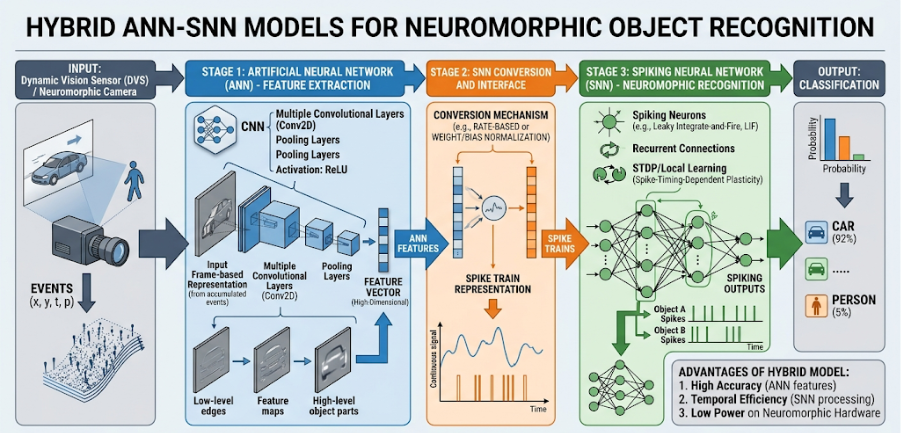
Understanding ANN and SNN Architectures
Artificial Neural Networks (ANNs)
ANNs are inspired by biological neurons but operate using continuous-valued activations. In computer vision, CNNs process images through layers of filters, pooling operations, and nonlinear activations.
Key Advantages
- High object recognition accuracy
- Mature training algorithms
- Strong support from GPUs and AI frameworks
- Excellent performance on large datasets
Limitations
- High energy consumption
- Large memory requirements
- Continuous computation even for static inputs
- Difficult deployment on low-power hardware
Spiking Neural Networks (SNNs)
SNNs use spikes occurring at specific time intervals to encode information. Neurons remain inactive until their membrane potential exceeds a threshold.
Key Advantages
- Event-driven processing
- Extremely low power consumption
- Temporal information handling
- Brain-like computation
Limitations
- Complex training procedures
- Non-differentiable spike functions
- Lower accuracy in some tasks
- Longer inference latency in deep networks
Why Hybrid ANN-SNN Models?
Hybrid architectures aim to combine:
- ANN accuracy and feature extraction
- SNN efficiency and temporal processing
This integration creates models that are:
- More energy-efficient than pure ANNs
- More accurate than standalone SNNs
- Suitable for real-time edge intelligence
Hybrid systems are especially useful for:
- Autonomous vehicles
- Surveillance systems
- Robotics
- Smart cameras
- Industrial automation
- IoT vision devices
Architecture of Hybrid ANN-SNN Systems
Hybrid models can be designed in several ways.
1. ANN Front-End + SNN Back-End
In this architecture:
- ANN layers perform initial feature extraction
- SNN layers perform classification or decision-making
Benefits
- Fast feature learning
- Reduced spike-processing overhead
- Lower energy consumption in later stages
Example Workflow
- Camera captures image
- CNN extracts spatial features
- Features converted into spike trains
- SNN classifier performs recognition
This design is popular in embedded vision systems.
2. Parallel ANN-SNN Processing
Both ANN and SNN process the same input simultaneously.
Characteristics
- ANN handles spatial analysis
- SNN handles temporal/event-based signals
- Outputs merged using fusion mechanisms
Applications
- Event cameras
- Motion recognition
- Real-time tracking
3. Layer-wise Hybrid Networks
Some layers use ANN neurons while others use spiking neurons.
Advantages
- Flexible optimization
- Better hardware mapping
- Gradual transition toward neuromorphic computation
Neuromorphic Object Recognition
Object recognition involves identifying and classifying objects in images or video streams.
Hybrid ANN-SNN models are particularly effective when paired with:
- Dynamic Vision Sensors (DVS)
- Event cameras
- Neuromorphic chips
Unlike traditional cameras that capture entire frames continuously, event cameras only record changes in brightness. This reduces redundant data and enables ultra-fast vision processing.
Event-Based Vision and Hybrid Models
Event Cameras
Event cameras generate asynchronous spikes whenever pixel intensity changes.
Advantages
- High temporal resolution
- Low latency
- Reduced power usage
- Excellent motion detection
These outputs naturally align with SNN processing.
Hybrid Processing Pipeline
Step 1: Event Encoding
Event streams are transformed into spike representations.
Step 2: ANN Feature Extraction
CNN modules identify spatial patterns.
Step 3: Temporal SNN Processing
SNN layers analyze timing relationships and motion dynamics.
Step 4: Classification
Objects are recognized with improved efficiency.
Training Hybrid ANN-SNN Networks
Training is one of the biggest challenges in hybrid neuromorphic systems.
ANN-to-SNN Conversion
A popular approach involves:
- Training a standard ANN
- Converting ANN activations into spike rates
Advantages
- Simpler training
- Higher accuracy retention
Challenges
- Conversion errors
- Increased inference time
- Information loss
Surrogate Gradient Learning
Because spike functions are non-differentiable, surrogate gradients approximate gradients during backpropagation.
Benefits
- End-to-end training
- Improved accuracy
- Better optimization
This method is becoming standard in modern SNN research.
Neuromorphic Hardware Platforms
Hybrid ANN-SNN models are often deployed on neuromorphic hardware designed for spike-based computation.
Popular Neuromorphic Chips
Intel Loihi
- Event-driven architecture
- On-chip learning support
- Extremely low power consumption
IBM TrueNorth
- Massive parallelism
- Efficient spike routing
- Brain-inspired architecture
SpiNNaker
- Large-scale neural simulations
- Real-time spike processing
These platforms enable energy-efficient object recognition at the edge.
Applications of Hybrid ANN-SNN Object Recognition
1. Autonomous Vehicles
Self-driving cars require:
- Fast object detection
- Low latency decision-making
- Energy-efficient onboard AI
Hybrid models improve:
- Pedestrian recognition
- Obstacle detection
- Traffic monitoring
2. Robotics
Robots benefit from:
- Real-time perception
- Adaptive learning
- Low-power processing
Applications include:
- Industrial robots
- Service robots
- Drone navigation
3. Smart Surveillance
Hybrid systems support:
- Continuous monitoring
- Motion-triggered recognition
- Reduced energy costs
4. Healthcare Devices
Wearable vision systems and assistive technologies use neuromorphic AI for:
- Gesture recognition
- Patient monitoring
- Mobility assistance
5. Edge AI and IoT
Battery-powered devices require efficient processing.
Hybrid ANN-SNN systems enable:
- Smart home monitoring
- Retail analytics
- Environmental sensing
Conclusion
Hybrid ANN-SNN models represent a significant advancement in neuromorphic object recognition. By combining the accuracy and mature learning capabilities of traditional neural networks with the low-power, event-driven nature of spiking neural networks, these systems offer an efficient solution for real-time intelligent vision applications.
As neuromorphic hardware and training algorithms continue to evolve, hybrid architectures are expected to become increasingly important in edge AI, robotics, autonomous systems, healthcare, and smart sensing technologies. Their ability to deliver high performance with minimal energy consumption positions them as a promising foundation for the future of brain-inspired computing and intelligent object recognition systems.