Artificial intelligence is entering a new era where traditional computing methods are no longer sufficient for ultra-efficient, real-time perception. As edge devices, autonomous systems, and robotics demand lower power consumption and faster decision-making, researchers are exploring the combination of quantum-inspired algorithms and neuromorphic vision systems.
This emerging field — Quantum-Inspired Neuromorphic Vision — aims to replicate the efficiency of biological brains while borrowing optimization principles from quantum computing. The result is a powerful approach for next-generation intelligent systems.
Introduction
Traditional computer vision systems rely heavily on frame-based image processing and deep neural networks running on GPUs. Although these methods achieve impressive accuracy, they consume significant computational power and memory.
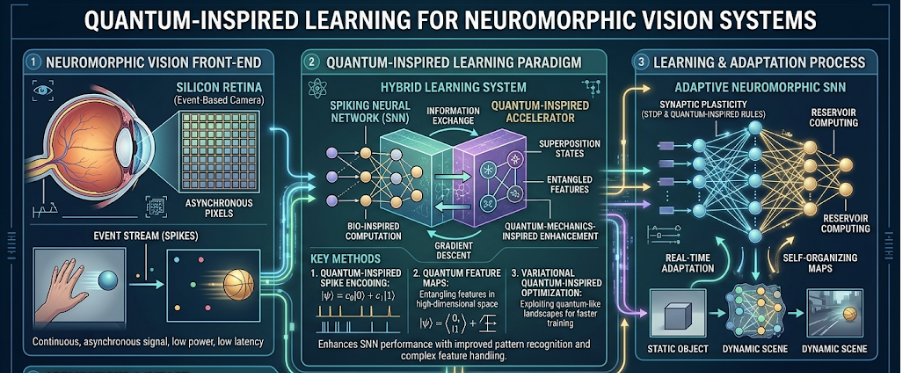
Neuromorphic vision changes this paradigm by using event-driven sensors and spiking neural networks (SNNs) that mimic biological neurons. Instead of processing full image frames continuously, event cameras only transmit changes in pixel intensity, dramatically reducing data redundancy and latency.
At the same time, quantum-inspired learning introduces computational techniques motivated by quantum mechanics such as:
- Superposition-inspired state representation
- Quantum probability models
- Quantum annealing optimization
- Tensor-based parallelism
- Amplitude encoding concepts
Importantly, these methods do not require an actual quantum computer. They are implemented on classical hardware while leveraging mathematical ideas from quantum systems.
Combining these two domains creates a highly efficient framework for intelligent visual perception.
Understanding Neuromorphic Vision
Neuromorphic vision systems attempt to imitate how the human visual cortex processes information.
Key characteristics include:
Event-Driven Processing
Instead of capturing images at fixed intervals, event cameras detect only brightness changes.
Advantages:
- Extremely low latency
- High temporal resolution
- Reduced bandwidth
- Low energy consumption
Spiking Neural Networks (SNNs)
Unlike traditional neural networks that use continuous activations, SNNs communicate through discrete spikes.
Benefits:
- Brain-like computation
- Sparse information processing
- Lower power usage
- Better suitability for edge AI hardware
Neuromorphic Hardware
Specialized chips such as:
- Intel Loihi
- IBM TrueNorth
- SpiNNaker
are designed specifically for spiking computations and parallel neural activity.
What Are Quantum-Inspired Learning Methods?
Quantum-inspired algorithms adapt concepts from quantum computing to solve optimization and learning problems more efficiently on classical systems.
These methods often focus on:
- High-dimensional state representation
- Probabilistic learning
- Parallel search optimization
- Efficient feature encoding
They are particularly useful when dealing with:
- Complex optimization landscapes
- Sparse sensory data
- Real-time adaptive learning
- Large-scale neural interactions
Why Combine Quantum-Inspired Learning with Neuromorphic Vision?
Neuromorphic systems already offer low-power perception. Quantum-inspired methods further improve:
- Learning efficiency
- Optimization speed
- Memory compression
- Adaptive intelligence
Together, they enable systems capable of:
- Real-time object recognition
- Autonomous navigation
- Dynamic scene understanding
- Ultra-low-power edge inference
This synergy is especially important for:
- Drones
- Autonomous vehicles
- Smart surveillance
- Space robotics
- Industrial automation
Core Quantum-Inspired Techniques in Neuromorphic Vision
1. Quantum-Inspired Optimization
Training spiking neural networks is difficult because spike generation is non-differentiable.
Quantum-inspired optimization methods help by:
- Escaping local minima
- Improving convergence
- Handling sparse spike patterns efficiently
Examples:
- Quantum annealing-inspired optimization
- Variational search methods
- Quantum evolutionary algorithms
These approaches improve learning stability in event-driven systems.
2. Tensor Network Learning
Tensor networks originate from quantum many-body physics and efficiently represent high-dimensional data.
Applications in neuromorphic vision:
- Event stream compression
- Efficient feature extraction
- Memory-efficient learning
Advantages:
- Reduced parameter count
- Faster inference
- Lower hardware requirements
This is particularly valuable for edge devices with limited memory.
3. Quantum Probability Models
Classical probability sometimes struggles with uncertainty in dynamic visual scenes.
Quantum probability models:
- Handle ambiguity more naturally
- Improve temporal event prediction
- Support adaptive attention mechanisms
Potential applications:
- Motion tracking
- Gesture recognition
- Human activity understanding
4. Quantum-Inspired Reinforcement Learning
Neuromorphic robots operating in changing environments require adaptive decision-making.
Quantum-inspired reinforcement learning can:
- Accelerate policy exploration
- Improve reward optimization
- Enhance autonomous adaptation
This is useful in:
- Self-driving systems
- Robotic exploration
- Swarm intelligence
5. Hybrid ANN-SNN Quantum Architectures
Researchers are increasingly combining:
- Artificial Neural Networks (ANNs)
- Spiking Neural Networks (SNNs)
- Quantum-inspired optimization layers
Hybrid models allow:
- Efficient feature extraction
- Low-power inference
- Faster training performance
These architectures are becoming promising solutions for practical deployment.
Applications of Quantum-Inspired Neuromorphic Vision
Autonomous Vehicles
Vehicles require:
- Real-time perception
- Fast reaction times
- Energy-efficient computation
Neuromorphic event cameras combined with quantum-inspired optimization improve:
- Obstacle detection
- Motion prediction
- Traffic analysis
Robotics
Robots benefit from:
- Low-latency sensory processing
- Adaptive learning
- Efficient navigation
Applications include:
- Warehouse automation
- Rescue robotics
- Industrial inspection
Smart Surveillance
Traditional surveillance systems consume massive computational resources.
Neuromorphic systems can:
- Detect motion instantly
- Reduce unnecessary data processing
- Improve anomaly detection
Quantum-inspired models enhance:
- Pattern recognition
- Behavioral analysis
- Multi-object tracking
Healthcare and Biomedical Vision
Potential uses:
- Brain-inspired prosthetics
- Real-time medical imaging
- Assistive robotics
These systems can process complex biological signals efficiently while maintaining low power consumption.
Major Challenges
Despite its promise, this field still faces several obstacles.
Hardware Limitations
True integration between:
- Neuromorphic chips
- Quantum-inspired algorithms
- Edge hardware
remains difficult.
Training Complexity
SNN training is already challenging. Adding quantum-inspired components increases mathematical and computational complexity.
Lack of Standard Frameworks
Most implementations are still experimental, with limited standardized software ecosystems.
Scalability Issues
Large-scale deployment requires:
- Better hardware acceleration
- Efficient memory management
- Stable learning algorithms
Future Research Directions
The future of this field looks highly promising.
Researchers are exploring:
- Quantum-inspired spiking transformers
- Event-driven generative AI
- Self-learning neuromorphic agents
- Quantum-enhanced edge AI
- Brain-inspired cognitive architectures
As neuromorphic chips become more advanced and quantum-inspired mathematics matures, intelligent systems may eventually achieve:
- Human-like perception
- Adaptive reasoning
- Ultra-efficient real-time learning
Conclusion
Quantum-inspired learning methods are opening exciting possibilities for neuromorphic vision systems. By combining brain-inspired event-driven computation with advanced optimization and probabilistic learning techniques, researchers are building AI systems that are:
- Faster
- Smarter
- More adaptive
- Energy efficient
This interdisciplinary field sits at the intersection of:
- Artificial Intelligence
- Neuromorphic Engineering
- Quantum Computing
- Robotics
- Edge Computing
Although still in its early stages, Quantum-Inspired Neuromorphic Vision has the potential to redefine how machines perceive and interact with the world.
The coming decade may witness intelligent systems capable of achieving unprecedented efficiency and autonomy through this revolutionary combination of neuroscience and quantum-inspired computation.