Introduction
In modern enterprises, hardware forms the backbone of digital operations. From servers and laptops to networking devices and storage systems, organizations depend on reliable hardware infrastructure to maintain productivity, security, and business continuity. However, managing hardware is not limited to purchasing devices and using them until failure. Enterprises require a structured approach known as Hardware Lifecycle Management (HLM) to optimize costs, improve efficiency, and reduce operational risks.
Hardware Lifecycle Management is the process of planning, acquiring, deploying, maintaining, upgrading, and retiring hardware assets throughout their operational life. Effective lifecycle management ensures that enterprise hardware remains secure, compliant, and aligned with business objectives.
What is Hardware Lifecycle Management?
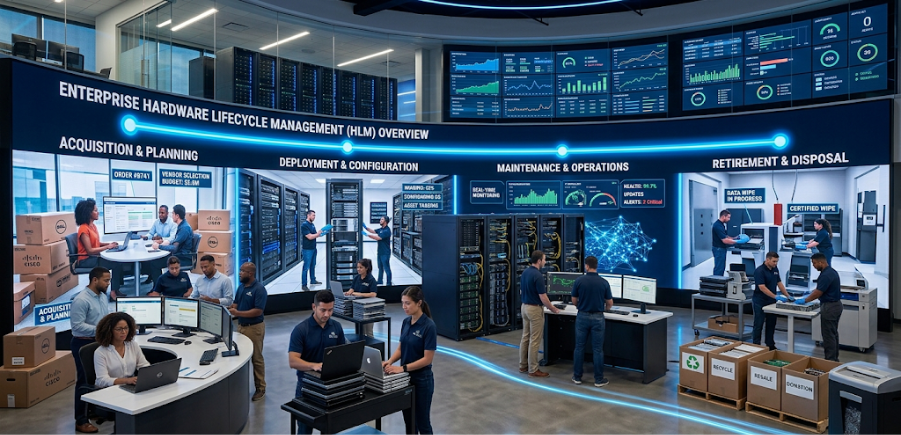
Hardware Lifecycle Management refers to the systematic management of physical IT assets from procurement to disposal. The lifecycle typically includes:
- Planning and Assessment
- Procurement and Acquisition
- Deployment and Configuration
- Monitoring and Maintenance
- Upgrades and Optimization
- Retirement and Disposal
Each phase contributes to maximizing hardware value while minimizing downtime and unnecessary expenses.
Importance of Hardware Lifecycle Management
Enterprises today operate in highly competitive and technology-driven environments. Poor hardware management can lead to unexpected failures, security vulnerabilities, compliance issues, and excessive operational costs.
Key benefits include:
- Improved operational efficiency
- Reduced downtime and maintenance costs
- Better security and compliance
- Enhanced asset visibility
- Optimized budgeting and forecasting
- Sustainable IT operations
Organizations that implement lifecycle management strategies gain greater control over their infrastructure investments.
Phases of Hardware Lifecycle Management
1. Planning and Assessment
The lifecycle begins with evaluating business requirements and forecasting hardware needs.
During this stage, enterprises analyze:
- Current infrastructure performance
- Future workload demands
- Scalability requirements
- Budget constraints
- Security and compliance needs
Proper planning helps organizations avoid over-purchasing or underutilizing hardware resources.
Example
A financial organization planning cloud integration may assess whether existing servers can support virtualization workloads or if new high-performance systems are required.
2. Procurement and Acquisition
After identifying requirements, organizations acquire hardware assets through vendors or procurement partners.
Important considerations include:
- Vendor reliability
- Warranty and support services
- Hardware compatibility
- Total cost of ownership (TCO)
- Energy efficiency
- Future upgrade capability
Enterprises often standardize hardware models to simplify support and maintenance.
Best Practice
Using centralized procurement policies ensures consistency and reduces compatibility issues across departments.
3. Deployment and Configuration
Once hardware is purchased, it must be configured and integrated into the enterprise environment.
Deployment tasks include:
- Operating system installation
- Security hardening
- Network configuration
- Asset tagging
- User provisioning
- Performance testing
Automation tools are increasingly used to accelerate deployment processes and reduce human errors.
Enterprise Example
Large enterprises use automated imaging and configuration management tools to deploy hundreds of employee laptops simultaneously.
4. Monitoring and Maintenance
Maintenance is one of the most critical phases of the hardware lifecycle.
Organizations continuously monitor:
- CPU and memory usage
- Disk health
- Temperature and power consumption
- Firmware status
- Hardware failures
- Network performance
Preventive maintenance minimizes unexpected outages and extends hardware lifespan.
Common Maintenance Activities
- Firmware updates
- Component replacement
- Security patching
- Performance tuning
- Hardware diagnostics
Predictive maintenance powered by AI and analytics is becoming increasingly popular in enterprise environments.
5. Upgrades and Optimization
As business needs evolve, hardware systems may require upgrades.
Examples include:
- Increasing RAM capacity
- Adding SSD storage
- Upgrading network switches
- Replacing aging processors
- Expanding server clusters
Enterprises must balance upgrade costs against replacement costs. Sometimes upgrading existing systems is more economical, while in other cases replacing outdated hardware delivers better long-term value.
Optimization Strategies
- Resource consolidation
- Virtualization
- Load balancing
- Energy-efficient hardware adoption
These strategies improve performance while reducing operational expenses.
6. Retirement and Disposal
Every hardware asset eventually reaches the end of its useful life.
Reasons for retirement include:
- Performance limitations
- Security risks
- Vendor end-of-support
- High maintenance costs
- Technology obsolescence
Proper disposal is essential to protect sensitive enterprise data.
Secure Disposal Practices
- Data wiping and destruction
- Compliance with environmental regulations
- Certified e-waste recycling
- Asset recovery and resale
Improper disposal can expose organizations to serious security and legal risks.
Challenges in Hardware Lifecycle Management
Despite its importance, enterprises face several challenges:
1. Asset Visibility
Large organizations often struggle to track thousands of hardware assets across multiple locations.
2. Rapid Technology Changes
Hardware becomes obsolete quickly due to rapid advancements in processors, storage, and networking technologies.
3. Security Risks
Outdated hardware may lack modern security features and become vulnerable to cyberattacks.
4. Budget Constraints
Balancing infrastructure modernization with financial limitations is a major challenge.
5. Remote Workforce Management
Managing laptops and devices for remote employees increases complexity in tracking and maintenance.
Role of Automation in Lifecycle Management
Automation significantly improves lifecycle efficiency.
Modern enterprises use:
- IT Asset Management (ITAM) platforms
- Remote monitoring tools
- Automated patch management
- AI-driven predictive analytics
- Configuration management systems
Automation reduces manual effort, improves accuracy, and accelerates issue resolution.
Sustainability and Green IT
Sustainability has become a major focus in enterprise IT strategies.
Hardware lifecycle management supports green IT initiatives through:
- Energy-efficient devices
- Hardware reuse programs
- Responsible recycling
- Reduced electronic waste
- Carbon footprint optimization
Organizations increasingly choose vendors committed to environmentally responsible manufacturing practices.
Emerging Trends in Hardware Lifecycle Management
Several technologies are shaping the future of enterprise hardware management.
AI-Driven Predictive Maintenance
Artificial intelligence helps predict hardware failures before they occur, reducing downtime and repair costs.
Digital Twin Technology
Digital replicas of hardware systems allow enterprises to simulate performance and optimize maintenance strategies.
Edge Computing Infrastructure
The growth of edge computing requires distributed hardware lifecycle management across remote locations.
Hardware-as-a-Service (HaaS)
Many enterprises are adopting subscription-based hardware models where vendors manage upgrades and maintenance.
Cloud-Integrated Asset Management
Cloud platforms provide centralized monitoring and lifecycle tracking across global enterprise environments.
Best Practices for Enterprises
To build an effective lifecycle management strategy, organizations should:
- Maintain accurate asset inventories
- Standardize hardware configurations
- Implement proactive monitoring
- Schedule regular maintenance
- Automate patching and updates
- Develop replacement roadmaps
- Follow secure disposal procedures
- Align hardware planning with business goals
A structured governance framework ensures consistency across departments and locations.
Conclusion
Hardware Lifecycle Management is essential for enterprises seeking reliable, secure, and cost-effective IT operations. By managing hardware assets strategically from acquisition to retirement, organizations can reduce operational risks, optimize investments, and improve infrastructure performance.
As enterprises continue adopting cloud computing, AI, edge infrastructure, and remote work technologies, lifecycle management will become even more critical. Businesses that embrace automation, predictive maintenance, and sustainable practices will be better positioned to handle future technological demands while maintaining operational excellence.
Effective hardware lifecycle management is no longer just an IT responsibility—it is a core business strategy that supports productivity, security, innovation, and long-term growth.