
In today’s hyperconnected digital world, routers are no longer simple packet-forwarding devices. They have evolved into intelligent, high-performance networking systems capable of managing enormous volumes of traffic with minimal latency. From cloud computing and 5G infrastructure to online gaming and enterprise security, modern networks demand faster packet processing, stronger encryption, and real-time traffic management. To meet these requirements, manufacturers increasingly rely on hardware acceleration.
Hardware acceleration allows routers to offload complex networking tasks from the main CPU to specialized hardware components, dramatically improving speed, efficiency, and scalability. As network traffic continues to grow exponentially, hardware acceleration has become a fundamental technology powering modern networking infrastructure.
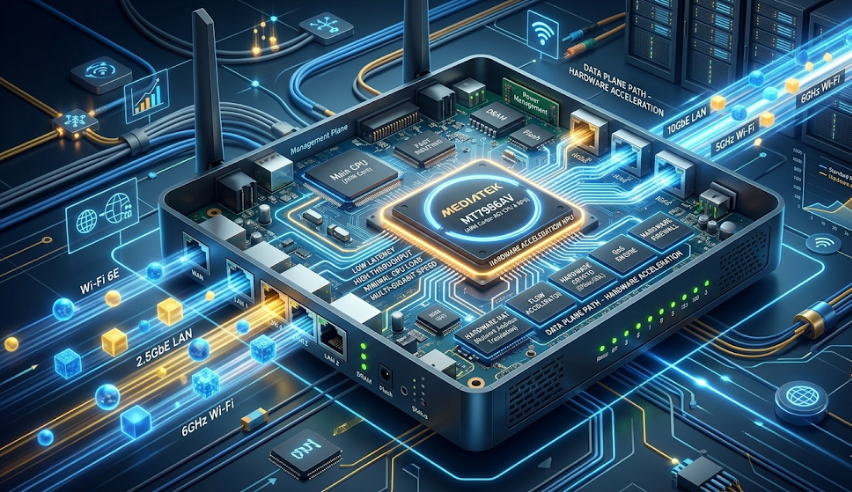
Understanding Hardware Acceleration
Hardware acceleration refers to the use of dedicated hardware modules to perform specific networking functions more efficiently than software running on a general-purpose processor.
Traditional routers depended heavily on software-based packet processing, where the CPU handled routing decisions, encryption, firewall inspection, and traffic management. While flexible, software processing becomes a bottleneck under heavy traffic loads.
Modern routers solve this challenge by integrating specialized hardware such as:
- Network Processing Units (NPUs)
- Application-Specific Integrated Circuits (ASICs)
- Field-Programmable Gate Arrays (FPGAs)
- Cryptographic accelerators
- Traffic management engines
- AI-assisted packet processors
These dedicated components execute networking operations in parallel and at wire speed, reducing CPU utilization and improving throughput.
Why Modern Routers Need Hardware Acceleration
The explosion of internet-connected devices and cloud-based applications has transformed network requirements.
Several major trends are driving the adoption of hardware acceleration:
1. Massive Data Traffic
Streaming services, video conferencing, online gaming, and IoT ecosystems generate enormous network traffic volumes. Software-only routing cannot efficiently handle multi-gigabit or terabit traffic rates.
Hardware acceleration enables routers to process packets at extremely high speeds without dropping performance.
2. Low-Latency Applications
Applications such as:
- Cloud gaming
- Financial trading
- Autonomous systems
- Industrial automation
- Remote surgery
require ultra-low latency.
Dedicated forwarding hardware minimizes packet processing delays and improves real-time responsiveness.
3. Advanced Network Security
Modern routers perform:
- VPN encryption
- Deep packet inspection
- Intrusion detection
- Firewall filtering
- Malware scanning
These security tasks are computationally expensive. Cryptographic acceleration hardware dramatically speeds up encryption and decryption processes.
4. Growth of 5G and Edge Computing
5G infrastructure requires routers capable of handling millions of simultaneous low-latency connections. Hardware acceleration ensures efficient packet forwarding near the network edge.
Key Hardware Components Used in Router Acceleration
ASICs (Application-Specific Integrated Circuits)
ASICs are custom-designed chips optimized for networking operations.
They provide:
- Extremely fast packet forwarding
- Low power consumption
- Deterministic performance
- High throughput
Modern enterprise and carrier-grade routers rely heavily on ASICs for core forwarding operations.
Advantages
- Wire-speed packet processing
- Minimal latency
- Energy efficiency
Limitations
- Limited flexibility
- Expensive development process
NPUs (Network Processing Units)
NPUs are programmable processors specifically designed for networking workloads.
Unlike ASICs, NPUs offer greater flexibility while maintaining high performance.
They are commonly used for:
- Packet classification
- Traffic shaping
- Quality of Service (QoS)
- Security inspection
NPUs can adapt more easily to evolving networking protocols.
FPGAs (Field-Programmable Gate Arrays)
FPGAs are reconfigurable chips that can be programmed after manufacturing.
Routers use FPGAs for:
- Protocol experimentation
- Custom acceleration
- Rapid feature deployment
- Specialized traffic analysis
They are especially useful in research networks and telecom infrastructure.
Cryptographic Accelerators
Encryption is one of the most resource-intensive networking operations.
Dedicated cryptographic engines accelerate:
- IPSec VPNs
- SSL/TLS encryption
- Secure tunneling
- Authentication protocols
This allows secure connections without sacrificing network performance.
Fast Path vs Slow Path Processing
Modern routers often separate traffic into two processing paths:
Fast Path
The fast path uses hardware acceleration for common packet flows.
Tasks include:
- Packet forwarding
- Basic filtering
- NAT processing
- QoS handling
Packets processed in the fast path bypass the main CPU for maximum efficiency.
Slow Path
The slow path handles:
- Complex routing decisions
- Rare protocols
- Exceptional packets
- Administrative functions
These operations are managed by software running on the router CPU.
This hybrid design balances performance with flexibility.
Hardware Offloading Techniques
Modern routers use several hardware offloading methods.
1. Packet Forwarding Offload
Dedicated forwarding engines handle routing table lookups and packet switching directly in hardware.
This enables:
- Multi-gigabit throughput
- Lower CPU usage
- Faster forwarding decisions
2. NAT Acceleration
Network Address Translation (NAT) can become CPU-intensive in large networks.
Hardware NAT engines process translation tables efficiently, improving broadband router performance.
3. VPN Offloading
VPN acceleration hardware speeds up encryption algorithms such as:
- AES
- SHA
- RSA
This is critical for enterprise remote-access systems.
4. QoS Hardware Scheduling
Traffic prioritization is accelerated through dedicated scheduling engines.
This improves:
- Video conferencing quality
- Voice-over-IP stability
- Gaming performance
Hardware Acceleration in Home Routers
Consumer routers increasingly include hardware acceleration features once reserved for enterprise systems.
Modern Wi-Fi routers now support:
- Hardware NAT
- AI traffic optimization
- Wi-Fi packet acceleration
- Gaming prioritization
- Security acceleration
These technologies improve:
- Streaming quality
- Gaming latency
- Multi-device performance
Enterprise and Data Center Routers
Enterprise routers require significantly more advanced acceleration technologies.
These routers support:
- Terabit-scale throughput
- Multi-layer traffic inspection
- Virtualized networking
- SD-WAN acceleration
- AI-assisted traffic analysis
High-end routers often integrate multiple acceleration chips working together.
AI and Machine Learning in Router Hardware
AI is beginning to influence router acceleration technologies.
Modern intelligent routers can:
- Predict congestion patterns
- Detect cyber threats
- Optimize traffic routes
- Automatically balance workloads
AI-enhanced hardware acceleration improves network adaptability and resilience.
Challenges of Hardware Acceleration
Despite its advantages, hardware acceleration introduces several challenges.
1. Reduced Flexibility
ASIC-based systems may struggle to adapt quickly to new protocols.
2. Increased Design Complexity
Integrating multiple acceleration engines complicates router architecture.
3. Cost
High-performance acceleration hardware increases manufacturing costs.
4. Security Risks
Hardware vulnerabilities can be difficult to patch compared to software issues.
Future Trends in Router Hardware Acceleration
The future of networking hardware is moving toward:
Software-Defined Hardware
Programmable acceleration platforms will combine flexibility with high performance.
AI-Integrated Networking Chips
Future routers may include dedicated AI accelerators for autonomous traffic optimization.
Photonic Networking Hardware
Optical packet processing could dramatically increase router speeds while reducing power consumption.
SmartNIC Integration
Smart Network Interface Cards (SmartNICs) will increasingly handle distributed acceleration tasks across cloud infrastructure.
Conclusion
Hardware acceleration has become the backbone of modern router performance. As networking demands continue to expand through cloud computing, AI, 5G, IoT, and edge infrastructure, software-only packet processing is no longer sufficient.
By integrating ASICs, NPUs, FPGAs, and cryptographic accelerators, modern routers achieve extraordinary throughput, low latency, and advanced security capabilities. These technologies enable routers to process massive data volumes efficiently while supporting the intelligent applications of the future.
As networks evolve toward autonomous, AI-driven infrastructure, hardware acceleration will remain one of the most critical innovations shaping the future of global connectivity.