
In modern enterprise computing, choosing the right server architecture directly impacts performance, scalability, operational efficiency, and long-term infrastructure costs. Among the most widely deployed server architectures today are blade servers and rack servers. While both serve critical roles in data centers, cloud environments, enterprise applications, and AI workloads, they differ significantly in design philosophy, deployment strategy, thermal efficiency, maintenance, and overall performance optimization.
As businesses continue to adopt virtualization, edge computing, AI processing, and high-density workloads, understanding the differences between blade and rack servers has become increasingly important for IT architects and infrastructure engineers.
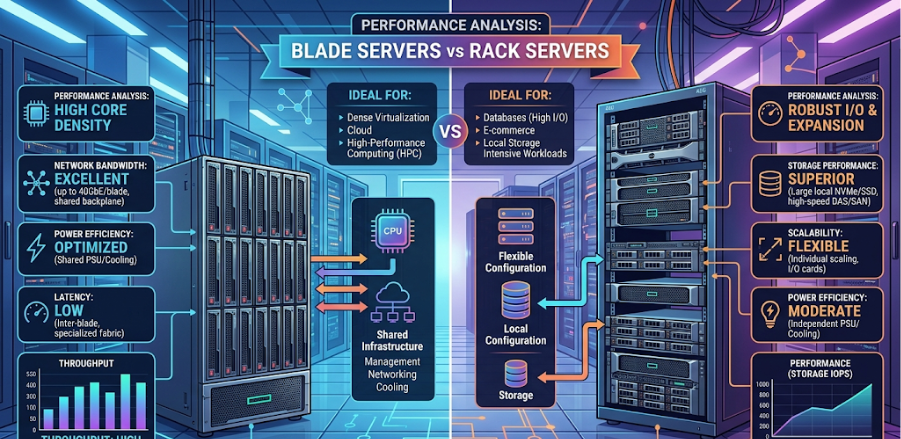
Understanding Blade Servers
Blade servers are compact, modular servers designed to fit into a shared chassis. Instead of functioning as independent units, multiple blade modules operate within a centralized enclosure that provides shared power supplies, cooling systems, networking, and management interfaces.
Each blade typically contains:
- CPU
- RAM
- Storage
- Network interfaces
The chassis handles:
- Power distribution
- Cooling
- Connectivity
- Centralized management
This architecture focuses heavily on density optimization and centralized infrastructure management.
Understanding Rack Servers
Rack servers are standalone servers mounted individually within standard server racks, usually measured in rack units (1U, 2U, 4U, etc.).
Each rack server includes:
- Dedicated power supply
- Dedicated cooling
- Independent networking
- Local management interfaces
Rack servers are highly versatile and are commonly used across:
- Enterprise data centers
- Web hosting
- Database systems
- AI inference workloads
- High-performance computing
Their modular independence makes them flexible for mixed workload environments.
Core Architectural Differences
| Feature | Blade Servers | Rack Servers |
| Design | Modular blades in chassis | Independent standalone units |
| Power Supply | Shared | Dedicated |
| Cooling | Shared chassis cooling | Individual cooling |
| Density | Very high | Moderate |
| Scalability | Chassis dependent | Flexible incremental scaling |
| Cabling | Minimal | More extensive |
| Initial Cost | High | Lower |
| Management | Centralized | Distributed |
| Hardware Flexibility | Limited by chassis | Highly flexible |
Performance Analysis
1. Compute Performance
In raw compute capability, modern blade and rack servers often use the same processors, including:
- Intel Xeon
- AMD EPYC
- ARM-based enterprise CPUs
Therefore, single-node compute performance is generally similar when identical hardware is used.
However, differences emerge in deployment efficiency and workload density.
Blade Server Advantage
Blade systems excel in:
- Virtualization clusters
- Dense cloud environments
- Large-scale VDI deployments
- Enterprise application consolidation
Because of their compact architecture, blade servers allow organizations to deploy significantly more compute power within limited physical space.
Rack Server Advantage
Rack servers perform better in:
- GPU-heavy workloads
- Storage-intensive applications
- Specialized hardware deployments
- AI training systems
- Custom high-performance configurations
Their independent architecture provides greater hardware customization.
2. Thermal Efficiency and Cooling
Cooling efficiency is one of the biggest differentiators.
Blade Servers
Blade servers use centralized cooling systems within the chassis.
Advantages:
- Optimized airflow
- Shared cooling infrastructure
- Reduced redundant fans
- Better energy efficiency at scale
Challenges:
- Heat density becomes extremely high
- Cooling failures affect multiple blades
- Requires advanced data center cooling systems
Blade environments often need:
- Hot aisle/cold aisle containment
- Precision cooling
- Liquid cooling in high-density AI deployments
Rack Servers
Rack servers use independent cooling systems.
Advantages:
- Better thermal isolation
- Easier fault containment
- Simpler cooling management
Challenges:
- More fans increase power usage
- Airflow optimization is harder at scale
Rack servers generally operate cooler under isolated workloads but consume more space and power overall.
3. Power Consumption
Blade Servers
Because blades share:
- Power supplies
- Cooling systems
- Network switches
They achieve higher power efficiency per compute node.
This reduces:
- Redundant power conversion losses
- Infrastructure overhead
Blade systems are highly efficient in large-scale enterprise environments.
Rack Servers
Rack servers have:
- Independent power supplies
- Individual cooling systems
This increases redundancy but reduces overall power efficiency compared to shared blade infrastructures.
However, modern rack servers with titanium-rated PSUs and advanced power management have significantly improved efficiency.
4. Scalability
Blade Servers
Blade servers scale vertically within the chassis.
Advantages:
- Rapid deployment
- Easy expansion
- Simplified management
Limitations:
- Constrained by chassis capacity
- Vendor lock-in
- Limited compatibility across generations
Rack Servers
Rack servers scale horizontally.
Advantages:
- Unlimited flexibility
- Easier incremental upgrades
- Multi-vendor compatibility
Rack architectures are often preferred in:
- Hyperscale environments
- Research computing
- AI clusters
5. Networking Performance
Blade Servers
Blade chassis often integrate:
- High-speed backplanes
- Internal switching fabrics
- Shared network modules
This reduces:
- Cable complexity
- Latency between blades
Ideal for:
- Virtualization clusters
- Private cloud environments
Rack Servers
Rack servers depend on external switching infrastructure.
Advantages:
- Greater network flexibility
- Easier custom network topologies
- Better for heterogeneous workloads
They are widely used in:
- Distributed storage systems
- HPC clusters
- AI inference nodes
6. Maintenance and Management
Blade Servers
Blade systems provide centralized management.
Benefits:
- Single management console
- Unified firmware updates
- Simplified provisioning
Challenges:
- Chassis failure impacts many systems
- Maintenance complexity is higher
- Vendor-specific ecosystems
Rack Servers
Rack servers are easier to troubleshoot individually.
Benefits:
- Independent maintenance
- Simpler replacement
- Reduced blast radius during failure
Challenges:
- More cabling
- More management overhead
7. Storage Performance
Rack servers dominate storage-heavy workloads because they support:
- More drive bays
- Larger RAID arrays
- Greater PCIe expansion
- Better GPU/storage combinations
Blade servers often rely on:
- Shared SAN/NAS infrastructure
- External storage arrays
Therefore:
- Blade servers excel in compute density
- Rack servers excel in storage flexibility
8. AI and High-Performance Computing
Modern AI workloads demand:
- Massive GPU support
- High thermal capacity
- Large PCIe bandwidth
Rack servers currently dominate AI infrastructure because they:
- Support larger GPUs
- Allow better thermal spacing
- Provide superior expansion flexibility
Blade systems are improving but remain constrained by:
- Thermal density
- Power delivery limitations
- Chassis design restrictions
Real-World Enterprise Use Cases
Best Use Cases for Blade Servers
| Use Case | Why Blade Servers Work Well |
| Virtualization Clusters | High compute density |
| Private Cloud | Centralized management |
| VDI Infrastructure | Efficient scaling |
| Enterprise ERP Systems | Consolidated compute |
| Space-Constrained Data Centers | Maximum density |
Best Use Cases for Rack Servers
| Use Case | Why Rack Servers Work Well |
| AI Training | GPU scalability |
| Storage Systems | Drive expansion |
| High-Performance Computing | Flexible architecture |
| Edge Computing | Independent deployment |
| Mixed Workloads | Hardware customization |
Cost Analysis
Blade Servers
Pros
- Lower operational cost at scale
- Reduced cabling
- Better density
Cons
- High upfront chassis cost
- Vendor dependency
- Expensive expansion modules
Rack Servers
Pros
- Lower entry cost
- Easier upgrades
- Multi-vendor flexibility
Cons
- Higher power overhead
- More rack space required
- More cabling complexity
Security Considerations
Blade systems centralize management, which simplifies security enforcement but creates larger attack surfaces if compromised.
Rack servers isolate failures more effectively, improving fault containment.
Modern deployments increasingly integrate:
- TPM modules
- Secure boot
- Hardware root of trust
- Encrypted management interfaces
across both architectures.
Future Trends
Several trends are reshaping server architecture decisions:
AI-Optimized Infrastructure
AI workloads increasingly favor rack-based GPU systems.
Liquid Cooling Adoption
Both blade and rack servers are moving toward liquid cooling solutions.
Composable Infrastructure
Future data centers may combine the modularity of blades with the flexibility of rack systems.
Edge Computing Growth
Rack servers dominate edge deployments due to deployment flexibility.
ARM-Based Enterprise Servers
Energy-efficient ARM architectures are changing density calculations for both systems.
Which One Should You Choose?
Choose Blade Servers If:
- You need maximum compute density
- You operate virtualization-heavy environments
- Data center space is limited
- Centralized management is critical
Choose Rack Servers If:
- You need hardware flexibility
- Your workloads require GPUs or massive storage
- You deploy mixed infrastructure
- You prioritize upgrade freedom
Final Thoughts
Blade servers and rack servers are both powerful enterprise computing solutions, but they solve different infrastructure problems.
Blade servers prioritize:
- Density
- Centralized management
- Operational efficiency
Rack servers prioritize:
- Flexibility
- Scalability
- Hardware customization
As AI, edge computing, and intelligent infrastructure continue to evolve, the choice between blade and rack servers increasingly depends on workload specialization rather than raw performance alone.
Organizations that align server architecture with workload characteristics, cooling strategy, and long-term scalability goals will gain the greatest operational and financial advantages in the next generation of enterprise computing.