
Introduction
Modern computing systems require increasing amounts of memory to process large datasets, run complex applications, and support artificial intelligence workloads. As AI models grow and data centers handle more demanding tasks, memory capacity and bandwidth have become important factors in overall system performance.
Traditional server architectures often connect memory directly to individual processors. Although this design provides efficient access to local memory, it can make memory expansion and resource sharing more complicated. Some servers may have unused memory capacity while others experience memory shortages.
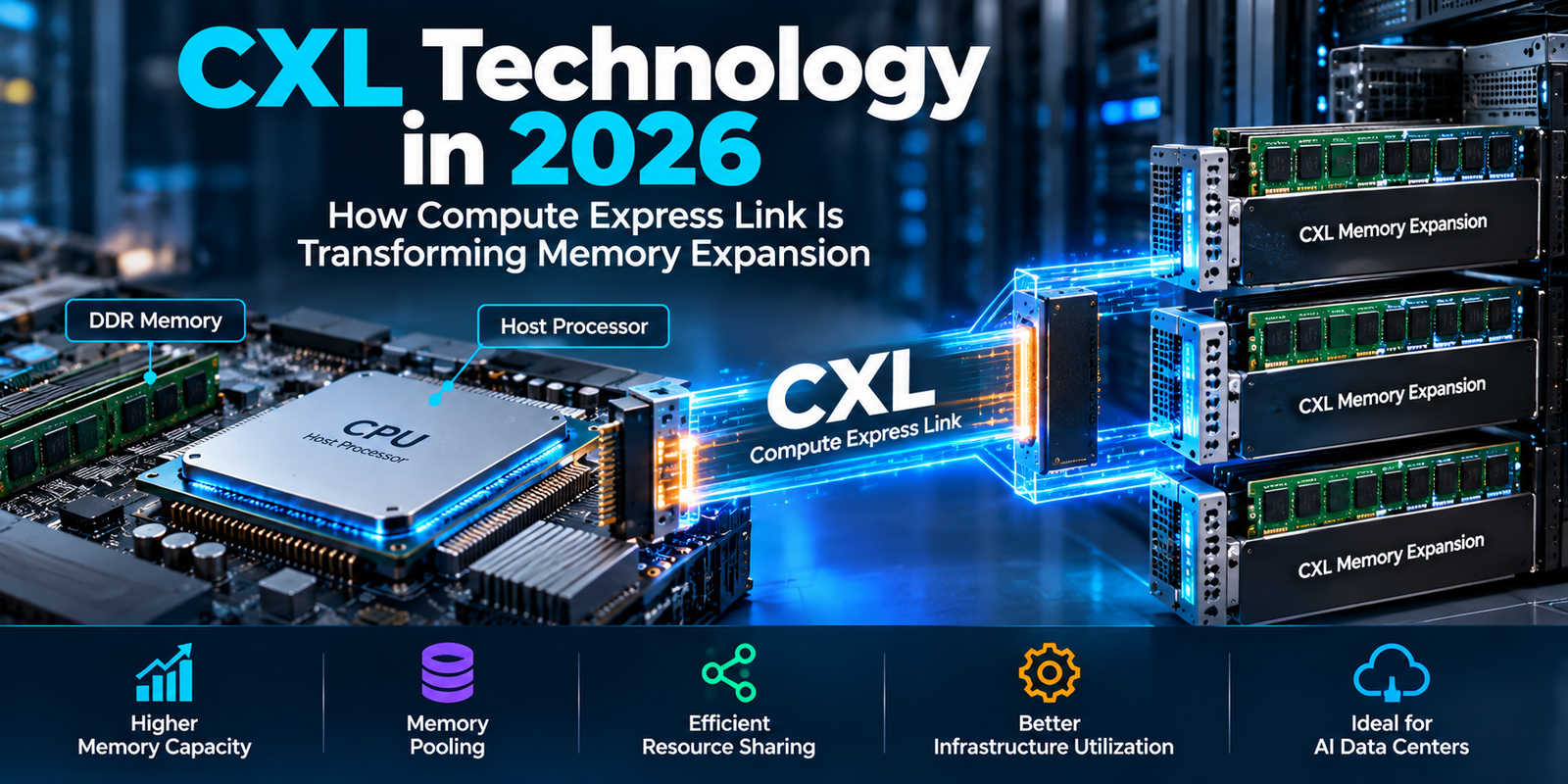
CXL technology, short for Compute Express Link, addresses part of this challenge by enabling high-speed communication between processors, memory devices, and accelerators over a standardized interconnect.
Built on the PCI Express physical and electrical interface, CXL supports communication protocols designed for memory access, device communication, and accelerator integration. Depending on the implementation, it can help systems expand memory capacity, share selected resources, and improve memory utilization.
In 2026, CXL remains an important technology for hardware engineers designing AI infrastructure, cloud servers, and high-performance computing systems.
However, CXL is not simply a replacement for conventional memory. Its benefits depend on the processor, operating system, device support, workload, and memory architecture.
In this article, we explain how CXL works, explore its main capabilities, compare it with traditional memory expansion, and examine its potential applications in modern computing.
1. How Does CXL Technology Work?
Compute Express Link is an industry-standard interconnect designed to connect processors with memory devices and accelerators while supporting memory coherency.
Memory coherency helps ensure that processors and connected devices can maintain a consistent view of shared data when using supported coherent memory mechanisms.
CXL uses the PCI Express (PCIe) physical and electrical interface, allowing compatible devices to communicate over a familiar high-speed connection.
However, CXL is more than a data-transfer interface. It defines protocols for different types of communication between processors and connected devices.
The Three Main CXL Protocols
CXL defines three primary protocols: CXL.io, CXL.cache, and CXL.mem.
1. CXL.io
CXL.io supports device discovery, configuration, and input/output operations. It builds on PCIe functionality to help the system identify and manage compatible devices.
2. CXL.cache
CXL.cache allows a compatible device to cache data from host memory while participating in supported coherency mechanisms.
This can be useful for accelerators that need efficient access to data managed by the host processor.
3. CXL.mem
CXL.mem allows a host processor to access memory attached to a compatible CXL device.
This capability is particularly important for memory expansion because it allows supported systems to access additional memory beyond conventional locally attached DRAM.
The protocols can be combined according to the capabilities and intended use of a device. For example, an accelerator may use CXL.cache and CXL.mem, while a memory expansion device typically uses CXL.io and CXL.mem.
These capabilities are defined by the CXL standard, although the features available in a particular product depend on its implementation. Compute Express Link –
How Does a CXL Connection Work?
A simplified CXL system contains the following components:
- Host processor: Runs applications and manages system operations.
- CXL host interface: Provides the connection between the processor platform and CXL devices.
- CXL link: Carries supported communication between the host and connected devices.
- CXL memory device: Provides additional memory capacity.
- Operating system and software: Manage memory allocation and determine how applications use available resources.
For example, a server may connect its processor to a CXL memory expansion device. The operating system can then make the additional memory available according to the platform’s supported memory configuration.
This allows the server to increase its usable memory capacity without relying exclusively on additional DIMMs installed directly in conventional memory slots.
2. Why Is CXL Technology Important in 2026?
The demand for memory is increasing as businesses adopt AI, analytics, cloud computing, and large-scale databases.
Many modern applications need to keep substantial amounts of data readily available to avoid repeated transfers between storage and memory.
Traditional server configurations can make it difficult to allocate memory efficiently across different workloads.
CXL introduces additional options for expanding and managing memory resources.
Growing Memory Requirements
AI inference, large databases, and in-memory analytics can require substantial memory capacity.
When the available memory is insufficient, systems may need to move data to slower storage or distribute workloads across additional servers.
These approaches can introduce latency, increase infrastructure complexity, or require additional resources.
CXL-connected memory can provide another option for applications that need more memory capacity.
Better Memory Resource Utilization
In suitable architectures, CXL can support memory pooling, allowing multiple compatible hosts or logical systems to access memory resources through supported switching and management mechanisms.
This can help data centers allocate resources according to workload requirements.
However, pooling is not automatically available on every CXL device. It requires compatible hardware, platform support, and appropriate resource-management software.
Support for Heterogeneous Computing
Modern computing systems increasingly combine CPUs, GPUs, AI accelerators, and other specialized devices.
CXL provides a standardized approach to connecting supported devices while enabling specific memory-sharing and coherency capabilities.
This can simplify some aspects of system integration compared with developing entirely separate interfaces for each device.
The overall benefit depends on the supported protocols, system architecture, and workload.
3. CXL Memory Expansion: How It Works
Memory expansion is one of the most important applications of CXL technology.
In a traditional server, the processor accesses locally attached DRAM through its integrated memory controllers.
This memory provides high bandwidth and low latency, but the system’s physical memory capacity is constrained by its supported memory channels, DIMM slots, processor configuration, and platform design.
CXL provides another way to attach memory to a compatible host.
What Is CXL Memory Expansion?
CXL memory expansion allows a compatible processor platform to access additional memory through a CXL connection.
The additional memory is physically separate from the processor’s local DRAM but can be exposed to the host through supported platform mechanisms.
This allows system designers to increase memory capacity without relying entirely on conventional memory slots.
Example of CXL Memory Expansion
Imagine a server with 512 GB of local DRAM running a memory-intensive application.
The application begins to require more memory than the server can provide efficiently.
A compatible CXL memory expansion device may allow the system to access additional memory capacity, subject to the host platform’s limits and configuration.
This could reduce the need to move some data to slower storage.
However, the performance benefit depends on how the application accesses memory. CXL-attached memory generally has different latency and bandwidth characteristics from directly attached DRAM.
Therefore, applications must be evaluated to determine whether additional capacity outweighs the cost of accessing memory over the CXL connection.
Benefits of CXL Memory Expansion
- Increases available memory capacity on supported systems.
- Provides additional options for memory-intensive workloads.
- Can reduce reliance on slower storage for suitable applications.
- Offers flexibility when selecting memory capacity.
- May reduce the need to overprovision local DRAM in some environments.
CXL memory expansion is most useful when memory capacity is a significant constraint and the workload can tolerate the characteristics of the attached memory.
4. CXL Memory Pooling: Sharing Memory Across Systems
Memory expansion adds capacity to a host, while memory pooling focuses on making memory resources available to multiple compatible hosts or logical systems.
The distinction is important because pooling requires additional hardware and software support.
How Does Memory Pooling Work?
A CXL memory pool contains memory resources connected through a compatible CXL fabric or switching architecture.
A resource-management system can allocate portions of that memory to supported hosts according to their requirements.
For example, consider a data center with two servers:
- Server A runs a database that needs additional memory during peak demand.
- Server B runs a workload that temporarily requires less memory.
In a suitable pooled-memory architecture, the system may allocate available memory resources to Server A while assigning other resources according to Server B’s requirements.
The precise allocation and reassignment mechanisms depend on the hardware, software, and CXL features supported.
Memory pooling is not the same as allowing multiple independent servers to access arbitrary memory simultaneously without coordination. Access permissions, isolation, address mapping, and resource management remain essential.
Benefits of Memory Pooling
Improved resource utilization: Memory capacity can be allocated according to changing workload requirements.
Flexible infrastructure: Data centers can separate some memory resources from individual servers.
Potential cost savings: More efficient allocation may reduce the need to provision every server for its maximum possible memory demand.
Scalable architecture: Compatible memory resources can be expanded according to system requirements.
The actual savings depend on workload patterns, hardware costs, utilization levels, and management overhead.
Memory Pooling vs Memory Expansion
| Feature | Memory Expansion | Memory Pooling |
|---|---|---|
| Primary purpose | Increase memory capacity for a host | Make memory resources available across supported hosts or logical systems |
| Typical arrangement | Host connected to a memory expansion device | Multiple compatible hosts connected to pooled memory resources |
| Main benefit | Additional memory capacity | More flexible allocation of memory resources |
| Hardware requirements | Compatible host and memory device | Compatible hosts, memory devices, switching or fabric support where required, and management software |
| Main challenge | Balancing latency, bandwidth, and capacity | Resource allocation, isolation, topology, and coordination |
Both approaches can be useful, but they solve different infrastructure problems.
5. CXL 4.0: What Is New in 2026?
The CXL Consortium released the CXL 4.0 specification on November 18, 2025. It introduces higher link bandwidth and additional capabilities for scalable computing systems. Compute Express Link –
As of October 2026, CXL 4.0 is an important development in the standard’s evolution. However, publication of a specification does not mean that every feature is already available in commercial products.
Increased Link Bandwidth
CXL 4.0 increases the specified data rate from 64 GT/s to 128 GT/s per lane, doubling the signaling rate compared with CXL 3.x.
Higher signaling rates can increase the bandwidth available over compatible links, subject to link width, protocol overhead, and implementation details. Compute Express Link –
This is relevant to systems that need to move large amounts of data between processors, memory devices, and accelerators.
Bundled Ports
CXL 4.0 introduces support for bundled ports, allowing compatible connections to be combined to increase available bandwidth between supported hosts and devices.
This provides additional flexibility when designing systems that need greater connectivity capacity. Compute Express Link –
Reliability, Availability, and Serviceability
CXL 4.0 also includes enhancements to reliability, availability, and serviceability (RAS).
These capabilities are important for data centers because hardware errors and maintenance events can affect application availability.
Improved error visibility and maintenance support can help operators diagnose problems and manage supported memory infrastructure. Compute Express Link –
Backward Compatibility
The CXL Consortium states that CXL 4.0 maintains backward compatibility with CXL 3.x, CXL 2.0, CXL 1.1, and CXL 1.0.
However, backward compatibility does not mean that an older host automatically gains every new feature or the full bandwidth of a newer specification. The negotiated capabilities depend on the components at both ends of the connection. Compute Express Link –
Important for hardware designers: When evaluating CXL 4.0, distinguish between specification capabilities, silicon availability, platform validation, and features supported by actual commercial products.
6. CXL vs Traditional DDR Memory: What Is the Difference?
DDR memory and CXL serve different purposes within a computing system.
DDR is a memory technology used to provide the processor with directly attached system memory. CXL is an interconnect standard that can enable access to additional memory devices and other supported components.
CXL does not replace DDR. Instead, it can complement conventional memory by providing additional ways to connect and manage memory resources.
Key Differences
| Feature | Traditional DDR Memory | CXL-Attached Memory |
|---|---|---|
| Connection | Directly connected through the processor’s memory controller | Connected through a compatible CXL interface |
| Main purpose | Provide system memory with high bandwidth and low latency | Expand memory capacity and enable additional memory configurations |
| Latency | Generally lower for local memory access | Typically higher than local DRAM access |
| Bandwidth | Depends on memory generation, channels, and configuration | Depends on CXL generation, link width, device, and platform |
| Expansion | Limited by supported memory slots, channels, and platform capacity | Depends on CXL device and host platform support |
| Resource sharing | Requires platform-specific mechanisms | Can support pooling and sharing in suitable configurations |
| Typical use | Main system memory | Additional memory capacity and disaggregated memory infrastructure |
Can CXL Replace DDR?
For most conventional server architectures, DDR remains an important source of local system memory.
CXL-attached memory can provide additional capacity, but it may have different latency and bandwidth characteristics.
A practical design may use both:
- Local DDR for frequently accessed data and latency-sensitive workloads.
- CXL-attached memory for additional capacity and suitable memory-intensive workloads.
This arrangement is sometimes described as a memory hierarchy, in which different memory resources serve different performance and capacity requirements.
The operating system and applications must be configured appropriately to benefit from this arrangement.
7. CXL vs PCIe: Understanding the Difference
CXL uses the PCIe physical and electrical interface, but the two technologies have different protocol capabilities.
PCIe is widely used to connect components such as graphics cards, storage devices, network adapters, and accelerators.
CXL builds on the PCIe interface and adds protocols designed for coherent memory access and device communication.
PCIe
PCIe provides a high-speed connection between a host and compatible devices.
It is commonly used for devices that communicate through input/output operations, including NVMe storage devices and graphics accelerators.
CXL
CXL supports device communication through CXL.io and adds CXL.cache and CXL.mem for supported coherent access and memory operations.
This makes CXL suitable for applications where processors need to interact with attached memory or accelerators using supported coherence mechanisms.
Comparison Table
| Feature | PCIe | CXL |
|---|---|---|
| Primary purpose | General-purpose device connectivity | Device connectivity with additional coherent memory capabilities |
| Physical interface | PCIe physical interface | Uses the PCIe physical and electrical interface |
| Device configuration | Supported | Supported through CXL.io |
| Host access to attached memory | Depends on the device and access mechanism | Supported through CXL.mem for compatible devices |
| Coherent device caching | Not provided by conventional PCIe transactions alone | Supported through CXL.cache where implemented |
| Memory expansion | Possible through specific device architectures | A key use case |
| Memory pooling | Requires other mechanisms or specialized architectures | Supported in compatible CXL pooling configurations |
The main distinction is that CXL adds memory-oriented capabilities beyond conventional PCIe device connectivity.
This makes it useful for hardware systems that need more flexible memory architectures.
8. Applications of CXL Technology in Modern Computing
CXL is relevant to several areas of computing where memory capacity, resource utilization, and processor connectivity are important.
However, its benefits vary depending on the workload and the capabilities of the selected platform.
AI and Machine Learning
AI workloads can require substantial memory to hold model parameters, intermediate results, and frequently accessed datasets.
CXL memory expansion can provide additional capacity for suitable AI systems.
For example, an inference server may use additional memory to accommodate larger datasets or model-related data structures.
However, CXL does not automatically increase GPU memory bandwidth or make every AI model run faster. The application must be able to use the attached memory effectively.
Cloud Computing
Cloud infrastructure must allocate computing resources across many applications with changing requirements.
CXL-compatible memory pooling can provide additional flexibility for memory allocation in supported environments.
This may help operators improve resource utilization when different workloads have different memory demands.
In-Memory Databases
In-memory databases store substantial amounts of data in RAM to reduce the need for slower storage access.
CXL-attached memory may help suitable database systems increase their available memory capacity.
Performance depends on access patterns, memory latency, data placement, and the database’s ability to manage multiple memory tiers.
High-Performance Computing
Scientific computing, simulation, analytics, and other high-performance computing workloads can require large memory capacities.
CXL may provide additional options for expanding memory resources in compatible systems.
Engineers must evaluate the workload’s latency and bandwidth requirements before deciding whether CXL-attached memory is appropriate.
Enterprise Servers
Enterprise applications such as virtualization, analytics, and large databases may benefit from additional memory capacity.
CXL can provide another option for system designers who need to scale memory resources beyond conventional platform configurations.
In each case, the expected benefit should be validated through representative workload testing.
9. Key Engineering Challenges of CXL Implementation
Although CXL offers additional options for memory architecture, implementing it successfully requires careful hardware and software design.
Engineers must evaluate electrical performance, memory characteristics, platform compatibility, and operational requirements.
1. Memory Latency
CXL-attached memory generally has higher access latency than directly attached local DRAM.
The difference depends on the processor, device, link, memory technology, and system configuration.
Latency-sensitive applications may experience reduced performance if frequently accessed data is placed in slower memory.
Engineering consideration: Keep frequently accessed data in suitable local memory when the workload requires very low latency.
2. Bandwidth Limitations
A CXL link has finite bandwidth.
When multiple devices share a link or switching infrastructure, contention can affect performance.
The effective bandwidth also depends on link width, protocol overhead, device capabilities, and traffic patterns.
Engineering consideration: Evaluate bandwidth requirements under realistic workloads and ensure that the selected topology can support the expected traffic.
3. Hardware Compatibility
A CXL device requires a compatible host platform and appropriate system support.
Not every processor, motherboard, operating system, or memory device supports every CXL feature.
Engineering consideration: Verify processor support, firmware requirements, device compatibility, operating system support, and available memory-management capabilities before selecting hardware.
4. Software and Memory Management
Operating systems and applications need appropriate mechanisms to identify, allocate, and manage additional memory resources.
Memory pooling also requires resource-management and isolation mechanisms supported by the platform.
Without suitable software support, additional memory capacity may not deliver the expected benefit.
Engineering consideration: Validate the software stack alongside the hardware architecture.
5. Power Consumption and Thermal Management
CXL memory devices and switching components consume power and generate heat.
The additional hardware may increase total system power consumption.
Engineering consideration: Measure power consumption and temperature at the device, rack, and system levels to understand the overall operating impact.
6. Reliability and Security
Memory devices must operate reliably and protect data from unauthorized access.
Multi-host memory configurations introduce additional considerations involving access control, isolation, error handling, and resource reassignment.
Engineering consideration: Evaluate error reporting, memory protection, firmware updates, access controls, and the platform’s supported security features.
10. How to Choose the Right CXL Solution
Selecting a CXL solution begins with understanding the problem the system needs to solve.
If a server is limited by memory capacity, expansion may be appropriate. If several workloads require flexible access to memory resources, pooling may be worth evaluating.
CXL is not automatically beneficial for every system.
Use the following checklist when planning an implementation.
| Evaluation Factor | Questions to Consider |
|---|---|
| Memory capacity | How much additional memory does the workload require? |
| Latency | Can the application tolerate higher latency than local DRAM? |
| Bandwidth | What data-transfer rate is required? |
| Processor compatibility | Does the host support the required CXL features? |
| Memory device | Is the selected device compatible with the host and operating system? |
| Pooling support | Does the platform support the intended multi-host or pooled-memory configuration? |
| Software | Can the operating system and application manage the additional memory? |
| Power | What additional power will the device and supporting hardware require? |
| Reliability | What monitoring, error handling, and maintenance features are available? |
| Cost | Does the solution provide sufficient value compared with alternative memory configurations? |
Step 1: Identify the Memory Bottleneck
Determine whether the application is limited by memory capacity, bandwidth, latency, or processor performance.
Adding memory will not necessarily improve an application that is primarily limited by computing performance.
Step 2: Evaluate the Workload
Measure memory usage, access patterns, latency sensitivity, and bandwidth requirements.
This helps determine whether CXL-attached memory is suitable.
Step 3: Verify Platform Support
Check the processor documentation, motherboard specifications, firmware, operating system, and supported CXL device configurations.
Do not assume that a platform supports every feature described in the latest CXL specification.
Step 4: Estimate the Total Cost
Compare the cost of CXL devices, supporting hardware, integration, power, cooling, and maintenance against alternative solutions.
Step 5: Test Before Deployment
Use representative workloads to compare performance, memory utilization, power consumption, and application response times.
Testing helps establish whether the proposed configuration delivers measurable benefits.
11. The Future of CXL Technology
The development of CXL reflects a broader change in computer architecture.
Instead of treating every processor and memory resource as an isolated component, modern systems increasingly explore ways to connect and manage resources more flexibly.
CXL 4.0 builds on this direction by increasing the specified link data rate to 128 GT/s, introducing bundled-port capabilities, and enhancing reliability and serviceability features. Compute Express Link –
Several areas will remain important as CXL technology develops.
Larger Memory Configurations
Memory expansion and pooling can help address the memory demands of AI, analytics, and cloud applications.
The value of these configurations will depend on hardware availability, workload characteristics, and software support.
More Flexible Infrastructure
CXL-based architectures can provide additional options for allocating memory resources across compatible computing systems.
This may help data centers respond to changing workloads without relying exclusively on fixed, server-by-server memory configurations.
Improved System Integration
As processor platforms and CXL devices evolve, interoperability, device management, and platform validation will remain essential.
Hardware manufacturers and software developers must coordinate their implementations to ensure that supported features work reliably together.
Growing Importance of Memory Management
Additional memory capacity is useful only when applications can access it efficiently.
Operating systems, hypervisors, databases, and AI software will play important roles in determining how effectively CXL resources are used.
Ultimately, CXL’s impact will depend on how well hardware and software work together to solve real memory and infrastructure challenges.
Conclusion
Compute Express Link is an important development in modern computer architecture because it provides additional ways to connect processors, memory devices, and accelerators.
By supporting memory expansion and, in compatible configurations, memory pooling, CXL technology can help address growing memory requirements in AI infrastructure, cloud computing, enterprise servers, and high-performance computing.
However, CXL does not eliminate the need for conventional DRAM or guarantee better performance in every application. Memory latency, bandwidth, hardware compatibility, software support, and system cost all influence its effectiveness.
For hardware engineers, the key is to understand the application’s memory requirements before choosing an architecture.
By evaluating local memory, CXL-attached resources, processor capabilities, and workload behavior together, organizations can make more informed infrastructure decisions.
As CXL specifications and supporting hardware continue to evolve, the technology offers an additional approach to building scalable and flexible memory architectures.
At Hashing Hardware, understanding CXL and other emerging hardware technologies helps engineers explore the design choices shaping the next generation of computing systems.