
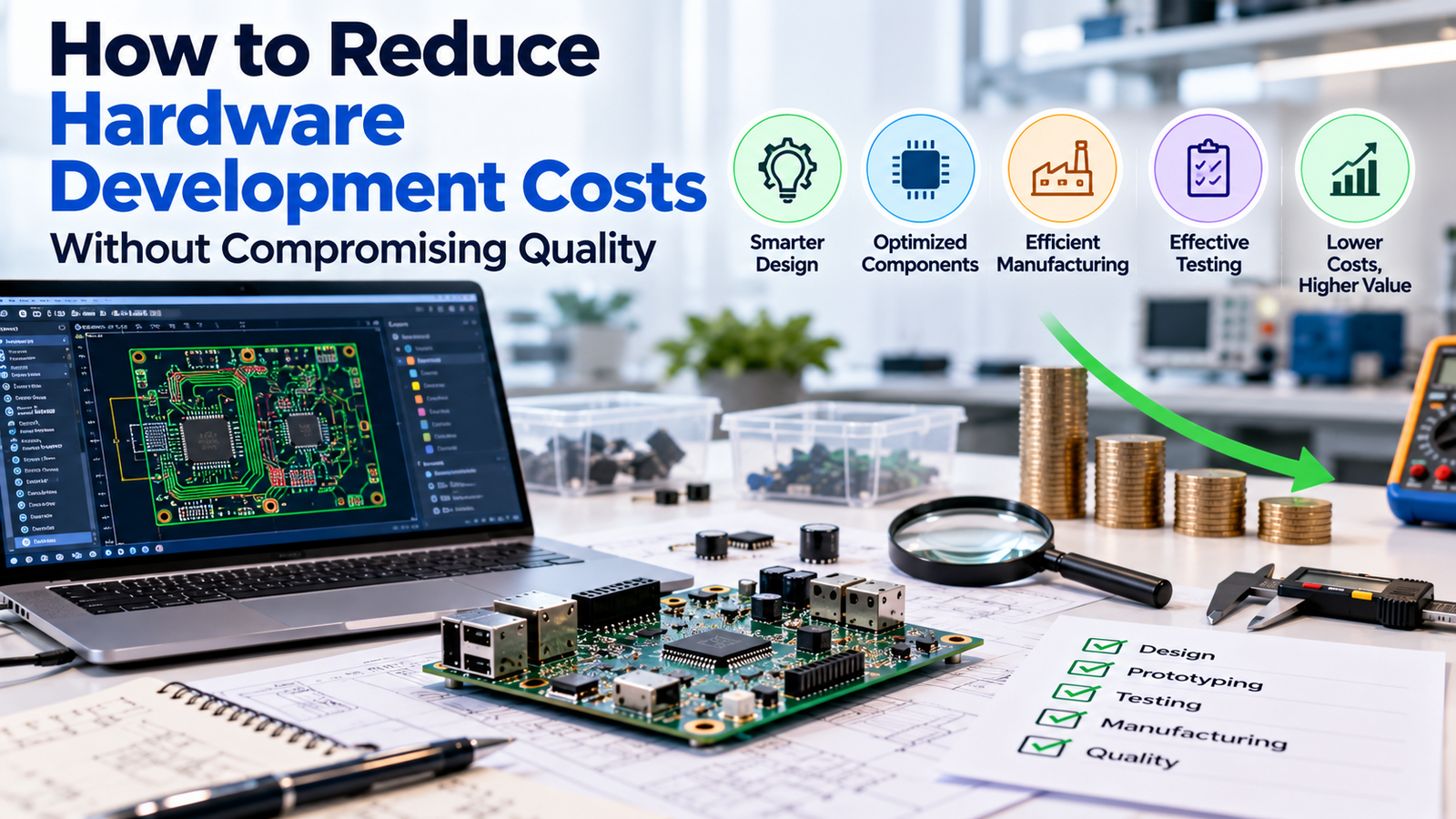
Developing a hardware product requires careful planning, engineering expertise, component selection, prototyping, and testing. However, unexpected design changes, component shortages, manufacturing defects, and repeated testing can increase development costs.
For hardware companies, startups, and engineering teams, the challenge is to reduce hardware development costs without sacrificing product quality, reliability, or performance.
The solution is not simply to choose cheaper components. Instead, teams should improve design decisions, identify problems early, optimize manufacturing processes, and use resources efficiently.
In this blog, we explore practical ways to reduce hardware development costs while maintaining high quality throughout the product development lifecycle.
What Is Hardware Development Cost?
Hardware development cost includes the expenses involved in designing, building, testing, and preparing a physical product for manufacturing.
Common cost categories include:
- Research and product design.
- PCB design and component selection.
- Prototype development.
- Testing and validation.
- Firmware and hardware integration.
- Manufacturing and assembly.
- Compliance and certification.
- Rework, maintenance, and product improvements.
Poor planning can increase costs at every stage. For example, discovering a PCB design issue after manufacturing begins may require a new board revision, additional components, and repeated testing.
Therefore, controlling costs starts with making informed decisions early in development.
1. Plan Requirements Before Starting Development
One of the easiest ways to control hardware development costs is to define product requirements clearly before designing the hardware.
Unclear requirements can lead to unnecessary features, repeated design changes, and wasted engineering time.
Before development begins, identify the product’s main purpose, target users, performance requirements, operating environment, and expected production volume.
How to reduce costs
- Define essential features before adding optional ones.
- Set clear performance and power consumption targets.
- Identify applicable safety and compliance requirements.
- Establish a realistic development budget.
- Document technical requirements for the engineering team.
A clear development plan helps teams avoid unnecessary changes and focus on features that deliver real value.
2. Optimize PCB Design Early
Printed circuit board (PCB) design directly affects product cost, reliability, and manufacturability.
Poor component placement, unnecessary layers, complex routing, and inadequate design reviews can lead to expensive PCB revisions.
Designing for manufacturability (DFM) helps engineers create boards that are easier and more cost-effective to manufacture.
How to reduce costs
- Optimize component placement and PCB layout.
- Use the simplest layer stack that meets electrical requirements.
- Follow manufacturer design guidelines.
- Avoid unnecessarily complex routing.
- Review power delivery and thermal requirements.
- Run design rule checks before manufacturing.
- Consult the PCB manufacturer early.
However, reducing PCB layers or choosing smaller components should not compromise signal integrity, electrical safety, or reliability.
A well-planned PCB design can reduce manufacturing problems and minimize costly redesigns.
3. Choose Components Based on Total Cost
Selecting the cheapest component does not always produce the lowest overall development cost.
Low-cost components may introduce reliability problems, longer testing cycles, or supply chain risks. Similarly, expensive components may offer capabilities that the product does not need.
The goal is to select components that meet technical requirements at an appropriate cost.
What to consider
- Purchase price and availability.
- Power consumption and performance.
- Reliability and operating temperature.
- Manufacturer support and documentation.
- Expected product lifetime.
- Alternative components and supply risks.
Whenever possible, identify suitable alternative components during the design stage.
This approach can reduce the impact of shortages and prevent expensive redesigns when a component becomes unavailable.
4. Use Rapid Prototyping to Identify Problems Early
Building a prototype allows engineers to test their ideas before committing to full-scale manufacturing.
It can reveal design weaknesses, component compatibility issues, thermal problems, and usability concerns.
Finding these problems early is usually less expensive than correcting them after production begins.
How to reduce prototyping costs
- Build prototypes around the most important technical risks.
- Reuse development boards where appropriate.
- Test critical components before integrating the entire system.
- Validate power consumption and thermal performance early.
- Record test results and design changes.
- Avoid ordering large prototype quantities before confirming the design.
For complex products, a staged approach can be effective. Teams can begin with a proof of concept, move to an engineering prototype, and then build a production-oriented prototype.
Each stage should answer specific technical questions before additional investment.
5. Automate Repetitive Testing
Testing is essential for product quality, but repeated manual checks can consume significant engineering time.
Automated testing can help teams perform routine checks consistently and identify defects more quickly.
For example, a hardware testing setup can automatically measure voltage, current, sensor outputs, communication responses, and other defined parameters.
Practical ways to automate testing
- Create automated test scripts for repetitive measurements.
- Use fixtures to simplify repeated hardware connections.
- Automate firmware flashing where appropriate.
- Record test results automatically.
- Establish clear pass and fail criteria.
- Reuse test procedures across compatible product revisions.
Automation requires an initial investment. Therefore, it is most valuable when tests are repeated frequently or when manual testing introduces avoidable errors.
6. Design for Manufacturing and Assembly
A product that works well as a prototype may still be expensive to manufacture.
Manufacturing costs depend on PCB complexity, component availability, assembly time, inspection requirements, and production volume.
Design for manufacturing and assembly (DFMA) helps engineers consider these factors before finalizing the product.
How to improve manufacturability
- Reduce unnecessary component variety.
- Use standard components where suitable.
- Simplify assembly steps.
- Provide adequate access for inspection and testing.
- Follow manufacturer tolerances and guidelines.
- Discuss production requirements with manufacturing partners early.
A simpler design can reduce assembly time and the likelihood of manufacturing defects.
However, design simplification should preserve the performance, durability, and safety required for the product.
7. Reduce Rework Through Early Validation
Rework occurs when a product or component must be corrected because it does not meet requirements.
Common causes include incorrect component selection, PCB layout errors, firmware integration problems, and insufficient testing.
Repeated rework increases engineering hours, delays production, and raises material costs.
How to prevent rework
- Conduct design reviews before manufacturing.
- Verify component footprints and electrical specifications.
- Test critical circuits individually.
- Validate firmware and hardware integration.
- Perform thermal and electrical testing.
- Document known issues and corrective actions.
Early validation is particularly important for power electronics, embedded systems, IoT devices, and other products with complex hardware requirements.
8. Manage Component Procurement and Inventory
Component procurement can significantly affect hardware development budgets.
Last-minute purchasing, limited supplier options, and unexpected component shortages can increase costs and delay development.
Effective procurement planning helps engineering teams avoid unnecessary expenses.
Best practices
- Identify long-lead-time components early.
- Compare suppliers based on quality, availability, and total cost.
- Check component authenticity and traceability.
- Maintain appropriate inventory for critical parts.
- Qualify alternatives before they are urgently needed.
- Avoid purchasing excessive quantities before the design is stable.
For production planning, evaluate the total cost of ownership rather than focusing only on the unit price.
9. Use Modular Hardware Design
Modular hardware design divides a product into separate functional sections.
For example, a device may use independent modules for processing, power management, sensing, and communication.
This approach allows engineers to test or update individual sections without redesigning the entire system.
Benefits of modular design
- Easier debugging and maintenance.
- Faster development of product variations.
- Reuse of validated hardware modules.
- Simplified upgrades.
- Reduced duplication of engineering effort.
However, modularity can increase connector count, PCB area, and assembly cost. Engineers should compare these trade-offs before deciding how much modularity the product needs.
10. Track Costs Throughout Development
Cost control should continue throughout the product lifecycle.
Without regular reviews, small expenses can accumulate into significant budget overruns.
Tracking development costs helps teams understand where resources are being used and identify opportunities for improvement.
Useful metrics include:
| Metric | Purpose |
|---|---|
| Prototype cost | Tracks spending on development builds. |
| PCB revision count | Helps identify recurring design issues. |
| Defect rate | Measures the frequency of failures. |
| Rework hours | Shows the engineering effort spent correcting problems. |
| Component cost | Tracks material expenses. |
| Test cycle time | Measures the time required for validation. |
| First-pass yield | Measures the proportion of units passing testing without rework. |
| Production cost per unit | Helps evaluate manufacturing efficiency. |
Reviewing these metrics regularly helps teams make evidence-based decisions without sacrificing product quality.
Conclusion
Reducing hardware development costs requires more than choosing inexpensive components. It involves better planning, optimized PCB design, early prototyping, efficient testing, and careful manufacturing decisions.
By defining requirements clearly, validating designs early, selecting suitable components, and tracking development expenses, engineering teams can reduce waste and avoid expensive redesigns.
The best way to reduce hardware development costs is to prevent problems before they become expensive to fix.
At Hashing Hardware, effective hardware engineering practices can help teams develop reliable products while improving development efficiency and controlling costs.