Bitcoin mining requires powerful machines, a stable electricity supply, proper cooling, and a reliable internet connection. Setting up these facilities at home can be expensive and difficult to manage.
ASIC hosting offers a simpler way to run Bitcoin mining machines without building your own mining facility. A hosting provider supplies the space, electricity, cooling, and other services needed to operate your equipment.
But how does ASIC hosting work? What does it cost, and how can you choose the right provider?
In this guide, we explain ASIC hosting in simple terms, explore its benefits and risks, and discuss what you should consider before investing in Bitcoin mining.
What Is ASIC Hosting?
ASIC hosting is a service that allows individuals and businesses to run their cryptocurrency mining machines in a professional facility.
ASIC stands for Application-Specific Integrated Circuit. These machines are designed to perform a specific computing task. In Bitcoin mining, they perform calculations using the SHA-256 algorithm to help secure the Bitcoin network.
However, ASIC miners consume large amounts of electricity and produce considerable heat. They also need a suitable operating environment to work reliably.
Building and maintaining this environment can be challenging for individual miners. Therefore, many people choose ASIC hosting instead.
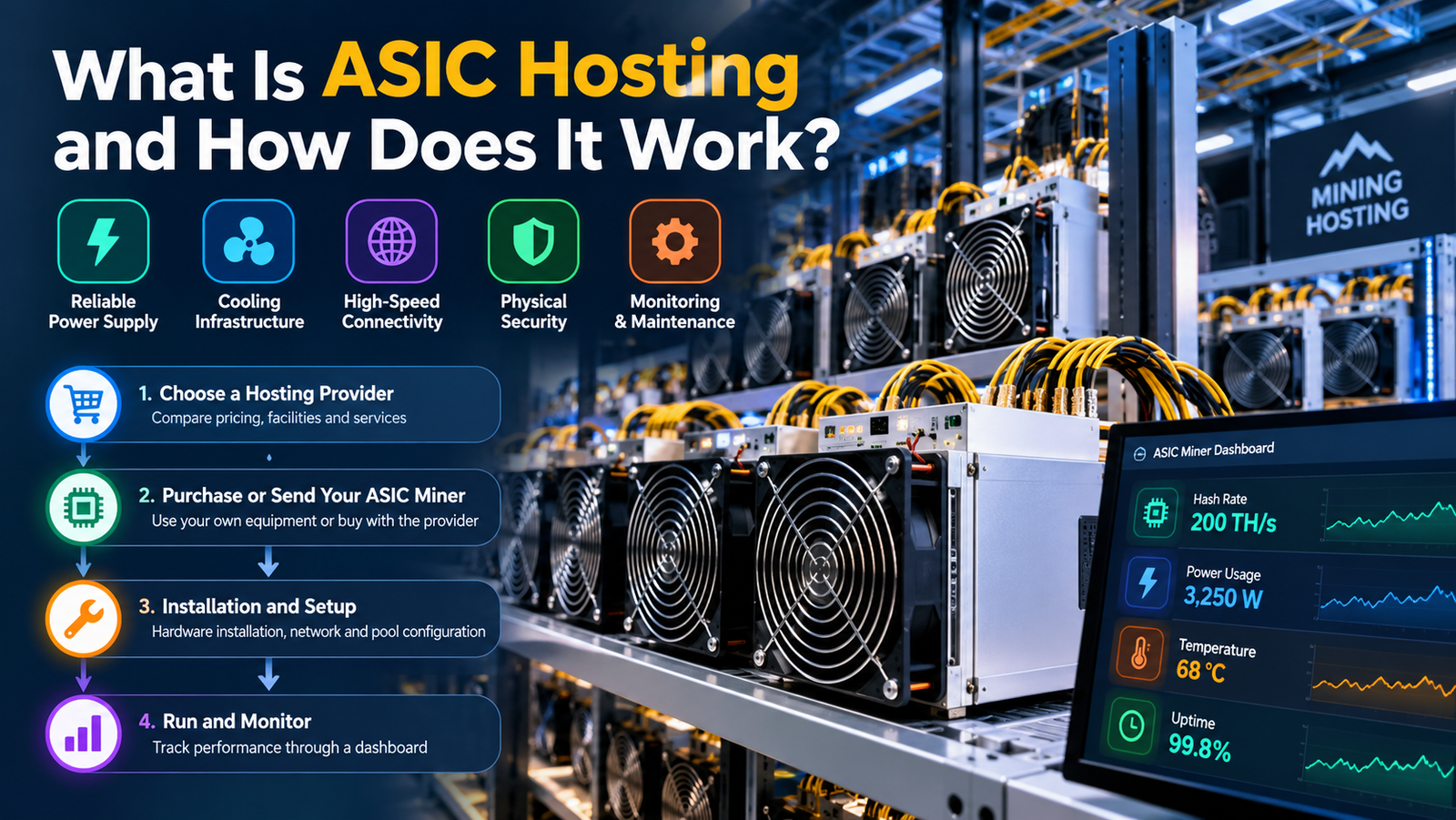
A hosting provider typically offers:
- Electricity: Supplies power to operate mining machines.
- Cooling: Uses ventilation or cooling systems to manage heat.
- Internet connection: Keeps mining equipment connected to the network.
- Hardware installation: Installs and configures compatible machines.
- Monitoring: Tracks machine performance and operating conditions.
- Maintenance: Provides troubleshooting and repair services according to the contract.
- Physical security: Uses measures to protect equipment inside the facility.
In most customer-owned hosting arrangements, you own the mining machine while the provider operates the facility. However, ownership and service responsibilities depend on the agreement.
How Does ASIC Hosting Work?
ASIC hosting involves several steps, from selecting a provider to monitoring your mining machine.
1. Choose a Hosting Provider
First, find a hosting company that offers the services you need.
Compare electricity prices, facility conditions, cooling systems, maintenance services, and contract terms. Additionally, check whether the provider accepts customer-owned machines or offers its own mining equipment.
A reliable provider should clearly explain its charges and responsibilities before you sign an agreement.
2. Purchase an ASIC Mining Machine
Next, select a mining machine that suits your budget and operating requirements.
Different ASIC miners offer different hash rates and power consumption levels. The hash rate measures how much computing work a machine can perform, while power consumption indicates how much electricity it uses.
Energy efficiency is particularly important when choosing a miner. A machine that produces more computing power for each unit of electricity may help reduce operating costs.
Before purchasing equipment, confirm that your chosen hosting facility supports the machine model.
3. Send the Machine to the Facility
After purchasing the equipment, arrange delivery to the hosting provider.
The provider receives the machine and prepares it for installation. Depending on the service, this process may include physical inspection, installation, power connections, network setup, and initial testing.
However, shipping, installation, and insurance charges may apply. Check these costs before sending your equipment.
4. Install and Configure the Miner
Once the machine arrives, the hosting team connects it to the required power and network systems.
The team may also configure the mining software, check operating temperatures, and verify that the machine is working correctly.
After testing, the miner can connect to a mining pool or another supported mining arrangement.
A mining pool allows multiple miners to combine their computing power. Participants receive payouts according to the pool’s reward distribution rules.
5. Run and Monitor the Mining Machine
Once the setup is complete, the machine can begin mining Bitcoin.
The hosting facility supplies the required electricity, cooling, and network connection. Meanwhile, you can monitor the machine remotely if the provider offers a monitoring dashboard.
Common monitoring features include:
- Hash rate and mining performance
- Electricity consumption
- Operating temperature
- Machine uptime
- Hardware errors
- Mining pool connection status
These details help you identify performance problems and understand how your equipment is operating.
6. Pay the Hosting Charges
The hosting company charges you according to the agreed pricing model.
Some providers charge for electricity separately, while others combine electricity and hosting services into a single rate. Installation, repairs, and additional services may also incur charges.
Mining pool rewards are generally paid according to the pool’s rules. You must then account for hosting expenses and other operating costs to determine whether your mining activity is profitable.
Remember: ASIC hosting makes mining easier to manage, but it does not guarantee Bitcoin rewards or profits.
What Are the Different Types of ASIC Hosting?
Hosting services differ according to the equipment you own and the level of support you need.
1. Customer-Owned ASIC Hosting
In this arrangement, you purchase the mining machine and send it to a hosting facility.
The provider supplies the infrastructure needed to operate it. You retain ownership of the equipment, subject to the terms of your agreement.
This option suits miners who want to control their hardware without managing their own facility.
2. Managed ASIC Hosting
Managed hosting includes infrastructure services and may also cover equipment monitoring, installation, troubleshooting, and maintenance.
The exact services depend on the provider. For example, routine monitoring may be included in the monthly fee, while replacement parts and repairs may cost extra.
This arrangement is useful for people who prefer to spend less time managing mining equipment.
3. ASIC Hosting With Hardware Purchase
Some providers help customers purchase mining machines and arrange hosting at the same time.
This can simplify the setup process, especially for beginners who are unfamiliar with mining hardware.
Before choosing this option, confirm the machine model, purchase price, warranty, hardware ownership, and hosting charges.
4. Industrial ASIC Hosting
Industrial hosting facilities are designed to operate large numbers of mining machines.
They may include dedicated power distribution systems, large-scale cooling arrangements, network infrastructure, and teams responsible for facility operations.
This option is generally more suitable for businesses and miners operating multiple machines.
What Are the Benefits of ASIC Hosting?
ASIC hosting can make cryptocurrency mining easier by reducing the need to build and maintain your own facility.
1. Access to Professional Infrastructure
Mining machines require adequate power, ventilation, and physical space.
Setting up these facilities at home may require electrical upgrades and additional equipment. In contrast, hosting allows you to use an existing facility designed for mining operations.
As a result, you can avoid managing much of the physical infrastructure yourself.
2. Better Heat Management
ASIC miners produce substantial heat during operation. Without suitable cooling, high temperatures can affect performance and increase the risk of equipment problems.
Hosting facilities typically use ventilation or cooling systems to manage operating temperatures.
However, cooling quality varies between providers. Therefore, ask about the facility’s cooling arrangements before making a decision.
3. Reduced Maintenance Responsibilities
Depending on your contract, the hosting company may monitor your equipment and handle routine maintenance.
For example, the provider may investigate hardware alerts or help identify problems with fans and power supplies.
This can save time, although repair costs and replacement parts may not be included in the hosting fee.
4. Remote Access to Performance Information
Many providers offer online dashboards or performance reports.
These tools allow you to check your machine’s operating status without travelling to the facility. In addition, they can help you identify downtime or unexpected changes in performance.
The available monitoring features depend on the provider’s systems.
5. Easier Cost Planning
A hosting agreement can help you estimate recurring expenses before starting operations.
For example, some providers charge a fixed rate for each unit of electricity consumed. Others offer a monthly package based on the machine’s power requirements.
Nevertheless, review the complete pricing structure. Additional fees, minimum payments, or electricity rate changes can affect your budget.
What Are the Risks of ASIC Hosting?
Although hosting offers several advantages, it also introduces financial and operational risks.
1. High Electricity Costs
Electricity is one of the largest ongoing expenses in Bitcoin mining.
Consider an ASIC miner that consumes 3,500 watts, or 3.5 kilowatts, while operating.
Its estimated electricity consumption over 30 days is:
3.5 kW × 24 hours × 30 days = 2,520 kWh
If electricity costs ₹8 per kWh, the estimated monthly electricity expense is:
2,520 kWh × ₹8 = ₹20,160
This example covers the miner’s electricity consumption only. Hosting fees, maintenance, pool charges, taxes, and other expenses may increase the total cost.
Therefore, compare the full monthly cost rather than looking at electricity prices alone.
2. Dependence on the Provider
When your mining machine operates in another company’s facility, you depend on that company for the services covered by your contract.
Power interruptions, cooling failures, or delayed repairs can reduce uptime. Consequently, mining revenue may decrease during periods when your machine cannot operate.
Before signing an agreement, check the provider’s uptime commitments, maintenance procedures, and policies for handling service interruptions.
3. Hardware Repairs and Replacement
ASIC miners operate continuously under demanding conditions.
Over time, components such as fans, power supplies, and control boards may require attention. Repair costs can reduce your overall returns.
Ask the provider who is responsible for diagnosing faults, approving repairs, and paying for replacement parts.
4. Changes in Mining Revenue
Bitcoin mining revenue can change as market conditions change.
For example, a decline in Bitcoin’s price may reduce the value of the rewards you receive. Similarly, an increase in network difficulty can affect how much Bitcoin your mining equipment is expected to earn.
Hosting fees may continue even when mining revenue falls.
For this reason, calculate profitability using different market scenarios instead of relying on a single estimate.
5. Security and Contract Risks
Your equipment may be located far from your home or office. Therefore, you need to understand how the provider protects and manages your hardware.
Check physical security measures, insurance coverage, equipment ownership records, and procedures for retrieving your machine.
In addition, review the contract carefully to understand termination conditions, additional fees, and the provider’s responsibilities.
How Much Does ASIC Hosting Cost?
ASIC hosting costs vary according to electricity prices, machine power consumption, facility location, and the services included in the agreement.
The main expenses are listed below.
| Cost | Description |
|---|---|
| Electricity | Power consumed by the mining machine |
| Hosting fee | Charges for facility space and infrastructure |
| Installation | Receiving, installing, and configuring the machine |
| Maintenance | Labour, repairs, and replacement parts where chargeable |
| Shipping | Transporting the machine to and from the facility |
| Insurance | Coverage for equipment, subject to the policy terms |
| Mining pool fees | Charges imposed by the selected mining pool |
| Taxes | Applicable taxes and other mandatory charges |
Some providers combine electricity and hosting into one price. Others charge separately for each service.
For example, a provider may advertise a low electricity rate but charge additional fees for maintenance or installation. As a result, the total cost may be higher than expected.
Before choosing a provider, calculate the complete monthly expense and compare it with your estimated mining revenue.
How to Choose the Right ASIC Hosting Provider
Selecting a hosting provider requires careful research. The following factors can help you compare your options.
1. Compare Electricity Rates
Ask each provider for its complete pricing structure.
Check whether the quoted rate includes cooling, facility overhead, taxes, and other charges. Additionally, confirm whether the provider bills actual electricity consumption or uses a fixed estimate.
2. Check the Facility Conditions
Find out where the facility is located and how it manages power, cooling, ventilation, and fire safety.
Where possible, request photographs, arrange an inspection, or ask for evidence of the facility’s operating conditions.
3. Review Uptime and Maintenance Policies
Ask how the provider monitors equipment and handles power or network interruptions.
Check the agreed uptime level, repair response times, and procedures for planned maintenance.
These details help you understand what support to expect when something goes wrong.
4. Confirm Hardware Ownership
The contract should clearly state who owns the mining equipment.
It should also explain what happens if a machine becomes damaged, requires repairs, or stops working.
Furthermore, confirm how you can retrieve your equipment if you decide to change providers.
5. Examine Security Measures
Ask how the facility restricts physical access to mining equipment.
You should also understand how the provider manages remote access and protects account credentials.
Good security practices can help reduce the risk of unauthorized access or equipment loss.
6. Read the Contract Carefully
Before making a payment, review the agreement and check for hidden costs.
Pay attention to:
- Contract duration and renewal terms
- Electricity rates and additional fees
- Deposits and minimum payments
- Maintenance and repair responsibilities
- Uptime commitments
- Insurance coverage and exclusions
- Termination conditions
- Equipment retrieval procedures
Avoid making a decision based only on advertised returns or verbal promises.
7. Calculate Mining Profitability
Finally, estimate your potential mining revenue and compare it with your total expenses.
Include electricity, hosting, maintenance, mining pool fees, hardware costs, and other applicable charges.
For a more realistic estimate, consider what would happen if Bitcoin’s price decreased, network difficulty increased, or your equipment experienced downtime.
This approach helps you understand the financial risks before investing.
ASIC Hosting vs. Home Bitcoin Mining
ASIC hosting and home mining use similar equipment, but they differ in how the machines are operated.
| Feature | ASIC Hosting | Home Mining |
|---|---|---|
| Equipment location | Professional facility | Home or personal property |
| Electricity | Supplied and billed by the hosting provider | Arranged and paid for by the owner |
| Cooling | Managed by the facility | Managed by the owner |
| Maintenance | May be included in the service | Handled by the owner or a technician |
| Noise management | Depends on the facility | Must be considered at home |
| Physical access | Subject to provider policies | Direct access |
| Cost structure | Hosting and associated fees | Electricity, cooling, and maintenance |
| Control | Shared according to the contract | Greater direct control |
ASIC hosting can be convenient when you do not have enough space or suitable infrastructure at home.
However, home mining gives you direct access to your equipment and more control over its operation.
The right option depends on your electricity costs, technical knowledge, available space, and preferred level of involvement.
Is ASIC Hosting Profitable?
ASIC hosting can generate a return, but profitability is never guaranteed.
Your results depend on several factors.
- Hash rate: Higher computing power can improve your share of mining work, although it does not guarantee rewards.
- Energy efficiency: More efficient machines can reduce electricity costs relative to their computing power.
- Electricity prices: Higher power costs can reduce net returns.
- Bitcoin price: The market value of mining rewards affects revenue.
- Network difficulty: Changes in mining difficulty influence expected rewards.
- Hosting fees: Monthly service charges reduce the money remaining after expenses.
- Hardware cost: The purchase price and useful life of the machine affect the overall investment.
For example, a powerful mining machine may generate more revenue but consume more electricity. If the additional electricity cost exceeds the additional revenue, the machine may be less attractive financially.
Therefore, compare hardware performance, energy efficiency, and hosting expenses before purchasing equipment.
Use a mining profitability calculator to estimate potential returns, but remember that the results depend on the assumptions you enter.
Frequently Asked Questions
1. What is ASIC hosting in Bitcoin mining?
ASIC hosting allows individuals and businesses to operate mining machines in a dedicated facility. The provider typically supplies electricity, cooling, network connectivity, and agreed infrastructure services.
2. Do I need to own an ASIC miner to use hosting?
Not always. Some providers accept customer-owned equipment, while others offer packages that include hardware procurement. Check the agreement to understand what is included.
3. Who receives the Bitcoin mining rewards?
Mining rewards are generally distributed through the selected mining pool according to its payout rules. Hosting charges are usually paid separately, so the equipment owner must account for those expenses when calculating returns.
4. How much electricity does an ASIC miner consume?
Consumption depends on the machine’s power rating. For example, a miner using 3,500 watts consumes approximately 3.5 kWh per hour. If it operates continuously, that equals approximately 84 kWh per day.
Actual consumption can vary depending on operating conditions.
5. Is ASIC hosting better than mining at home?
ASIC hosting may be more convenient if you lack suitable electricity, cooling, or space. Home mining provides more direct control but requires you to manage the equipment and its operating environment.
Compare the total costs before deciding.
6. What should I check before choosing an ASIC hosting provider?
Compare electricity rates, facility conditions, cooling systems, maintenance policies, security measures, uptime commitments, contract terms, and equipment retrieval procedures.
7. Can ASIC hosting guarantee profits?
No. A hosting provider supplies infrastructure and services, but mining revenue depends on Bitcoin’s price, network difficulty, electricity costs, and other factors. Unexpected downtime can also affect returns.
Conclusion
ASIC hosting provides a practical way to run Bitcoin mining machines without building your own mining facility. A hosting provider supplies the required infrastructure, including electricity, cooling, network connectivity, and varying levels of technical support.
However, choosing the right provider requires more than comparing advertised prices. You should understand the contract, evaluate the facility, confirm hardware ownership, and calculate the total cost of operating your equipment.
By comparing mining performance, energy efficiency, hosting fees, and provider reliability, you can make a more informed decision about ASIC hosting. Careful planning also helps you understand the risks before committing money to cryptocurrency mining.