
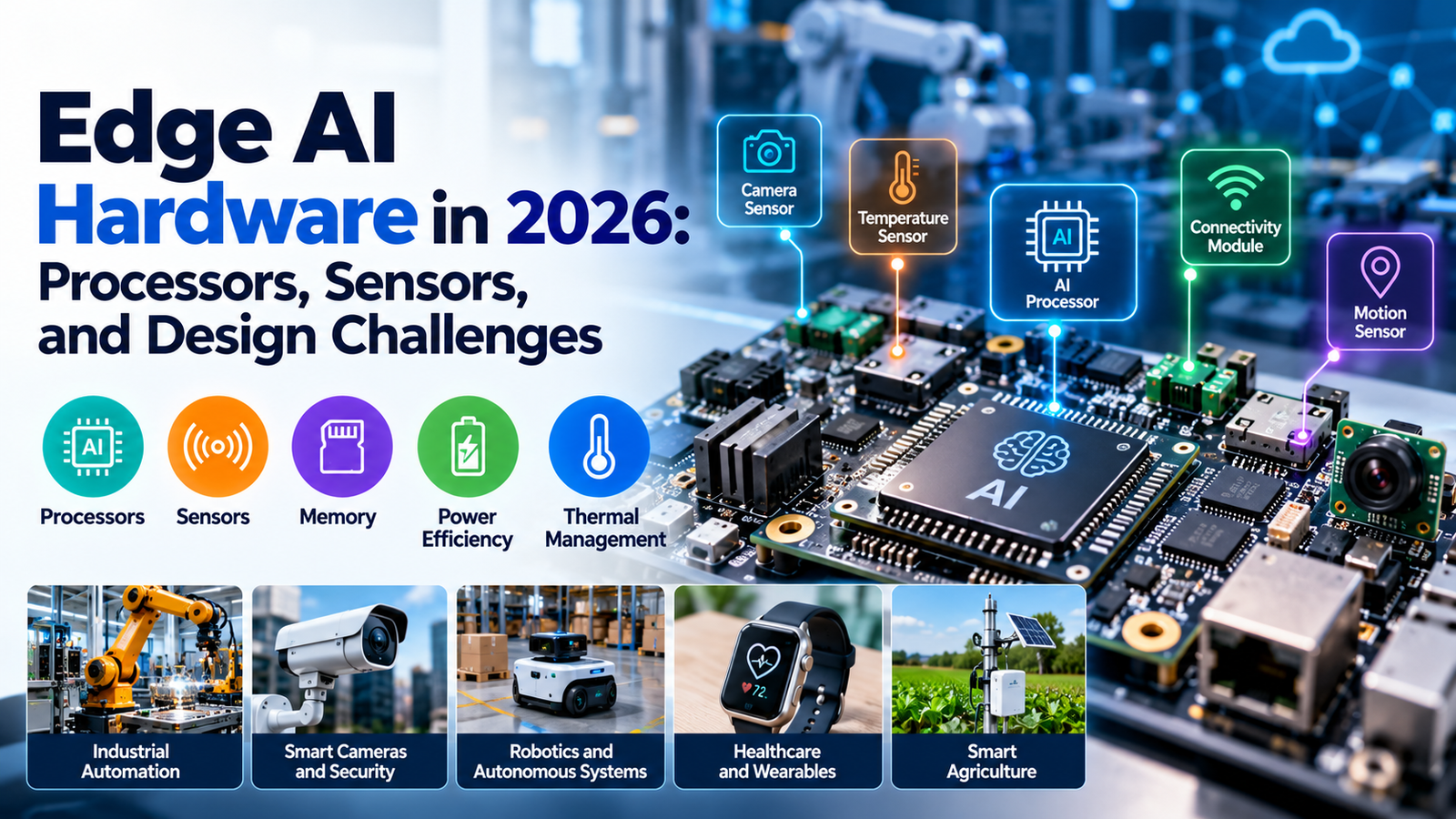
Edge AI is changing how devices process information. Instead of sending every piece of data to the cloud, edge AI systems can analyze information locally using processors built into devices.
From smart cameras and industrial sensors to robotics and IoT equipment, edge AI enables faster responses, reduced network dependency, and more efficient data processing.
However, designing edge AI hardware requires careful decisions about processors, sensors, memory, power consumption, and thermal management.
In this blog, we explore the key components of edge AI hardware in 2026, the latest design considerations, and the challenges engineers must address when developing reliable edge AI devices.
What Is Edge AI Hardware?
Edge AI hardware refers to the physical components that allow a device to run artificial intelligence models close to where data is generated.
Unlike cloud-based AI systems, edge devices can process certain tasks locally without continuously sending raw data to remote servers.
A typical edge AI system includes:
- AI processors: Execute machine learning models.
- Sensors: Collect information from the physical environment.
- Memory: Stores models, instructions, and processing data.
- Embedded controllers: Manage device operations.
- Communication modules: Connect devices to networks when required.
- Power management components: Control energy consumption.
- Cooling and thermal components: Help maintain safe operating temperatures.
These components must work together within the device’s cost, size, performance, and power limits.
For example, an industrial camera may use an image sensor and an AI processor to detect defects directly on a production line. This reduces the need to transmit every image to a remote server.
Types of Processors Used in Edge AI Hardware
Choosing the right processor is one of the most important decisions when designing an edge AI device. Different processors offer different levels of performance, power efficiency, and flexibility.
1. Central Processing Units (CPUs)
CPUs handle general computing tasks, system control, and application logic. They are commonly used in embedded computers, smart devices, and industrial gateways.
Modern CPUs may also include AI acceleration features. This makes them suitable for certain machine learning workloads without requiring a separate accelerator.
Best suited for: General-purpose edge computing, control systems, and lightweight AI applications.
2. Graphics Processing Units (GPUs)
GPUs perform many calculations in parallel. This makes them useful for computationally intensive AI workloads, including image recognition, video analytics, and computer vision.
However, GPU-based systems may require more power and cooling than simpler embedded platforms.
Best suited for: Advanced computer vision, multi-camera analytics, robotics, and demanding edge AI applications.
3. Neural Processing Units (NPUs)
NPUs are specialized processors designed to accelerate neural network operations.
They can execute supported AI models efficiently while reducing the workload on the CPU. This makes them useful for devices that need local AI inference within limited power and thermal budgets.
Best suited for: Smart cameras, voice recognition, object detection, and real-time AI applications.
4. Microcontrollers (MCUs)
Microcontrollers combine processing, memory, and peripheral interfaces in a compact device. Some modern MCUs also support AI acceleration or optimized machine learning operations.
They are particularly useful when a device must process sensor data while consuming very little power.
Best suited for: Smart sensors, wearable devices, battery-powered equipment, and simple predictive maintenance applications.
5. Field-Programmable Gate Arrays (FPGAs)
FPGAs allow engineers to configure hardware logic for specific processing tasks. They can provide flexibility for specialized workloads and real-time processing.
However, FPGA development can require additional design expertise and verification effort.
Best suited for: Specialized signal processing, industrial automation, and applications with specific timing requirements.
Key takeaway: The best processor depends on the workload, power budget, memory requirements, response time, and development cost. Peak AI performance alone is not enough to determine the right hardware.
The Role of Sensors in Edge AI Systems
Sensors collect the real-world information that edge AI systems analyze. Their accuracy, response time, and data quality directly influence AI performance.
Different applications require different sensor technologies.
| Sensor type | Common applications |
|---|---|
| Image sensors | Object detection, inspection, and smart cameras |
| Temperature sensors | Equipment monitoring and predictive maintenance |
| Motion sensors | Robotics, movement detection, and security |
| Microphones | Voice recognition and sound anomaly detection |
| Pressure sensors | Industrial monitoring and process control |
| Accelerometers and gyroscopes | Motion tracking, vibration analysis, and navigation |
| Distance sensors | Obstacle detection and automated systems |
Why Sensor Selection Matters
An AI model cannot compensate for every limitation in the data it receives. Poor sensor accuracy, electrical noise, or unsuitable sampling rates can reduce system performance.
Engineers should therefore consider the following factors:
- Sensor accuracy and resolution.
- Sampling rate and response time.
- Power consumption.
- Operating temperature range.
- Interface compatibility.
- Calibration requirements.
- Resistance to environmental interference.
Additionally, sensor placement matters. Poor positioning can produce unreliable readings or limit the information available to the AI model.
For some applications, sensor fusion is also useful. This approach combines information from multiple sensors to create a more complete understanding of the environment.
Major Edge AI Hardware Design Challenges
Although edge AI offers several advantages, building a reliable device requires careful hardware and system design.
1. Power Consumption and Battery Life
Many edge AI devices operate in locations where electricity is limited or unavailable. Battery-powered sensors, wearables, and remote monitoring devices must balance AI performance with energy consumption.
Running complex models continuously can shorten battery life and increase heat generation.
How to address it:
- Choose energy-efficient processors.
- Use lightweight AI models where suitable.
- Reduce unnecessary sensor activity.
- Apply sleep modes and power management.
- Process data only when required.
2. Thermal Management
Processors and AI accelerators generate heat during operation. Compact devices have limited space for heatsinks, fans, and other cooling components.
Excessive heat can reduce performance and affect component reliability.
How to address it:
- Measure component temperatures under realistic workloads.
- Optimize PCB layout and thermal paths.
- Select appropriate cooling solutions.
- Evaluate performance under high ambient temperatures.
- Consider thermal throttling during sustained workloads.
Thermal design should begin during hardware development rather than after the PCB is finalized.
3. Memory and Data Transfer
AI models require memory to store parameters, intermediate results, and input data. Some applications also process large images, video streams, or multiple sensor inputs simultaneously.
Insufficient memory capacity or bandwidth can limit performance, even when the processor is powerful enough.
How to address it:
- Estimate model memory requirements before selecting hardware.
- Choose suitable memory capacity and bandwidth.
- Reduce unnecessary data movement.
- Optimize model size and input resolution.
- Test the complete workload on the target device.
Memory architecture is particularly important when combining computer vision, sensor fusion, and real-time analytics.
4. PCB Design and Component Integration
Edge AI devices often combine processors, memory, sensors, wireless modules, and power management circuits on a compact PCB.
This creates challenges involving routing, signal integrity, electromagnetic interference, and thermal performance.
How to address it:
- Plan component placement carefully.
- Follow processor and memory layout guidelines.
- Provide suitable power delivery and grounding.
- Separate sensitive signals from noisy circuits where appropriate.
- Validate high-speed interfaces.
- Perform thermal and electromagnetic compatibility testing when required.
Early PCB design reviews can help identify problems before manufacturing.
5. Connectivity and Communication
Some edge AI devices must communicate with cloud platforms, gateways, or other equipment. However, network connectivity may be unreliable in remote or industrial environments.
Wireless communication can also increase power consumption and introduce additional security considerations.
How to address it:
- Select suitable wired or wireless interfaces.
- Support local operation when connectivity is unavailable.
- Minimize unnecessary data transmission.
- Protect communication channels.
- Test performance under weak or intermittent network conditions.
Local processing can reduce dependence on continuous cloud connectivity, but remote monitoring and updates may still require a network connection.
6. Security and Data Privacy
Edge AI devices may collect sensitive information, including images, audio, and industrial operating data.
Local processing can reduce the need to transmit raw data. However, it does not automatically make a device secure.
How to address it:
- Use secure boot where supported.
- Protect stored credentials and sensitive information.
- Authenticate devices and software updates.
- Encrypt communications where appropriate.
- Apply security patches throughout the product lifecycle.
- Restrict access to debugging and maintenance interfaces.
Security should be considered from the beginning of hardware and firmware development.
Edge AI Applications in 2026
Edge AI hardware is being used across several industries where fast responses, local processing, and efficient operation are important.
Industrial Automation
Factories use edge AI to detect equipment abnormalities, inspect products, and monitor production processes. Local processing can help identify problems without sending every sensor reading to a cloud platform.
Smart Cameras and Security
AI-enabled cameras can recognize objects, detect movement, and analyze video locally. This can reduce bandwidth requirements and support faster responses.
Robotics and Autonomous Systems
Robots use processors, cameras, and other sensors to understand their surroundings. Edge AI supports tasks such as obstacle detection, object tracking, and navigation.
Healthcare and Wearable Devices
Wearable devices can analyze sensor data to identify patterns and provide timely feedback. Hardware selection must consider power consumption, accuracy, privacy, and applicable safety requirements.
Smart Agriculture
Edge AI devices can process data from soil sensors, cameras, and environmental monitoring equipment. These systems can help automate irrigation, detect crop problems, and monitor growing conditions.
Industry developments in 2026 highlight the growing importance of combining efficient processors, sensors, memory, and embedded software to support these applications. Siemens Blog Network
Best Practices for Designing Edge AI Hardware
Before developing an edge AI product, engineers should evaluate the complete system rather than selecting components independently.
Consider these best practices:
- Define the workload: Identify the AI tasks, expected response time, and required accuracy.
- Choose suitable processors: Compare CPU, GPU, NPU, MCU, and FPGA options against the application requirements.
- Evaluate sensors: Check accuracy, sampling rate, power consumption, and environmental suitability.
- Optimize memory: Ensure that the model and its intermediate data fit within the available memory resources.
- Plan thermal management: Test the device under sustained workloads and expected ambient conditions.
- Review PCB design: Verify power delivery, routing, signal integrity, and component placement.
- Test security: Include secure boot, protected updates, and suitable communication security.
- Validate the complete device: Test performance, power consumption, reliability, and connectivity on the actual hardware.
These steps can reduce redesign costs and help engineering teams move from prototypes to production-ready products.
Conclusion
Edge AI hardware is making intelligent processing possible in devices ranging from industrial sensors to smart cameras and robotics systems.
In 2026, designing these devices requires careful selection of processors, sensors, memory, and communication components. Engineers must also address power consumption, thermal management, PCB design, connectivity, and security.
The key to successful edge AI hardware is balancing performance, power efficiency, reliability, and cost.
At Hashing Hardware, understanding these hardware design considerations helps engineering teams develop efficient and reliable solutions for modern embedded and AI-powered applications.