
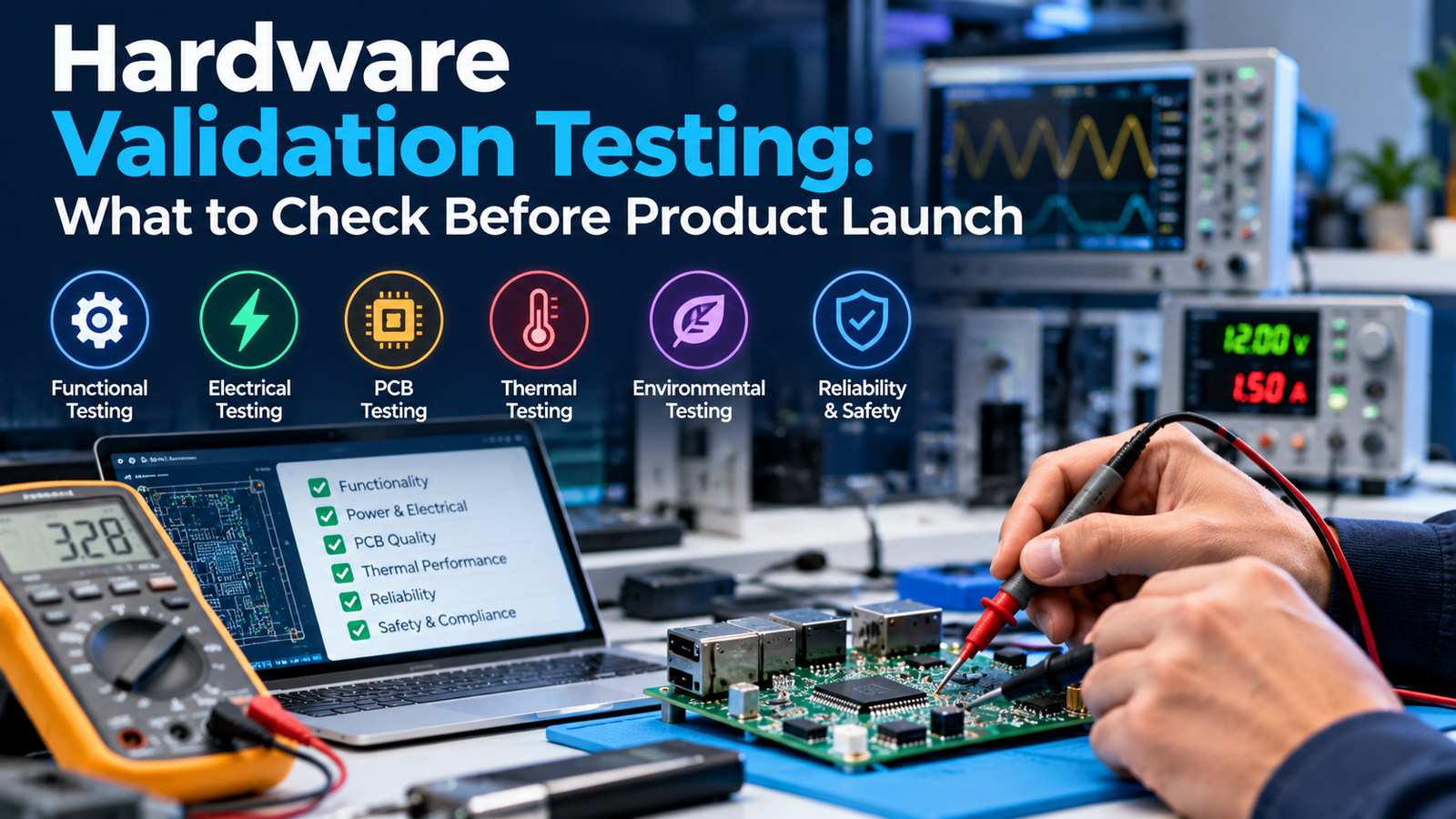
Before launching a hardware product, it is important to confirm that it works correctly, performs reliably, and meets safety requirements. Hardware validation testing helps identify design issues, component failures, and performance problems before a product reaches customers.
From PCB assemblies and embedded systems to IoT devices and electronic equipment, proper testing can reduce product failures, improve quality, and avoid costly redesigns.
In this blog, we explore the key hardware validation tests to perform before product launch and explain how they help ensure product readiness.
What Is Hardware Validation Testing?
Hardware validation testing evaluates whether a product meets its intended requirements under expected operating conditions.
It checks electrical performance, functionality, durability, safety, and reliability. Testing also helps identify weaknesses that may not appear during initial development.
Hardware validation is different from design verification. Verification checks whether the design meets its specifications, while validation evaluates whether the product meets its intended use and user requirements. Both are important before launch.
1. Functional Testing
Functional testing confirms that every feature works as expected.
For example, an IoT device should collect sensor data, process information, and communicate with the required system.
What to check:
- Whether all features operate correctly.
- Whether inputs produce the expected outputs.
- Whether buttons, sensors, and interfaces respond properly.
- Whether communication interfaces work as intended.
- Whether the product recovers correctly from errors.
Testing should cover normal operation as well as common error conditions.
2. Electrical and Power Testing
Electrical testing checks whether the product operates within its specified voltage, current, and power limits.
Incorrect power delivery can cause unstable performance, overheating, or component damage.
What to check:
- Input voltage and current requirements.
- Power consumption during normal operation.
- Voltage regulation and power stability.
- Startup and shutdown behaviour.
- Battery performance, if applicable.
- Protection against overcurrent and reverse polarity, where required.
These tests help confirm that the power system is suitable for the intended application.
3. PCB and Signal Integrity Testing
Printed circuit boards (PCBs) connect electronic components and carry electrical signals. Manufacturing defects or design issues can affect product performance.
PCB validation should examine both physical assembly quality and electrical behaviour.
What to check:
- Short circuits and open connections.
- Solder joint quality.
- Component placement and orientation.
- Continuity of important connections.
- Signal integrity for high-speed interfaces.
- Electromagnetic interference (EMI), where relevant.
Automated optical inspection, in-circuit testing, and functional testing can help detect different types of PCB defects.
4. Thermal Testing
Electronic components generate heat during operation. Excessive temperatures can reduce performance and shorten component life.
Thermal testing checks whether a product can operate safely within its specified temperature limits.
What to check:
- Component temperatures under normal loads.
- Temperature during sustained high-load operation.
- Heat distribution across the PCB.
- Cooling system performance.
- Thermal behaviour during startup and shutdown.
- Performance under specified ambient temperatures.
Thermal testing is particularly important for high-power electronics, embedded systems, and computing hardware.
5. Environmental Testing
Hardware products may experience changing temperatures, humidity, vibration, and other environmental conditions.
Environmental testing helps determine whether the product can withstand the conditions it is designed for.
What to check:
- Operating and storage temperature limits.
- Humidity resistance.
- Vibration and mechanical shock.
- Dust and water ingress protection, where applicable.
- Corrosion resistance for relevant environments.
Select tests based on the product’s intended use. Not every product requires every environmental test.
6. Reliability and Durability Testing
Reliability testing evaluates whether a product continues to perform as expected over time and under repeated use.
These tests help identify weaknesses that may not appear during short functional checks.
What to check:
- Repeated power cycles.
- Continuous operation under expected loads.
- Connector and switch durability.
- Battery charge and discharge cycles, where applicable.
- Component performance over time.
- Failure patterns during extended testing.
Accelerated life testing may help estimate long-term reliability, but its conditions and assumptions must be appropriate for the product.
7. Firmware and Hardware Integration Testing
Hardware products often depend on firmware to control sensors, process data, and manage communication.
Even when individual components work correctly, integration problems can prevent the complete product from operating as expected.
What to check:
- Communication between firmware and hardware.
- Sensor readings and calibration.
- Boot and restart behaviour.
- Firmware updates and recovery.
- Error handling and fault detection.
- Compatibility between hardware revisions and firmware versions.
Testing the complete system helps identify issues that component-level testing may miss.
8. Safety and Compliance Testing
Before launch, hardware products must meet the safety and regulatory requirements that apply to their product category and target market.
The exact requirements depend on factors such as voltage, wireless functionality, intended use, and operating environment.
What to check:
- Electrical safety.
- Electromagnetic compatibility (EMC).
- Radio-frequency requirements for wireless products.
- Battery safety, where applicable.
- Applicable product certifications and documentation.
- Labelling and user instructions.
Identify applicable standards early and use qualified testing laboratories when required. Do not assume that passing internal tests automatically means a product is compliant.
9. Performance Testing
Performance testing determines whether a product meets its expected operating requirements.
For example, a network device may need to support a target data rate, while an embedded system may need to respond within a specified time.
What to check:
- Processing speed and response time.
- Data throughput.
- Memory and resource usage.
- Power consumption under different workloads.
- Communication range, where applicable.
- Performance during sustained operation.
Testing should use realistic operating conditions and clearly defined acceptance criteria.
10. Final Pre-Launch Quality Checklist
Before approving a hardware product for launch, review the following checklist.
| Testing area | What to confirm |
|---|---|
| Functional testing | All required features work correctly. |
| Electrical testing | Voltage, current, and power remain within specifications. |
| PCB testing | Assembly defects and electrical faults are addressed. |
| Thermal testing | Components operate within specified temperature limits. |
| Environmental testing | The product meets its intended environmental requirements. |
| Reliability testing | Repeated operation does not reveal unacceptable failures. |
| Firmware integration | Hardware and firmware work together correctly. |
| Safety and compliance | Applicable requirements have been met. |
| Performance testing | The product meets defined performance targets. |
| Documentation | Test results, known limitations, and approvals are recorded. |
A product should proceed to launch only after critical issues have been resolved and the required acceptance criteria have been met.
Conclusion
Hardware validation testing is an essential step before launching an electronic product. It helps identify design weaknesses, electrical faults, thermal problems, integration issues, and compliance gaps before they affect customers.
By testing functionality, power consumption, PCB quality, reliability, environmental performance, and safety, engineering teams can improve product readiness and reduce the risk of costly failures.
A successful hardware launch starts with systematic testing, clear acceptance criteria, and documented results.
For hardware developers, investing in validation early can save time, improve product quality, and build customer confidence.