
Modern embedded devices do much more than control electronic systems. Today, they collect data, connect to networks, process information, and control physical equipment.
As a result, security has become an important part of embedded product development. A security problem in one device can affect user data, device operation, network access, or even an entire connected system.
This is where hardware security by design becomes important.
Instead of adding security after development, engineers can build security into the product from the beginning. This approach covers hardware, firmware, communication, manufacturing, deployment, and long-term maintenance.
Therefore, a secure embedded product needs more than secure software. It needs a security-focused hardware and firmware architecture.
What Is Hardware Security by Design?
Hardware security by design means considering security requirements while engineers design the hardware and firmware.
Rather than treating security as a final step, development teams consider it during system architecture, component selection, PCB design, firmware development, testing, and manufacturing.
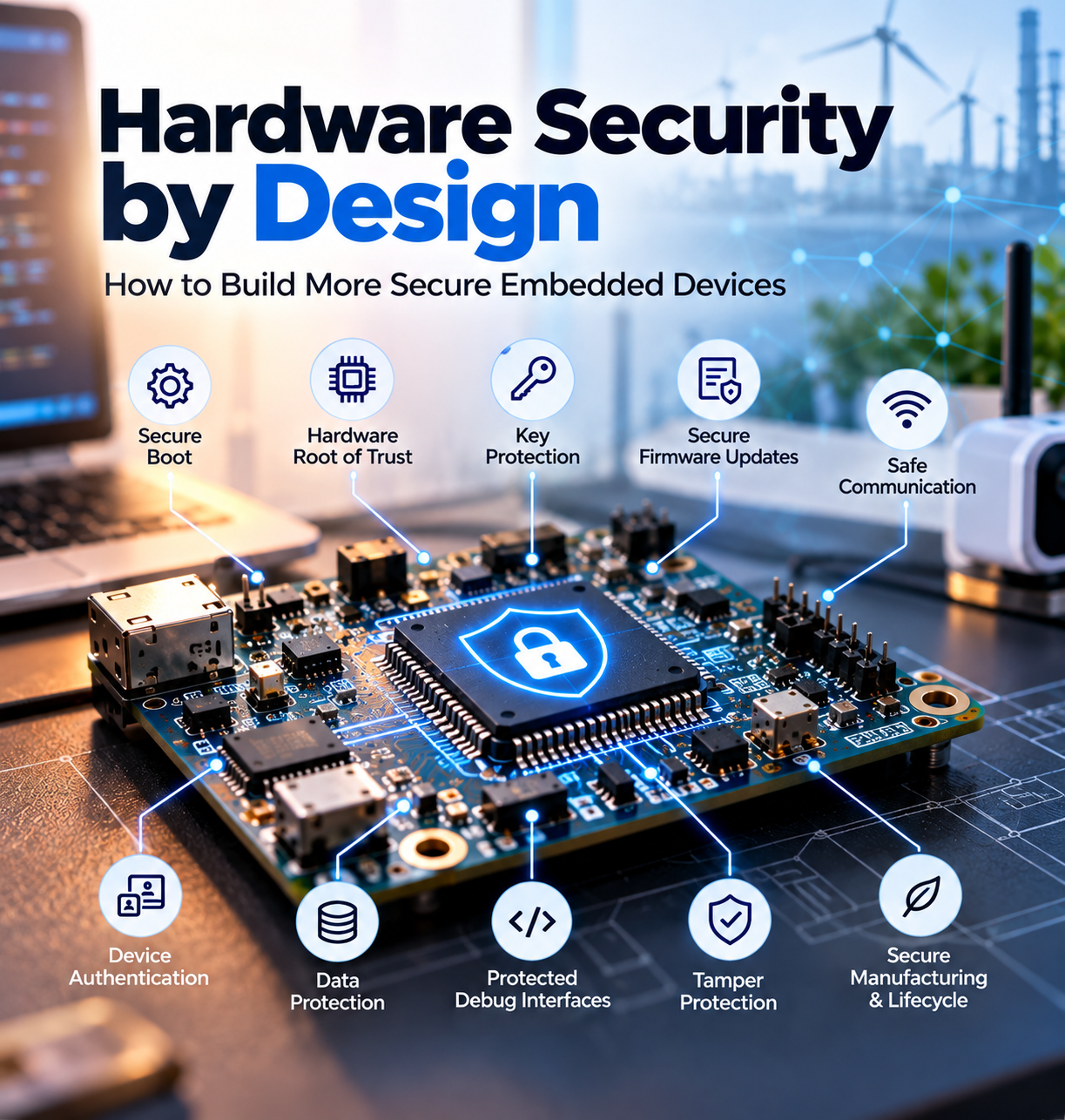
A secure embedded device may use:
- Secure boot
- Hardware root of trust
- Protected key storage
- Device authentication
- Secure firmware updates
- Secure communication
- Debug-interface protection
- Data protection
- Tamper protection
- Secure manufacturing processes
The exact combination depends on the product.
For example, a smart home sensor may need different protections from an industrial controller. Similarly, a connected medical device may have different security requirements from a consumer electronics product.
Therefore, engineers should first understand the device, its environment, and the risks it may face.
Why Does Hardware Security Matter?
Embedded devices often operate outside controlled environments.
A sensor may remain outdoors for years. An industrial controller may operate inside a factory. A connected consumer device may stay in a customer’s home.
Because of this, attackers may gain physical or network access to the device.
A compromised device could expose:
- User data
- Device credentials
- Firmware
- Configuration data
- Network information
- Cryptographic keys
- Communication channels
Attackers may also try to modify firmware, access protected information, or take control of device functions.
Therefore, engineers should consider security before the product reaches the prototype stage.
Hardware Security vs. Software Security
Hardware and software security work together, but they protect different layers of a product.
Software security can protect applications, operating systems, communication protocols, and services.
Hardware security can provide a stronger foundation for functions such as secure boot, key storage, device identity, and trusted execution.
For example, a hardware-based security feature can protect a cryptographic key even when the main application software faces an attack.
As a result, combining hardware and software security can create a stronger overall security architecture.
1. Start With a Threat Model
Before selecting security components, engineers should understand what they need to protect.
A threat model helps development teams identify possible attackers, attack paths, valuable assets, and potential consequences.
The team should ask:
- What information needs protection?
- Who could attack the device?
- Can someone access the device physically?
- Which communication interfaces are exposed?
- What happens if an attacker modifies the firmware?
- What happens if someone obtains a device credential?
- How should the device recover from an attack?
For example, an industrial controller may require strong physical protection because unauthorized access could affect machinery.
On the other hand, a simple indoor sensor may face fewer physical risks but still require secure network communication.
Therefore, security decisions should match the actual threat environment.
What Should You Protect?
Depending on the product, important assets may include:
- Firmware
- Bootloader
- Cryptographic keys
- Device credentials
- Sensor data
- Configuration data
- Network credentials
- Device identity
- Communication interfaces
Once engineers identify these assets, they can select suitable security mechanisms.
2. Use Secure Boot
Secure boot helps a device verify firmware before it starts running.
During startup, the device checks whether the next software component comes from a trusted source. If the verification succeeds, the system continues the boot process.
However, if the firmware fails verification, the device can prevent unauthorized software from running.
A typical trust chain may look like:
Root of Trust → Bootloader → Firmware → Application
This approach helps protect the device from unauthorized firmware changes.
Secure boot does not solve every security problem. Nevertheless, it provides an important foundation for protecting the software execution process.
3. Establish a Hardware Root of Trust
A hardware root of trust provides a trusted foundation for important security functions.
Depending on the device architecture, this foundation may use:
- Secure processor features
- Protected hardware
- Security controllers
- Secure elements
- Hardware-backed cryptographic functions
A hardware root of trust can support:
- Secure boot
- Key protection
- Device identity
- Firmware verification
- Secure updates
- Cryptographic operations
The main idea is simple: critical security functions should not depend entirely on ordinary application software.
Consequently, hardware-based protection can make it harder for an attacker to bypass important security controls.
4. Protect Cryptographic Keys
Encryption can protect sensitive information. However, encryption only works effectively when engineers protect the keys used by the encryption system.
If an attacker obtains a private key or another sensitive credential, the security of the related system can become much weaker.
Therefore, teams should carefully decide where cryptographic keys will live.
Possible approaches include:
- Secure elements
- Hardware-backed storage
- Protected memory
- Trusted execution features
- Device-specific credentials
For example, an IoT product may use unique credentials for each device.
As a result, compromising one device does not automatically expose every device in the product fleet.
5. Give Every Device a Strong Identity
Connected devices need reliable identities.
A unique device identity helps a system recognize an authorized device. It can also support authentication, access control, provisioning, and device management.
For example, an IoT platform may need to distinguish between thousands of deployed devices.
Without proper identity management, unauthorized devices may attempt to connect to the system.
Therefore, device identity should become part of the product architecture from the beginning.
A strong identity system can support:
- Device authentication
- Secure provisioning
- Certificate-based communication
- Access control
- Device management
- Fleet monitoring
6. Secure Communication Interfaces
Embedded products often use several communication technologies.
Common examples include:
- Wi-Fi
- Bluetooth
- Ethernet
- Cellular
- LoRa
- Zigbee
- CAN
- USB
- UART
- SPI
- I2C
Each interface can create different security considerations.
Network interfaces can expose a device to remote attacks. Meanwhile, local interfaces can create risks when an attacker has physical access.
Therefore, engineers should identify which interfaces the product actually needs.
Unused interfaces should not remain unnecessarily exposed.
For network communication, appropriate authentication and secure communication protocols can help protect data and device interactions.
Similarly, local interfaces should have suitable access controls.
7. Secure Firmware Updates
Firmware updates allow manufacturers to fix bugs, improve features, and address security vulnerabilities after deployment.
However, an insecure update process can create a new attack path.
An attacker may try to:
- Install unauthorized firmware
- Replace legitimate firmware
- Modify an update package
- Install an older vulnerable version
- Interrupt the update process
Therefore, the device should verify firmware before installation.
A secure update process can include:
- Firmware signing
- Authentication
- Integrity verification
- Version checks
- Rollback protection
- Recovery mechanisms
- Secure key management
In addition, the update process should handle failures safely.
For example, the device should have a recovery method if power fails during an update.
As a result, secure firmware updates can help manufacturers maintain devices throughout their operating life.
8. Protect Debug Interfaces
Debug interfaces are extremely useful during development.
Engineers use interfaces such as JTAG and SWD to:
- Program firmware
- Debug code
- Inspect hardware
- Test components
- Diagnose failures
However, unrestricted debug access can create a security problem after deployment.
For this reason, production devices need a clear debug-access strategy.
Depending on the product, teams may:
- Disable debug access
- Lock debug features
- Require authentication
- Protect programming interfaces
- Separate development and production configurations
The goal is not necessarily to remove every debugging capability.
Instead, engineers should prevent unauthorized users from gaining powerful development access to deployed devices.
9. Consider Physical Security
Embedded devices can face physical attacks.
An attacker with physical access may try to:
- Open the enclosure
- Access exposed connectors
- Probe electrical signals
- Extract storage
- Replace components
- Modify firmware
- Recover sensitive information
The level of physical protection should match the product’s risk.
For example, a device installed inside a restricted factory may face different threats from a consumer product placed in a public location.
Therefore, engineers should consider the deployment environment during the design stage.
Possible protections include:
- Secure enclosure design
- Tamper detection
- Protected connectors
- Secure component placement
- Encrypted storage
- Hardware-backed secrets
10. Design the PCB With Security in Mind
Security does not belong only to firmware.
PCB design can also influence the physical security of an embedded device.
Engineers should consider how components, traces, connectors, and test points affect the security boundary.
For example, sensitive signals may require careful routing and physical protection.
Similarly, programming connectors should not remain unnecessarily accessible on production hardware.
Component placement can also affect access to security-related components.
Therefore, PCB design should support the security architecture from the beginning.
This approach can reduce the need for expensive hardware changes later.
11. Protect Sensitive Data
Embedded devices often collect and process important information.
Examples include:
- User credentials
- Network credentials
- Device certificates
- Sensor data
- Configuration information
- Encryption keys
- Operational data
First, teams should identify which information the device actually needs.
Next, they should decide where the device should store that information.
Finally, engineers should apply suitable protection mechanisms.
Moreover, teams should avoid storing sensitive information when the product does not require it.
Reducing unnecessary data storage can also reduce the potential impact of a device compromise.
12. Secure the Manufacturing Process
Security does not begin when the product reaches the customer.
Manufacturing also creates important security considerations.
During production, teams may program firmware, assign device identities, install credentials, or provision cryptographic keys.
Therefore, the manufacturing process needs appropriate controls.
Teams should consider:
- Firmware programming
- Key provisioning
- Device identity
- Production credentials
- Debug configuration
- Component authenticity
- Manufacturing access
Development credentials should not remain active on production devices.
Similarly, sensitive production keys should receive appropriate protection.
As a result, manufacturing becomes an important part of the product’s overall security architecture.
13. Plan for the Entire Product Lifecycle
A secure device at launch can still become vulnerable later.
New vulnerabilities may appear as attackers discover new techniques. At the same time, components can reach end-of-life and security requirements can change.
Therefore, teams need a lifecycle security plan.
This plan may include:
- Vulnerability monitoring
- Security updates
- Firmware patches
- Key management
- Device support
- Incident response
- Product retirement
- End-of-life planning
Security should continue after the product reaches customers.
For example, manufacturers may need to provide firmware updates when researchers discover a new vulnerability.
Consequently, lifecycle planning can help maintain product security over time.
Common Hardware Security Mistakes
Adding Security at the End
Some teams complete the hardware architecture first and consider security later.
However, late security changes can require PCB revisions, component changes, firmware updates, and additional testing.
Better approach: Define security requirements during system architecture.
Using the Same Credentials Across Devices
Shared credentials can create unnecessary risk across a device fleet.
Instead, teams should use appropriate device-specific identities and credentials.
Leaving Debug Interfaces Unprotected
Development access can become a production security weakness.
Therefore, engineers should define debug access before manufacturing begins.
Ignoring Firmware Updates
A device without a secure update mechanism can become difficult to protect when new vulnerabilities appear.
For this reason, teams should plan firmware updates before deployment.
Protecting Software but Ignoring Hardware
Software security cannot address every physical attack.
Instead, teams should combine hardware, firmware, communication, and operational security.
Forgetting the Manufacturing Stage
Security can weaken if manufacturing processes expose sensitive keys, credentials, or programming interfaces.
Therefore, teams should include manufacturing security in the overall design.
Hardware Security Checklist
Before releasing an embedded product, teams can review the following areas.
Architecture
- Have we defined security requirements?
- Have we created a threat model?
- Have we identified critical assets?
- Have we defined the security boundary?
Hardware
- Does the processor provide suitable security features?
- Do we need a secure element?
- Are sensitive components protected?
- Are debug interfaces controlled?
Firmware
- Does the device support secure boot where required?
- Can it verify firmware integrity?
- Can it authenticate firmware updates?
- Can it recover safely from failed updates?
Identity and Access
- Does every device have an appropriate identity?
- Are credentials protected?
- Are unnecessary interfaces restricted?
Communication
- Are network connections authenticated?
- Is sensitive data protected during transmission?
- Are unused interfaces disabled?
Manufacturing
- How will the team provision device credentials?
- How will engineers protect cryptographic keys?
- Are development and production configurations separate?
- Are programming interfaces appropriately secured?
Lifecycle
- How will the team handle new vulnerabilities?
- How will firmware updates reach deployed devices?
- How will keys and credentials be managed?
- What happens when the product reaches end of life?
How Hardware Security Fits Into Product Development
Security should connect with the complete hardware development process.
A typical workflow can follow this path:
Requirements → Threat Modeling → System Architecture → Component Selection → PCB Design → Secure Firmware → Prototype → Security Testing → Manufacturing → Deployment → Lifecycle Support
Each stage influences the next.
For example, threat modeling can influence component selection. Component selection can affect PCB design. Hardware capabilities can influence firmware architecture.
Similarly, manufacturing decisions can affect device identity, key provisioning, and debug access.
Therefore, teams should treat security as a cross-functional engineering requirement.
This approach also fits an end-to-end hardware development process that connects electronics, PCB design, embedded systems, prototyping, manufacturing, testing, and lifecycle support.
Hardware Security by Design for IoT Products
IoT devices create additional security challenges because they often operate as part of a larger ecosystem.
A typical IoT architecture may look like:
Device → Gateway → Cloud → Application
Each layer can introduce security risks.
For example, an insecure device credential can affect cloud access. Similarly, an insecure firmware update process can compromise devices across an entire fleet.
Therefore, security teams should evaluate the complete ecosystem rather than focusing only on the physical device.
An IoT product may need:
- Unique device identification
- Secure configuration
- Protected data
- Controlled interfaces
- Secure software updates
- Device integrity checks
- Secure communication
The exact requirements depend on the product and its deployment environment.
Why Security Should Start Before the First PCB
Changing the security architecture after manufacturing begins can become expensive.
For example, a late requirement for secure key storage may require a different component.
Likewise, a new secure-boot requirement may affect processor selection.
Physical security requirements can also affect PCB layout or enclosure design.
Therefore, early security planning gives engineering teams more flexibility.
It also allows hardware and firmware engineers to work together before the design becomes difficult to change.
As a result, teams can reduce the risk of expensive redesigns during later development stages.
Final Thoughts
Embedded devices increasingly connect physical systems with digital networks.
They collect data, control equipment, communicate with other devices, and perform important functions. Consequently, security needs to become part of the engineering process.
Hardware security by design provides a practical way to achieve that goal.
By considering threat modeling, secure boot, hardware roots of trust, key protection, device identity, secure communication, firmware updates, debug access, physical protection, manufacturing, and lifecycle management, teams can build a stronger security foundation.
However, no single security feature can protect every embedded product.
The right architecture depends on the device, threat environment, data, connectivity, deployment model, and business requirements.
Most importantly, security planning should begin before the first PCB reaches production.
Secure hardware starts with secure engineering decisions.
Hashing Hardware brings together electronics design, PCB engineering, embedded systems, firmware development, IoT architecture, prototyping, manufacturing, and lifecycle support to help teams move from hardware concepts toward production-ready products.
Frequently Asked Questions
What is hardware security by design?
Hardware security by design means including security requirements in hardware and firmware architecture from the beginning instead of adding security after product development is complete.
Why is hardware security important for embedded devices?
Embedded devices can process sensitive data, communicate with networks, and control physical systems. Therefore, security measures can help protect firmware, credentials, device identity, interfaces, and other important assets.
What is a hardware root of trust?
A hardware root of trust provides a trusted foundation for important security functions. It can support secure boot, key protection, device identity, and firmware verification.
What is secure boot?
Secure boot verifies software before the device allows it to execute. As a result, it can help prevent unauthorized or modified firmware from running.
How can IoT devices receive secure firmware updates?
IoT devices can use authenticated update systems that verify the source and integrity of firmware before installation. A secure update process can also include version checks and recovery mechanisms.
Should debug interfaces remain enabled in production?
The answer depends on the product and its security requirements. However, teams should deliberately control production debug access instead of leaving development interfaces unrestricted.
When should hardware security planning begin?
Security planning should begin during the requirements and system architecture stages. Early planning can influence processor selection, security components, PCB design, firmware, manufacturing, and lifecycle support.