
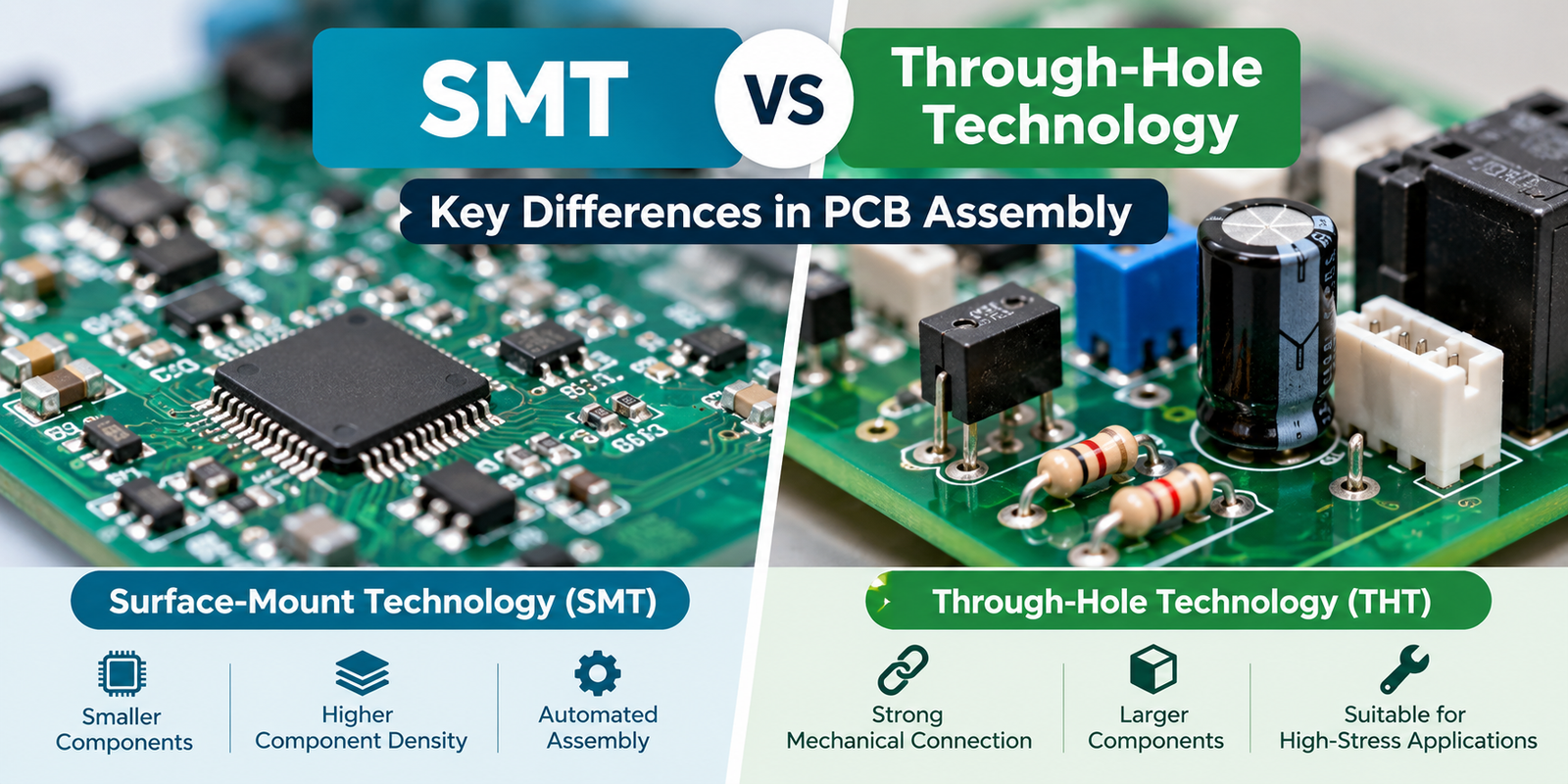
Printed circuit boards (PCBs) power almost every modern electronic device. Manufacturers use different methods to attach components to a PCB. The two common methods are Surface-Mount Technology (SMT) and Through-Hole Technology (THT).
Both methods have different strengths. Understanding Surface-Mount Technology vs Through-Hole Technology can help hardware designers choose the right method for their products.
What Is Surface-Mount Technology?
Surface-Mount Technology (SMT) places electronic components directly on the surface of a PCB.
Manufacturers use automated machines to place SMT components on solder paste. The PCB then passes through a reflow oven. Heat melts the solder and creates strong electrical connections.
Common SMT components include:
- Resistors and capacitors
- Microcontrollers
- Integrated circuits
- Sensors
- Diodes and transistors
- Communication modules
SMT works well for compact products because its small components save PCB space.
What Is Through-Hole Technology?
Through-Hole Technology (THT) uses components with leads that pass through holes in a PCB.
Manufacturers insert the component leads into the drilled holes and solder them to the board. This process creates a strong mechanical connection.
Common through-hole components include:
- Connectors
- Switches
- Relays
- Transformers
- Large capacitors
- Power components
THT works well for products that need strong mechanical connections.
SMT vs Through-Hole Technology
The main difference lies in how the components connect to the PCB.
| Feature | SMT | Through-Hole |
|---|---|---|
| Mounting | PCB surface | Through PCB holes |
| Component size | Smaller | Larger |
| PCB space | Uses less space | Uses more space |
| Assembly | Highly automated | More manual work |
| Production speed | Faster | Usually slower |
| Component density | High | Lower |
| Mechanical strength | Good | Very strong |
| Common use | Compact electronics | Industrial and power electronics |
Key Differences Between SMT and THT
1. Component Size
SMT components take up less space than most through-hole components. This allows designers to build smaller PCBs.
Through-hole components need space for both the component body and the holes. Therefore, they usually require more board space.
2. Manufacturing Process
SMT supports automated PCB assembly. Pick-and-place machines can position thousands of components quickly. Reflow soldering then connects the components to the PCB.
THT assembly often requires more manual work. Manufacturers may insert components by hand or use special insertion machines.
Therefore, SMT works especially well for large production volumes.
3. Mechanical Strength
Through-hole components offer strong mechanical connections because their leads pass through the PCB.
For this reason, designers often use THT for connectors, switches, transformers, and other components that face physical stress.
SMT components also provide reliable connections when designers use the correct PCB layout and assembly process.
4. PCB Space
SMT helps designers create high-density PCB layouts. Designers can place small components close together and use both sides of the PCB.
Through-hole components need drilled holes and additional space. This limits the available area for routing and component placement.
5. Cost and Production
SMT can reduce assembly costs in high-volume production. Automated machines can place components quickly and accurately.
THT may cost more to assemble when manufacturers need more manual work. However, THT can remain practical for prototypes, low-volume products, and large components.
Can SMT and THT Work Together?
Yes. Many modern PCBs use both technologies.
For example, designers can use SMT for:
- Microcontrollers
- Resistors
- Capacitors
- Sensors
- Small ICs
They can use THT for:
- Connectors
- Switches
- Large capacitors
- Transformers
- Power components
This mixed approach gives designers more flexibility.
When Should You Choose SMT?
SMT works well when you need:
- A compact PCB
- High component density
- Fast automated assembly
- Large production volumes
- Lightweight electronics
Manufacturers commonly use SMT in IoT devices, computers, smartphones, communication equipment, and consumer electronics.
When Should You Choose Through-Hole Technology?
THT works well when you need:
- Strong mechanical connections
- Large components
- High-power components
- Easy manual assembly
- Components that face physical stress
Industrial equipment, power electronics, test equipment, and some specialized hardware still use THT.
Conclusion
Surface-Mount Technology and Through-Hole Technology both play important roles in PCB manufacturing.
SMT supports compact designs, high component density, and fast automated production. THT provides strong mechanical connections and works well for larger or high-stress components.
In many cases, designers combine both technologies on one PCB. The right choice depends on the product size, component type, production volume, mechanical requirements, and manufacturing process.
Frequently Asked Questions
What is the main difference between SMT and through-hole technology?
SMT places components directly on the PCB surface. THT inserts component leads through holes in the PCB.
Is SMT better than through-hole technology?
Neither method works best for every product. SMT suits compact, high-density electronics, while THT suits products that need strong mechanical connections.
Can SMT and THT work on the same PCB?
Yes. Many manufacturers combine SMT and THT components on the same PCB.
Why do manufacturers use SMT?
SMT allows manufacturers to build compact PCBs and automate the assembly process. It also supports high component density and large production volumes.