
Embedded systems power products that interact with the physical world. From IoT sensors and industrial controllers to smart appliances and medical devices, these systems need firmware that responds quickly and reliably.
However, engineers have an important decision to make when developing embedded firmware: Should the system use bare-metal programming or a real-time operating system (RTOS)?
Both approaches have advantages. However, they solve different engineering problems.
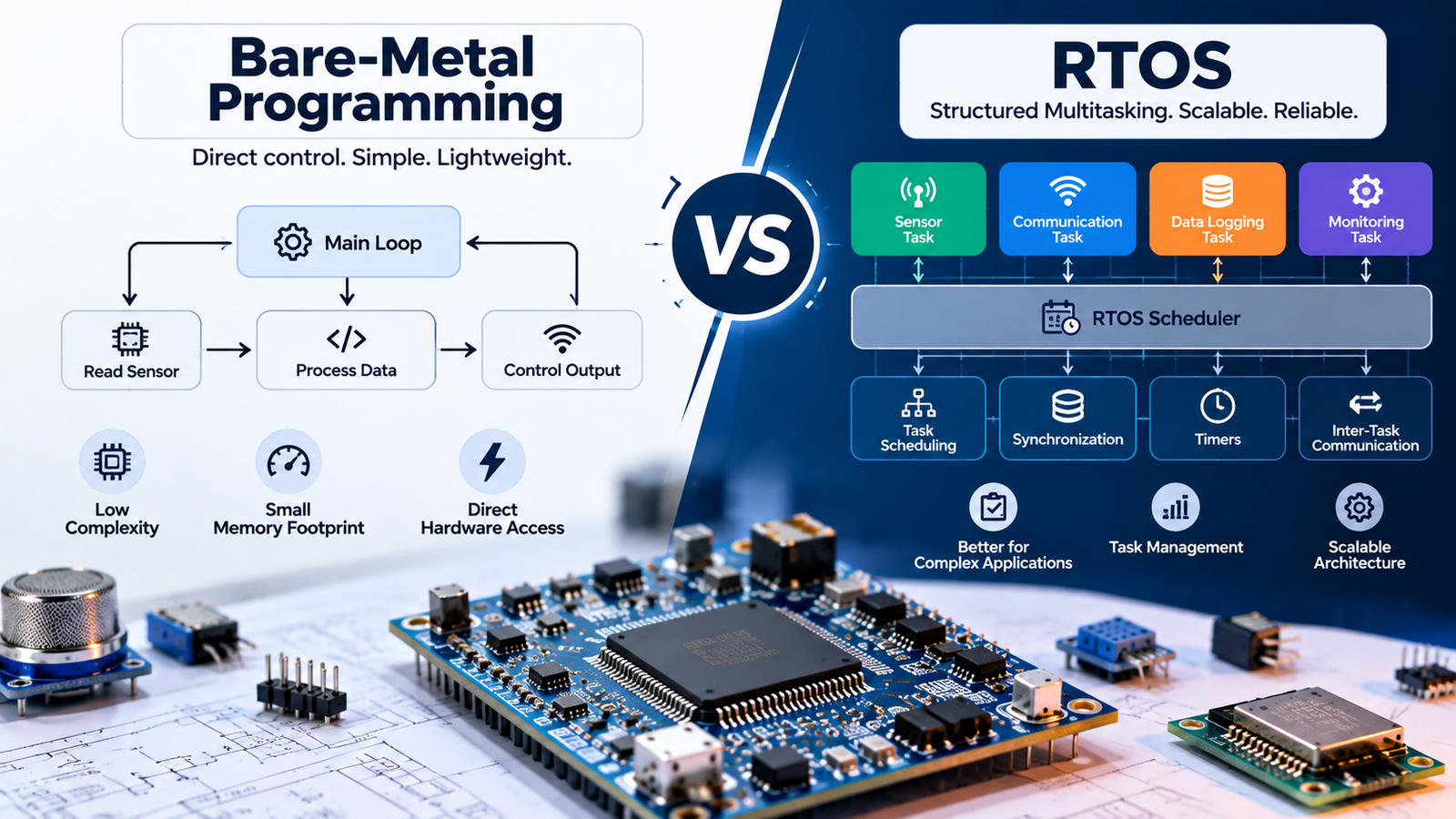
Bare-metal programming gives developers direct control over the microcontroller. In contrast, an RTOS provides task management, scheduling, synchronization, and other services that help developers build more complex firmware.
Therefore, the right choice depends on the product requirements rather than a simple preference for one approach.
In this guide, we will compare RTOS vs bare-metal programming, explain how each approach works, and show when each one makes sense for an embedded system.
What Is Bare-Metal Programming?
Bare-metal programming means running firmware directly on a microcontroller without a general-purpose operating system or RTOS managing the application.
The firmware typically interacts directly with:
- CPU registers
- GPIO
- Timers
- Interrupts
- ADCs
- UART
- SPI
- I2C
- PWM
- Memory
For example, a simple temperature sensor may read data from a sensor, process the measurement, and send the result through a communication interface.
The firmware can perform these operations directly without an operating system.
As a result, bare-metal systems can remain small and efficient.
What Is an RTOS?
An RTOS, or Real-Time Operating System, provides a structured environment for running multiple tasks on an embedded device.
Instead of placing all application logic inside one main loop, developers can divide the firmware into separate tasks.
For example, an IoT device might have:
- A sensor task
- A communication task
- A data-processing task
- A storage task
- A monitoring task
The RTOS scheduler manages when these tasks run.
In addition, an RTOS can provide services such as:
- Task scheduling
- Queues
- Semaphores
- Mutexes
- Timers
- Event handling
- Inter-task communication
- Memory management
Therefore, an RTOS can make complex embedded applications easier to organize and maintain.
RTOS vs Bare-Metal: What Is the Difference?
The main difference is how the firmware manages execution.
With bare-metal programming, developers generally control the program flow directly.
With an RTOS, the operating system manages multiple tasks according to scheduling rules and system priorities.
| Feature | Bare-Metal | RTOS |
|---|---|---|
| Operating system | No | Yes |
| Direct hardware control | Very high | High |
| Task management | Developer-managed | RTOS-managed |
| Memory footprint | Usually smaller | Usually larger |
| Architecture | Simple to complex | Structured for multitasking |
| Scheduling | Manual | Scheduler-based |
| Multitasking | Usually limited or custom | Built-in task management |
| Development complexity | Lower for simple systems | Better structured for complex systems |
| Resource requirements | Lower | Higher |
| Scalability | Limited for complex applications | Stronger for multitasking applications |
Neither approach is automatically better.
Instead, engineers should choose according to the product’s performance, timing, memory, power, and scalability requirements.
1. Performance and Response Time
Performance matters in almost every embedded system.
Bare-metal firmware can provide very direct control over execution. Because the application does not need an RTOS scheduler, the firmware can have a small execution path.
For simple applications, this can provide predictable behavior with very little overhead.
However, complex systems require more than raw execution speed.
For example, an IoT gateway may need to:
- Collect sensor data
- Process information
- Communicate with another device
- Store data
- Monitor system health
Managing all these operations manually can make the firmware difficult to maintain.
An RTOS can organize these operations into separate tasks. Consequently, developers can manage complex workloads more systematically.
Therefore, the best approach depends on the workload rather than on performance alone.
2. Memory Usage
Memory is an important consideration in embedded systems.
Microcontrollers often have limited:
- Flash memory
- RAM
- CPU resources
- Storage
Bare-metal firmware usually has a smaller software footprint because it does not require an RTOS kernel and associated services.
Therefore, bare-metal programming can work well for small microcontrollers with tight memory constraints.
An RTOS requires additional memory for the kernel, task stacks, scheduling structures, and other services.
However, the extra memory requirement can provide significant benefits when the application needs multiple concurrent tasks.
As a result, engineers should evaluate the available memory before selecting an architecture.
3. Firmware Complexity
Simple firmware can work very well with a bare-metal architecture.
For example, consider a basic device that performs the following sequence:
Read sensor → Process value → Control output → Repeat
A simple main loop may handle this application efficiently.
However, firmware becomes more complicated when the device must perform several operations at the same time.
For example:
Sensor acquisition + Bluetooth communication + data logging + user interface + system monitoring
Managing all these functions inside a single loop can make the code harder to understand.
An RTOS can separate these functions into independent tasks.
Therefore, an RTOS often becomes useful as firmware complexity increases.
4. Real-Time Requirements
Real-time behavior is another important factor.
A real-time system must respond to events within defined timing requirements.
However, “real-time” does not simply mean “very fast.”
Instead, the system needs predictable timing behavior for the tasks that matter.
For example, an industrial controller may need to respond to a sensor event within a defined time window.
Bare-metal firmware can provide highly controlled execution for simple systems.
Meanwhile, an RTOS can provide priority-based scheduling and timing mechanisms that help developers manage multiple time-sensitive tasks.
Therefore, engineers should define the system’s timing requirements before choosing the firmware architecture.
5. Interrupt Handling
Interrupts allow a microcontroller to respond to hardware events.
For example, an interrupt may occur when:
- A sensor produces new data
- A timer reaches a specific value
- A communication packet arrives
- A GPIO signal changes
- A hardware fault occurs
Bare-metal applications often handle interrupts directly and then execute the required logic.
With an RTOS, an interrupt can trigger or notify an RTOS task.
For example, an interrupt may signal a sensor task that new data has arrived. The task can then process the data outside the interrupt service routine.
This approach can make complex systems easier to structure.
However, developers still need to design interrupt handling carefully in both architectures.
6. Power Consumption
Power efficiency is especially important for battery-powered IoT devices.
A simple bare-metal application can enter low-power modes when it has no work to perform.
For example, a sensor can:
- Wake up
- Read the sensor
- Process the result
- Transmit the data
- Return to sleep
This approach can provide efficient power management for simple devices.
An RTOS can also support low-power designs. However, developers must carefully manage task activity, timers, communication, and wake-up events.
Therefore, power consumption depends more on the complete firmware architecture than simply on whether the product uses bare-metal or an RTOS.
7. Development and Maintenance
Bare-metal programming can remain easy to understand when the application is small.
However, complexity can increase quickly as developers add more features.
A large main loop can become difficult to maintain. Similarly, extensive interrupt-driven logic can create dependencies that make debugging harder.
An RTOS provides a more structured architecture.
Developers can organize firmware into separate tasks and communication mechanisms.
For example:
- Task A handles sensors.
- Task B handles communications.
- Task C manages storage.
- Task D monitors system health.
As a result, teams can often maintain larger firmware projects more easily.
However, developers also need a strong understanding of RTOS concepts to avoid problems such as deadlocks, race conditions, priority inversion, and excessive task creation.
8. Scalability
Scalability becomes important when a product will receive new features over time.
A simple embedded device may initially require only one or two functions.
Later, the product may need:
- Wireless communication
- Data logging
- Firmware updates
- Security
- Diagnostics
- Multiple sensors
- Cloud connectivity
With a bare-metal architecture, developers can add these features manually.
However, the architecture can become increasingly difficult to manage as the number of functions grows.
An RTOS provides a framework for organizing multiple tasks.
Therefore, an RTOS can be a practical choice when engineers expect the firmware to become more complex.
When Should You Choose Bare-Metal Programming?
Bare-metal programming can make sense when the application is relatively simple and resource constraints are important.
Consider bare-metal when the system has:
- A simple control loop
- Limited memory
- Low software complexity
- Strict resource constraints
- Few concurrent operations
- Simple timing requirements
- Minimal communication requirements
For example, a small sensor node that wakes periodically, measures one or two values, transmits the result, and returns to sleep may not need an RTOS.
In such a case, a simple firmware architecture can reduce software complexity and resource usage.
When Should You Choose an RTOS?
An RTOS becomes more attractive when the application needs multiple concurrent operations.
Consider an RTOS when the system requires:
- Multiple independent tasks
- Task prioritization
- Complex communication
- Structured multitasking
- Advanced timing requirements
- Background processing
- Networking
- Data logging
- Firmware updates
- Future feature expansion
For example, an industrial IoT gateway may need to collect sensor data, communicate over a network, store information, monitor hardware, and process commands.
Managing all these functions manually can become difficult.
Therefore, an RTOS can provide a more structured foundation.
Common Mistakes When Choosing Between RTOS and Bare-Metal
Choosing an RTOS for Every Project
An RTOS can provide powerful features. However, a simple application may not need them.
Adding unnecessary software complexity can increase development and debugging effort.
Therefore, use an RTOS when the application actually benefits from its capabilities.
Avoiding an RTOS When the Firmware Is Already Complex
The opposite problem can also occur.
Developers sometimes continue expanding a bare-metal application even after it has become difficult to manage.
As a result, the code can become harder to debug and maintain.
At that point, an RTOS may provide a cleaner architecture.
Ignoring Memory Constraints
Developers should evaluate RAM and Flash requirements before selecting an RTOS.
Similarly, they should estimate application growth rather than considering only the initial firmware version.
Focusing Only on CPU Speed
A faster processor does not automatically solve software architecture problems.
Instead, engineers should consider task scheduling, timing requirements, communication, memory, power, and maintainability.
Designing Firmware Separately From Hardware
Firmware and hardware influence each other.
For example, processor selection, memory size, communication interfaces, timers, interrupts, and power architecture all affect firmware design.
Therefore, hardware and firmware teams should work together from the early stages of development.
RTOS vs Bare-Metal Decision Checklist
Before selecting an architecture, ask the following questions:
Application Complexity
- How many independent functions does the device need?
- Do multiple operations need to run concurrently?
Timing
- What are the system’s response-time requirements?
- Does the application require predictable task scheduling?
Memory
- How much RAM and Flash does the microcontroller provide?
- How much memory can the firmware use?
Power
- Is the device battery-powered?
- How frequently does the system need to wake up?
Connectivity
- Does the product require Wi-Fi, Bluetooth, cellular, Ethernet, or another communication technology?
Scalability
- Will the product receive new features later?
- Will firmware updates add more tasks or services?
Team Expertise
- Does the development team have experience with RTOS concepts?
- Can the team debug concurrency and synchronization issues?
Maintenance
- Will the firmware need long-term maintenance?
- Will several developers work on the codebase?
The answers to these questions can help engineers select a suitable architecture.
Can Bare-Metal and RTOS Approaches Work Together?
Yes.
An embedded system does not always need to follow a completely rigid architecture.
Developers can use different execution models for different parts of a system.
For example, time-critical hardware handling may rely heavily on interrupts and direct hardware access, while higher-level application logic runs through RTOS tasks.
This approach can provide both low-level control and structured application management.
However, developers need clear boundaries between interrupt routines, drivers, tasks, and application logic.
Good architecture prevents unnecessary dependencies and makes the system easier to debug.
How the Choice Affects Embedded Product Development
The RTOS vs bare-metal decision can influence several stages of product development.
It can affect:
- Microcontroller selection
- RAM and Flash requirements
- Power architecture
- Firmware structure
- Driver development
- Communication design
- Testing
- Debugging
- Product scalability
- Long-term maintenance
Therefore, engineers should make the decision during system architecture rather than waiting until firmware development has already started.
Hashing Hardware’s embedded engineering capabilities include microcontroller programming, RTOS development, device-driver architecture, and firmware optimization. This makes the RTOS-versus-bare-metal decision relevant to the broader hardware and firmware architecture of an embedded product.
RTOS vs Bare-Metal: A Practical Comparison
| Requirement | Bare-Metal | RTOS |
|---|---|---|
| Simple sensor | Suitable | May be unnecessary |
| Simple controller | Suitable | May be unnecessary |
| Very limited memory | Often suitable | Depends on available resources |
| Multiple concurrent tasks | More difficult | Suitable |
| Complex communication | Can become difficult | Often suitable |
| Large firmware project | Can become harder to maintain | More structured |
| Strict resource constraints | Strong option | Requires careful planning |
| Future feature expansion | Can become challenging | Often easier to scale |
| Task prioritization | Custom implementation | Built-in scheduling |
| Complex application architecture | More development effort | Stronger structure |
This comparison is not a universal rule.
Instead, engineers should evaluate the complete system before making the final decision.
Final Thoughts
The choice between RTOS vs bare-metal programming is not about choosing the more advanced technology.
It is about choosing the architecture that fits the product.
Bare-metal programming can provide a lightweight and direct approach for simple embedded applications. On the other hand, an RTOS can provide structured task management for systems that need multiple concurrent operations.
Therefore, engineers should evaluate:
- Application complexity
- Timing requirements
- Memory
- Power consumption
- Connectivity
- Scalability
- Team expertise
- Long-term maintenance
Most importantly, the firmware architecture should support the product’s actual requirements.
A simple device does not need unnecessary complexity. Similarly, a complex connected product may become difficult to maintain if developers force everything into a single bare-metal loop.
The right architecture starts with understanding the system.
When engineers choose the firmware architecture early and align it with the hardware, they can build embedded products that are easier to develop, test, maintain, and scale.