
Introduction
Modern digital infrastructure relies heavily on high-performance networking systems to support cloud computing, enterprise applications, edge computing, IoT ecosystems, telecommunications, streaming platforms, and data-intensive workloads. As network traffic continues to grow exponentially, traditional network management approaches are becoming increasingly difficult to scale efficiently.
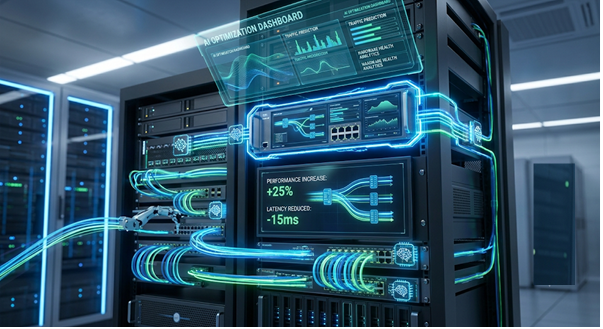
Modern networks generate enormous volumes of operational data, including traffic patterns, device performance metrics, latency measurements, security events, and infrastructure health indicators. Managing these complex environments manually is no longer practical in large-scale enterprise and cloud infrastructures.
To address these challenges, organizations are adopting AI-Powered Network Hardware Optimization technologies. Artificial Intelligence enables networking hardware to automatically analyze traffic, optimize routing, predict failures, improve bandwidth utilization, reduce latency, enhance security, and dynamically adapt to changing network conditions.
By combining AI algorithms with advanced networking hardware, organizations can create intelligent, self-optimizing communication systems capable of delivering higher performance, improved reliability, lower operational costs, and better user experiences.
What Is AI-Powered Network Hardware Optimization?
AI-Powered Network Hardware Optimization refers to the use of Artificial Intelligence and Machine Learning techniques to improve the performance, efficiency, reliability, and security of networking hardware systems.
AI systems analyze data from:
- Routers
- Switches
- Firewalls
- Wireless infrastructure
- Edge devices
- Data center networks
To make intelligent real-time decisions regarding:
- Traffic management
- Resource allocation
- Routing optimization
- Security enforcement
- Predictive maintenance
This creates adaptive and autonomous networking environments.
Why Modern Networks Need AI Optimization
Traditional network management methods rely heavily on manual configuration and static rules.
However, modern networks face growing challenges such as:
- Massive traffic growth
- Dynamic workloads
- Complex cloud architectures
- Real-time application demands
- Increasing cybersecurity threats
- IoT device expansion
AI helps networks respond intelligently and automatically to these evolving conditions.
Core Components of AI-Optimized Networking Hardware
Intelligent Routers
AI-enabled routers dynamically optimize traffic flow based on real-time conditions.
Capabilities include:
- Congestion prediction
- Intelligent routing
- Traffic prioritization
- Adaptive bandwidth allocation
Smart Switches
AI-powered switches analyze traffic patterns to improve network efficiency.
Functions include:
- Dynamic packet forwarding
- Load balancing
- Latency optimization
- Security monitoring
AI-Driven Firewalls
Modern firewalls use machine learning for:
- Threat detection
- Traffic classification
- Behavioral analysis
- Automated response systems
Edge Networking Devices
Edge systems increasingly integrate AI acceleration for:
- Local traffic processing
- Real-time analytics
- Autonomous optimization
- Reduced cloud dependency
How AI Optimizes Networking Hardware
AI systems continuously collect and analyze network telemetry data.
The optimization process typically includes:
- Data collection
- Traffic analysis
- Pattern recognition
- Predictive modeling
- Automated decision-making
- Dynamic hardware adjustment
This creates intelligent self-learning networking systems.
Traffic Analysis Using AI
AI algorithms analyze network traffic in real time.
Capabilities
- Identifying congestion patterns
- Detecting unusual traffic behavior
- Predicting bandwidth requirements
- Monitoring application performance
This improves network efficiency and responsiveness.
Dynamic Routing Optimization
Traditional routing often uses static configurations.
AI-powered routing systems dynamically select optimal communication paths based on:
- Network congestion
- Latency conditions
- Bandwidth availability
- Device performance
- Traffic priority
This improves overall network reliability and speed.
Predictive Maintenance in Networking Hardware
Networking devices generate large volumes of operational data.
AI systems analyze this data to predict:
- Hardware failures
- Component degradation
- Thermal issues
- Power anomalies
Benefits
- Reduced downtime
- Faster maintenance planning
- Lower operational costs
- Improved infrastructure reliability
Predictive maintenance is one of the most valuable AI networking applications.
AI-Based Bandwidth Optimization
Modern applications require intelligent bandwidth management.
AI systems optimize bandwidth by:
- Prioritizing critical applications
- Detecting inefficient usage
- Dynamically reallocating resources
- Reducing congestion
This improves user experience across enterprise networks.
Machine Learning for Network Traffic Classification
Machine learning models can automatically classify network traffic types.
Examples include:
- Video streaming
- Voice communication
- Cloud applications
- Gaming traffic
- IoT device communication
This enables intelligent traffic shaping and policy enforcement.
AI-Powered Load Balancing
Load balancing distributes traffic across multiple devices or servers.
AI improves load balancing through:
- Predictive traffic distribution
- Real-time workload analysis
- Dynamic infrastructure scaling
This improves system stability and application performance.
AI in Wireless Network Optimization
Wireless environments are highly dynamic and interference-prone.
AI helps optimize:
- Signal strength
- Channel selection
- Beamforming
- User distribution
- Wireless interference mitigation
These capabilities are critical for modern Wi-Fi and 5G networks.
Smart Antenna Optimization
AI-driven smart antenna systems dynamically adjust signal direction and power.
Benefits
- Improved wireless coverage
- Reduced interference
- Better energy efficiency
- Enhanced user connectivity
AI-powered beamforming is especially important in 5G infrastructure.
AI for Data Center Networking
Data centers operate highly complex networking environments.
AI optimizes:
- East-west traffic flow
- Virtualized network performance
- Cloud connectivity
- Storage networking
- Resource allocation
This improves scalability and operational efficiency.
AI-Driven Network Security
Cybersecurity is a major component of network optimization.
Threat Detection
AI identifies abnormal traffic behavior and suspicious activities.
Anomaly Analysis
Machine learning detects previously unknown attack patterns.
Automated Threat Response
AI systems can:
- Isolate compromised devices
- Block malicious traffic
- Update security policies automatically
Behavioral Monitoring
Continuous monitoring improves network resilience against cyber threats.
Edge AI and Networking Hardware
Edge computing is transforming network architectures.
Why Edge AI Matters
Local AI processing reduces:
- Latency
- Bandwidth usage
- Cloud dependency
Applications
- Industrial automation
- Autonomous vehicles
- Smart cities
- IoT ecosystems
AI-powered edge networking improves real-time decision-making.
Energy Efficiency Through AI Optimization
Networking infrastructure consumes significant electrical power.
AI improves energy efficiency by:
- Dynamically adjusting hardware workloads
- Optimizing cooling systems
- Reducing idle power consumption
- Predicting resource demand
This lowers operational costs and environmental impact.
AI and Software-Defined Networking (SDN)
Software-Defined Networking separates control logic from hardware infrastructure.
AI enhances SDN by enabling:
- Intelligent traffic orchestration
- Autonomous network management
- Dynamic policy enforcement
- Self-optimizing communication paths
AI and SDN together create highly adaptive networking environments.
Network Automation Using AI
AI enables advanced network automation capabilities.
Automated Configuration
AI systems can configure devices dynamically.
Self-Healing Networks
Networks automatically recover from failures.
Intelligent Resource Provisioning
Resources scale automatically based on demand.
Automation reduces human error and operational complexity.
Digital Twin Technology for Network Optimization
Digital twins create virtual models of networking infrastructure.
AI-powered digital twins help:
- Simulate network behavior
- Predict failures
- Test optimization strategies
- Improve infrastructure planning
This enhances operational reliability.
Challenges in AI-Powered Network Optimization
Large Data Requirements
AI systems require massive amounts of operational data.
Model Complexity
Training advanced machine learning models can be computationally expensive.
Security Risks
AI systems themselves may become attack targets.
Hardware Compatibility
Legacy infrastructure may not support AI integration.
Real-Time Processing Demands
Low-latency optimization requires high-performance hardware.
Hardware Acceleration for AI Networking
AI workloads require specialized processing hardware.
AI Accelerators
Networking systems increasingly integrate:
- GPUs
- TPUs
- FPGA accelerators
- AI inference engines
These processors improve real-time AI performance.
AI in 5G and Future Wireless Networks
5G infrastructure depends heavily on intelligent optimization.
AI supports:
- Massive MIMO optimization
- Beamforming
- Dynamic spectrum allocation
- Low-latency communication
Future 6G networks will likely rely even more heavily on AI-driven infrastructure.
AI and IoT Networking
IoT environments create highly distributed communication systems.
AI helps manage:
- Device authentication
- Traffic prioritization
- Energy-efficient communication
- Edge processing
This improves scalability and reliability.
Future Trends in AI-Powered Networking Hardware
Autonomous Self-Managing Networks
Networks capable of operating with minimal human intervention.
AI-Native Networking Hardware
Devices designed specifically for integrated AI processing.
Quantum Networking Optimization
AI-assisted optimization for future quantum communication systems.
Intent-Based Networking
Networks automatically adapting to business objectives.
Distributed Edge Intelligence
Collaborative AI optimization across distributed edge systems.
Applications Across Industries
Enterprise IT Infrastructure
Optimizing business communication systems.
Cloud Computing
Managing hyperscale data center networking.
Telecommunications
Improving mobile and broadband networks.
Healthcare
Supporting real-time medical communication systems.
Industrial Automation
Enhancing smart manufacturing infrastructure.
Smart Cities
Managing urban connectivity and IoT deployments.
Educational Importance
Studying AI-powered networking provides knowledge in:
- Artificial Intelligence
- Computer Networks
- Embedded Systems
- Cloud Computing
- Cybersecurity
- Wireless Communication
- Data Analytics
These interdisciplinary skills are highly valuable in modern technology industries.
Conclusion
AI-Powered Network Hardware Optimization is transforming modern communication infrastructure by enabling intelligent, adaptive, and autonomous networking systems. Through machine learning, predictive analytics, real-time traffic analysis, automated security enforcement, and intelligent resource management, AI significantly improves network performance, scalability, reliability, and operational efficiency.
As organizations continue expanding cloud infrastructure, IoT ecosystems, edge computing deployments, and high-speed wireless networks, AI-driven networking hardware will become increasingly essential. Although challenges related to data processing, infrastructure integration, security, and computational complexity remain significant, ongoing advancements in AI acceleration, edge intelligence, and autonomous networking technologies are rapidly reshaping the future of digital communication infrastructure.
The next generation of networks will not simply transport data — they will intelligently understand, optimize, protect, and adapt themselves in real time using AI-powered hardware systems.