
Introduction
The modern digital world depends heavily on the rapid movement of enormous volumes of data across global communication networks. Cloud computing, video streaming, artificial intelligence, financial systems, telecommunications, edge computing, smart cities, and hyperscale data centers all require high-speed, low-latency, and highly reliable data transmission technologies.
Traditional copper-based communication systems face limitations in bandwidth, signal attenuation, electromagnetic interference, and transmission distance. To overcome these challenges, industries increasingly rely on Optical Fiber Hardware for ultra-fast data transfer.
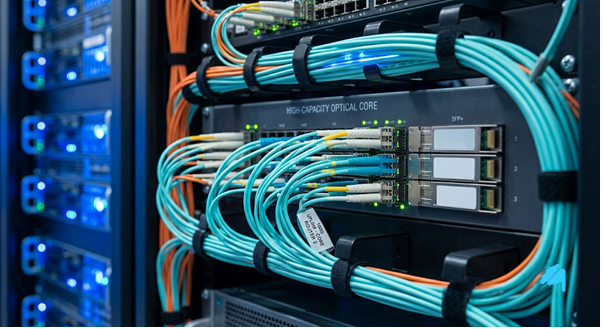
Optical fiber technology uses light signals to transmit data through ultra-thin glass or plastic fibers at extremely high speeds across long distances with minimal signal loss. Combined with advanced networking hardware, optical fiber infrastructure forms the backbone of modern internet communication, enterprise networking, telecommunications systems, and next-generation digital infrastructure.
As global demand for bandwidth and connectivity continues to grow, optical fiber hardware is becoming one of the most important technologies driving the future of ultra-fast communication systems.
What Is Optical Fiber Communication?
Optical fiber communication is a technology that transmits information using light signals through thin strands of optical fiber.
Unlike electrical communication systems, optical networks use:
- Laser signals
- Light pulses
- Optical transceivers
- Fiber optic cables
To achieve extremely high-speed data transmission.
This allows communication systems to support massive bandwidth and long-distance connectivity.
Why Optical Fiber Is Important
Modern digital applications generate enormous amounts of network traffic.
Examples include:
- Cloud computing
- AI model training
- Video streaming
- 5G infrastructure
- Financial transactions
- Scientific computing
- IoT ecosystems
Optical fiber provides the speed and scalability required to support these applications efficiently.
Advantages of Optical Fiber Hardware
Ultra-High Bandwidth
Optical fiber supports significantly higher bandwidth than copper cables.
Long-Distance Transmission
Signals can travel long distances with minimal loss.
Low Latency
Optical communication enables faster data transfer speeds.
Electromagnetic Immunity
Fiber optics are resistant to electromagnetic interference.
Higher Security
Intercepting optical signals is more difficult than tapping electrical communication lines.
Energy Efficiency
Optical systems can reduce power consumption in large-scale networks.
Basic Working Principle of Optical Fiber
Optical communication systems convert electrical signals into light signals.
The general process includes:
- Electrical signal generation
- Optical signal conversion
- Light transmission through fiber
- Signal reception
- Optical-to-electrical conversion
This process enables ultra-fast communication across networks.
Core Components of Optical Fiber Hardware
Optical Fiber Cables
The fiber cable is the transmission medium for light signals.
It consists of:
- Core
- Cladding
- Protective coating
The core carries the light signal through internal reflection.
Optical Transceivers
Transceivers convert electrical data into optical signals and vice versa.
Functions include:
- Signal encoding
- Light generation
- Optical reception
- Data decoding
These devices are essential for fiber communication systems.
Laser Sources
Lasers generate the optical signals transmitted through fibers.
Requirements include:
- Stable wavelength
- High signal precision
- Fast modulation capability
Laser quality significantly impacts transmission performance.
Photodetectors
Photodetectors convert received light back into electrical signals.
Common detector technologies include:
- PIN photodiodes
- Avalanche photodiodes
These components influence receiver sensitivity and accuracy.
Types of Optical Fiber
Single-Mode Fiber
Single-mode fiber supports one light propagation path.
Advantages
- Extremely long transmission distances
- Higher bandwidth
- Lower signal distortion
Widely used in telecommunications and data centers.
Multimode Fiber
Multimode fiber supports multiple light paths.
Advantages
- Lower cost
- Easier installation
- Suitable for shorter distances
Common in enterprise and local-area networks.
Optical Networking Hardware
Modern optical networks use advanced hardware systems.
Optical Switches
Route optical signals across communication networks.
Optical Amplifiers
Boost weakened light signals without electrical conversion.
Wavelength Division Multiplexers
Allow multiple signals to travel simultaneously through a single fiber.
Optical Routers
Manage high-speed optical traffic.
These technologies improve network scalability and efficiency.
Wavelength Division Multiplexing (WDM)
WDM enables multiple optical signals to share a single fiber.
How It Works
Different wavelengths carry separate communication channels.
Benefits
- Massive bandwidth expansion
- Efficient fiber utilization
- Improved network scalability
WDM is critical for modern ultra-high-capacity communication systems.
Dense Wavelength Division Multiplexing (DWDM)
DWDM is an advanced form of WDM supporting extremely high channel density.
Applications
- Long-haul telecom networks
- Cloud infrastructure
- Hyperscale data centers
Advantages
- Ultra-high bandwidth
- Long-distance communication
- Efficient spectrum utilization
Optical Amplification Technologies
Long-distance optical signals weaken over time.
Erbium-Doped Fiber Amplifiers (EDFA)
Amplify optical signals directly without electrical conversion.
Benefits
- Reduced latency
- Improved signal quality
- Efficient long-distance transmission
Optical amplification is essential for global communication infrastructure.
Optical Fiber in Data Centers
Modern data centers require extremely high-speed communication.
Optical fiber supports:
- Server interconnects
- Storage networking
- Cloud communication
- AI infrastructure
- High-performance computing
Fiber connectivity improves bandwidth and reduces latency within large-scale data centers.
AI and Optical Networking
Artificial Intelligence increasingly optimizes optical communication systems.
AI-Based Traffic Management
Machine learning predicts network congestion patterns.
Optical Signal Optimization
AI dynamically adjusts transmission parameters.
Predictive Maintenance
AI detects potential fiber failures before disruptions occur.
Autonomous Optical Networks
Self-optimizing communication systems improve network reliability.
Optical Fiber for 5G and Future Networks
5G infrastructure requires massive data transfer capacity.
Optical fiber enables:
- High-speed backhaul communication
- Low-latency connectivity
- Massive wireless traffic support
Future 6G networks will likely depend even more heavily on optical infrastructure.
Fiber Optics in Edge Computing
Edge computing environments require low-latency communication.
Optical fiber supports:
- Fast edge-to-cloud communication
- Real-time analytics
- Distributed AI systems
- Industrial automation
This improves responsiveness and scalability.
Optical Fiber and Cloud Computing
Cloud platforms generate enormous network traffic volumes.
Fiber infrastructure enables:
- High-speed cloud access
- Data replication
- Virtualized networking
- AI workload distribution
Optical networking is essential for modern cloud ecosystems.
Security Advantages of Optical Fiber
Optical communication offers several security benefits.
Reduced Electromagnetic Leakage
Fiber cables do not emit electromagnetic interference.
Difficult Signal Interception
Physical fiber tapping is more complex than copper interception.
Secure Long-Distance Communication
Optical systems improve data confidentiality.
Challenges in Optical Fiber Hardware
High Infrastructure Costs
Fiber deployment can be expensive.
Installation Complexity
Fiber systems require precise installation techniques.
Signal Loss and Dispersion
Long-distance transmission may still experience signal degradation.
Fiber Fragility
Optical fibers are more delicate than copper cables.
Specialized Hardware Requirements
Optical systems require advanced transceivers and networking equipment.
Thermal Management in Optical Hardware
High-speed optical systems generate significant heat.
Cooling Requirements
Optical transceivers and switches require efficient cooling systems.
Thermal Stability
Temperature variations can affect optical signal quality.
Advanced thermal engineering improves system reliability.
Silicon Photonics
Silicon photonics integrates optical communication directly onto semiconductor chips.
Advantages
- Higher integration density
- Lower power consumption
- Faster communication
- Improved scalability
Silicon photonics is becoming increasingly important in AI and cloud infrastructure.
Optical Interconnects in AI Infrastructure
AI systems require massive internal data movement.
Optical interconnects improve:
- GPU communication
- AI cluster networking
- Distributed model training
- High-performance computing efficiency
This supports large-scale AI workloads.
Quantum Communication and Optical Fiber
Quantum networking technologies increasingly rely on optical communication.
Applications
- Quantum key distribution
- Secure communication
- Quantum internet research
Optical fibers provide ideal transmission media for quantum signals.
Future Trends in Optical Fiber Hardware
Terabit Optical Networking
Ultra-high-speed communication systems supporting terabit-level bandwidth.
AI-Optimized Optical Networks
Intelligent autonomous communication infrastructure.
Integrated Photonic Chips
Advanced optical processing within semiconductor devices.
Hollow-Core Fiber Technology
Lower latency and improved transmission efficiency.
Quantum Optical Networks
Next-generation secure communication systems.
Applications Across Industries
Telecommunications
Global internet and mobile infrastructure.
Cloud Computing
High-speed data center communication.
Healthcare
Medical imaging and remote diagnostics.
Financial Systems
Ultra-low-latency transaction networks.
Industrial Automation
Real-time smart factory communication.
Scientific Research
Large-scale data transfer for simulations and analytics.
Educational Importance
Studying optical fiber hardware provides knowledge in:
- Optical Engineering
- Telecommunications
- Networking Systems
- Embedded Hardware
- Signal Processing
- Photonics
- High-Speed Communication
These interdisciplinary skills are highly valuable in modern technology industries.
Conclusion
Optical Fiber Hardware for Ultra-Fast Data Transfer is one of the most important technologies powering modern digital infrastructure. Through high-bandwidth optical communication, low-latency transmission, advanced networking hardware, AI-driven optimization, and scalable photonic technologies, optical fiber systems enable the enormous data transfer demands of cloud computing, telecommunications, AI infrastructure, data centers, and future intelligent networks.
As global connectivity requirements continue expanding and emerging technologies demand faster and more efficient communication systems, optical fiber hardware will remain central to the evolution of next-generation digital infrastructure. Although challenges related to cost, deployment complexity, signal management, and specialized hardware remain significant, ongoing advancements in photonics, AI optimization, silicon integration, and optical networking continue to drive innovation in ultra-fast communication technologies.
The future of digital communication will increasingly depend on intelligent optical infrastructure capable of delivering secure, scalable, and ultra-high-speed connectivity across the world.