
Introduction
Wireless communication has become one of the most essential foundations of modern digital infrastructure. From mobile networks and satellite communications to IoT systems, autonomous vehicles, industrial automation, and next-generation wireless connectivity, the demand for faster, more reliable, and higher-capacity communication systems continues to grow rapidly.
Traditional antenna systems often struggle to meet the increasing requirements of modern wireless networks, especially in environments with high user density, interference, signal fading, and limited spectrum availability. To overcome these challenges, advanced communication systems increasingly rely on Smart Antenna Hardware.
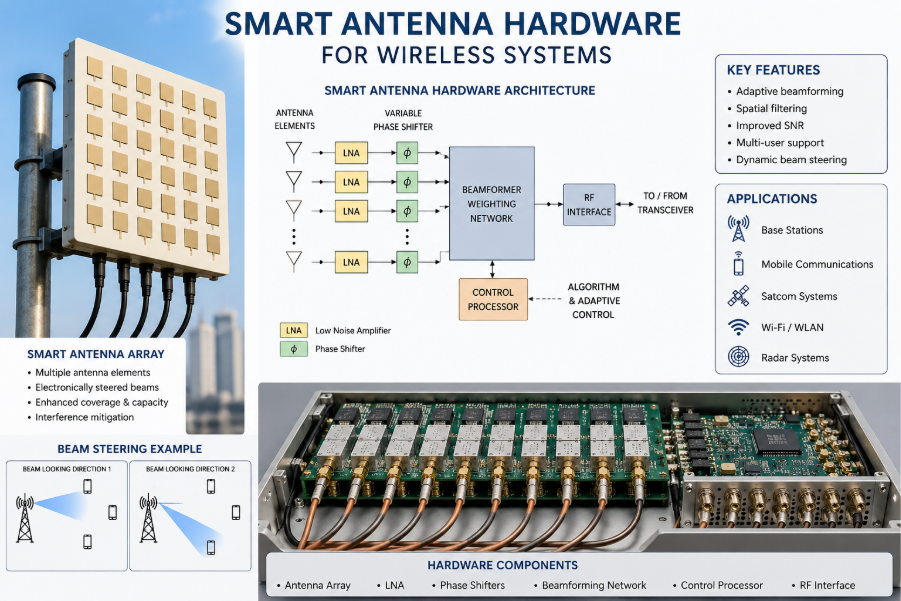
Smart antenna technology combines multiple antenna elements, signal processing hardware, beamforming techniques, and intelligent control systems to improve wireless communication performance. These systems dynamically optimize signal transmission and reception, enabling better coverage, higher bandwidth efficiency, reduced interference, and enhanced communication reliability.
As wireless technologies evolve toward 5G, 6G, IoT ecosystems, and edge-connected intelligent systems, smart antenna hardware is becoming a critical component of next-generation communication infrastructure.
What Is a Smart Antenna?
A smart antenna is an advanced antenna system that uses multiple antenna elements along with signal processing algorithms to dynamically optimize wireless communication.
Unlike traditional fixed antennas, smart antennas can:
- Adjust signal direction
- Focus transmission beams
- Reduce interference
- Improve signal quality
- Track user movement
This intelligent signal management significantly enhances wireless network performance.
Why Smart Antennas Are Important
Modern wireless systems face several major challenges:
- Increasing network congestion
- Limited radio spectrum
- Signal interference
- Multipath fading
- Growing bandwidth demands
Smart antennas help solve these problems by improving spectral efficiency and communication reliability.
Benefits include:
- Higher data rates
- Improved coverage
- Reduced interference
- Better energy efficiency
- Increased network capacity
Basic Working Principle of Smart Antennas
Smart antennas operate by combining antenna arrays with signal processing hardware.
The general process includes:
- Receiving wireless signals through multiple antenna elements
- Analyzing signal characteristics
- Identifying signal direction
- Dynamically adjusting transmission patterns
- Optimizing communication paths
This enables intelligent wireless communication management.
Types of Smart Antenna Systems
Switched Beam Antennas
Switched beam systems select from predefined antenna patterns.
How They Work
The system automatically chooses the strongest beam based on signal conditions.
Advantages
- Improved signal strength
- Reduced interference
- Lower hardware complexity
Limitations
Beam patterns remain fixed and less adaptive.
Adaptive Array Antennas
Adaptive antennas dynamically modify radiation patterns in real time.
Capabilities
- Continuous beam adjustment
- Interference suppression
- User tracking
- Dynamic optimization
Adaptive arrays provide superior performance compared to switched beam systems.
Core Components of Smart Antenna Hardware
Antenna Arrays
Smart antennas use multiple antenna elements arranged in specific configurations.
Common array types include:
- Linear arrays
- Circular arrays
- Planar arrays
- Phased arrays
Array geometry significantly affects system performance.
RF Front-End Circuits
The RF front-end processes incoming and outgoing radio signals.
Components include:
- Amplifiers
- Filters
- Mixers
- Frequency converters
These circuits are essential for signal quality and sensitivity.
Signal Processors
Digital signal processors analyze wireless signals and control beamforming operations.
Functions include:
- Signal filtering
- Direction estimation
- Beam steering
- Noise reduction
Modern systems increasingly use AI-assisted processing.
Beamforming Hardware
Beamforming circuits adjust signal phase and amplitude across antenna elements.
This allows the antenna system to:
- Focus signals toward users
- Minimize interference
- Improve communication range
Beamforming is one of the most important smart antenna technologies.
Beamforming Technology
Beamforming directs wireless signals toward specific targets instead of broadcasting in all directions.
Benefits
- Improved signal strength
- Reduced power wastage
- Better coverage
- Increased network efficiency
Analog Beamforming
Uses analog phase shifters to control antenna patterns.
Advantages include:
- Lower power consumption
- Simpler implementation
Digital Beamforming
Uses digital signal processing for more precise beam control.
Advantages include:
- Higher flexibility
- Better interference management
- Advanced multi-user support
Hybrid Beamforming
Combines analog and digital techniques to balance performance and efficiency.
Widely used in modern 5G systems.
Phased Array Antenna Systems
Phased arrays are advanced smart antenna architectures.
How They Work
Signal phase differences between antenna elements control beam direction electronically.
Advantages
- No mechanical movement required
- Fast beam steering
- High directional accuracy
Phased arrays are widely used in:
- 5G infrastructure
- Radar systems
- Satellite communication
- Defense applications
MIMO Technology and Smart Antennas
Multiple Input Multiple Output (MIMO) systems are closely related to smart antennas.
How MIMO Works
Multiple antennas transmit and receive data simultaneously.
Benefits
- Higher data throughput
- Improved spectral efficiency
- Better signal reliability
Massive MIMO is a core technology in modern wireless networks.
Massive MIMO Hardware
Massive MIMO systems use large antenna arrays containing dozens or hundreds of antenna elements.
Advantages
- Extremely high network capacity
- Improved user density handling
- Enhanced signal precision
Massive MIMO is critical for high-speed wireless communication systems.
AI and Smart Antenna Systems
Artificial Intelligence is increasingly integrated into smart antenna hardware.
AI-Based Beam Optimization
Machine learning algorithms dynamically optimize beam patterns.
Interference Prediction
AI predicts network congestion and interference conditions.
Adaptive Network Management
Intelligent systems automatically adjust antenna behavior based on traffic patterns.
User Mobility Tracking
AI helps maintain stable connections during movement.
Wireless Standards Using Smart Antennas
Smart antenna systems are widely used across modern wireless technologies.
5G Networks
Smart antennas support:
- Beamforming
- Massive MIMO
- High-speed connectivity
Wi-Fi Systems
Advanced Wi-Fi systems use smart antenna technologies for:
- Better indoor coverage
- Improved throughput
- Reduced interference
Satellite Communication
Smart antennas improve long-distance signal transmission.
IoT Networks
Efficient communication for large numbers of connected devices.
Smart Antennas in 5G Infrastructure
5G networks rely heavily on advanced antenna technologies.
High-Frequency Communication
Millimeter-wave frequencies require precise beam steering.
Dense Urban Connectivity
Smart antennas improve coverage in crowded environments.
Low-Latency Communication
Beamforming enhances signal efficiency and response times.
Smart Antennas for Autonomous Systems
Autonomous systems require highly reliable wireless communication.
Applications include:
- Autonomous vehicles
- Drones
- Industrial robots
- Smart transportation systems
Smart antennas improve communication reliability in dynamic environments.
IoT and Edge Connectivity
Large-scale IoT deployments create significant communication demands.
Smart antennas support:
- Efficient spectrum usage
- Low-power communication
- Improved network scalability
- Enhanced edge device connectivity
Signal Interference Reduction
Interference is a major challenge in wireless systems.
Smart antennas reduce interference through:
- Directional beam control
- Signal filtering
- Spatial separation
- Adaptive signal processing
This improves overall communication quality.
Power Efficiency Advantages
Smart antennas improve energy efficiency by:
- Focusing transmission energy
- Reducing unnecessary broadcasting
- Optimizing communication paths
This lowers power consumption in wireless networks.
Challenges in Smart Antenna Hardware Design
Hardware Complexity
Advanced antenna arrays require sophisticated electronic systems.
Signal Processing Demands
Real-time beamforming requires high computational power.
Miniaturization Challenges
Compact devices require smaller antenna structures.
Thermal Management
High-performance RF systems generate significant heat.
Cost Considerations
Advanced antenna systems can be expensive to manufacture.
Materials and Manufacturing Technologies
Modern smart antennas use advanced materials for improved performance.
Low-Loss RF Materials
Reduce signal attenuation.
Flexible Antenna Materials
Enable wearable and compact wireless devices.
Advanced PCB Technologies
Improve signal routing and RF efficiency.
Edge AI and Smart Antennas
Edge computing is increasingly integrated with wireless infrastructure.
Real-Time Processing
Local AI processing reduces communication latency.
Autonomous Optimization
Edge AI dynamically manages antenna configurations.
Distributed Wireless Intelligence
Smart antenna systems collaborate across networks.
Security Considerations
Wireless systems require strong security protections.
Secure Beamforming
Directional transmission reduces interception risks.
Encrypted Communication
Protects transmitted data.
AI-Based Threat Detection
Machine learning identifies abnormal communication patterns.
Applications of Smart Antenna Systems
Mobile Networks
Enhanced cellular communication performance.
Satellite Communication
Improved long-distance connectivity.
Military and Defense Systems
Advanced radar and secure communication systems.
Healthcare Devices
Wireless medical monitoring systems.
Industrial Automation
Reliable communication for smart factories.
Smart Cities
Efficient urban communication infrastructure.
Future Trends in Smart Antenna Hardware
6G Communication Systems
Future wireless networks will require even more advanced beamforming capabilities.
AI-Native Wireless Infrastructure
Fully autonomous network optimization.
Terahertz Communication
Ultra-high-frequency communication systems.
Reconfigurable Intelligent Surfaces
Smart surfaces dynamically controlling wireless propagation.
Integrated Satellite-Terrestrial Networks
Unified global communication systems.
Educational Importance
Studying smart antenna hardware provides knowledge in:
- Wireless Communication
- RF Engineering
- Signal Processing
- Embedded Systems
- AI Networking
- Telecommunications
- Electromagnetic Systems
These skills are highly valuable in modern communication technology industries.
Conclusion
Smart Antenna Hardware for Wireless Systems is transforming modern communication infrastructure by enabling intelligent signal management, advanced beamforming, reduced interference, improved coverage, and higher network efficiency. Through innovations in antenna arrays, signal processing, AI integration, massive MIMO architectures, and adaptive wireless technologies, smart antennas are becoming essential for next-generation wireless communication systems.
As global demand for faster, more reliable, and more scalable connectivity continues increasing, smart antenna technologies will play a critical role in supporting 5G, 6G, IoT ecosystems, autonomous systems, satellite communication, and intelligent edge computing networks. Although challenges related to hardware complexity, cost, thermal management, and signal processing remain significant, ongoing advancements continue to improve the performance and accessibility of smart wireless infrastructure.
The future of wireless communication will increasingly depend on intelligent antenna systems capable of dynamically adapting to complex and rapidly evolving network environments.