
Introduction
Modern digital networks generate enormous amounts of data every second. From cloud computing and enterprise infrastructure to telecommunications, cybersecurity systems, financial trading platforms, and edge computing environments, networks must process millions of packets with extremely low latency and high reliability. Traditional software-based packet processing methods often struggle to keep pace with the growing demand for speed, scalability, and real-time performance.
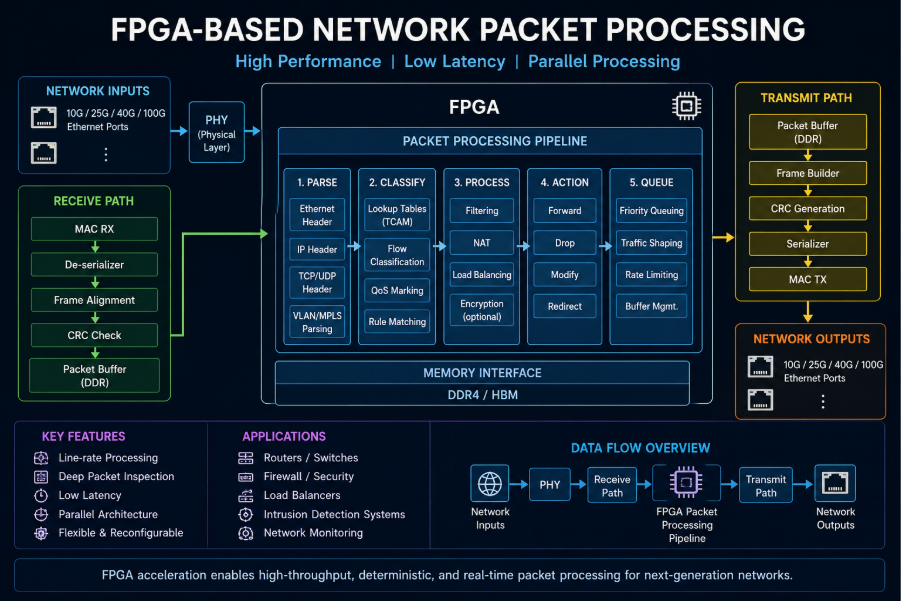
To address these challenges, organizations increasingly rely on FPGA-Based Network Packet Processing systems. Field-Programmable Gate Arrays (FPGAs) provide highly parallel, customizable hardware acceleration for networking tasks, enabling ultra-fast packet inspection, routing, filtering, encryption, traffic analysis, and protocol processing.
FPGA technology combines the flexibility of programmable logic with the performance of dedicated hardware, making it one of the most powerful solutions for modern high-speed networking infrastructure.
What Is an FPGA?
A Field-Programmable Gate Array (FPGA) is an integrated circuit that can be programmed and reconfigured after manufacturing.
Unlike fixed-function processors, FPGAs allow developers to create custom hardware architectures optimized for specific applications.
Key FPGA characteristics include:
- Parallel processing capability
- Reconfigurable logic
- Low-latency execution
- Hardware-level acceleration
- Customizable data paths
These features make FPGAs highly suitable for network packet processing workloads.
Understanding Network Packet Processing
Network packet processing refers to the analysis, modification, routing, filtering, and management of data packets as they travel across communication networks.
Typical packet processing operations include:
- Packet parsing
- Protocol analysis
- Traffic routing
- Firewall filtering
- Deep packet inspection
- Load balancing
- Encryption and decryption
- Traffic shaping
High-performance packet processing is essential for modern digital infrastructure.
Why Traditional Packet Processing Faces Challenges
Traditional packet processing often relies on CPUs and software stacks.
As network traffic grows, software-based systems encounter limitations such as:
- Higher latency
- CPU bottlenecks
- Increased power consumption
- Limited scalability
- Reduced throughput under heavy traffic
These issues become critical in high-speed environments such as:
- Data centers
- Telecom infrastructure
- Cloud networking
- Financial systems
- Edge computing platforms
Why FPGAs Are Ideal for Packet Processing
FPGAs provide several advantages over conventional CPU-based processing.
Massive Parallelism
FPGAs can process multiple packets simultaneously using parallel hardware pipelines.
Ultra-Low Latency
Hardware-level execution reduces processing delays.
Custom Data Path Design
Packet processing logic can be optimized for specific protocols and workloads.
Reconfigurability
Network functions can be updated without replacing hardware.
Energy Efficiency
FPGAs often deliver better performance-per-watt compared to general-purpose processors.
Core Components of FPGA-Based Packet Processing Systems
Programmable Logic Blocks
Logic blocks perform custom packet processing operations.
These blocks can implement:
- Parsing engines
- Filtering logic
- Routing functions
- Encryption systems
High-Speed Transceivers
Modern FPGAs include high-speed communication interfaces for network connectivity.
These interfaces support:
- Ethernet
- Optical networking
- PCIe
- High-bandwidth data transmission
Memory Systems
Packet processing requires fast memory access.
FPGAs integrate:
- On-chip memory
- External DRAM interfaces
- High-speed buffering systems
Efficient memory architecture is critical for performance.
Hardware Accelerators
Specialized accelerators improve:
- Encryption
- Compression
- Pattern matching
- AI inference
These accelerators enhance networking efficiency.
How FPGA Packet Processing Works
FPGA packet processing typically follows a hardware pipeline architecture.
Packet Reception
Incoming packets enter through network interfaces.
Packet Parsing
Headers and protocol information are extracted.
Classification
Packets are categorized based on rules and policies.
Processing Logic
Custom hardware performs required operations.
Forwarding or Modification
Packets are routed, filtered, or modified.
Transmission
Processed packets exit through output interfaces.
Because these stages operate in parallel, FPGAs achieve extremely high throughput.
Packet Parsing in FPGA Hardware
Packet parsing identifies protocol structures and extracts relevant fields.
Common parsing targets include:
- IP addresses
- Port numbers
- Protocol identifiers
- Payload metadata
Hardware-based parsing provides much faster performance than software approaches.
Deep Packet Inspection (DPI)
Deep Packet Inspection analyzes packet contents beyond basic headers.
Applications include:
- Intrusion detection
- Malware analysis
- Traffic monitoring
- Content filtering
FPGA acceleration significantly improves DPI performance by processing data streams in parallel.
Network Security Applications
FPGAs are widely used in network security systems.
Firewall Acceleration
Hardware filtering improves security response times.
Intrusion Detection Systems
FPGAs rapidly analyze suspicious traffic patterns.
Encryption and Decryption
Dedicated cryptographic hardware accelerates secure communication.
DDoS Mitigation
Real-time traffic filtering helps protect infrastructure against large-scale attacks.
Load Balancing and Traffic Management
Modern networks require intelligent traffic distribution.
FPGA-based systems support:
- Packet scheduling
- Traffic prioritization
- Flow management
- Dynamic routing
These capabilities improve network efficiency and reliability.
High-Frequency Trading Networks
Financial systems require extremely low-latency networking.
FPGAs enable:
- Real-time market data processing
- Ultra-fast trade execution
- Hardware-accelerated analytics
In financial environments, even microseconds can significantly impact performance.
FPGA Networking in Data Centers
Data centers increasingly use FPGA acceleration for:
- Smart Network Interface Cards (SmartNICs)
- Traffic offloading
- Virtual switching
- AI networking workloads
This reduces CPU overhead and improves scalability.
SmartNIC and FPGA Integration
SmartNICs combine networking hardware with programmable acceleration capabilities.
Benefits
- Reduced server CPU usage
- Faster packet handling
- Improved virtualization support
- Enhanced security processing
FPGA-powered SmartNICs are becoming common in modern cloud infrastructure.
Edge Computing and FPGA Networking
Edge environments require low-latency local processing.
FPGAs support edge networking by enabling:
- Real-time packet analysis
- AI-assisted traffic optimization
- Secure local processing
- Efficient IoT communication
These features improve edge computing performance.
AI Integration in FPGA Packet Processing
Artificial Intelligence is increasingly integrated into networking hardware.
Traffic Prediction
AI models predict network congestion patterns.
Anomaly Detection
Machine learning identifies suspicious traffic behavior.
Adaptive Routing
AI dynamically optimizes packet flow.
Hardware AI Acceleration
FPGAs can accelerate neural network inference directly within networking systems.
Programmability and Reconfigurable Networking
One of the biggest FPGA advantages is hardware reconfigurability.
Dynamic Updates
Network functions can be updated without replacing physical hardware.
Protocol Adaptation
FPGAs can support evolving communication standards.
Custom Networking Architectures
Organizations can design specialized packet processing pipelines.
Latency Optimization Techniques
Reducing latency is critical in FPGA networking systems.
Pipeline Processing
Multiple packet operations execute simultaneously.
Direct Memory Access
Efficient data movement minimizes processing delays.
Hardware Offloading
Specific tasks bypass CPU software stacks.
Parallel Execution
Multiple data streams process concurrently.
Power Efficiency Advantages
Compared to traditional processors, FPGAs often provide:
- Lower power consumption
- Better thermal efficiency
- Higher performance-per-watt
This is particularly important in large-scale data centers.
Challenges in FPGA-Based Packet Processing
Development Complexity
FPGA programming requires specialized hardware engineering knowledge.
Longer Development Cycles
Hardware logic design can be time-consuming.
Debugging Difficulty
Hardware-level debugging is more complex than software debugging.
Resource Constraints
FPGA logic, memory, and bandwidth resources are finite.
Cost Factors
High-performance FPGA hardware can be expensive.
Programming Models for FPGA Networking
Modern FPGA development uses various hardware design approaches.
Hardware Description Languages
Traditional FPGA development uses languages such as:
- Verilog
- VHDL
High-Level Synthesis (HLS)
HLS tools allow developers to use higher-level programming languages for hardware design.
Network-Specific Frameworks
Specialized frameworks simplify packet processing development.
FPGA Acceleration for 5G and Telecommunications
Telecommunication networks increasingly depend on FPGA acceleration.
Applications include:
- 5G baseband processing
- Network slicing
- Edge packet routing
- Real-time traffic management
FPGAs help meet the strict latency and bandwidth requirements of modern telecom systems.
Virtualization and Cloud Networking
Cloud infrastructure requires scalable virtual networking solutions.
FPGA-based acceleration improves:
- Virtual switch performance
- Tenant isolation
- Network function virtualization
- Secure cloud communication
Future Trends in FPGA Packet Processing
AI-Native Networking Hardware
Integrated AI accelerators for intelligent traffic management.
Programmable Data Planes
More flexible hardware-defined networking architectures.
Higher-Speed Interfaces
Support for ultra-high-bandwidth communication standards.
Hybrid CPU-FPGA Architectures
Combining software flexibility with hardware acceleration.
Quantum-Safe Cryptographic Processing
Advanced security acceleration for future communication systems.
Educational Importance
Studying FPGA-based networking provides knowledge in:
- Digital Electronics
- Computer Networks
- Embedded Systems
- Hardware Acceleration
- High-Speed Communication
- Cybersecurity
- Real-Time Computing
These skills are highly valuable in modern hardware and networking industries.
Conclusion
FPGA-Based Network Packet Processing is transforming modern networking infrastructure by delivering ultra-low latency, high throughput, hardware acceleration, and flexible programmability. Through parallel processing architectures, customizable pipelines, intelligent traffic handling, and AI-assisted optimization, FPGAs enable networking systems to meet the growing demands of cloud computing, telecommunications, cybersecurity, financial systems, and edge computing environments.
Although FPGA development presents challenges related to complexity, resource management, and hardware design expertise, ongoing advancements in development tools, AI integration, and programmable networking frameworks are making FPGA acceleration increasingly accessible and powerful.
As network traffic volumes continue to grow and real-time performance becomes more critical, FPGA-based packet processing will remain one of the most important technologies shaping the future of high-performance networking systems.