
Machine Learning (ML) has transformed industries ranging from healthcare and finance to autonomous vehicles and scientific research. However, as machine learning models grow larger and datasets become increasingly complex, traditional computing systems face challenges related to processing speed, energy consumption, and computational scalability. Training advanced neural networks often requires enormous computational resources, leading researchers to explore new computing paradigms capable of accelerating machine learning workloads.
One of the most promising emerging technologies is Quantum Computing. By leveraging the principles of quantum mechanics, quantum computers have the potential to solve certain classes of problems exponentially faster than classical computers. The foundation of this revolutionary capability lies in Quantum Hardware—specialized computing systems designed to manipulate quantum states for computation.
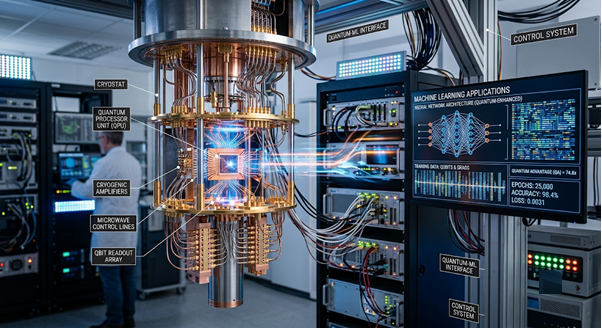
As quantum technology matures, researchers are investigating how quantum hardware can enhance machine learning algorithms, accelerate optimization tasks, improve pattern recognition, and enable entirely new forms of artificial intelligence. The convergence of quantum computing and machine learning represents one of the most exciting frontiers in modern computing.
Understanding Quantum Computing
Quantum computing differs fundamentally from classical computing.
Traditional computers process information using:
- Bits
- Binary states (0 or 1)
Quantum computers use:
- Quantum bits (Qubits)
Unlike classical bits, qubits can exist in multiple states simultaneously through a phenomenon known as superposition.
This enables quantum systems to process vast numbers of possibilities at the same time.
Core Quantum Principles
Several quantum mechanical concepts enable quantum computing.
Superposition
A classical bit can hold only one value at a time.
A qubit can exist as:
- 0
- 1
- A combination of both states
This allows quantum computers to perform many calculations simultaneously.
Entanglement
Entangled qubits become interconnected.
Changes to one qubit influence others regardless of physical separation.
Benefits include:
- Faster information processing
- Complex computational relationships
- Improved algorithm efficiency
Quantum Interference
Quantum systems can amplify correct computational paths while suppressing incorrect ones.
This improves the probability of obtaining useful solutions.
Why Machine Learning Needs More Computing Power
Modern machine learning systems require enormous computational resources.
Examples include:
- Deep neural networks
- Large language models
- Computer vision systems
- Reinforcement learning platforms
Challenges include:
Massive Data Volumes
Datasets often contain billions of data points.
Complex Optimization
Training requires repeated adjustment of millions of parameters.
High Energy Consumption
Large-scale training consumes substantial electrical power.
Long Processing Times
Advanced models may require days or weeks to train.
Quantum hardware may help address these limitations.
What Is Quantum Hardware?
Quantum hardware consists of physical systems capable of storing, manipulating, and measuring qubits.
Unlike conventional processors built from transistors, quantum processors use quantum mechanical phenomena for computation.
Key components include:
- Qubits
- Quantum control systems
- Cryogenic infrastructure
- Readout electronics
- Error correction mechanisms
Together these components create functional quantum computing platforms.
Types of Quantum Hardware
Several quantum hardware technologies are under development.
Superconducting Qubits
Superconducting circuits are among the most widely researched quantum technologies.
Characteristics include:
- Fast operation
- High scalability potential
- Strong industry interest
These systems operate at extremely low temperatures near absolute zero.
Trapped Ion Systems
Individual ions are suspended using electromagnetic fields.
Advantages include:
- High computational accuracy
- Long coherence times
- Excellent qubit stability
These systems are well suited for quantum algorithm research.
Photonic Quantum Hardware
Photonic systems use particles of light for computation.
Benefits include:
- Room-temperature operation
- High-speed communication
- Networking potential
Photonic quantum computing is particularly promising for future distributed systems.
Neutral Atom Systems
Neutral atoms are manipulated using laser technologies.
Advantages include:
- Large-scale qubit arrays
- High flexibility
- Strong scalability prospects
Spin-Based Quantum Devices
These systems utilize electron or nuclear spin states.
Potential benefits include:
- Compact design
- Semiconductor compatibility
- Efficient integration with existing technologies
Machine Learning and Quantum Computing
Quantum computing introduces new computational methods for machine learning.
This field is known as:
Quantum Machine Learning (QML)
QML combines:
- Quantum algorithms
- Machine learning techniques
- Advanced optimization methods
The goal is to improve learning efficiency and computational performance.
Quantum Data Processing
Quantum systems can represent information differently than classical computers.
Potential advantages include:
- Compact data encoding
- High-dimensional feature representation
- Efficient information processing
This capability may improve complex pattern analysis.
Quantum Feature Spaces
Machine learning often relies on transforming data into higher-dimensional spaces.
Quantum systems naturally support extremely large feature spaces.
Benefits include:
- Improved classification
- Enhanced pattern recognition
- Better anomaly detection
Quantum Optimization
Optimization lies at the heart of machine learning.
Examples include:
- Neural network training
- Parameter tuning
- Resource allocation
Quantum algorithms may solve certain optimization problems more efficiently than classical methods.
Applications include:
- Deep learning
- Supply chain optimization
- Financial modeling
Quantum Neural Networks
Researchers are developing Quantum Neural Networks (QNNs) that combine concepts from:
- Artificial neural networks
- Quantum information processing
Potential advantages include:
- Faster learning
- Improved pattern recognition
- Enhanced computational efficiency
QNNs remain an active area of research.
Quantum Support Vector Machines
Support Vector Machines are widely used for classification tasks.
Quantum implementations may:
- Process larger datasets
- Improve classification speed
- Handle complex feature relationships
This could significantly enhance machine learning performance.
Quantum Generative Models
Generative models create new data based on learned patterns.
Applications include:
- Image generation
- Drug discovery
- Scientific simulation
Quantum hardware may accelerate generative learning processes.
Hardware Requirements for Quantum Machine Learning
Machine learning applications impose demanding requirements on quantum hardware.
Qubit Count
Larger machine learning models require:
- More qubits
- Greater computational capacity
Scalability remains a major focus of quantum hardware development.
Qubit Fidelity
Machine learning computations require highly accurate qubit operations.
Higher fidelity improves:
- Model accuracy
- Training reliability
- Computational stability
Coherence Time
Coherence refers to how long quantum information remains usable.
Longer coherence times allow:
- More computations
- Deeper algorithms
- Better performance
Error Correction
Quantum systems are highly sensitive to environmental disturbances.
Error correction technologies are essential for:
- Reliable computation
- Large-scale machine learning workloads
Hybrid Quantum-Classical Systems
Near-term machine learning applications are expected to use hybrid architectures.
These systems combine:
- Classical processors
- Quantum accelerators
Advantages include:
- Practical deployment
- Improved scalability
- Efficient resource utilization
Hybrid computing is considered the most realistic path toward commercial quantum machine learning.
Applications of Quantum Hardware in Machine Learning
Drug Discovery
Quantum machine learning may accelerate:
- Molecular analysis
- Protein interaction modeling
- Pharmaceutical research
This could significantly reduce development timelines.
Financial Modeling
Applications include:
- Risk analysis
- Portfolio optimization
- Fraud detection
Quantum optimization algorithms may improve financial decision-making.
Computer Vision
Machine learning powers image recognition and visual understanding.
Quantum computing may enhance:
- Feature extraction
- Object classification
- Pattern detection
Natural Language Processing
Future quantum-enhanced NLP systems may improve:
- Language understanding
- Text classification
- Information retrieval
Autonomous Systems
Autonomous vehicles and robots rely on complex decision-making.
Quantum machine learning may improve:
- Sensor fusion
- Route optimization
- Real-time adaptation
Cybersecurity Applications
Quantum-enhanced machine learning can assist in:
- Threat detection
- Anomaly identification
- Security analytics
This may improve cyber defense capabilities.
Challenges Facing Quantum Machine Learning
Despite significant potential, several challenges remain.
Limited Qubit Availability
Current systems contain relatively small numbers of usable qubits.
Large-scale machine learning requires much larger quantum processors.
Noise and Error Rates
Quantum hardware remains vulnerable to:
- Environmental interference
- Computational errors
- Signal instability
Reducing noise remains a major research priority.
Hardware Complexity
Quantum systems require sophisticated infrastructure.
Examples include:
- Cryogenic cooling systems
- Precision control electronics
- Specialized materials
Algorithm Development
Many quantum machine learning algorithms remain experimental.
Researchers continue exploring practical implementations.
Future Trends
Several developments are shaping the future of quantum hardware for machine learning.
Fault-Tolerant Quantum Computing
Improved reliability and scalability.
Quantum AI Accelerators
Dedicated hardware optimized for machine learning.
Quantum Cloud Platforms
Remote access to quantum computing resources.
Advanced Error Correction
Enabling larger and more stable computations.
Quantum-Neuromorphic Systems
Combining quantum computing with brain-inspired architectures.
Educational Importance
Quantum machine learning combines multiple advanced disciplines:
- Quantum Physics
- Computer Engineering
- Artificial Intelligence
- Mathematics
- Information Theory
- Machine Learning
Understanding these technologies will become increasingly valuable as quantum systems mature.
Conclusion
Quantum hardware has the potential to revolutionize machine learning by introducing entirely new computational capabilities that extend beyond the limits of classical computing. Through quantum phenomena such as superposition, entanglement, and interference, quantum systems may accelerate optimization, improve pattern recognition, and enable advanced learning architectures that are currently impractical on traditional hardware.
While today’s quantum hardware remains in the early stages of development, ongoing advancements in qubit technology, error correction, and hybrid computing architectures continue to bring practical quantum machine learning closer to reality. As research progresses, the integration of quantum hardware and artificial intelligence may unlock transformative breakthroughs across healthcare, finance, cybersecurity, scientific discovery, and autonomous systems.