
The rapid advancement of artificial intelligence, machine learning, robotics, and edge computing has exposed fundamental limitations in traditional computing architectures. Modern processors deliver remarkable performance, yet they consume significant power, generate heat, and often struggle with tasks that biological systems perform effortlessly. Activities such as pattern recognition, sensory processing, decision-making, and adaptive learning require enormous computational resources when executed on conventional hardware.
Nature, however, offers a different model. The human brain can perform complex cognitive tasks using only a fraction of the energy consumed by modern computing systems. This remarkable efficiency has inspired researchers to develop Bio-Inspired Computing Hardware Systems—computing architectures that emulate the structure, behavior, and information-processing mechanisms found in biological organisms.
By drawing inspiration from neural networks, synaptic communication, sensory systems, and adaptive learning processes, bio-inspired hardware aims to create intelligent systems that are faster, more energy-efficient, and capable of learning in real time. These technologies are expected to play a significant role in the future of artificial intelligence, robotics, autonomous systems, and next-generation computing platforms.
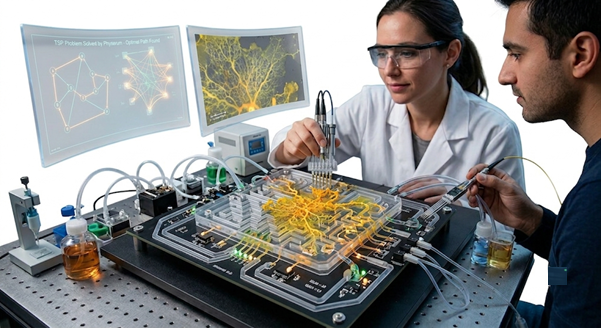
What Is Bio-Inspired Computing?
Bio-inspired computing refers to computational systems designed using principles observed in biological organisms.
Instead of relying solely on traditional digital logic, these systems mimic:
- Neural structures
- Brain-inspired processing
- Biological learning mechanisms
- Sensory perception systems
- Adaptive behaviors
The goal is to achieve greater efficiency, flexibility, and intelligence than conventional computing architectures.
Why Biology Inspires Computing
Biological systems demonstrate extraordinary capabilities.
For example, the human brain can:
- Process vast amounts of sensory information
- Learn continuously
- Recognize patterns instantly
- Operate with exceptional energy efficiency
- Adapt to changing environments
These capabilities have motivated engineers to explore biologically inspired approaches to hardware design.
Limitations of Traditional Computing
Conventional computing systems are based on the von Neumann architecture, where memory and processing units are physically separated.
This design introduces several challenges:
Memory Bottlenecks
Data must constantly move between memory and processors.
High Energy Consumption
Large amounts of power are required for computation and data transfer.
Limited Adaptability
Traditional systems are optimized for predefined tasks.
Scalability Challenges
Increasing performance often results in greater complexity and power requirements.
Bio-inspired architectures seek to overcome these limitations.
Principles of Bio-Inspired Hardware
Several biological concepts influence hardware design.
Parallel Processing
The human brain contains billions of neurons operating simultaneously.
Bio-inspired systems adopt massive parallelism to improve computational efficiency.
Benefits include:
- Faster processing
- Reduced latency
- Improved scalability
Distributed Intelligence
Biological intelligence is distributed across networks of neurons.
Similarly, bio-inspired hardware distributes computation across numerous processing elements.
Advantages include:
- Fault tolerance
- Flexibility
- Adaptability
Event-Driven Operation
Biological neurons communicate only when necessary.
This event-driven approach reduces energy consumption.
Bio-inspired systems often process information only when meaningful events occur.
Adaptive Learning
Biological organisms continuously learn from experience.
Hardware systems inspired by biology incorporate mechanisms for:
- Real-time adaptation
- Self-optimization
- Continuous learning
Neuromorphic Computing
Neuromorphic computing is one of the most important branches of bio-inspired hardware.
Neuromorphic systems attempt to replicate:
- Neurons
- Synapses
- Neural communication pathways
These architectures process information similarly to biological brains.
Artificial Neurons
Artificial neurons serve as computational units.
Functions include:
- Receiving inputs
- Processing signals
- Generating outputs
Large numbers of artificial neurons form complex neural networks.
Artificial Synapses
Synapses connect neurons and regulate signal transmission.
In bio-inspired hardware, artificial synapses:
- Store information
- Adjust connection strengths
- Enable learning mechanisms
These components are essential for adaptive intelligence.
Spiking Neural Networks
Traditional artificial neural networks process data continuously.
Spiking Neural Networks (SNNs) operate differently.
Characteristics include:
- Event-based communication
- Temporal information processing
- Energy-efficient computation
SNNs closely resemble biological neural behavior.
Neuromorphic Chips
Neuromorphic processors are specialized hardware platforms designed to execute brain-inspired computations.
Advantages include:
Low Power Consumption
Significantly lower energy requirements than conventional processors.
Real-Time Learning
Ability to adapt during operation.
Massive Parallelism
Thousands or millions of computational elements operate simultaneously.
High Efficiency
Optimized for AI and sensory processing workloads.
Memristive Hardware Systems
Memristors are electronic components capable of remembering previous states.
Their behavior resembles biological synapses.
Applications include:
- Memory storage
- Neural network acceleration
- Adaptive learning systems
Memristive technologies are considered promising candidates for future neuromorphic hardware.
Bio-Inspired Sensory Systems
Nature provides exceptional examples of sensory processing.
Engineers have developed hardware inspired by:
- Vision systems
- Auditory systems
- Tactile perception
- Olfactory sensing
These systems improve machine perception capabilities.
Vision-Inspired Hardware
The human visual system efficiently processes vast amounts of information.
Bio-inspired vision hardware focuses on:
- Motion detection
- Pattern recognition
- Dynamic scene analysis
Applications include:
- Robotics
- Autonomous vehicles
- Surveillance systems
Auditory-Inspired Processing
The biological auditory system can separate complex sounds with remarkable accuracy.
Bio-inspired audio hardware supports:
- Speech recognition
- Sound localization
- Environmental awareness
These capabilities are valuable in intelligent machines.
Tactile Computing Systems
Human skin contains millions of sensory receptors.
Bio-inspired tactile systems enable machines to:
- Detect pressure
- Sense texture
- Recognize physical interactions
Such systems improve robotic dexterity and human-machine interaction.
Swarm Intelligence Hardware
Many biological systems exhibit collective intelligence.
Examples include:
- Ant colonies
- Bee swarms
- Bird flocks
Swarm-inspired hardware architectures distribute computation across many simple units.
Advantages include:
- Scalability
- Fault tolerance
- Self-organization
Applications include robotics and distributed sensor networks.
Evolutionary Hardware Systems
Evolution has optimized biological organisms over millions of years.
Evolutionary hardware applies similar principles through:
- Self-optimization
- Adaptive configuration
- Dynamic architecture changes
Systems evolve toward better solutions over time.
Bio-Inspired Robotics
Bio-inspired computing plays a crucial role in advanced robotics.
Examples include:
Insect-Inspired Robots
Efficient navigation and environmental sensing.
Fish-Inspired Robots
Underwater exploration and monitoring.
Bird-Inspired Drones
Enhanced flight efficiency and maneuverability.
Human-Inspired Humanoid Systems
Advanced interaction and learning capabilities.
Applications in Artificial Intelligence
AI systems benefit significantly from bio-inspired hardware.
Advantages include:
- Faster neural processing
- Lower energy consumption
- Real-time adaptation
- Improved learning efficiency
Potential applications include:
- Machine learning
- Computer vision
- Natural language processing
- Autonomous systems
Edge Computing Applications
Edge devices often operate under strict power constraints.
Bio-inspired hardware offers:
- Efficient local processing
- Reduced cloud dependency
- Longer battery life
Applications include:
- Smart sensors
- Wearable devices
- Industrial monitoring systems
Healthcare Applications
Bio-inspired computing can improve healthcare technologies.
Examples include:
- Brain-computer interfaces
- Medical diagnostics
- Neural prosthetics
- Intelligent monitoring devices
These systems may enable more personalized and responsive healthcare solutions.
Autonomous Systems
Autonomous vehicles, drones, and robots require rapid decision-making.
Bio-inspired architectures support:
- Sensor fusion
- Adaptive learning
- Real-time control
This improves system reliability and efficiency.
Advantages of Bio-Inspired Hardware
Energy Efficiency
Mimics the low-power operation of biological systems.
Adaptability
Learns and evolves over time.
Scalability
Supports large distributed networks.
Fault Tolerance
Continues operating despite component failures.
Real-Time Learning
Adjusts behavior dynamically.
Efficient Pattern Recognition
Excels at complex sensory tasks.
Challenges and Limitations
Despite significant promise, several challenges remain.
Hardware Complexity
Biological systems are extraordinarily sophisticated.
Manufacturing Difficulties
Advanced architectures require specialized fabrication techniques.
Programming Challenges
New development methodologies are needed.
Standardization Issues
The field lacks universally accepted frameworks.
Validation and Testing
Ensuring reliability can be difficult.
Emerging Research Areas
Several technologies are accelerating bio-inspired computing development.
Neuromorphic Processors
Dedicated brain-inspired computing platforms.
Memristive Networks
Adaptive memory and learning architectures.
Event-Based Computing
Processing information only when changes occur.
Brain-Machine Interfaces
Direct interaction between biological and digital systems.
Hybrid AI Architectures
Combining conventional AI with bio-inspired processing.
Future Applications
Bio-inspired hardware may transform numerous industries.
Artificial Intelligence
More efficient machine learning systems.
Autonomous Transportation
Smarter navigation and decision-making.
Robotics
Adaptive and intelligent robots.
Smart Cities
Distributed intelligent infrastructure.
Healthcare
Advanced diagnostic and assistive technologies.
Space Exploration
Autonomous systems capable of operating in extreme environments.
Educational Importance
Bio-inspired computing combines knowledge from multiple disciplines:
- Computer Engineering
- Electronics
- Artificial Intelligence
- Neuroscience
- Robotics
- Materials Science
- Cognitive Science
Studying these systems helps engineers understand how biological principles can drive future technological innovation.
Conclusion
Bio-inspired computing hardware systems represent a transformative shift in the design of intelligent machines. By learning from nature’s most efficient information-processing systems, engineers are developing hardware architectures that can learn, adapt, and operate with remarkable energy efficiency.
From neuromorphic processors and artificial synapses to event-driven sensory systems and adaptive robotics, bio-inspired hardware offers solutions to many limitations of traditional computing architectures. As artificial intelligence, edge computing, and autonomous systems continue to expand, these biologically inspired technologies will become increasingly important.
The future of computing may not be defined solely by faster processors or smaller transistors, but by how effectively technology can emulate the intelligence, adaptability, and efficiency that nature has refined over millions of years. Bio-inspired computing is a significant step toward that future, bridging the gap between biological intelligence and digital innovation.