
Introduction
Artificial Intelligence (AI) has revolutionized numerous industries, enabling machines to perform tasks that once required human intelligence. However, conventional AI systems, particularly deep neural networks, demand substantial computational resources and power consumption. As AI applications continue to expand into edge devices, robotics, autonomous systems, and IoT environments, the need for more efficient computing architectures has become increasingly important.
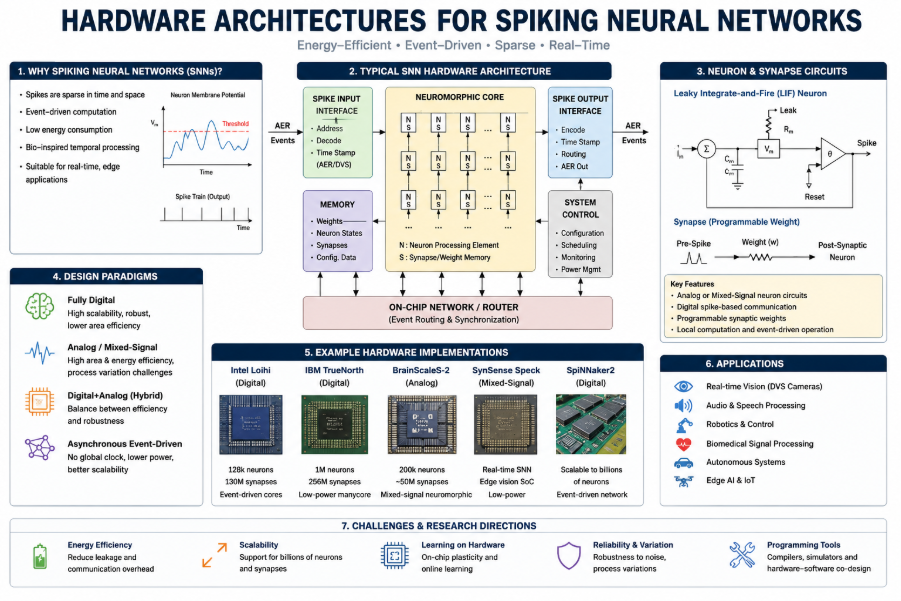
One of the most promising solutions is Spiking Neural Networks (SNNs). Inspired by the biological brain, SNNs process information through discrete electrical impulses known as spikes, enabling highly efficient, event-driven computation. To fully leverage the advantages of SNNs, specialized hardware architectures have been developed that mimic the structure and behavior of biological neural systems.
These hardware architectures form the foundation of neuromorphic computing, a field that aims to create intelligent systems capable of brain-like efficiency, adaptability, and real-time learning.
Understanding Spiking Neural Networks
Spiking Neural Networks represent the third generation of artificial neural network models. Unlike traditional neural networks that process continuous numerical values, SNNs communicate through spikes generated when neuron activity reaches specific thresholds.
Key characteristics of SNNs include:
- Event-driven processing
- Temporal information encoding
- Sparse communication
- Biological realism
- Energy-efficient computation
Because neurons only communicate when necessary, SNNs can significantly reduce computational overhead compared to conventional AI models.
Why Specialized Hardware Is Necessary
Traditional CPUs and GPUs were designed for sequential and parallel numerical processing rather than event-driven neural computation.
When running SNN workloads on conventional processors, several limitations arise:
- High energy consumption
- Inefficient spike processing
- Memory bottlenecks
- Increased latency
- Poor scalability for large neural networks
To overcome these limitations, researchers have developed dedicated hardware architectures optimized specifically for spike-based processing.
Fundamental Components of SNN Hardware
Artificial Neurons
Artificial neurons serve as the primary processing elements within an SNN.
Each neuron:
- Receives input spikes
- Accumulates incoming signals
- Compares activity against a threshold
- Generates output spikes when activated
These neurons emulate the behavior of biological neurons found in the human brain.
Artificial Synapses
Synapses are responsible for transmitting signals between neurons.
Their functions include:
- Weight storage
- Signal modulation
- Learning adaptation
- Information transfer
Efficient synaptic implementation is crucial for high-performance neuromorphic systems.
Spike Communication Networks
Since SNNs rely on spikes rather than continuous data streams, specialized communication networks are required to route spike events efficiently throughout the system.
Neuromorphic Hardware Architecture
Neuromorphic hardware is specifically designed to emulate neural structures and biological information processing.
Its key features include:
- Massive parallelism
- Event-driven execution
- Distributed memory
- Asynchronous communication
- Low-power operation
Neuromorphic systems provide an ideal platform for implementing large-scale SNNs.
Digital Neuromorphic Architectures
Digital neuromorphic systems use conventional digital circuits to implement neurons and synapses.
Advantages
- High reliability
- Precise computations
- Easy programmability
- Scalable architecture
Applications
- Edge AI devices
- Robotics
- Smart sensors
- Autonomous systems
Digital architectures are often preferred for commercial and industrial deployments due to their robustness.
Analog Neuromorphic Architectures
Analog neuromorphic systems attempt to replicate neural behavior using continuous electrical signals.
Advantages
- Extremely low power consumption
- High biological realism
- Natural neural dynamics
Challenges
- Noise sensitivity
- Manufacturing variability
- Limited precision
Despite these challenges, analog systems offer exceptional efficiency for specific AI applications.
Mixed-Signal Architectures
Mixed-signal neuromorphic hardware combines the strengths of both analog and digital approaches.
Benefits
- Analog energy efficiency
- Digital accuracy
- Flexible neural modeling
- Improved scalability
Many modern neuromorphic processors utilize mixed-signal architectures to achieve optimal performance.
Event-Driven Processing Systems
One of the defining features of SNN hardware is event-driven computation.
Unlike conventional processors that execute instructions continuously, event-driven systems perform computations only when spike events occur.
Benefits
- Reduced power consumption
- Lower computational overhead
- Faster response times
- Efficient resource utilization
This approach closely mirrors biological neural processing.
Memory Architectures for Spiking Neural Networks
Memory design plays a critical role in neuromorphic systems.
Distributed Memory
Each neuron stores local information, reducing data movement across the system.
Benefits include:
- Lower latency
- Reduced energy consumption
- Improved scalability
Synaptic Memory
Large SNNs require storage for millions or even billions of synaptic weights.
Efficient synaptic memory architectures help improve:
- Network capacity
- Learning performance
- System efficiency
In-Memory Computing
In-memory computing integrates computation directly within memory structures.
Advantages include:
- Reduced memory bottlenecks
- Faster processing
- Improved energy efficiency
This approach is becoming increasingly important in advanced neuromorphic designs.
Communication Infrastructure
Efficient communication is essential for large-scale SNN operation.
Network-on-Chip (NoC)
Network-on-Chip architectures provide scalable communication between neurons and processing elements.
Benefits include:
- High throughput
- Low latency
- Flexible scalability
Event Routing Networks
Event routing systems deliver spike information throughout the network.
Efficient routing improves:
- Communication speed
- System responsiveness
- Resource utilization
Learning Mechanisms in Hardware
Hardware-based learning enables neuromorphic systems to adapt dynamically.
Spike-Timing Dependent Plasticity (STDP)
STDP is a biologically inspired learning mechanism where synaptic strength changes based on spike timing relationships.
The learning principle can be represented as:
\Delta w=f(t_{post}-t_{pre})
This enables systems to learn from experience without explicit supervision.
Online Learning
Online learning allows networks to continuously adapt during operation.
Advantages include:
- Real-time adaptation
- Environmental awareness
- Autonomous behavior modification
Memristor-Based Architectures
Memristors are emerging devices that mimic biological synapses.
Advantages
- Non-volatile storage
- High integration density
- Low power consumption
- Natural synaptic behavior
Memristor-based neuromorphic systems are considered a promising pathway toward brain-like computing architectures.
FPGA-Based SNN Implementations
Field Programmable Gate Arrays (FPGAs) offer flexible platforms for SNN development.
Benefits
- Reconfigurability
- Rapid prototyping
- Custom neural architectures
- Research flexibility
FPGAs are widely used for experimental neuromorphic computing systems.
ASIC-Based Neuromorphic Processors
Application-Specific Integrated Circuits (ASICs) are custom-designed chips optimized for neural computation.
Advantages
- Maximum performance
- Minimal power consumption
- Optimized spike processing
- High scalability
ASIC-based neuromorphic processors are increasingly being adopted for commercial AI applications.
Applications of SNN Hardware Architectures
Robotics
Spiking neural hardware enables:
- Adaptive navigation
- Real-time perception
- Autonomous decision-making
Autonomous Vehicles
Applications include:
- Sensor fusion
- Object detection
- Path planning
- Low-latency decision systems
Edge Artificial Intelligence
SNN hardware supports:
- Smart cameras
- Wearable devices
- Industrial IoT systems
- Battery-powered AI applications
Brain-Computer Interfaces
Neuromorphic processors naturally complement neural signal processing and cognitive interaction systems.
Event-Based Vision Systems
Event-based cameras generate spike streams instead of image frames, making them ideal companions for SNN hardware.
Advantages of Hardware Architectures for SNNs
Exceptional Energy Efficiency
Processing occurs only when events happen, dramatically reducing power consumption.
Massive Parallelism
Millions of neurons can operate simultaneously.
Real-Time Processing
Supports rapid response for time-critical applications.
Biological Realism
Closer resemblance to natural neural systems.
Scalability
Can support increasingly sophisticated AI workloads.
Adaptive Learning
Allows systems to evolve based on experience.
Challenges and Limitations
Despite significant progress, several challenges remain.
Training Complexity
Training SNNs is more difficult than training conventional neural networks.
Hardware Design Challenges
Neuromorphic architectures require specialized design expertise.
Software Ecosystem Limitations
Development tools and frameworks are still maturing.
Large-Scale Integration
Building brain-scale neural systems remains a major engineering challenge.
Standardization
The field lacks universal standards and development methodologies.
Future Trends
Several emerging technologies are expected to accelerate SNN adoption.
Neuromorphic AI Accelerators
Dedicated processors optimized for spike-based computation.
Advanced Memristive Systems
Improved synaptic storage and learning capabilities.
In-Memory Neuromorphic Computing
Combining storage and processing into unified architectures.
Bio-Inspired Learning Models
More sophisticated and adaptive neural learning systems.
Edge Neuromorphic Intelligence
Autonomous devices capable of local learning and decision-making.
Conclusion
Hardware Architectures for Spiking Neural Networks represent one of the most exciting developments in the evolution of artificial intelligence and computing. By emulating the event-driven, massively parallel, and energy-efficient operation of biological neural systems, these architectures offer a compelling alternative to traditional AI hardware.
Through innovations in neuromorphic processors, memristive technologies, in-memory computing, and event-based communication, SNN hardware is paving the way for a new generation of intelligent machines. As research continues to advance, these architectures are expected to become a cornerstone of future AI systems, enabling smarter, faster, and more energy-efficient computing across industries ranging from robotics and healthcare to autonomous transportation and edge intelligence.