The rapid growth of artificial intelligence, robotics, autonomous systems, and machine vision has created an increasing demand for faster and more efficient visual sensing technologies. Traditional image sensors have served as the foundation of computer vision for decades, capturing frames at fixed intervals to generate a sequence of images. While effective for many applications, conventional cameras often struggle with high-speed motion, dynamic lighting conditions, and energy efficiency constraints.
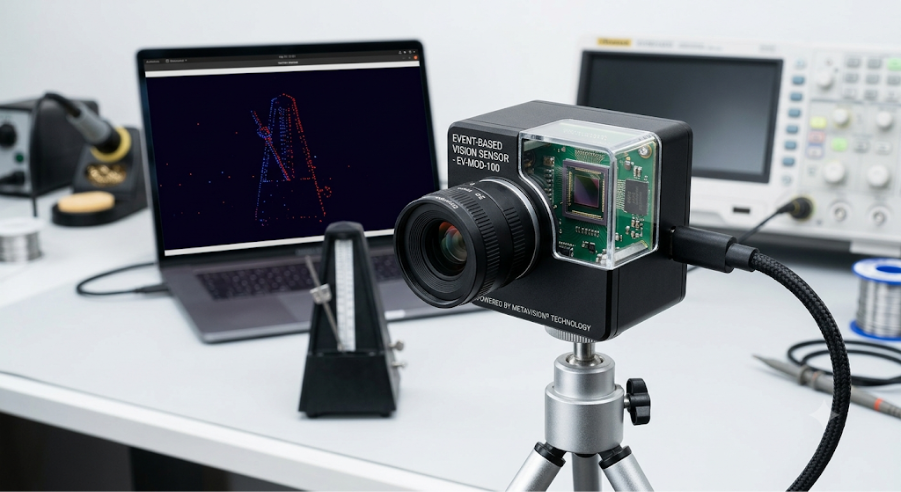
To address these limitations, researchers have developed Event-Based Vision Sensors, a revolutionary imaging technology inspired by the human visual system. Unlike traditional cameras that capture entire images at fixed frame rates, event-based sensors detect and transmit only changes in brightness at individual pixels. This fundamentally different approach enables ultra-fast response times, lower power consumption, reduced data processing requirements, and improved performance in dynamic environments.
As robotics, autonomous vehicles, drones, industrial automation, and edge AI systems continue to evolve, event-based vision sensor hardware is emerging as a critical technology for the future of intelligent perception systems.
What Are Event-Based Vision Sensors?
Event-based vision sensors are imaging devices that operate asynchronously.
Instead of capturing complete image frames at regular intervals, each pixel independently monitors changes in light intensity.
When a significant brightness change occurs:
- The pixel generates an event
- The event is immediately transmitted
- No full image frame is required
This creates a continuous stream of visual information representing only meaningful scene changes.
Inspiration from Human Vision
The biological retina does not process visual information as a sequence of frames.
Instead, retinal neurons primarily respond to:
- Motion
- Contrast changes
- Brightness variations
Event-based vision systems mimic this behavior by focusing on visual changes rather than continuously recording static information.
This biomimetic approach leads to greater efficiency and responsiveness.
Limitations of Traditional Cameras
Conventional image sensors capture frames at fixed rates such as:
- 30 frames per second
- 60 frames per second
- 120 frames per second
This approach presents several challenges.
Redundant Data Collection
Static portions of a scene are repeatedly captured.
Motion Blur
Fast-moving objects may appear blurred.
High Data Volumes
Every frame contains large amounts of information.
Increased Power Consumption
Continuous image acquisition requires significant energy.
Processing Bottlenecks
AI systems must analyze every frame regardless of scene activity.
These limitations become significant in real-time applications.
How Event-Based Sensors Work
Each pixel functions independently.
When brightness changes exceed a predefined threshold:
- The pixel detects the change.
- An event is generated.
- Event information is transmitted immediately.
Each event typically contains:
- Pixel coordinates
- Timestamp
- Brightness change polarity
The result is a highly efficient stream of visual events.
Components of an Event-Based Vision Sensor
Pixel Array
The pixel array forms the sensing surface.
Unlike conventional image sensors, each pixel contains:
- Light detection circuitry
- Change detection logic
- Event generation electronics
This allows autonomous pixel operation.
Event Detection Circuitry
The detection circuit continuously monitors brightness levels.
Events are generated only when changes exceed predefined thresholds.
Benefits include:
- Reduced data generation
- Faster response times
- Improved efficiency
Timestamp Generation System
Every event receives an accurate timestamp.
High-resolution timing enables:
- Motion analysis
- Object tracking
- Real-time decision-making
Precise timing is one of the defining features of event-based vision.
Event Communication Network
Events must be transmitted efficiently from millions of pixels.
The communication subsystem handles:
- Event routing
- Data buffering
- Output management
Optimized communication reduces latency.
Key Characteristics of Event-Based Sensors
Ultra-Low Latency
Traditional cameras introduce delays between frame captures.
Event-based sensors respond immediately to changes.
Response times often reach:
- Microsecond-level latency
This is critical for high-speed applications.
High Temporal Resolution
Temporal resolution refers to how quickly visual changes can be detected.
Event-based sensors provide significantly higher temporal precision than frame-based cameras.
Benefits include:
- Fast motion tracking
- Improved reaction speed
- Enhanced control systems
High Dynamic Range
Dynamic range measures the ability to capture both bright and dark areas simultaneously.
Event-based sensors perform exceptionally well in:
- Direct sunlight
- Shadows
- Nighttime environments
- High-contrast scenes
This makes them suitable for outdoor applications.
Low Power Consumption
Only active pixels consume significant energy.
Benefits include:
- Extended battery life
- Reduced cooling requirements
- Improved edge deployment
This is particularly valuable for mobile systems.
Reduced Data Bandwidth
Instead of transmitting complete images, only meaningful changes are communicated.
Advantages include:
- Lower storage requirements
- Faster processing
- Reduced network load
Event-Based Vision vs Traditional Cameras
| Feature | Traditional Camera | Event-Based Sensor |
| Image Capture | Full Frames | Brightness Changes |
| Data Generation | Continuous | Event Driven |
| Latency | Milliseconds | Microseconds |
| Motion Blur | Possible | Minimal |
| Power Consumption | Higher | Lower |
| Dynamic Range | Moderate | Very High |
| Data Efficiency | Lower | Higher |
Applications in Autonomous Vehicles
Autonomous vehicles require rapid perception of dynamic environments.
Event-based sensors help detect:
- Pedestrians
- Vehicles
- Road obstacles
- Traffic movements
Advantages include:
- Faster reaction times
- Improved safety
- Better performance under challenging lighting conditions
Robotics Applications
Robots often operate in rapidly changing environments.
Event-based vision enables:
- Real-time navigation
- Object tracking
- Motion analysis
- Collision avoidance
The low latency significantly improves robotic responsiveness.
Drone Navigation Systems
Drones have strict limitations regarding:
- Weight
- Power consumption
- Processing capability
Event-based sensors offer:
- Efficient obstacle detection
- High-speed maneuvering
- Extended flight duration
These advantages are particularly valuable for autonomous aerial systems.
Industrial Automation
Manufacturing environments often require rapid visual inspection.
Applications include:
- Quality control
- Defect detection
- Conveyor tracking
- Robotic assembly systems
Event-based vision enables precise monitoring of high-speed production lines.
Edge AI Systems
Edge computing platforms process data locally rather than relying on cloud infrastructure.
Event-based sensors complement edge AI by reducing:
- Data transmission
- Processing requirements
- Energy consumption
This enables efficient deployment in resource-constrained environments.
Surveillance and Security
Security systems benefit from:
- Motion detection
- Intrusion monitoring
- Low-light operation
Event-based sensors can identify activity while minimizing unnecessary data storage.
Augmented Reality and Virtual Reality
AR and VR systems require:
- Fast tracking
- Low latency
- Accurate motion detection
Event-based vision can improve:
- User interaction
- Head tracking
- Environmental awareness
These improvements contribute to more immersive experiences.
Event-Based AI Processing
Traditional AI models are designed for image frames.
Event-based AI systems process streams of events instead.
Advantages include:
- Faster inference
- Lower computational requirements
- Real-time operation
Specialized neural networks are being developed specifically for event-driven data.
Neuromorphic Computing Integration
Event-based sensors pair naturally with neuromorphic processors.
Both technologies are inspired by biological neural systems.
Benefits include:
- Energy efficiency
- Event-driven computation
- Real-time learning
Together they form the foundation of next-generation intelligent systems.
Hardware Design Challenges
Despite their advantages, event-based sensors present engineering challenges.
Pixel Complexity
Each pixel contains additional circuitry compared to conventional image sensors.
Challenges include:
- Increased design complexity
- Manufacturing difficulty
- Area optimization
Noise Management
Random brightness fluctuations may generate unwanted events.
Engineers must implement:
- Filtering mechanisms
- Adaptive thresholds
- Signal validation
Event Processing Infrastructure
Large numbers of events must be processed efficiently.
This requires:
- Specialized processors
- High-speed communication systems
- Efficient memory architectures
Algorithm Development
Traditional computer vision algorithms are not directly compatible with event streams.
New approaches are needed for:
- Object recognition
- Tracking
- Scene understanding
Future Innovations
Several emerging technologies are accelerating event-based vision development.
AI-Optimized Event Sensors
Integrated AI capabilities directly within sensor hardware.
Hybrid Imaging Systems
Combining traditional cameras with event-based sensors.
Neuromorphic Vision Platforms
End-to-end biologically inspired perception systems.
Edge Intelligence Integration
Improved local processing and decision-making.
Advanced Sensor Fusion
Combining event-based vision with:
- LiDAR
- Radar
- Ultrasonic sensing
Future Applications
Event-based vision technology is expected to impact:
- Autonomous transportation
- Industrial robotics
- Smart cities
- Medical devices
- Aerospace systems
- Defense applications
- Consumer electronics
As AI systems become increasingly real-time and energy-sensitive, event-based vision will play a growing role.
Educational Importance
Studying event-based vision hardware provides valuable knowledge in:
- Computer vision
- Semiconductor design
- Embedded systems
- Artificial intelligence
- Robotics
- Neuromorphic engineering
These interdisciplinary skills are increasingly relevant in advanced technology industries.
Conclusion
Event-based vision sensor hardware represents a transformative advancement in machine perception technology. By capturing only meaningful visual changes rather than continuously recording complete image frames, these sensors achieve exceptional speed, efficiency, and responsiveness.
Their ability to operate with microsecond-level latency, high dynamic range, low power consumption, and reduced data bandwidth makes them particularly attractive for autonomous vehicles, robotics, drones, industrial automation, and edge AI applications. Although challenges remain in sensor design, event processing, and algorithm development, ongoing research continues to unlock new possibilities.
As intelligent systems demand faster perception and more efficient computation, event-based vision sensors are poised to become a cornerstone technology for the next generation of adaptive, real-time, and energy-efficient machine vision platforms.