
Artificial Intelligence (AI) has become a driving force behind modern technological innovation, powering applications ranging from autonomous vehicles and smart manufacturing to healthcare diagnostics and intelligent robotics. As AI models continue to grow in complexity, traditional computing architectures face increasing challenges in delivering the performance, flexibility, and energy efficiency required by next-generation intelligent systems.
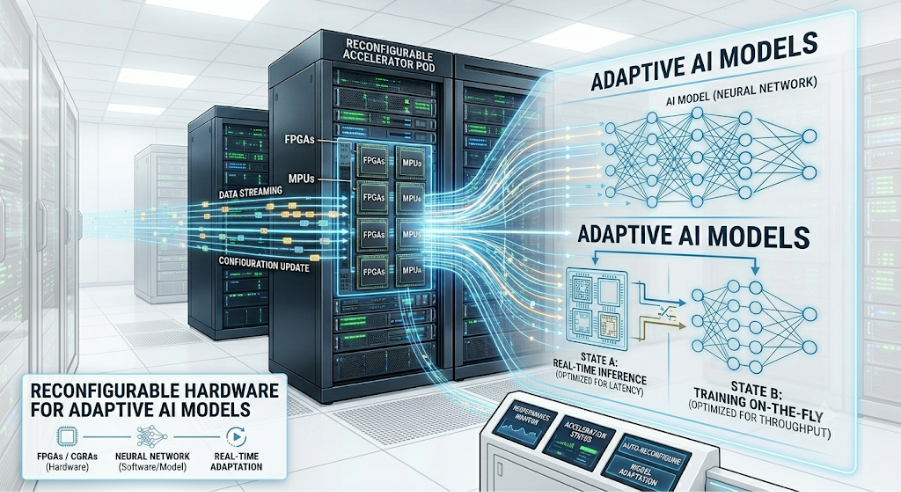
One promising solution is reconfigurable hardware, a computing approach that allows hardware resources to be dynamically modified and optimized for specific workloads. Unlike fixed-function processors, reconfigurable hardware can adapt its architecture to match the requirements of different AI models, providing significant improvements in performance, power efficiency, and scalability.
As AI workloads become increasingly diverse and rapidly evolving, reconfigurable hardware is emerging as a critical technology for enabling adaptive AI systems capable of learning, evolving, and operating efficiently in dynamic environments.
What Is Reconfigurable Hardware?
Reconfigurable hardware refers to computing systems whose internal architecture can be modified after manufacturing.
Instead of using a fixed hardware design, these systems allow engineers to:
- Change data paths
- Modify logic functions
- Optimize processing pipelines
- Adapt hardware resources to workloads
This flexibility enables hardware to be customized for specific applications without requiring new chip fabrication.
Why AI Needs Reconfigurable Hardware
Modern AI systems face several challenges:
- Increasing model complexity
- Rapid algorithm evolution
- High computational demands
- Power consumption constraints
- Real-time processing requirements
Traditional processors are designed for general-purpose computing and may not efficiently execute specialized AI workloads.
Reconfigurable hardware provides a solution by tailoring computational resources directly to the needs of AI algorithms.
The Evolution of AI Hardware
AI computing has progressed through several stages.
General-Purpose Processors
Initially, AI workloads ran on conventional CPUs.
Advantages:
- Flexibility
- Ease of programming
Limitations:
- Limited parallelism
- Higher power consumption
Graphics Processing Units
GPUs introduced large-scale parallel processing.
Benefits:
- Accelerated neural network training
- Improved inference performance
Challenges:
- High energy consumption
- Fixed architecture
AI Accelerators
Dedicated accelerators improved efficiency for specific AI operations.
Advantages:
- High throughput
- Optimized neural network execution
Drawbacks:
- Reduced adaptability
- Limited flexibility for future algorithms
Reconfigurable Platforms
Reconfigurable hardware combines performance with flexibility.
Benefits:
- Adaptable architecture
- Efficient resource utilization
- Future-proof design
Understanding Adaptive AI Models
Adaptive AI systems continuously adjust their behavior based on new information.
Examples include:
- Autonomous vehicles
- Industrial robots
- Intelligent surveillance systems
- Smart healthcare devices
- Edge AI applications
Adaptive models require hardware capable of evolving alongside changing workloads.
Core Principles of Reconfigurable Computing
Hardware Adaptability
The system can alter its structure to support different computational tasks.
Examples include:
- Neural network acceleration
- Signal processing
- Data analytics
This flexibility improves overall efficiency.
Parallel Processing
AI workloads often involve thousands of simultaneous calculations.
Reconfigurable architectures can create custom parallel processing pipelines optimized for specific models.
Resource Optimization
Hardware resources are allocated dynamically based on workload requirements.
Benefits include:
- Reduced idle hardware
- Improved utilization
- Lower energy consumption
Low-Latency Execution
Custom hardware paths reduce processing delays.
This is critical for:
- Real-time AI systems
- Autonomous control
- Industrial automation
Field-Programmable Gate Arrays (FPGAs)
FPGAs are among the most widely used reconfigurable computing platforms.
An FPGA contains:
- Programmable logic blocks
- Configurable interconnects
- Input/output resources
Engineers can reconfigure these elements to implement custom hardware architectures.
Why FPGAs Are Valuable for AI
FPGAs offer several advantages:
Custom Parallelism
AI operations can be executed in highly parallel structures.
Low Power Consumption
Optimized architectures reduce unnecessary processing.
Flexible Deployment
Hardware can be updated after deployment.
Real-Time Processing
Supports latency-sensitive AI applications.
Dynamic Reconfiguration
One of the most powerful features of reconfigurable hardware is dynamic reconfiguration.
This capability allows hardware modifications while the system remains operational.
Benefits include:
- Workload adaptation
- Resource optimization
- Reduced downtime
Dynamic reconfiguration is particularly useful for adaptive AI systems operating in changing environments.
AI Inference Acceleration
Inference is the process of generating predictions from trained AI models.
Reconfigurable hardware accelerates inference by:
- Optimizing data movement
- Creating dedicated processing pipelines
- Reducing memory bottlenecks
Applications include:
- Image recognition
- Natural language processing
- Object detection
Neural Network Optimization
Different neural networks require different computational structures.
Examples include:
Convolutional Neural Networks
Used for:
- Computer vision
- Image classification
Recurrent Neural Networks
Used for:
- Sequential data processing
- Time-series analysis
Transformer Models
Used for:
- Language processing
- Generative AI
Reconfigurable hardware can adapt to each architecture, improving efficiency.
Edge AI Applications
Edge AI performs computations close to data sources rather than relying on cloud infrastructure.
Examples include:
- Smart cameras
- Industrial sensors
- Autonomous drones
- Healthcare devices
Reconfigurable hardware is well-suited for edge environments because it offers:
- Low power operation
- Real-time responsiveness
- Flexible deployment
Autonomous Systems
Autonomous systems must continuously adapt to changing conditions.
Examples include:
- Self-driving vehicles
- Mobile robots
- Agricultural automation
Reconfigurable AI hardware enables:
- Faster decision-making
- Sensor fusion optimization
- Dynamic workload management
Industrial Automation
Manufacturing environments increasingly rely on AI-driven systems.
Applications include:
- Predictive maintenance
- Quality inspection
- Process optimization
Reconfigurable hardware allows systems to evolve as production requirements change.
Smart Healthcare Devices
Healthcare applications demand:
- Accuracy
- Reliability
- Energy efficiency
Examples include:
- Diagnostic systems
- Medical imaging devices
- Wearable health monitors
Adaptive AI hardware supports continuous improvement of medical algorithms without replacing hardware platforms.
Data Center Acceleration
Large-scale AI workloads require enormous computational resources.
Reconfigurable hardware can improve:
- Throughput
- Energy efficiency
- Resource allocation
Benefits include:
- Reduced operating costs
- Improved scalability
- Better workload optimization
Memory and Data Movement Optimization
Many AI systems spend more energy moving data than performing computations.
Reconfigurable architectures address this challenge by:
- Reducing memory access
- Optimizing data paths
- Increasing locality of computation
This significantly improves overall efficiency.
Security Advantages
Reconfigurable hardware offers unique security benefits.
Hardware-Level Protection
Security mechanisms can be implemented directly in hardware.
Rapid Updates
Security features can be modified after deployment.
Workload Isolation
Sensitive AI workloads can be separated from other system functions.
These capabilities improve resilience against evolving threats.
Challenges of Reconfigurable Hardware
Despite its advantages, reconfigurable computing presents several challenges.
Programming Complexity
Developing custom hardware architectures requires specialized expertise.
Engineers must understand:
- Digital logic design
- Hardware description languages
- System optimization
Development Time
Designing optimized hardware configurations can be time-consuming.
Resource Constraints
Hardware resources remain finite.
Engineers must balance:
- Performance
- Flexibility
- Power consumption
Verification and Testing
Reconfigurable systems require extensive validation to ensure reliability.
Testing becomes more complex as hardware configurations evolve.
Emerging Technologies
Several innovations are enhancing reconfigurable AI platforms.
AI-Assisted Hardware Design
Artificial intelligence can automate portions of hardware optimization.
Adaptive Computing Fabrics
Future systems may automatically reconfigure themselves based on workload requirements.
Neuromorphic Architectures
Brain-inspired computing systems may integrate reconfigurable principles.
In-Memory Computing
Combining memory and computation improves efficiency.
Quantum-Inspired Processing
Advanced optimization techniques may further accelerate AI workloads.
Future Applications
Reconfigurable hardware is expected to play a significant role in:
- Autonomous transportation
- Smart cities
- Robotics
- Industrial automation
- Healthcare technology
- Aerospace systems
- Edge intelligence platforms
As AI models continue to evolve, adaptable hardware will become increasingly important.
Educational Importance
Studying reconfigurable hardware provides valuable knowledge in:
- Computer architecture
- Digital electronics
- Embedded systems
- Artificial intelligence
- Hardware acceleration
- Parallel computing
These skills are becoming increasingly relevant in modern engineering disciplines.
Conclusion
Reconfigurable hardware represents a powerful bridge between the flexibility of software and the performance of specialized hardware. By allowing computing architectures to adapt dynamically to changing AI workloads, reconfigurable platforms provide an ideal foundation for adaptive artificial intelligence systems.
From edge devices and autonomous vehicles to industrial automation and large-scale data centers, reconfigurable hardware enables faster processing, lower power consumption, improved scalability, and future-proof adaptability. Although challenges remain in programming complexity and system design, ongoing advancements in hardware architectures, development tools, and AI optimization techniques continue to accelerate adoption.
As intelligent systems become more dynamic and computationally demanding, reconfigurable hardware will play a central role in shaping the future of adaptive AI, delivering the flexibility and efficiency required for the next generation of intelligent computing platforms.