
Modern semiconductor devices are becoming increasingly complex. AI processors, GPUs, and high-performance computing systems require greater processing power, faster communication, and improved energy efficiency.
Traditional chip designs often integrate multiple functions into a single silicon die. However, manufacturing large chips can be expensive and technically challenging.
To address these limitations, semiconductor manufacturers are adopting chiplet-based architectures. One technology supporting this approach is Universal Chiplet Interconnect Express (UCIe).
UCIe provides a standardized way for chiplets to communicate inside an advanced semiconductor package. It helps different chiplet components work together while supporting scalable processor designs.
In this article, we explore how UCIe works, its architecture, benefits, applications, and the latest developments in the standard.
What Is Universal Chiplet Interconnect Express (UCIe)?
Universal Chiplet Interconnect Express, commonly called UCIe, is an open industry standard designed for high-speed communication between chiplets within a semiconductor package.
It defines the physical interface, communication protocols, and software architecture needed to connect different chiplet components.
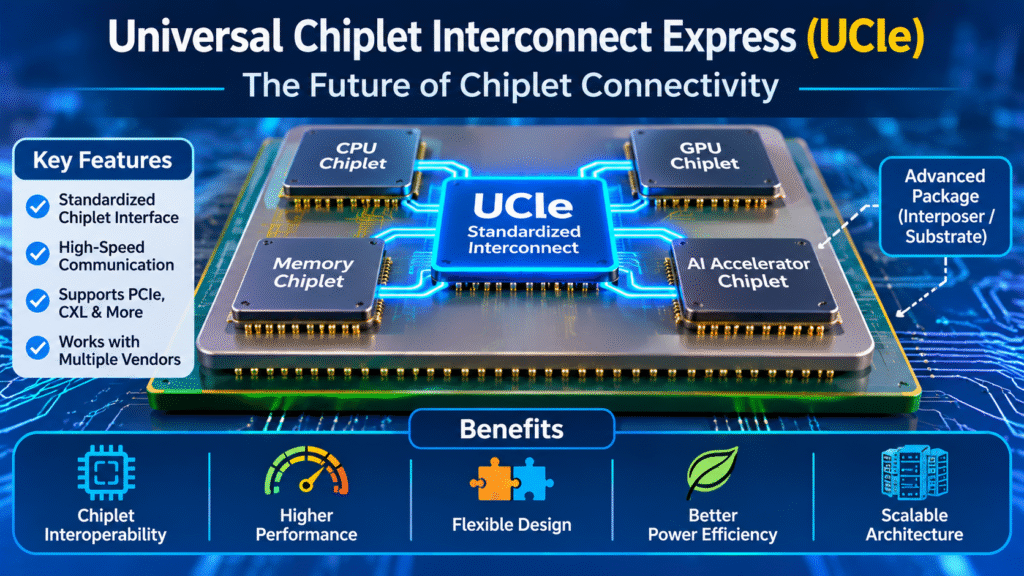
For example, a processor package may contain separate CPU, GPU, AI accelerator, and memory-related chiplets. UCIe provides a standardized communication interface that allows these components to exchange data.
The standard also aims to support interoperability between chiplets developed by different manufacturers.
You can explore the technology through the official UCIe Consortium website.
Why Is UCIe Important?
Chiplet architecture is becoming important because traditional monolithic chip designs have several limitations.
A large processor can be difficult to manufacture, and defects in a large die can affect production yield. In addition, different processing functions may benefit from different semiconductor manufacturing technologies.
Chiplets provide a more flexible approach. Instead of building everything into one large die, manufacturers can develop smaller components and integrate them into one package.
However, these components need a reliable communication interface.
UCIe addresses this requirement by providing a standardized die-to-die connection.
Its major advantages include:
- Standardized communication between chiplets.
- Support for different semiconductor manufacturers.
- High-bandwidth data transfer.
- Improved flexibility in processor architecture.
- Support for advanced 2.5D and 3D packaging.
How Does UCIe Work?
UCIe creates a communication link between two chiplets inside a semiconductor package.
Each connected chiplet contains a UCIe interface that manages data transmission and reception.
The communication process involves several important layers.
1. Physical Layer
The physical layer handles electrical signaling between chiplets.
It defines the electrical interface, data lanes, clocking, and connection requirements.
Additionally, the physical implementation depends on the package architecture and connection technology.
2. Die-to-Die Adapter
The die-to-die adapter manages communication between the physical layer and protocol layer.
It handles functions such as link management, flow control, and error-related mechanisms.
Therefore, it helps maintain reliable communication between connected chiplets.
3. Protocol Layer
The protocol layer supports different communication formats.
UCIe can transport PCI Express (PCIe), Compute Express Link (CXL), and supported streaming protocols.
This flexibility allows chiplets to support different application requirements without requiring a completely separate interconnect standard.
4. Software Stack
The software architecture supports system-level configuration, initialization, and management.
As chiplet systems become more complex, software support becomes important for managing multiple connected components.
Main Components of UCIe Architecture
A UCIe-based system includes several important components.
Chiplets: Individual semiconductor dies that perform specific functions such as processing, memory control, or acceleration.
UCIe PHY: The physical interface responsible for transmitting and receiving signals.
Die-to-Die Adapter: Manages communication between the physical and protocol layers.
Protocol Stack: Supports supported data communication protocols such as PCIe and CXL.
Package Substrate or Interposer: Provides the physical connections between different chiplets.
Together, these components enable communication within an advanced semiconductor package.
UCIe Package Types
UCIe supports different package architectures to accommodate various chiplet integration requirements.
1. Standard Package
Standard package implementations use conventional package technologies to connect chiplets.
They offer a practical approach for systems that do not require the extremely fine-pitch connections of advanced packaging.
2. Advanced Package
Advanced packaging uses technologies such as silicon interposers and high-density routing structures.
These approaches support more connections within a smaller area.
As a result, they are suitable for high-performance applications that require significant chiplet bandwidth.
3. 3D Packaging
3D packaging places semiconductor dies vertically rather than arranging every die side by side.
UCIe 2.0 introduced support for 3D packaging, including implementations optimized for hybrid bonding.
This approach can increase bandwidth density and improve power efficiency compared with some conventional package arrangements.
UCIe Specification Evolution
The UCIe standard continues to evolve to support more advanced semiconductor architectures.
| Specification | Important developments |
|---|---|
| UCIe 1.0 | Established the standardized die-to-die interconnect |
| UCIe 1.1 | Improved reliability, testing, and automotive-related capabilities |
| UCIe 2.0 | Added manageability features and 3D packaging support |
| UCIe 3.0 | Introduced 48 GT/s and 64 GT/s data rates |
| UCIe 4.0 | Expanded on-package memory connectivity, security, manageability, and reliability |
What Is New in UCIe 4.0?
The UCIe 4.0 specification was announced in November 2026.
It introduces several improvements for building more scalable chiplet-based systems.
Key developments include:
- On-package memory connectivity: Standardized connections between system-on-chip devices and memory logic dies.
- Improved energy efficiency: Co-optimized link profiles can improve power efficiency.
- Enhanced security: Trusted chiplet state reporting and protected management communications.
- Better system management: Improved reset management and chiplet-state visibility.
- Improved reliability: Additional error notifications and link-health monitoring.
These improvements move UCIe beyond basic chiplet connectivity toward more complete system-level integration.
For technical details, visit the UCIe specifications page.
Benefits of UCIe in Modern Semiconductor Design
UCIe offers several advantages for semiconductor manufacturers and system designers.
1. Chiplet Interoperability
Different chiplets can communicate through a standardized interface.
This creates opportunities for manufacturers to combine components from different vendors, provided they meet the required compatibility and implementation requirements.
2. High-Speed Communication
UCIe supports high-speed data transfer between connected dies.
Consequently, processor components can exchange information efficiently within a package.
3. Flexible Processor Design
Manufacturers can select different chiplets based on application requirements.
For example, a computing system can combine CPU, GPU, and AI accelerator components.
4. Improved Manufacturing Flexibility
Chiplets can be manufactured using different process technologies.
This allows designers to select suitable manufacturing processes for individual functions instead of building the entire system using one technology.
5. Support for Advanced Packaging
UCIe supports different packaging approaches, including advanced 2.5D and 3D architectures.
Therefore, it provides flexibility when designing complex semiconductor packages.
UCIe vs. Traditional Chip-to-Chip Communication
Traditional chip-to-chip communication methods often depend on proprietary interfaces or application-specific connections.
UCIe introduces a standardized approach for communication between chiplets.
| Feature | Traditional Chip Connections | UCIe |
|---|---|---|
| Interface | May use proprietary interfaces | Open industry standard |
| Interoperability | Depends on implementation | Designed for standardized interoperability |
| Protocol support | Varies by interface | Supports PCIe, CXL, and streaming protocols |
| Packaging | Depends on implementation | Supports standard and advanced packaging |
| Scalability | Depends on design | Designed for modular chiplet architectures |
However, UCIe does not automatically make every chiplet compatible. Both components must support compatible specifications, protocols, and implementation requirements.
Challenges in UCIe Implementation
Although UCIe provides several advantages, implementing it requires careful engineering.
1. Signal Integrity
High-speed electrical signals can be affected by crosstalk, impedance mismatches, and signal losses.
Therefore, package designers must carefully plan routing and validate electrical performance.
2. Thermal Management
Advanced semiconductor packages can contain several high-power chiplets.
As a result, heat generated by one component may affect nearby dies. Thermal analysis and appropriate cooling solutions are essential.
3. Power Delivery
Multiple chiplets require stable power delivery.
Engineers must design suitable power distribution networks while considering voltage requirements, current demand, and package limitations.
4. Testing and Debugging
Testing individual chiplets is different from validating a complete multi-die package.
For this reason, manufacturers need effective test strategies, fault detection, and debugging mechanisms.
5. Design Complexity
Integrating different chiplets requires coordination between physical design, package design, firmware, and system architecture teams.
Consequently, successful implementation depends on careful planning and validation.
Applications of UCIe Technology
UCIe is relevant to several advanced computing applications.
AI accelerators: Connects specialized processing chiplets to build powerful AI computing systems.
Data center processors: Supports modular processor architectures for high-performance server platforms.
Graphics processing units: Enables advanced multi-die designs with high-speed internal communication.
High-performance computing: Supports scalable computing systems that require efficient communication between processing components.
Networking hardware: Provides opportunities to combine networking, processing, and acceleration chiplets within a single package.
AMD has also announced plans to bring native UCIe connectivity to select Versal adaptive SoCs, demonstrating growing industry interest in standardized chiplet communication.
Read the AMD announcement for more details.
Future of UCIe in Semiconductor Technology
The semiconductor industry is moving toward more modular and heterogeneous chip architectures.
As AI workloads grow, manufacturers need better ways to combine processing, memory, and specialized accelerator components.
UCIe provides a standardized foundation for connecting these components.
Moreover, improvements in 3D packaging, hybrid bonding, power efficiency, and system-level management could make chiplet-based designs more practical.
However, adoption will depend on ecosystem maturity, compatible products, manufacturing capabilities, and software support.
UCIe is therefore an important step toward building more flexible and scalable semiconductor systems.
Frequently Asked Questions (FAQs)
1. What does UCIe stand for?
UCIe stands for Universal Chiplet Interconnect Express. It is an open standard for communication between chiplets inside a semiconductor package.
2. What is the main purpose of UCIe?
Its main purpose is to provide a standardized interface that allows different chiplets to communicate efficiently.
3. Is UCIe based on PCIe?
UCIe uses a physical interface designed for die-to-die communication and supports protocols such as PCIe and CXL. It is not simply an external PCIe connection.
4. What is the difference between UCIe and CXL?
UCIe defines the package-level connection between chiplets. CXL defines protocols for communication and memory-related operations between supported devices. UCIe can transport CXL protocols.
5. What is the latest UCIe specification?
As of November 18, 2026, UCIe 4.0 is the latest announced specification.
6. Does UCIe support 3D packaging?
Yes. UCIe 2.0 introduced support for 3D packaging, including implementations optimized for hybrid bonding.
Conclusion
Universal Chiplet Interconnect Express is an important development in advanced semiconductor packaging.
By providing a standardized communication interface, UCIe helps manufacturers build modular processor architectures using multiple chiplets.
Its continued development, particularly improvements in bandwidth, power efficiency, security, and system management, could support the next generation of AI processors and high-performance computing systems.
As chiplet technology evolves, UCIe will remain an important part of the semiconductor industry’s move toward scalable and interoperable hardware designs.
Whether you’re exploring new ideas, learning something new, or looking for opportunities, Enigma Community brings you closer to a world of possibilities.
Join Us: https://www.enigmacommunity.com/