
Introduction
Thermal management in electronics is an important part of modern hardware design. As electronic devices become smaller and more powerful, they generate more heat during operation. Without proper cooling, excessive heat can affect performance, reduce component lifespan, and cause unexpected hardware failures.
From CPUs and GPUs to AI processors, embedded systems, and power electronics, every electronic device requires an effective approach to heat management.
Thermal management involves controlling the temperature of electronic components and transferring unwanted heat away from sensitive areas.
Engineers use different techniques, including heat sinks, cooling fans, thermal interface materials, and liquid cooling systems, to maintain suitable operating temperatures.
In this article, we explore how thermal management works, why it matters, the different cooling techniques, and how engineers can design more reliable electronic hardware.
What Is Thermal Management in Electronics?
Thermal management is the process of controlling heat generated by electronic components during operation.
Every electronic component produces some amount of heat when electrical energy flows through it. However, high-performance processors and power devices can generate significant amounts of heat.
If the temperature exceeds the recommended operating range, components may experience performance degradation or permanent damage.
Therefore, engineers design thermal management systems to:
- Remove excess heat from electronic components.
- Maintain suitable operating temperatures.
- Prevent overheating.
- Improve hardware reliability.
- Support consistent device performance.
- Extend component operating life.
An effective thermal design considers the complete system, including the PCB, enclosure, airflow, cooling components, and surrounding environment.
Why Is Thermal Management Important?
Temperature directly affects the performance and reliability of electronic hardware.
Here are some important reasons why thermal management matters.
1. Prevents Hardware Overheating
Electronic components generate heat during normal operation.
However, excessive temperatures can damage sensitive components and cause unexpected system shutdowns.
Cooling solutions help maintain temperatures within the manufacturer’s recommended operating limits.
2. Improves Hardware Performance
Many processors automatically reduce their operating frequency when temperatures become too high.
This process is called thermal throttling.
For example, a CPU or GPU may reduce its clock speed to control temperature and prevent damage.
As a result, poor thermal management can reduce processing performance.
3. Extends Component Lifespan
Continuous exposure to excessive temperatures can accelerate component ageing.
Thermal stress can also affect solder joints, semiconductor packages, capacitors, and other electronic components.
Therefore, maintaining appropriate operating temperatures helps improve long-term hardware reliability.
4. Supports High-Performance Computing
AI workloads, machine learning applications, and data center operations require powerful processors and accelerators.
These devices can generate substantial amounts of heat during intensive workloads.
Consequently, effective thermal management is essential for maintaining reliable computing performance.
5. Improves Energy Efficiency
Cooling systems also consume energy.
An efficient thermal design helps remove heat without using unnecessary cooling power.
This is particularly important in large data centers and industrial computing environments.
Common Causes of Heat Generation in Electronic Devices
Before selecting a cooling method, engineers must understand where the heat comes from.
Several factors contribute to heat generation.
1. Electrical Resistance
When electrical current flows through a conductor, resistance produces heat.
This effect is commonly known as Joule heating.
Power components, PCB traces, connectors, and other electrical paths can generate heat depending on their current and resistance.
2. Processor Workloads
CPUs, GPUs, and AI accelerators generate heat while processing data.
Generally, intensive workloads increase power consumption and thermal output.
3. Power Conversion
Voltage regulators, power supplies, and DC-DC converters lose some energy during power conversion.
These losses appear as heat.
4. Poor Airflow
Electronic components need suitable airflow to transfer heat away from their surfaces.
However, tightly packed components, restricted ventilation, and poorly designed enclosures can create hot spots.
5. High Ambient Temperature
The surrounding environment also affects device temperature.
For example, industrial equipment operating in hot environments may require more effective cooling than devices used in temperature-controlled offices.
Common Thermal Management Techniques
Engineers use different cooling techniques depending on the device’s power requirements, size, cost, and operating environment.
1. Heat Sinks
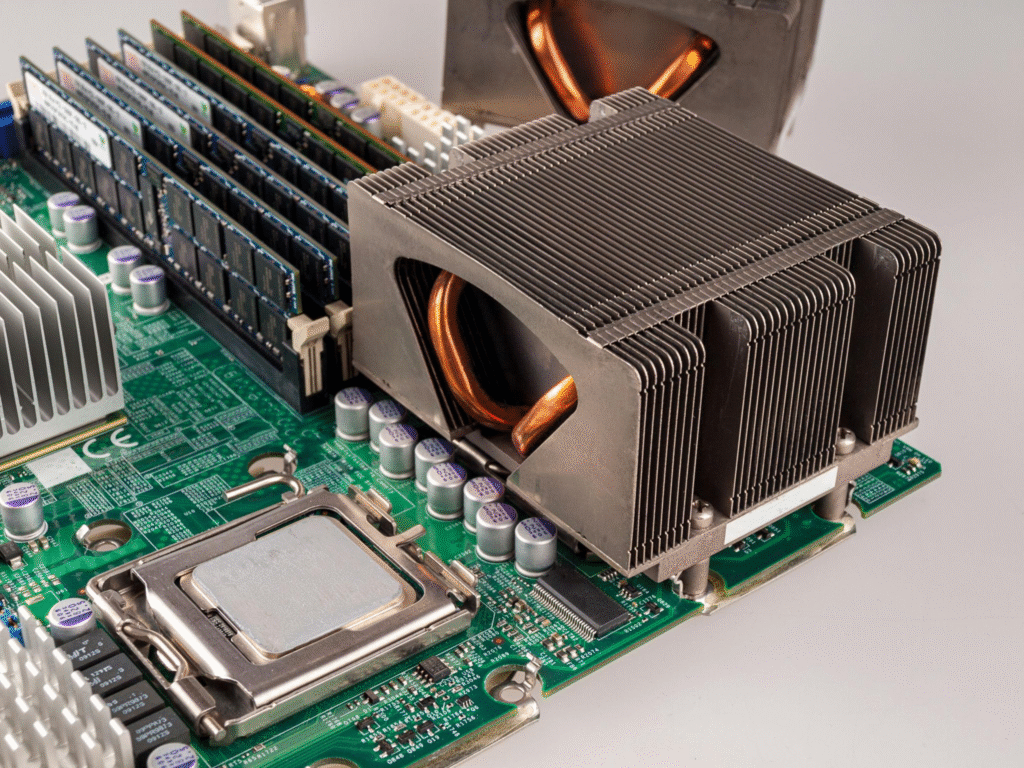
A heat sink is a passive cooling component that transfers heat away from electronic devices.
It typically uses metal materials such as aluminium or copper because of their thermal conductivity.
Heat sinks commonly contain fins that increase the surface area available for heat transfer.
They are widely used in:
- CPUs.
- GPUs.
- Power transistors.
- Voltage regulators.
- LED lighting systems.
- Industrial electronics.
A properly selected heat sink can reduce component temperature without requiring additional electrical power.
2. Cooling Fans
Cooling fans use moving air to remove heat from electronic components.
They are commonly installed in computers, servers, industrial control systems, and power electronics equipment.
Fans can improve heat transfer by increasing airflow across heat sinks and other hot surfaces.
However, engineers must consider noise, power consumption, dust accumulation, and fan reliability when selecting this cooling method.
3. Thermal Interface Materials (TIM)
Thermal interface materials improve heat transfer between two surfaces.
For example, engineers commonly place thermal paste or thermal pads between a processor and its heat sink.
These materials fill small air gaps and improve thermal contact.
Common thermal interface materials include:
- Thermal paste.
- Thermal pads.
- Phase-change materials.
- Thermally conductive adhesives.
Selecting the right material helps improve heat transfer and maintain consistent thermal contact.
4. Liquid Cooling
Liquid cooling systems use circulating coolant to transfer heat away from electronic components.
Compared with conventional air cooling, liquid cooling can support higher heat removal in certain high-power applications.
Common applications include:
- High-performance computing.
- AI data centers.
- Advanced gaming systems.
- Industrial power electronics.
- Specialized computing infrastructure.
However, liquid cooling systems require additional components such as pumps, pipes, heat exchangers, and coolant management systems.
5. Heat Pipes and Vapor Chambers
Heat pipes transfer heat through the evaporation and condensation of an internal working fluid.
They move heat from a hot region to a cooler region efficiently.
Vapor chambers use a similar principle but spread heat across a wider surface.
Engineers commonly use these solutions in laptops, GPUs, compact computing devices, and high-performance electronics.
6. Natural Convection
Natural convection transfers heat through the movement of air caused by temperature differences.
Unlike fan-based cooling, this method does not require powered airflow.
It is useful in applications where low noise, simplicity, and reduced power consumption are important.
However, engineers must carefully consider enclosure design, component placement, and available ventilation.
Understanding Thermal Resistance
Thermal resistance describes how difficult it is for heat to move through a material or system.
Engineers use it to evaluate the effectiveness of thermal paths between a component and its surroundings.
Thermal resistance is commonly expressed in degrees Celsius per watt (°C/W).
A simplified relationship is:
Temperature rise = Power dissipation × Thermal resistance
For example, if an electronic component dissipates 10 watts and the thermal resistance of its cooling path is 3°C/W, the temperature rise across that path is approximately 30°C.
This relationship helps engineers estimate temperatures and compare cooling solutions.
However, actual component temperature also depends on ambient temperature, package characteristics, PCB construction, and airflow.
PCB Thermal Management: Important Design Considerations
Thermal management should begin during PCB design rather than after manufacturing.
The PCB itself plays an important role in transferring heat away from electronic components.
1. Component Placement
High-power components can generate significant heat.
Therefore, engineers should consider component spacing and avoid concentrating multiple high-heat components in a small area.
Proper placement can also improve airflow.
2. Copper Planes
Copper planes help distribute heat across the PCB.
Engineers can use suitable copper areas and layers to improve thermal conduction.
However, the actual benefit depends on board construction, copper thickness, via arrangement, and thermal connections.
3. Thermal Vias
Thermal vias transfer heat between PCB layers.
Engineers commonly place them beneath power components and exposed thermal pads.
These vias can help move heat toward larger copper areas or additional cooling structures.
4. PCB Material Selection
PCB materials have different thermal properties.
Engineers should select materials based on operating temperature, electrical performance, manufacturing requirements, and thermal conditions.
5. Airflow and Enclosure Design
PCB layout and enclosure design should work together.
Engineers should consider ventilation openings, airflow paths, fan locations, and component orientation.
This helps prevent hot spots and improves cooling effectiveness.
For more information, read our guide on Electronic Component Selection for Hardware Design.
Thermal Management in AI Hardware and Data Centers
AI hardware has increased the demand for effective thermal management.
Modern AI processors and GPUs perform intensive calculations that can generate substantial amounts of heat.
Data centers must remove this heat while maintaining reliable computing performance.
Common approaches include:
Air Cooling
Traditional server cooling systems use fans and controlled airflow to remove heat from processors and other components.
Direct-to-Chip Liquid Cooling
This technique circulates coolant through cold plates attached to high-power processors.
It helps remove heat close to the source.
Immersion Cooling
Immersion cooling places electronic equipment in a specially designed dielectric fluid.
The fluid absorbs heat from electronic components and transfers it to a cooling system.
Advanced Thermal Monitoring
Data center operators use temperature sensors and monitoring systems to identify hot spots and manage cooling operations.
These techniques help support the growing thermal requirements of AI infrastructure.
How to Design an Effective Thermal Management System
A structured approach helps engineers develop suitable cooling solutions.
Follow these steps:
1. Identify Heat Sources: Determine which components generate the most heat during normal and peak operation.
2. Calculate Power Dissipation: Estimate the heat generated by processors, regulators, transistors, and other components.
3. Define Temperature Limits: Review the operating temperature specifications provided by component manufacturers.
4. Select a Cooling Method: Evaluate heat sinks, fans, thermal pads, heat pipes, or liquid cooling based on system requirements.
5. Optimize PCB Layout: Improve component placement, copper distribution, and thermal via arrangements.
6. Evaluate Enclosure Design: Check ventilation, airflow paths, and available cooling space.
7. Perform Thermal Simulation: Use suitable engineering tools to estimate temperature distribution and identify potential hot spots.
8. Build a Prototype: Test the physical hardware under realistic operating conditions.
9. Validate Thermal Performance: Measure component temperatures during normal and demanding workloads.
10. Improve the Design: Adjust cooling components, PCB layout, or enclosure design based on test results.
Common Thermal Management Mistakes to Avoid
Even well-designed electronic products can experience thermal problems when engineers overlook important details.
Here are some common mistakes.
1. Ignoring Power Dissipation: Selecting components without estimating their heat generation can create unexpected thermal problems.
2. Poor Component Placement: Placing multiple high-power components close together can create hot spots.
3. Using Inadequate Heat Sinks: A heat sink with insufficient thermal capacity may fail to maintain suitable operating temperatures.
4. Ignoring Airflow: Restricted ventilation can reduce cooling performance.
5. Choosing Incorrect Thermal Interface Materials: Poor thermal contact can reduce heat transfer between components and cooling structures.
6. Skipping Thermal Testing: Simulation alone cannot confirm real-world thermal performance. Engineers should also validate physical prototypes.
7. Ignoring Ambient Conditions: A design that works in a controlled laboratory may struggle in a hot industrial environment.
Applications of Thermal Management in Electronics
Thermal management is important across many industries.
- Computers and Laptops: Cooling systems maintain CPU and GPU temperatures during intensive workloads.
- AI Data Centers: Advanced cooling supports high-performance processors and accelerators.
- Electric Vehicles: Battery packs, power electronics, and electric motors require thermal control.
- Industrial Automation: Motor drives, controllers, and power supplies generate heat during operation.
- Consumer Electronics: Smartphones, gaming devices, and portable electronics require compact cooling solutions.
- Telecommunications: Networking equipment and communication hardware need reliable thermal performance.
- Renewable Energy: Inverters and power conversion systems require suitable cooling under demanding operating conditions.
Conclusion
Thermal management is a critical part of modern electronic hardware design.
As processors become more powerful and electronic devices become more compact, controlling heat becomes increasingly important.
Techniques such as heat sinks, cooling fans, thermal interface materials, liquid cooling, and thermal vias help engineers maintain suitable operating temperatures.
However, effective thermal management requires more than choosing a cooling component. Engineers must consider power dissipation, PCB layout, component placement, airflow, enclosure design, and operating conditions.
By planning thermal requirements early and validating designs through testing, hardware development teams can improve product performance, reliability, and operating life.
At HashingHardware, understanding thermal engineering fundamentals helps engineers develop more efficient and reliable electronic products.
Frequently Asked Questions
What is thermal management in electronics?
Thermal management is the process of controlling heat generated by electronic components to maintain suitable operating temperatures and prevent overheating.
Why is thermal management important in PCB design?
It helps distribute and remove heat from electronic components, reducing thermal stress and improving hardware reliability.
What are the common methods of electronic cooling?
Common methods include heat sinks, cooling fans, thermal interface materials, heat pipes, natural convection, and liquid cooling.
What is thermal throttling?
Thermal throttling occurs when a processor reduces its operating speed to control temperature and prevent overheating.
What are thermal vias in PCB design?
Thermal vias are conductive connections between PCB layers that help transfer heat away from components toward other copper areas.
Is liquid cooling better than air cooling?
Liquid cooling can remove higher amounts of heat in certain applications, but it adds complexity and cost. Air cooling is often simpler and more suitable for lower thermal loads.
How can engineers test thermal performance?
Engineers can use temperature sensors, thermal cameras, thermal simulation tools, and controlled workload testing to evaluate thermal performance.