
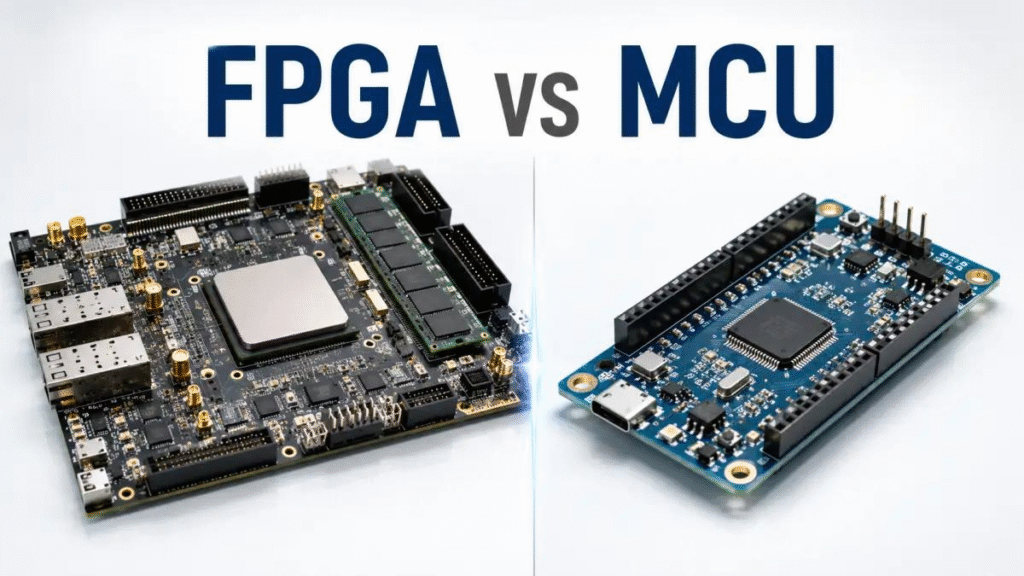
Introduction
Choosing the right processing hardware is an important decision when developing an electronic product. For example, industrial automation systems, IoT devices, communication equipment, and consumer electronics require different levels of processing performance.
Two commonly used technologies in hardware development are Field Programmable Gate Arrays (FPGAs) and Microcontrollers (MCUs).
However, these technologies work differently and serve different purposes.
A microcontroller executes software instructions using a predefined processor architecture. In contrast, an FPGA allows engineers to configure programmable hardware logic to perform specific operations.
Therefore, understanding the differences between FPGA and microcontroller technology helps engineers select the right solution based on performance, power consumption, cost, development complexity, and application requirements.
In this article, we explore how FPGAs and microcontrollers work, compare their features, discuss their applications, and explain how to choose the right technology for a hardware project.
What Is an FPGA?
A Field Programmable Gate Array (FPGA) is a semiconductor device that engineers can configure after manufacturing to implement custom digital logic circuits.
Unlike traditional processors with fixed architectures, FPGAs contain programmable logic resources and configurable connections.
As a result, engineers can use these resources to create hardware functions that match specific application requirements.
FPGAs commonly use Hardware Description Languages (HDLs), such as:
- Verilog
- VHDL
These languages describe how digital hardware behaves and how different circuit components interact.
How Does an FPGA Work?
An FPGA contains several important internal resources.
1. Configurable Logic Blocks
These blocks contain programmable logic elements that engineers use to implement digital functions.
2. Programmable Interconnects
These connections link different logic resources and help engineers create custom circuit structures.
3. Input and Output Blocks
These blocks provide interfaces between the FPGA and external hardware.
4. Memory Resources
Many FPGAs include internal memory blocks that support data storage and processing.
5. DSP Blocks
Some FPGA devices include dedicated Digital Signal Processing (DSP) resources for arithmetic-intensive operations.
Once engineers configure an FPGA, its internal logic resources work together to perform the required hardware functions.
One major advantage is that an FPGA can execute multiple independent hardware operations in parallel.
What Is a Microcontroller?
A Microcontroller Unit (MCU) is a compact integrated circuit that combines a processor, memory, and peripheral interfaces on a single chip.
Engineers use microcontrollers to control electronic devices and execute embedded software.
For example, microcontrollers power:
- Smart home appliances.
- Industrial controllers.
- IoT devices.
- Automotive electronics.
- Medical monitoring equipment.
- Consumer electronics.
Popular microcontroller families include ARM Cortex-M-based devices, Microchip PIC, and AVR microcontrollers.
How Does a Microcontroller Work?
A microcontroller executes instructions stored in its program memory.
Its processor reads instructions, performs calculations, processes input data, and controls connected hardware.
A typical microcontroller includes:
1. CPU: Executes program instructions and manages system operations.
2. RAM: Stores temporary data during program execution.
3. Flash Memory: Stores firmware and application code.
4. GPIO: Allows the microcontroller to interact with external electronic components.
5. Communication Interfaces: Supports protocols such as UART, SPI, I2C, and CAN.
6. Timers and ADCs: Help manage timing operations and convert analog signals into digital values.
Additionally, microcontrollers often provide development environments, debugging tools, and software libraries.
As a result, engineers can develop many microcontroller applications using familiar programming languages such as C and C++.
FPGA vs Microcontroller: Key Differences
Although both technologies support embedded and electronic systems, their architectures and capabilities differ.
| Feature | FPGA | Microcontroller |
|---|---|---|
| Architecture | Configurable hardware logic | Fixed processor architecture |
| Processing | Parallel hardware operations | Instruction-based execution |
| Programming | Verilog or VHDL | C, C++ and other supported languages |
| Flexibility | Configurable hardware architecture | Programmable firmware |
| Power consumption | Depends on device and workload | Often lower for simple control tasks |
| Cost | Generally higher | Generally more affordable |
| Development | Requires hardware design knowledge | More accessible software development |
| Best suited for | Custom logic and parallel processing | Embedded control applications |
However, these differences do not mean that one technology is always better.
Instead, engineers should evaluate the actual processing, power, and functionality requirements before choosing a device.
Advantages of FPGA Technology
FPGAs provide several benefits for applications that require specialized hardware functionality.
1. Parallel Processing
An FPGA can implement multiple independent hardware operations that run simultaneously.
Therefore, engineers can use FPGAs for applications involving high-speed data processing, signal processing, and multiple input channels.
2. Hardware Customization
Engineers can configure internal logic resources to implement application-specific digital circuits.
For example, they can create custom interfaces, processing pipelines, and control functions.
This flexibility makes FPGAs useful for specialized hardware applications.
3. Low and Predictable Latency
FPGAs can provide predictable response times when engineers design the hardware architecture carefully.
Consequently, they are useful in applications with strict timing requirements.
4. Reconfigurability
Engineers can reconfigure FPGAs after manufacturing.
As a result, development teams can modify implemented logic to support new functions or correct design issues without manufacturing a completely new chip.
5. Hardware Acceleration
FPGAs can accelerate selected workloads, including image processing, signal processing, and specialized data-processing tasks.
However, actual performance depends on the implemented architecture and available FPGA resources.
Advantages of Microcontrollers
Microcontrollers remain one of the most practical solutions for many electronic products.
1. Lower Cost
Manufacturers offer microcontrollers in different price and performance categories.
Therefore, engineers can find affordable solutions for applications that do not require complex programmable logic.
2. Lower Power Consumption
Many microcontrollers support energy-efficient operation.
For example, sleep modes and power management features help reduce energy consumption in battery-powered products.
3. Easier Development
Engineers can program microcontrollers using familiar languages such as C and C++.
Additionally, development environments, debugging tools, libraries, and documentation are widely available.
4. Integrated Peripherals
Most microcontrollers include built-in peripherals such as timers, ADCs, PWM controllers, communication interfaces, and GPIO.
Consequently, developers can reduce the need for additional external components.
5. Suitable for Real-Time Control
Microcontrollers support many applications that require predictable control operations.
For example, they can manage sensors, motors, communication interfaces, and other embedded functions.
FPGA vs Microcontroller: Applications and Use Cases
The best technology depends on the application and its performance requirements.
Let’s explore some common examples.
1. IoT Devices
Microcontrollers are commonly used in IoT devices because they provide low-power processing, communication interfaces, and sensor control.
For example, a smart temperature sensor can use an MCU to collect readings, process data, and transmit information through a wireless connection.
However, an FPGA may be useful when a device requires specialized high-speed signal processing.
2. Industrial Automation
Both technologies play important roles in industrial systems.
Microcontrollers can manage equipment control, sensor monitoring, and communication.
Meanwhile, FPGAs can support high-speed signal processing, multiple synchronized control channels, and custom hardware interfaces.
3. Image Processing
FPGAs can handle image processing applications that benefit from parallel operations.
For example, engineers can implement customized hardware pipelines to process multiple data streams.
On the other hand, microcontrollers may suit simpler image-related tasks with limited processing requirements.
4. Automotive Electronics
Microcontrollers are widely used in automotive control systems, including body electronics, sensor interfaces, and motor control.
However, FPGAs can support specialized applications involving high-speed data processing, sensor integration, and advanced driver assistance systems.
Engineers must also consider applicable safety and reliability requirements when designing automotive electronics.
5. Communication Systems
Communication equipment often requires high-speed data handling, protocol processing, and precise timing.
FPGAs can implement custom digital interfaces and processing pipelines.
Meanwhile, microcontrollers can manage system configuration, monitoring, and lower-speed control functions.
Can FPGA and Microcontroller Work Together?
Yes. In fact, combining an FPGA with a microcontroller can provide an effective architecture for certain applications.
Each device can handle the tasks that best match its capabilities.
For example:
- The microcontroller manages system control and communication.
- The FPGA handles high-speed data processing.
- Both devices exchange information through suitable interfaces.
Consider an industrial monitoring system.
The microcontroller can collect sensor information, manage user commands, and communicate with external systems.
At the same time, the FPGA can process multiple high-speed input signals and perform time-critical operations.
This combination provides software flexibility alongside hardware-level parallel processing.
Furthermore, some semiconductor devices integrate processor cores and programmable FPGA logic into a single System-on-Chip FPGA.
Important Factors to Consider Before Choosing
Before selecting an FPGA or microcontroller, engineers should evaluate several important factors.
1. Processing Requirements
First, determine how much processing power the application needs.
If the system requires several independent operations to happen simultaneously, an FPGA may be appropriate.
However, a microcontroller may provide sufficient performance for standard control tasks.
2. Power Consumption
Battery-powered products often prioritize low power consumption.
Therefore, compare device specifications and estimate total system power under realistic operating conditions.
3. Development Complexity
FPGA development requires knowledge of digital logic design, timing constraints, simulation, and hardware description languages.
In comparison, microcontroller development generally involves firmware programming and embedded software debugging.
Consequently, consider your engineering team’s experience before making a decision.
4. Total Development Cost
Component price represents only one part of the overall project cost.
Additionally, consider development tools, engineering resources, PCB complexity, testing, power requirements, and manufacturing expenses.
For more information, read our guide on Electronic Component Selection for Hardware Design.
5. Future Scalability
Think about whether the product may require additional features or higher processing performance in the future.
FPGAs provide flexibility for changing hardware logic. Meanwhile, microcontrollers support firmware updates within their existing hardware capabilities.
6. Component Availability
Before finalizing a device, check manufacturer support, product lifecycle, supply availability, and alternative components.
This is particularly important for products that require long-term manufacturing support.
Common Mistakes to Avoid
Choosing the wrong processing platform can increase development time and product costs.
Here are some common mistakes engineers should avoid.
1. Selecting an FPGA Without a Clear Need
An FPGA may introduce unnecessary complexity when a microcontroller can handle the application.
2. Ignoring Power Requirements
FPGA power consumption can vary significantly depending on the device and implemented design.
Therefore, estimate power requirements before selecting the hardware.
3. Underestimating Development Skills
FPGA projects require specialized hardware design knowledge.
Consequently, evaluate available engineering skills before starting development.
4. Choosing Based Only on Processing Speed
Architecture, latency, timing, peripheral support, and total system cost also matter.
5. Ignoring Integration Requirements
Consider how the selected device will connect to sensors, memory, communication interfaces, and other hardware.
A Practical Workflow for Selecting the Right Technology
Follow these steps when choosing between an FPGA and a microcontroller.
1. Define Application Requirements: Identify the main functions and expected system behavior.
2. Evaluate Processing Needs: Determine whether the application requires sequential control, parallel processing, or both.
3. Estimate Power Requirements: Consider operating power, standby power, and thermal conditions.
4. Compare Available Devices: Review processing resources, memory, peripherals, interfaces, and specifications.
5. Evaluate Development Complexity: Consider available engineering skills, development tools, and project timelines.
6. Review PCB Requirements: Check component packages, power delivery, routing, and external memory requirements.
7. Build a Prototype: Test the selected platform under realistic operating conditions.
8. Validate Performance: Measure response time, power consumption, reliability, and overall system performance.
9. Consider Future Requirements: Make sure the architecture can support expected product updates and long-term needs.
Conclusion
FPGA and microcontroller technologies play important roles in modern electronic hardware development.
FPGAs provide configurable hardware logic and parallel processing capabilities. Therefore, engineers often choose them for specialized high-speed and timing-sensitive applications.
On the other hand, microcontrollers offer an affordable, power-efficient, and accessible solution for a wide range of embedded control applications.
Neither technology is universally better. Instead, the right choice depends on processing requirements, power consumption, development complexity, cost, and application needs.
In some designs, combining both technologies can provide an effective balance between hardware flexibility and software control.
Ultimately, understanding their differences and evaluating project requirements early helps hardware engineers choose the right processing platform and develop more efficient, reliable electronic products.
At HashingHardware, we explore important hardware engineering technologies to help readers understand modern electronic design and development.
Frequently Asked Questions
What does FPGA stand for?
FPGA stands for Field Programmable Gate Array. It is a semiconductor device that engineers can configure after manufacturing to implement custom digital logic.
What is the main difference between FPGA and microcontroller?
An FPGA implements configurable hardware logic, while a microcontroller executes software instructions using a predefined processor architecture.
Is FPGA faster than a microcontroller?
An FPGA can perform multiple operations in parallel and may provide better performance for specialized workloads. However, the actual performance depends on the application and hardware design.
Which is better for IoT projects?
Microcontrollers are generally suitable for many IoT applications because they offer low-power processing and integrated communication peripherals. However, some specialized IoT applications may benefit from FPGA capabilities.
Can FPGA replace a microcontroller?
An FPGA can implement many digital control functions, but replacing a microcontroller may require additional hardware and development effort. The right choice depends on system requirements.
Can FPGA and microcontroller work together?
Yes. Engineers can combine both technologies, using the FPGA for parallel processing and the microcontroller for system control, communication, and firmware execution.