
The Hook (Intro)
For decades, the sound of a data center was defined by the roar of thousands of server fans. But as we enter the era of Generative AI and trillion-parameter models, that sound is fading. In its place? The quiet hum of liquid.
We have officially hit the “Thermal Wall.” Standard air cooling is no longer physically capable of removing the heat generated by the latest generation of GPUs (like the Blackwell architecture). To stay competitive, the industry is moving toward two dominant liquid-cooling architectures: Direct-to-Chip and Immersion Cooling.
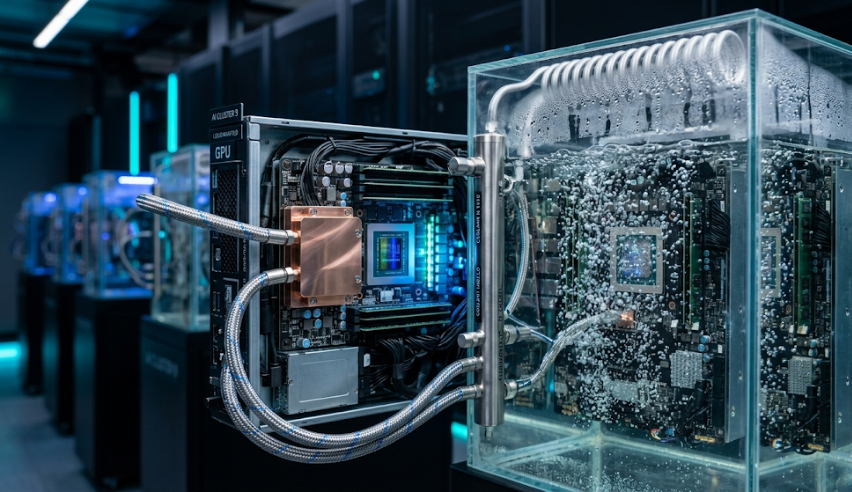
1. Direct-to-Chip (DTC) Cooling: The Precision Scalpel
Direct-to-Chip, often called “Cold Plate” cooling, is the most popular bridge between legacy infrastructure and the AI future.
- How it works: Instead of blowing air over a heatsink, a liquid-filled plate is mounted directly onto the CPU or GPU. A closed-loop system circulates coolant (usually treated water) through micro-channels in the plate, absorbing heat at the source.
- The Benefit: It is incredibly efficient at targeting “hot spots.” It allows for rack densities pushing 80kW to 100kW—a massive jump from the 15kW–20kW limit of air-cooled racks.
- Best For: Enterprise data centers that need to upgrade existing facilities to support AI clusters without a total building overhaul.
2. Immersion Cooling: The Radical Shift
Immersion cooling is the “total immersion” approach. Here, we stop fighting the air and embrace the fluid. The entire server—motherboard, memory, and processors—is submerged in a tank of non-conductive (dielectric) fluid.
There are two primary methods:
- Single-Phase: The fluid stays liquid and is circulated through a heat exchanger. It’s simple, silent, and requires very little maintenance.
- Two-Phase: The fluid actually boils when it touches the chips, turning into vapor and rising to a cooling coil where it condenses back into liquid. This is the “gold standard” for heat rejection.
The “Silent” Advantage: Immersion eliminates the need for server fans entirely. Fans can consume up to 15% of a server’s total energy; removing them instantly improves your Power Usage Effectiveness (PUE).
3. The Business Case: ROI Beyond the Hardware
Moving to liquid isn’t just an engineering preference; it’s a financial and ethical imperative.
- Sustainability (ESG): Liquid cooling can reduce data center energy consumption by up to 40%. For companies with “Net Zero” targets, this is the single biggest lever available.
- Space Efficiency: Because you can pack 5x more compute into the same square footage, you can delay expensive “land and power” acquisitions.
- Hardware Longevity: Liquid maintains a constant temperature, preventing the “thermal cycling” (expansion and contraction) that causes chips to fail prematurely.
The Conclusion (The Call to Action)
The transition from air to liquid cooling represents the most significant shift in physical IT infrastructure in the last 30 years. Organizations that fail to adapt won’t just face higher energy bills—they will be physically unable to run the next generation of AI hardware.