
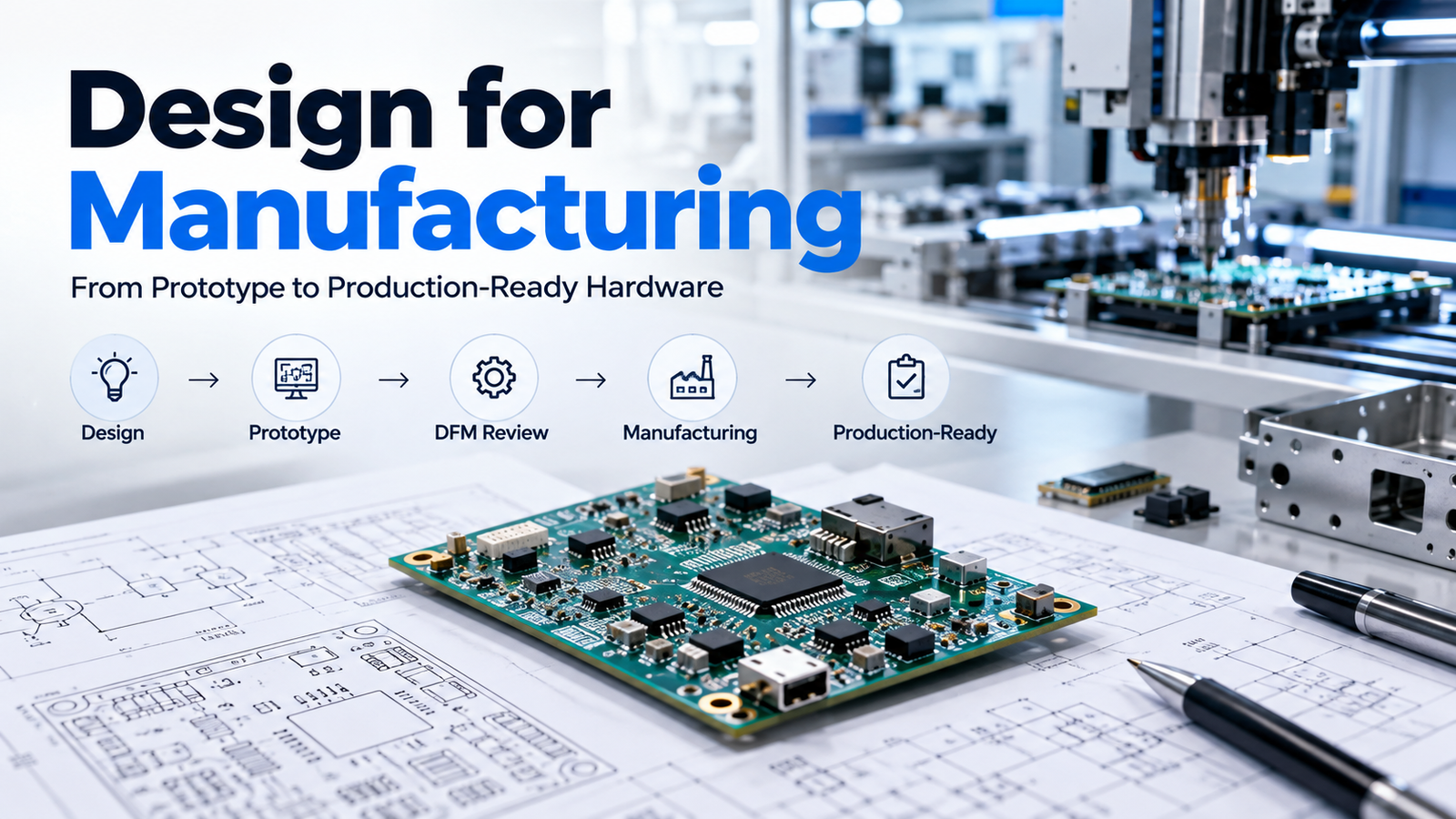
Building a hardware product does not end when the prototype works. Instead, the team must ensure that the product can move smoothly from a working prototype to reliable production.
A prototype may perform exactly as expected in the lab. However, the same design may become difficult, expensive, or inconsistent to manufacture at scale. Therefore, Design for Manufacturing (DFM) plays an important role in hardware development.
DFM encourages engineers to consider manufacturing requirements while they design the product. As a result, teams can identify production problems earlier and make changes before manufacturing costs increase.
For hardware companies, this approach can reduce manufacturing challenges, unnecessary redesigns, production delays, and avoidable costs.
What Is Design for Manufacturing?
Design for Manufacturing, commonly called DFM, is an engineering approach that helps teams design products for efficient and repeatable manufacturing.
Instead of designing a product first and considering production later, engineers consider manufacturing requirements from the beginning.
These requirements can include:
- Component availability
- PCB layout
- Component placement
- Manufacturing tolerances
- Assembly methods
- Material selection
- Testing requirements
- Production volume
- Manufacturing equipment
- Supplier capabilities
- Quality requirements
The goal is not simply to create a product that works. Instead, engineers aim to create a product that manufacturers can produce consistently at the required quality, volume, and cost.
Moreover, DFM connects product design with manufacturing realities. This connection becomes especially important when a company moves from a small prototype run to larger production volumes.
Why Is DFM Important for Hardware Products?
Hardware products have physical constraints that software products do not face. Consequently, teams cannot always solve physical design problems after production begins.
For example, a small design decision can affect manufacturing time, assembly cost, reliability, production yield, and testing.
A PCB may work correctly during manual prototype assembly. However, the same PCB may become difficult to assemble when a manufacturer needs to produce thousands of units.
Therefore, engineers should consider manufacturing requirements before they finalize the design.
In addition, early DFM reviews can help teams identify potential production issues while design changes remain easier and less expensive.
DFM vs. Prototype Design
A prototype and a production-ready product serve different purposes.
A prototype primarily helps engineers validate a concept. In contrast, a production-ready design must support repeatable manufacturing.
| Prototype | Production-ready product |
|---|---|
| Focuses on proving the concept | Focuses on repeatable production |
| May use manual assembly | Supports efficient assembly |
| Usually involves limited quantities | Supports the required production volume |
| May tolerate component substitutions | Requires reliable component sourcing |
| May rely on manual testing | Supports repeatable testing |
| Can accept flexible tolerances | Requires defined tolerances |
| Cost may be secondary | Cost and scalability become important |
Therefore, a working prototype does not automatically mean that a product is ready for mass production.
Instead, teams should review the design from manufacturing, testing, sourcing, and quality perspectives before they begin large-scale production.
1. Choose Components With Manufacturing in Mind
Component selection provides one of the earliest opportunities to apply DFM principles.
Engineers should not select a component only because it meets the technical specification. Instead, they should evaluate its availability, package type, cost, lifecycle, and sourcing options.
Important considerations include:
- Availability
- Lead time
- Package type
- Cost
- Lifecycle status
- Alternative components
- Supplier availability
- Production volume
- Environmental requirements
For example, a component may satisfy every electrical requirement but still create a production problem if suppliers cannot provide it consistently.
Therefore, engineers should evaluate sourcing risks during the design stage.
Furthermore, teams should identify alternative components when practical. This approach gives manufacturers more flexibility if a preferred component becomes unavailable.
2. Design the PCB for Manufacturing
PCB layout plays a major role in DFM.
A PCB must provide the required electrical connections. At the same time, it must remain practical to fabricate, assemble, inspect, and test.
Important considerations include:
- Trace widths
- Spacing
- Via sizes
- Board thickness
- Layer count
- Component footprints
- Component spacing
- Copper distribution
- Soldering requirements
- Fabrication tolerances
Engineers should complete design-rule checks before they release manufacturing files.
In addition, they should review the PCB with the intended manufacturing process in mind.
For example, a layout that works well for a prototype may create assembly difficulties during high-volume production. Therefore, the team should evaluate manufacturability before approving the final PCB.
3. Optimize Component Placement
Component placement affects both electrical performance and manufacturing efficiency.
Therefore, engineers should position components according to their electrical, thermal, mechanical, and assembly requirements.
For example, engineers may place high-speed components close to one another to reduce critical signal paths. Similarly, they may separate heat-generating components from temperature-sensitive devices.
Connectors also require careful placement. They should remain accessible during assembly, testing, and final product use.
As a result, thoughtful component placement can improve product performance while also making manufacturing and testing easier.
4. Consider Assembly Methods Early
The intended assembly method should influence the product design from the beginning.
Depending on the product, manufacturers may use:
- Surface-mount technology
- Through-hole components
- Automated PCB assembly
- Manual assembly
- Mechanical fastening
- Adhesives
- Cable connections
- Enclosure assembly
For example, a design that requires many unnecessary manual operations can increase production time and labor requirements.
Therefore, engineers should identify opportunities to simplify assembly.
Where appropriate, teams can design products around automated and repeatable processes. This approach becomes particularly valuable as production volume increases.
5. Control Manufacturing Tolerances
No physical manufacturing process produces perfectly identical parts. Instead, every process introduces some level of variation.
Tolerances define the acceptable range of that variation.
For hardware products, tolerances may apply to:
- PCB dimensions
- Component placement
- Mechanical parts
- Enclosures
- Connectors
- Mounting holes
- Material dimensions
If engineers specify unnecessarily tight tolerances, manufacturers may need more expensive processes.
On the other hand, excessively loose tolerances can create fit or performance problems.
Therefore, engineers should define tolerances according to actual functional requirements and manufacturing capabilities.
6. Design for Testing
A production-ready hardware product must support efficient testing.
Testing helps manufacturers identify:
- Assembly defects
- Electrical failures
- Incorrect component placement
- Communication problems
- Power issues
- Firmware-related problems
- Functional failures
For this reason, DFM should work together with Design for Testability (DFT).
Engineers can improve testability by adding:
- Test points
- Programming interfaces
- Debug connectors
- Diagnostic interfaces
- Automated functional tests
For example, accessible test points can help technicians measure important signals without disassembling the entire product.
Consequently, thoughtful test design can make production troubleshooting faster and more consistent.
7. Consider Thermal Requirements
Thermal performance also matters during hardware development.
Components such as processors, power regulators, and communication modules can generate heat during operation.
If the design cannot dissipate that heat effectively, the product may experience performance or reliability problems.
Therefore, engineers should consider:
- Copper areas
- Thermal vias
- Heat sinks
- Component spacing
- Airflow
- Enclosure design
In addition, the team should evaluate thermal behavior during prototype testing.
By identifying thermal issues before production, engineers can make necessary changes without disrupting a larger manufacturing run.
8. Design for Consistent Quality
Manufacturing one successful unit differs significantly from manufacturing thousands of consistent units.
Therefore, production designs should minimize unnecessary variation.
Teams should consider:
- Component tolerances
- Assembly processes
- Material specifications
- Inspection procedures
- Testing methods
- Quality requirements
For example, manufacturers can define repeatable inspection and testing procedures to identify defects during production.
As a result, teams can detect problems earlier instead of discovering them after products reach customers.
9. Consider the Supply Chain Before Production
DFM should also work alongside supply-chain planning.
A technically strong design can still face production problems if critical components become unavailable.
Therefore, teams should evaluate:
- Critical components
- Alternative parts
- Supplier availability
- Lead times
- Minimum order quantities
- Component lifecycle
- Regional sourcing options
- Production capacity
For example, relying on a single supplier for a critical component can create additional production risk.
Instead, teams can evaluate alternative suppliers or compatible components where practical.
This approach can give manufacturers greater flexibility during production.
10. Design for Production Scale
The manufacturing process for ten prototypes may look very different from the process for ten thousand units.
At low production volumes, manual assembly may be practical. However, higher volumes may require:
- Automated assembly
- Production fixtures
- Automated testing
- Specialized tooling
- Process controls
- Standardized inspection
Therefore, teams should consider expected production volume during the design stage.
A scalable design can make the transition from prototype manufacturing to larger production runs more efficient.
Common DFM Mistakes to Avoid
Designing Only for Function
A product can function correctly and still create manufacturing problems.
Therefore, engineers should consider manufacturing requirements alongside electrical and mechanical requirements.
Choosing Hard-to-Source Components
A component may satisfy technical requirements but create supply problems later.
Instead, teams should evaluate availability and identify practical alternatives early.
Ignoring Assembly
A PCB layout may work electrically but still require unnecessary manual assembly.
Therefore, engineers should design around the intended assembly process.
Using Unnecessary Tight Tolerances
Extremely tight tolerances can increase manufacturing complexity and cost.
Instead, teams should specify tolerances according to actual product requirements.
Skipping Production Testing
Manufacturers may discover defects too late if they do not plan adequate testing.
Therefore, teams should define production tests before manufacturing begins.
Treating DFM as a Final Review
Waiting until the final design stage can make manufacturing changes more difficult.
Instead, teams should apply DFM principles throughout product development.
DFM Checklist for Hardware Products
Before moving from prototype to production, teams should review several areas.
Product Design
- Is the design suitable for the intended production volume?
- Are the materials appropriate?
- Are mechanical tolerances clearly defined?
Components
- Are critical components available?
- Have engineers identified alternatives?
- Are component lifecycle risks understood?
PCB
- Has the PCB passed design-rule checks?
- Are trace widths and clearances appropriate?
- Is component placement optimized?
- Can the board support the intended fabrication process?
Assembly
- Is the assembly process clearly defined?
- Can the team reduce unnecessary manual operations?
- Can manufacturers assemble the product consistently?
Testing
- Are required test points available?
- Can manufacturers perform functional testing efficiently?
- Are production test procedures documented?
Manufacturing
- Can the manufacturer achieve the required tolerances?
- Can the supplier support the expected production volume?
- Are quality-control procedures defined?
Supply Chain
- Are critical components available?
- Have teams identified alternative suppliers or parts?
- Are lead times understood?
From Prototype to Production: Where DFM Fits
A typical hardware development process can follow this path:
Idea → Feasibility → System Architecture → Schematic → PCB Design → Prototype → Validation → DFM Review → Production → Quality Control → Deployment
However, DFM should not appear only as a single step before manufacturing.
Instead, manufacturing considerations should influence decisions throughout the development process.
For example, component selection affects sourcing. PCB layout affects fabrication and assembly. Testing requirements affect board design. Production volume affects manufacturing methods.
Therefore, DFM works best when engineers consider these factors together.
How DFM Can Reduce Hardware Development Risk
DFM cannot eliminate every manufacturing problem. However, it can help engineering teams identify many potential issues before production begins.
For example, DFM can help teams address:
- Manufacturing complexity
- Assembly challenges
- Component availability
- Production scalability
- Testing requirements
- Unnecessary costs
- Redesign risks
- Quality problems
Moreover, early identification gives engineers more opportunities to improve the design.
Instead of discovering a manufacturing problem after thousands of units have been produced, teams can address the issue while the product remains in development.
Final Thoughts
A successful hardware product needs to do more than work during prototyping.
It must also support manufacturing, testing, scalability, reliability, and consistent quality.
That is why Design for Manufacturing matters.
By considering components, PCB layout, assembly, tolerances, testing, thermal performance, supply chain, and production volume early in the development process, hardware teams can create a stronger path from prototype to production.
Most importantly, teams should treat manufacturing as part of product engineering rather than as a separate final-stage activity.
When engineers design with manufacturing in mind from the beginning, they create a clearer path toward reliable and scalable hardware production.
Hashing Hardware supports hardware development across electronics and PCB design, embedded systems, prototyping, manufacturing, quality assurance, supply chain, and lifecycle management. Consequently, teams can approach hardware development as a connected process from engineering through production.