
As enterprise computing workloads continue to expand, traditional air-cooling systems are reaching their physical and operational limits. Artificial intelligence, cloud computing, high-performance computing (HPC), big data analytics, and hyperscale data centers generate enormous amounts of heat that conventional cooling infrastructures increasingly struggle to manage efficiently.
Modern enterprise servers now contain:
- High-core-count CPUs
- Powerful GPUs
- AI accelerators
- Dense memory configurations
- High-speed networking hardware
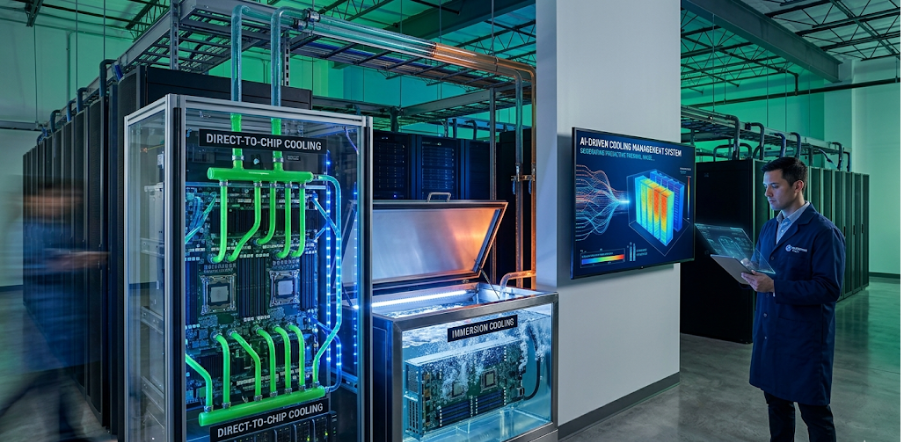
These components can generate extremely high thermal loads within compact server environments. To maintain performance, reliability, and energy efficiency, organizations are rapidly adopting liquid cooling technologies as the next evolution in enterprise infrastructure management.
Liquid cooling is transforming modern server architecture by enabling higher computational density, better thermal management, reduced power consumption, and improved sustainability in enterprise data centers.
Why Cooling Matters in Enterprise Servers
Electronic components generate heat during operation.
As computational intensity increases:
- Processor temperatures rise
- Power consumption increases
- Thermal throttling occurs
- Hardware lifespan decreases
Excessive heat can cause:
- System instability
- Performance degradation
- Unexpected shutdowns
- Hardware failures
Efficient cooling is therefore essential for:
- Reliability
- Performance
- Energy efficiency
- Infrastructure scalability
Limitations of Traditional Air Cooling
For decades, enterprise servers relied primarily on air cooling.
This approach uses:
- Fans
- Heat sinks
- Air circulation systems
- CRAC units (Computer Room Air Conditioning)
While effective for moderate workloads, air cooling faces major limitations in modern environments.
1. Increasing Heat Density
AI and HPC servers generate extremely high thermal loads.
Modern rack power densities can exceed:
- 30 kW
- 50 kW
- Even 100 kW per rack
Air cooling struggles to remove heat efficiently at these densities.
2. Energy Inefficiency
Cooling systems consume substantial electricity.
In many data centers:
- Cooling represents a major portion of total energy usage
Large fan systems also increase:
- Operational costs
- Power consumption
- Noise levels
3. Physical Airflow Constraints
Dense server configurations reduce airflow efficiency.
Hot spots can form around:
- GPUs
- CPUs
- Memory modules
leading to uneven thermal distribution.
4. Thermal Limitations for AI Infrastructure
Modern AI accelerators produce concentrated heat loads that exceed the capabilities of conventional air cooling systems.
This is especially problematic for:
- Deep learning clusters
- AI training servers
- High-density GPU racks
What Is Liquid Cooling?
Liquid cooling uses fluids instead of air to absorb and transfer heat away from electronic components.
Liquids are far more effective at heat transfer than air because they have:
- Higher thermal conductivity
- Greater heat capacity
- Better thermal efficiency
Liquid cooling systems transport heat away from critical hardware components using:
- Pumps
- Tubes
- Coolant loops
- Heat exchangers
Types of Liquid Cooling Technologies
Several liquid cooling approaches are used in enterprise servers.
1. Direct-to-Chip Liquid Cooling
Direct-to-chip cooling is one of the most common enterprise liquid cooling methods.
Cold plates are attached directly to:
- CPUs
- GPUs
- AI accelerators
Coolant flows through the cold plates, absorbing heat directly from the processor surfaces.
Advantages
- Highly efficient heat removal
- Reduced server temperatures
- Better energy efficiency
- Supports high-density computing
Common Applications
- AI servers
- HPC clusters
- Enterprise GPU systems
- Scientific computing
2. Immersion Cooling
Immersion cooling submerges entire servers or hardware components into a thermally conductive dielectric liquid.
Because the liquid is non-conductive:
- Electronics operate safely while submerged
Single-Phase Immersion Cooling
In single-phase systems:
- Coolant remains liquid throughout operation
- Heat is transferred through circulation systems
Two-Phase Immersion Cooling
In two-phase systems:
- Liquid boils upon contact with hot components
- Vapor carries heat away
- Vapor condenses back into liquid
This method provides extremely efficient thermal transfer.
Benefits
- Exceptional cooling performance
- Minimal fan usage
- Lower energy consumption
- Reduced noise
- High rack density support
Challenges
- Specialized infrastructure requirements
- Maintenance complexity
- Fluid management considerations
3. Rear Door Heat Exchangers
These systems place liquid-cooled heat exchangers at the back of server racks.
Hot exhaust air passes through:
- Water-cooled radiator systems
before entering the data center environment.
Advantages
- Compatible with existing air-cooled servers
- Improved cooling efficiency
- Easier deployment
4. Liquid Cooling Loops
Liquid cooling loops circulate coolant through server infrastructure.
Components include:
- Pumps
- Reservoirs
- Heat exchangers
- Cooling distribution units (CDUs)
These loops transfer heat away from servers toward centralized cooling systems.
Key Components in Liquid Cooling Systems
Cold Plates
Cold plates absorb heat directly from processors.
Typically made from:
- Copper
- Aluminum
Internal channels allow coolant flow across heated surfaces.
Coolants
Enterprise liquid cooling systems use specialized coolants.
Common options include:
- Water-glycol mixtures
- Dielectric fluids
- Synthetic cooling liquids
Coolants must provide:
- Thermal efficiency
- Corrosion resistance
- Electrical safety
Pumps
Pumps maintain coolant circulation throughout the system.
Reliable pump operation is essential for:
- Continuous cooling
- Thermal stability
Heat Exchangers
Heat exchangers transfer heat from coolant into:
- External cooling systems
- Facility water loops
- Chillers
Cooling Distribution Units (CDUs)
CDUs regulate:
- Coolant flow
- Temperature
- Pressure
They serve as central management systems for liquid cooling infrastructure.
Benefits of Liquid Cooling in Enterprise Servers
1. Higher Cooling Efficiency
Liquids transfer heat far more effectively than air.
This allows:
- Better thermal management
- Stable operating temperatures
- Improved hardware performance
2. Increased Server Density
Liquid cooling enables:
- More servers per rack
- Denser AI infrastructure
- Smaller data center footprints
This is critical for modern enterprise scalability.
3. Reduced Energy Consumption
Liquid cooling reduces reliance on:
- High-speed fans
- Large HVAC systems
This improves:
- Power efficiency
- Sustainability
- Operational cost savings
4. Better AI and GPU Performance
AI accelerators generate intense thermal loads.
Liquid cooling helps maintain:
- Maximum GPU performance
- Stable AI training environments
- Reduced thermal throttling
5. Lower Noise Levels
Liquid cooling systems require fewer fans.
This reduces:
- Acoustic noise
- Mechanical vibration
in enterprise environments.
6. Improved Hardware Lifespan
Stable operating temperatures reduce:
- Thermal stress
- Component degradation
- Failure rates
This can extend hardware lifespan significantly.
Liquid Cooling in AI Data Centers
AI infrastructure is driving rapid liquid cooling adoption.
AI training clusters often contain:
- Thousands of GPUs
- High-bandwidth networking
- Massive power consumption
Traditional cooling methods struggle with these environments.
Liquid cooling enables:
- Stable AI operations
- Higher computational density
- Improved thermal scalability
Sustainability Benefits
Data centers consume enormous amounts of electricity globally.
Liquid cooling supports sustainability goals by reducing:
- Cooling energy requirements
- Carbon emissions
- Water consumption in some architectures
Improved efficiency helps enterprises meet:
- Green computing targets
- ESG initiatives
- Environmental regulations
Challenges of Liquid Cooling Adoption
Despite its advantages, liquid cooling introduces several challenges.
1. Higher Initial Costs
Liquid cooling infrastructure requires:
- Specialized hardware
- Plumbing systems
- Cooling units
- Facility modifications
Initial deployment costs can be substantial.
2. Maintenance Complexity
Liquid systems require:
- Leak prevention
- Fluid management
- Pump maintenance
- Thermal monitoring
Operational expertise becomes critical.
3. Infrastructure Compatibility
Older data centers may not support:
- High-capacity liquid systems
- Plumbing integration
- Thermal distribution requirements
Retrofitting can be difficult.
4. Risk of Coolant Leaks
Although modern systems are highly reliable, coolant leaks remain a concern.
Enterprise designs therefore include:
- Leak detection systems
- Redundant safety mechanisms
- Pressure monitoring
5. Specialized Skill Requirements
Managing liquid-cooled infrastructure requires expertise in:
- Thermal engineering
- Fluid dynamics
- Data center operations
Monitoring and Management
Modern liquid cooling systems rely heavily on intelligent monitoring.
Sensors track:
- Temperature
- Coolant pressure
- Flow rates
- Leak detection
- Pump performance
Advanced management platforms use:
- AI analytics
- Predictive maintenance
- Real-time telemetry
to optimize cooling performance.
Liquid Cooling and Edge Computing
Edge data centers are becoming more powerful and compact.
Liquid cooling helps support:
- High-performance edge AI
- Remote deployments
- Compact infrastructure
where airflow may be limited.
Future Trends in Liquid Cooling
Several trends are shaping the future of enterprise server cooling.
AI-Optimized Cooling Systems
Future systems may dynamically adjust cooling based on:
- AI workload intensity
- Thermal forecasting
- Real-time telemetry
Warm Water Cooling
Some systems use warmer water temperatures to reduce:
- Chiller dependency
- Energy usage
while enabling heat reuse.
Heat Reuse Systems
Excess server heat may be repurposed for:
- Building heating
- Industrial energy systems
- District heating infrastructure
Advanced Dielectric Fluids
New cooling fluids are being developed with:
- Better thermal conductivity
- Improved environmental safety
- Longer operational lifespan
Autonomous Cooling Infrastructure
AI-driven cooling management systems may automatically:
- Optimize coolant flow
- Predict failures
- Balance thermal loads
- Reduce operational costs
Liquid Cooling vs Air Cooling
| Feature | Air Cooling | Liquid Cooling |
| Cooling Efficiency | Moderate | Very High |
| Rack Density Support | Limited | Excellent |
| Energy Efficiency | Lower | Higher |
| Noise Levels | Higher | Lower |
| AI Infrastructure Support | Limited | Excellent |
| Infrastructure Complexity | Lower | Higher |
The Future of Enterprise Thermal Management
As enterprise workloads continue evolving, liquid cooling is rapidly becoming essential rather than optional.
Technologies such as:
- Artificial intelligence
- Quantum computing
- High-performance analytics
- Large-scale simulations
will generate increasingly intense thermal requirements.
Future enterprise infrastructure will likely depend on:
- Intelligent thermal systems
- Liquid cooling integration
- Autonomous environmental optimization
to maintain performance and sustainability.
Final Thoughts
Liquid cooling technologies are transforming enterprise server infrastructure by enabling higher performance, greater energy efficiency, and better scalability for modern computing workloads. As AI, HPC, and cloud computing continue driving unprecedented heat densities in data centers, traditional air-cooling approaches are no longer sufficient for many enterprise environments.
Liquid cooling provides a powerful solution for managing the thermal challenges of next-generation computing while improving sustainability and operational efficiency. Although deployment complexity and infrastructure costs remain challenges, the long-term advantages make liquid cooling one of the most important technologies shaping the future of enterprise computing infrastructure.
The future of computing performance will depend not only on faster processors and smarter software, but also on how effectively we manage the heat those systems generate.