
Introduction
Battery technology is one of the most critical components driving modern technological innovation. From smartphones and laptops to electric vehicles, renewable energy systems, industrial equipment, and portable electronics, batteries serve as the primary source of stored energy. As the demand for higher performance, longer operational life, faster charging, and greater sustainability continues to grow, significant advancements in battery hardware technology are reshaping the future of energy storage.
Modern battery research focuses not only on increasing energy capacity but also on improving safety, reducing charging times, extending lifespan, and minimizing environmental impact. These innovations are enabling new possibilities in transportation, consumer electronics, aerospace, healthcare, and smart infrastructure.
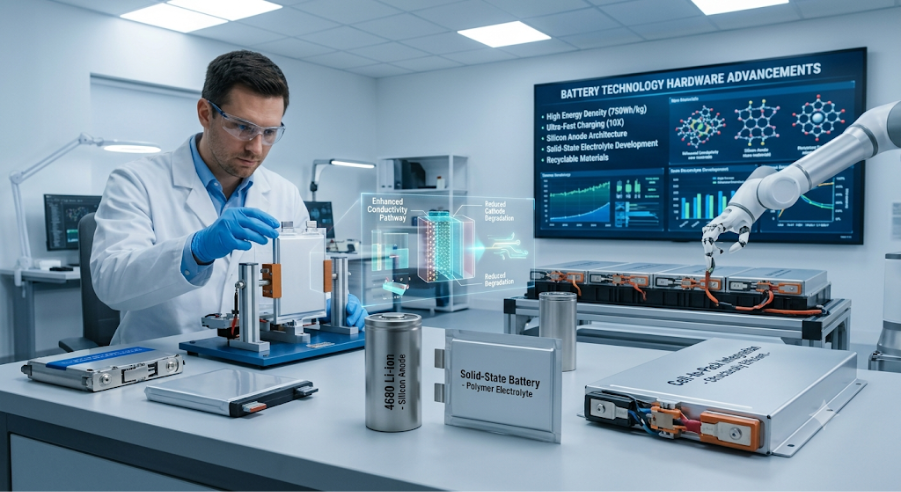
Battery hardware advancements are becoming a key factor in supporting the next generation of intelligent and energy-efficient technologies.
The Importance of Advanced Battery Hardware
Energy storage has become increasingly important due to the rapid growth of:
- Electric mobility
- Renewable energy systems
- Portable electronics
- Industrial automation
- Smart devices
- Edge computing systems
Advanced battery hardware provides:
- Higher energy density
- Improved safety
- Faster charging
- Longer operational life
- Reduced maintenance requirements
These improvements help support the growing energy demands of modern technology.
Evolution of Battery Technology
Battery technology has evolved significantly over the years.
Early Battery Systems
Initial battery technologies offered:
- Limited energy capacity
- Short operational life
- Slow charging capabilities
These batteries were suitable for basic applications but lacked the performance required by modern devices.
Rechargeable Battery Revolution
The introduction of rechargeable batteries transformed portable electronics by enabling repeated charging cycles.
Benefits included:
- Reduced waste
- Lower operating costs
- Increased convenience
Modern Energy Storage Solutions
Today’s batteries focus on:
- High efficiency
- Enhanced safety
- Long-term reliability
- Sustainable materials
These advancements continue to push the boundaries of energy storage.
Key Performance Metrics in Battery Hardware
Energy Density
Energy density measures how much energy a battery can store relative to its size or weight.
Higher energy density enables:
- Longer device runtime
- Smaller battery packs
- Improved portability
Power Density
Power density indicates how quickly energy can be delivered.
High power density is important for:
- Electric vehicles
- Robotics
- Industrial machinery
- High-performance electronics
Cycle Life
Cycle life refers to the number of charge-discharge cycles a battery can complete before performance degrades significantly.
Longer cycle life reduces replacement costs and improves sustainability.
Charging Speed
Fast-charging technology is increasingly important for modern users who require minimal downtime.
Safety
Battery safety remains a top priority due to risks associated with overheating and thermal instability.
Advancements in Electrode Materials
Electrodes play a critical role in battery performance.
High-Capacity Anode Materials
Researchers are developing advanced anode materials capable of storing more energy than traditional designs.
Benefits include:
- Increased energy density
- Improved charging performance
- Enhanced battery lifespan
Advanced Cathode Materials
Modern cathode materials aim to:
- Improve capacity
- Increase stability
- Extend battery life
These innovations help maximize overall battery performance.
Solid-State Battery Technology
One of the most promising battery advancements is the development of solid-state batteries.
Unlike traditional batteries that use liquid electrolytes, solid-state batteries use solid conductive materials.
Advantages
- Higher energy density
- Improved safety
- Reduced fire risk
- Longer lifespan
- Faster charging capabilities
Applications
Solid-state batteries are expected to play a significant role in:
- Electric vehicles
- Aerospace systems
- Consumer electronics
- Medical devices
Fast-Charging Hardware Innovations
Charging speed has become a major focus of battery development.
Advanced Charging Circuits
Modern charging systems optimize energy transfer while protecting battery health.
Benefits include:
- Reduced charging times
- Improved efficiency
- Enhanced thermal management
Smart Charging Systems
Smart charging hardware monitors:
- Temperature
- Voltage
- Current flow
This enables safer and more efficient charging operations.
Battery Thermal Management Systems
Heat management is critical for battery safety and performance.
Active Cooling Systems
Active cooling methods use dedicated hardware to remove excess heat.
Benefits include:
- Improved efficiency
- Extended battery life
- Enhanced safety
Passive Cooling Technologies
Passive systems rely on advanced materials and thermal design techniques to regulate temperature.
Advantages include:
- Simplicity
- Reliability
- Lower maintenance requirements
Battery Management Systems (BMS)
Battery Management Systems are intelligent control units responsible for monitoring and protecting batteries.
Core Functions
- Voltage monitoring
- Temperature management
- Charge balancing
- Fault detection
- Performance optimization
Benefits
A well-designed BMS improves:
- Safety
- Reliability
- Efficiency
- Battery longevity
Modern BMS hardware increasingly incorporates artificial intelligence for predictive analysis.
Flexible and Wearable Battery Hardware
The rise of wearable technology has created demand for flexible energy storage solutions.
Characteristics
- Lightweight construction
- Flexible form factors
- Mechanical durability
Applications
- Smart watches
- Health monitoring devices
- Wearable sensors
- Smart clothing
Flexible batteries enable entirely new product categories.
High-Power Batteries for Industrial Applications
Industrial systems often require batteries capable of delivering substantial power.
Applications include:
- Manufacturing equipment
- Robotics
- Automated warehouses
- Backup power systems
Advancements focus on:
- Rapid discharge capabilities
- Thermal stability
- Long operational life
Battery Hardware for Renewable Energy Storage
Renewable energy sources such as solar and wind require effective energy storage solutions.
Grid Storage Systems
Large-scale battery installations help:
- Stabilize power grids
- Store excess energy
- Improve energy availability
Distributed Energy Storage
Smaller battery systems support:
- Residential installations
- Commercial facilities
- Remote locations
Advanced battery hardware is essential for enabling widespread renewable energy adoption.
Nanotechnology in Battery Development
Nanotechnology is transforming battery performance at the material level.
Benefits
- Faster charging
- Increased energy density
- Improved conductivity
- Enhanced durability
Nanostructured materials provide greater surface area for energy storage reactions.
Advanced Battery Packaging and Design
Hardware design plays a major role in battery performance.
Compact Packaging
Modern packaging techniques maximize energy storage while minimizing physical size.
Mechanical Protection
Protective structures safeguard batteries from:
- Vibration
- Impact
- Environmental exposure
Thermal Optimization
Efficient thermal design helps maintain safe operating temperatures.
Artificial Intelligence in Battery Hardware
AI is increasingly integrated into battery systems.
Predictive Maintenance
AI can identify potential failures before they occur.
Charge Optimization
Machine learning algorithms optimize charging patterns.
Performance Forecasting
AI models predict:
- Battery health
- Remaining lifespan
- Energy availability
These capabilities improve overall system efficiency.
Applications of Advanced Battery Technologies
Electric Transportation
Advanced batteries enable:
- Longer driving ranges
- Faster charging
- Improved vehicle performance
Consumer Electronics
Benefits include:
- Extended device runtime
- Smaller form factors
- Enhanced portability
Medical Devices
Reliable battery systems support:
- Monitoring equipment
- Implantable devices
- Portable diagnostic tools
Aerospace Systems
High-performance batteries power:
- Satellites
- Unmanned aircraft
- Space exploration equipment
Industrial Automation
Modern batteries support:
- Autonomous robots
- Smart factories
- Automated logistics systems
Challenges in Battery Hardware Development
Despite significant progress, several challenges remain.
Material Availability
Some advanced materials are costly or difficult to source.
Manufacturing Complexity
Producing high-performance batteries requires sophisticated manufacturing processes.
Thermal Safety
Managing heat remains a major engineering challenge.
Recycling and Sustainability
Improving battery recycling is essential for long-term environmental sustainability.
Cost Reduction
Advanced battery technologies must become more affordable for widespread adoption.
Future Trends
Several emerging developments are shaping the future of battery hardware.
Solid-State Energy Storage
Improved safety and energy density.
Ultra-Fast Charging Systems
Charging times measured in minutes rather than hours.
AI-Driven Battery Management
Smarter energy optimization and predictive maintenance.
Advanced Nanomaterials
Higher performance through material innovation.
Sustainable Battery Manufacturing
Reduced environmental impact and increased recyclability.
Next-Generation Energy Storage Architectures
Novel battery designs offering greater efficiency and longevity.
Educational Importance
Studying battery technology provides valuable knowledge in:
- Electrical Engineering
- Materials Science
- Electronics Design
- Energy Systems
- Embedded Hardware
- Thermal Engineering
- Sustainable Technology
These disciplines are becoming increasingly important as energy storage continues to evolve.
Conclusion
Battery technology hardware advancements are transforming the way energy is stored, managed, and utilized across countless industries. Through innovations in materials, thermal management, battery management systems, solid-state architectures, and intelligent charging technologies, modern batteries are becoming more efficient, safer, and capable than ever before.
As demand for electric mobility, renewable energy integration, portable electronics, and intelligent devices continues to rise, advanced battery hardware will play a crucial role in enabling future technological progress. While challenges related to cost, sustainability, and manufacturing remain, ongoing research and development are paving the way for energy storage systems that are more powerful, reliable, and environmentally responsible.
The future of technology depends heavily on the future of energy storage, and battery hardware innovations are at the center of that transformation.