
As climate awareness, environmental monitoring, and smart agriculture continue to grow in importance, weather monitoring systems are becoming valuable tools for homeowners, farmers, researchers, educators, and technology enthusiasts. Traditional weather stations often rely on grid power and expensive commercial equipment, limiting their deployment in remote or off-grid locations.
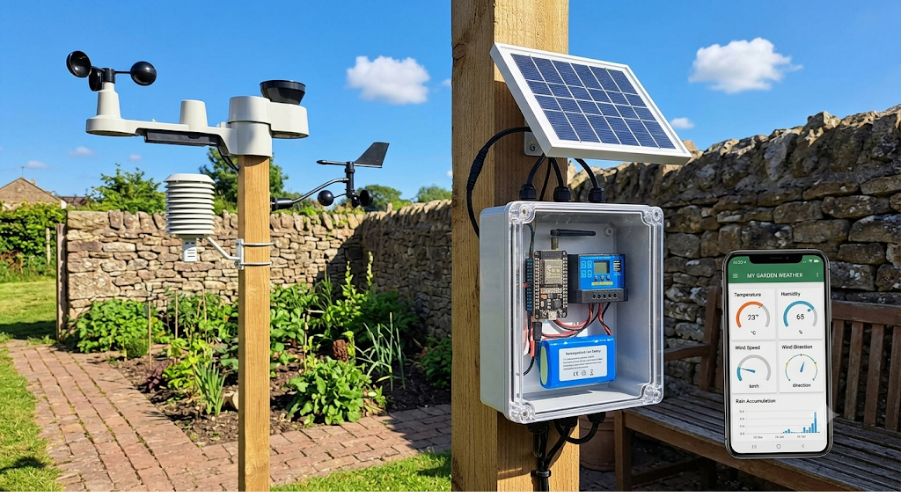
A solar-powered IoT weather station offers an efficient and sustainable solution by combining renewable energy, wireless communication, sensors, and cloud connectivity into a self-sufficient environmental monitoring platform. Such systems can continuously collect weather data, transmit information to cloud dashboards, and operate autonomously for months or even years with minimal maintenance.
Building a solar-powered IoT weather station is an excellent project that combines embedded systems, renewable energy engineering, sensor integration, wireless networking, and Internet of Things (IoT) technologies into a practical real-world application.
What Is a Solar-Powered IoT Weather Station?
A solar-powered IoT weather station is an autonomous monitoring system that:
- Collects environmental data
- Processes sensor readings
- Transmits information wirelessly
- Operates using solar energy
The station typically measures:
- Temperature
- Humidity
- Atmospheric pressure
- Rainfall
- Wind speed
- Wind direction
- Solar radiation
- Air quality
Collected data can be viewed remotely through:
- Mobile applications
- Web dashboards
- Cloud platforms
Why Build a Solar-Powered Weather Station?
Several factors make solar-powered weather stations increasingly attractive.
Sustainable Operation
Solar energy eliminates dependence on grid electricity.
Remote Deployment
The system can operate in:
- Farms
- Forests
- Mountains
- Construction sites
- Research locations
Low Operating Cost
After installation, energy costs are nearly zero.
Real-Time Monitoring
Users receive continuous environmental updates from anywhere.
Educational Value
The project teaches:
- Embedded systems
- Renewable energy
- IoT networking
- Sensor integration
- Data analytics
System Architecture
A typical solar-powered IoT weather station consists of several integrated subsystems.
Environmental Sensors
Collect weather-related data.
Processing Unit
Reads sensor values and controls system operation.
Wireless Communication Module
Transmits data to cloud services.
Solar Power System
Generates electrical energy.
Battery Storage
Stores excess solar energy.
Cloud Dashboard
Displays and analyzes collected information.
Environmental Sensors
Sensors are the heart of any weather station.
Temperature Sensor
Measures ambient air temperature.
Applications:
- Climate monitoring
- Greenhouse management
- Agricultural forecasting
Important characteristics:
- Accuracy
- Response time
- Environmental durability
Humidity Sensor
Measures moisture content in the atmosphere.
Useful for:
- Weather prediction
- Indoor air monitoring
- Crop management
Atmospheric Pressure Sensor
Tracks changes in air pressure.
Pressure trends help predict:
- Rainfall
- Storm development
- Weather pattern changes
Rain Sensor
Detects precipitation levels.
Types include:
- Tipping bucket sensors
- Capacitive rain detectors
- Optical rainfall sensors
Applications:
- Irrigation management
- Flood monitoring
- Weather analysis
Wind Speed Sensor
Measures airflow velocity.
Common technologies:
- Cup anemometers
- Ultrasonic sensors
Important for:
- Agriculture
- Renewable energy monitoring
- Environmental studies
Wind Direction Sensor
Determines wind orientation.
Typically uses:
- Weather vanes
- Magnetic sensors
Provides valuable meteorological information.
Solar Radiation Sensor
Measures sunlight intensity.
Useful for:
- Solar power analysis
- Agricultural research
- Environmental monitoring
Air Quality Sensors
Advanced weather stations may include:
- Particulate matter sensors
- Carbon dioxide sensors
- Volatile organic compound detectors
These help monitor environmental health.
Choosing the Processing Unit
The microcontroller serves as the system’s brain.
Key requirements include:
- Low power consumption
- Multiple sensor interfaces
- Wireless connectivity
- Reliable operation
Popular choices often support:
- Wi-Fi
- Bluetooth
- LoRa
- Cellular communication
Wireless Communication Options
The weather station must transmit data to remote servers.
Wi-Fi
Advantages:
- High data rates
- Easy cloud integration
Limitations:
- Limited range
Suitable for:
- Home installations
- Smart buildings
LoRa
Advantages:
- Long-range communication
- Extremely low power consumption
Suitable for:
- Farms
- Remote monitoring sites
- Rural deployments
Cellular Networks
Advantages:
- Wide coverage
- Independent operation
Suitable for:
- Remote weather stations
- Infrastructure monitoring
Bluetooth Low Energy
Useful for:
- Local monitoring
- Mobile device integration
Solar Power System Design
The solar subsystem provides continuous energy.
Solar Panel Selection
Solar panels convert sunlight into electricity.
Selection depends on:
- Sensor count
- Communication frequency
- Battery capacity
- Local sunlight conditions
Factors to consider:
- Panel efficiency
- Voltage rating
- Weather resistance
Battery Storage
Batteries store energy generated during daylight.
This allows operation during:
- Nighttime
- Cloudy weather
- Rainy seasons
Common battery technologies include:
- Lithium-ion
- Lithium iron phosphate (LiFePO4)
- Sealed lead-acid
Charge Controller
The charge controller regulates energy flow between:
- Solar panel
- Battery
- Electronics
Functions include:
- Overcharge protection
- Deep discharge prevention
- Voltage regulation
Power Management Strategies
Efficient power management is critical.
Techniques include:
Sleep Modes
The processor remains inactive between measurements.
Sensor Duty Cycling
Sensors activate only when needed.
Adaptive Transmission
Data is transmitted at optimized intervals.
Energy Monitoring
Battery voltage is continuously monitored.
These strategies significantly extend operational life.
Weatherproof Enclosure Design
Outdoor deployment requires robust protection.
The enclosure should protect against:
- Rain
- Dust
- UV exposure
- Extreme temperatures
- Insects
Key design considerations include:
- Waterproof sealing
- Ventilation
- Corrosion resistance
- Easy maintenance access
Data Collection and Processing
The system continuously performs:
- Sensor measurement
- Data filtering
- Local storage
- Wireless transmission
Collected information may include:
- Time stamps
- Weather trends
- Battery status
- System diagnostics
Cloud Integration
Cloud connectivity enables remote monitoring.
Features include:
- Real-time dashboards
- Historical analysis
- Alert notifications
- Data visualization
Users can access weather information from:
- Smartphones
- Tablets
- Computers
Data Visualization
Visual dashboards help users understand trends.
Common displays include:
- Temperature graphs
- Humidity trends
- Rainfall accumulation
- Wind speed history
- Battery performance
Advanced systems may generate:
- Weather forecasts
- Seasonal analytics
- Environmental reports
Alert and Notification Systems
Weather stations can automatically generate alerts.
Examples:
High Temperature Alert
Triggered when temperature exceeds a threshold.
Heavy Rain Alert
Warns of potential flooding conditions.
Low Battery Warning
Indicates solar power issues.
Strong Wind Alert
Useful for farms and outdoor facilities.
Notifications may be delivered through:
- Mobile apps
- SMS
- Messaging platforms
Applications of Solar-Powered IoT Weather Stations
Smart Agriculture
Farmers use weather data for:
- Irrigation scheduling
- Crop protection
- Pest management
- Yield optimization
Environmental Research
Researchers collect:
- Climate data
- Ecosystem information
- Long-term weather trends
Smart Cities
Municipalities monitor:
- Urban temperatures
- Air quality
- Rainfall patterns
Renewable Energy Monitoring
Weather stations help optimize:
- Solar installations
- Wind energy systems
Disaster Prevention
Used for:
- Flood monitoring
- Storm detection
- Early warning systems
Challenges in Weather Station Design
Power Reliability
Extended cloudy conditions may reduce solar energy generation.
Sensor Accuracy
Environmental exposure can affect sensor performance over time.
Communication Coverage
Remote locations may experience weak network connectivity.
Environmental Durability
Hardware must survive:
- Rain
- Heat
- Dust
- Humidity
- Lightning events
Maintenance Requirements
Periodic maintenance includes:
- Cleaning solar panels
- Calibrating sensors
- Inspecting enclosures
- Checking battery health
Future Enhancements
Future weather stations may incorporate:
Artificial Intelligence
AI can improve:
- Forecasting accuracy
- Anomaly detection
- Predictive maintenance
Edge Computing
Local processing reduces cloud dependency.
Machine Learning Analytics
Identify long-term environmental patterns.
Satellite Integration
Combine local and regional weather data.
Digital Twin Systems
Create virtual models of environmental conditions.
Educational Benefits
Building a solar-powered IoT weather station teaches valuable skills in:
- Electronics design
- Embedded programming
- Renewable energy systems
- Wireless communication
- Sensor technology
- Data science
- Cloud computing
It serves as an ideal project for students, hobbyists, and aspiring IoT engineers.
Conclusion
A solar-powered IoT weather station represents an excellent example of how renewable energy and connected technologies can work together to create intelligent environmental monitoring systems. By combining sensors, wireless communication, cloud platforms, and solar power, these stations provide reliable, real-time weather information while operating independently of traditional infrastructure.
As smart agriculture, climate monitoring, and sustainable technology continue to expand, solar-powered weather stations will play an increasingly important role in collecting the environmental data needed to make better decisions. Whether deployed in a backyard, a remote farm, or a research facility, these systems demonstrate the powerful potential of IoT and renewable energy working together to build a smarter and more sustainable future.