
For more than five decades, silicon has been the foundation of modern computing. From microprocessors and smartphones to cloud data centers and artificial intelligence systems, silicon-based transistors have driven the exponential growth of computational power predicted by Moore’s Law. However, as transistor dimensions shrink toward atomic scales, the semiconductor industry is approaching fundamental physical limitations. Power leakage, thermal constraints, electron scattering, and fabrication complexity are making it increasingly difficult to sustain traditional silicon scaling.
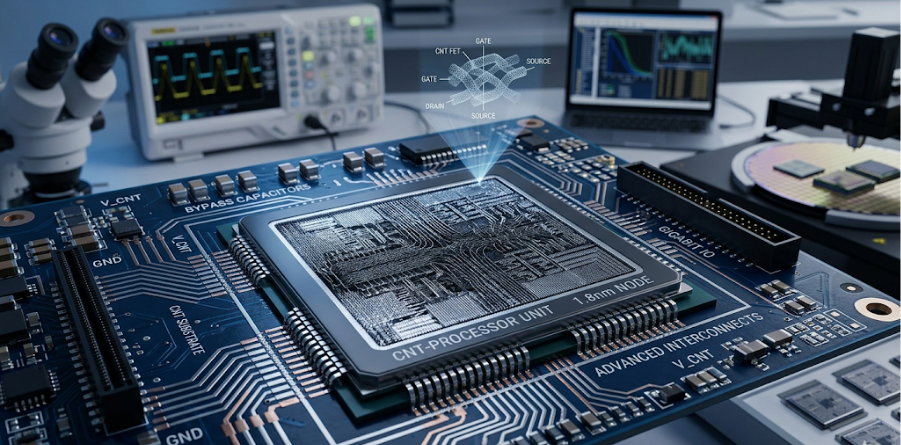
To overcome these limitations, researchers are exploring revolutionary materials capable of enabling the next generation of ultra-fast, energy-efficient computing systems. Among the most promising candidates are carbon nanotubes (CNTs), nanoscale cylindrical carbon structures with extraordinary electrical, thermal, and mechanical properties.
Carbon nanotube-based processor hardware has the potential to redefine the future of computing by enabling faster processors, lower energy consumption, greater transistor density, and entirely new computing architectures beyond conventional silicon technology.
What Are Carbon Nanotubes?
Carbon nanotubes are cylindrical nanostructures composed entirely of carbon atoms arranged in a hexagonal lattice similar to graphene.
These structures are:
- Extremely thin
- Incredibly strong
- Highly conductive
- Thermally efficient
Typical nanotube diameters measure:
- Approximately 1–100 nanometers
while lengths can extend to several micrometers or even millimeters.
Types of Carbon Nanotubes
Carbon nanotubes are generally classified into two categories:
1. Single-Walled Carbon Nanotubes (SWCNTs)
These consist of:
- One graphene cylinder
Advantages:
- Excellent electrical performance
- Ideal for transistor channels
2. Multi-Walled Carbon Nanotubes (MWCNTs)
These contain:
- Multiple concentric nanotube layers
Advantages:
- Higher mechanical durability
- Better structural applications
For processor hardware, single-walled nanotubes are typically preferred because of their superior semiconductor characteristics.
Why Silicon Is Reaching Its Limits
Modern silicon processors face several major challenges.
1. Transistor Scaling Problems
As transistors shrink below:
- 5 nanometers
quantum effects become increasingly problematic:
- Electron tunneling
- Leakage currents
- Signal instability
2. Heat Generation
Higher transistor density produces:
- Significant thermal challenges
- Increased cooling requirements
- Reduced energy efficiency
3. Power Consumption
AI workloads and high-performance computing demand enormous energy resources.
Data centers consume vast amounts of electricity, creating economic and environmental concerns.
4. Fabrication Complexity
Advanced silicon manufacturing requires:
- EUV lithography
- Atomic-scale precision
- Extremely expensive fabrication facilities
Why Carbon Nanotubes Are Revolutionary
Carbon nanotubes offer several advantages over silicon.
1. Exceptional Electrical Conductivity
CNTs allow electrons to move with extremely low resistance.
Benefits:
- Faster signal propagation
- Reduced power loss
- Higher switching speed
Electron mobility in CNTs is significantly higher than in silicon.
2. Lower Power Consumption
CNT transistors operate at:
- Lower voltages
- Reduced leakage currents
This dramatically improves:
- Energy efficiency
- Battery life
- Data center sustainability
3. Superior Thermal Conductivity
Carbon nanotubes dissipate heat much more effectively than silicon.
Advantages:
- Reduced overheating
- Better thermal stability
- Higher transistor density
4. Atomic-Scale Dimensions
CNTs are extremely small.
This enables:
- Higher transistor packing density
- More compact processors
- Continued Moore’s Law scaling
5. Mechanical Strength
Carbon nanotubes are among the strongest materials ever discovered.
Benefits include:
- Improved hardware durability
- Flexible electronics potential
- Wear-resistant nanoscale systems
Carbon Nanotube Transistors
The most important application of CNTs in computing is the carbon nanotube field-effect transistor (CNTFET).
CNTFETs function similarly to silicon MOSFETs but replace the silicon channel with carbon nanotubes.
Structure of CNTFETs
A typical CNT transistor includes:
- Source terminal
- Drain terminal
- Gate electrode
- Carbon nanotube channel
The nanotube channel controls electron flow with extremely high efficiency.
Advantages of CNTFETs
Compared to silicon transistors, CNTFETs offer:
- Faster switching
- Lower leakage
- Reduced power consumption
- Smaller size
- Better scalability
How CNT Processors Could Transform Computing
1. Ultra-Low Power AI Hardware
AI workloads require enormous computation.
CNT processors could dramatically reduce:
- AI accelerator power usage
- GPU energy consumption
- Edge AI thermal requirements
This is especially important for:
- Mobile AI
- Robotics
- Autonomous systems
2. Flexible and Wearable Electronics
Because CNTs are mechanically flexible, they enable:
- Bendable processors
- Wearable computing
- Smart textiles
- Flexible displays
3. Faster Data Centers
CNT-based processors could:
- Reduce data center energy costs
- Improve computational density
- Lower cooling requirements
4. Neuromorphic Computing
CNT devices may support brain-inspired architectures by enabling:
- Dense nanoscale interconnects
- Analog-like signal processing
- Low-power neural hardware
5. Space and Aerospace Systems
CNT processors may perform better under:
- Radiation exposure
- Extreme temperatures
- Harsh environments
making them attractive for:
- Satellites
- Spacecraft
- Defense systems
Manufacturing Challenges
Despite enormous potential, CNT processors face significant engineering challenges.
1. Nanotube Alignment
Processors require billions of perfectly aligned nanotubes.
However:
- CNTs naturally grow randomly
- Misalignment causes defects
- Manufacturing precision is difficult
2. Metallic vs Semiconductor CNTs
Some CNTs behave as:
- Metals Others behave as:
- Semiconductors
Processors require precise separation because metallic nanotubes can short circuits.
3. Large-Scale Fabrication
Mass-producing CNT chips with:
- High yield
- Low defects
- Commercial affordability
remains extremely challenging.
4. Integration with Existing Manufacturing
Current semiconductor fabs are optimized for silicon.
Transitioning to CNT manufacturing would require:
- New fabrication techniques
- New process equipment
- Massive industry investment
Hybrid Silicon-CNT Architectures
Rather than replacing silicon entirely, early systems may combine:
- Silicon logic
- CNT accelerators
- Hybrid processing architectures
This approach may accelerate commercial adoption.
Carbon Nanotubes in Memory Technology
CNTs are also being explored for advanced memory systems.
Potential applications include:
- CNT RAM
- Neuromorphic memory
- Non-volatile memory
- Ultra-dense storage
Advantages:
- Faster access
- Lower power
- Greater durability
CNTs and Quantum Computing
Carbon nanotubes may also contribute to quantum hardware.
Researchers are investigating CNT-based:
- Quantum dots
- Spin qubits
- Nanoelectronic quantum systems
CNT properties may help improve:
- Quantum coherence
- Device miniaturization
Environmental Impact
CNT processors could improve sustainability by reducing:
- Energy consumption
- Cooling requirements
- Electronic waste
However, nanotube manufacturing itself raises environmental and safety concerns related to:
- Nanoparticle handling
- Material toxicity
- Fabrication waste
Responsible manufacturing practices will be essential.
Future Applications of CNT Processor Hardware
The future may include:
- CNT AI accelerators
- CNT mobile processors
- Flexible CNT computers
- Ultra-low-power IoT chips
- CNT-based edge computing
- Advanced robotics hardware
CNTs vs Graphene
Graphene is another major post-silicon material.
However:
- Graphene lacks a natural bandgap
- CNTs can function as semiconductors
This gives CNTs an advantage for transistor applications.
The Race Beyond Moore’s Law
The semiconductor industry is actively searching for technologies that can continue computational advancement beyond silicon limitations.
Potential future technologies include:
- Carbon nanotubes
- Graphene
- Spintronics
- Photonic computing
- Quantum computing
- Molecular electronics
CNT processors are among the most practical and promising candidates.
Final Thoughts
Carbon nanotube-based processor hardware represents one of the most exciting frontiers in modern computing technology. As silicon approaches its physical and economic limits, CNTs offer a path toward faster, smaller, cooler, and more energy-efficient processors capable of supporting the next generation of artificial intelligence, edge computing, robotics, and advanced digital systems.
While significant manufacturing challenges remain, the extraordinary electrical and thermal properties of carbon nanotubes make them a leading candidate for the future of post-silicon computing.
The transition from silicon to carbon nanotube computing may eventually become as historically significant as the transition from vacuum tubes to transistors — a technological shift capable of reshaping the entire computing industry for decades to come.