
The rise of the Internet of Things (IoT) has transformed the way devices interact with the physical world. At the center of this revolution is the ESP32, one of the most versatile and affordable microcontrollers available today. Combining powerful processing capabilities, integrated WiFi and Bluetooth connectivity, low power consumption, and extensive GPIO support, the ESP32 has become a favorite platform for engineers, hobbyists, startups, and students building smart hardware systems.
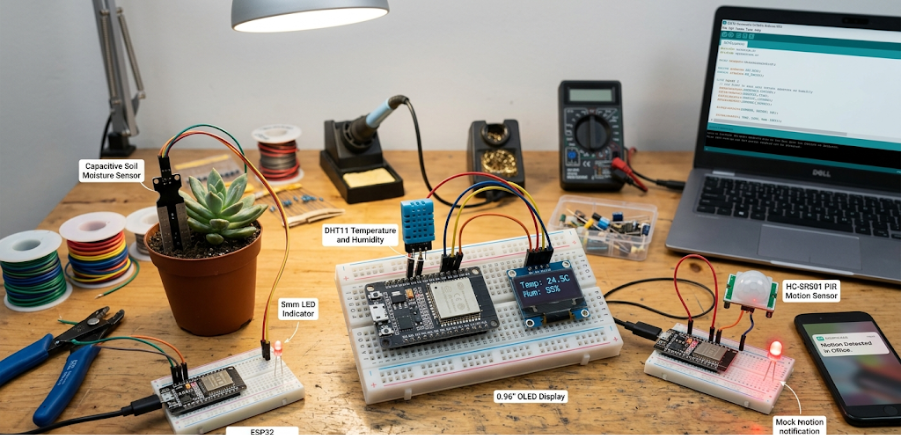
When combined with sensors, the ESP32 becomes a powerful embedded intelligence platform capable of monitoring, automating, analyzing, and controlling real-world environments. From smart homes and industrial monitoring systems to robotics, agriculture, healthcare, and wearable electronics, ESP32-based sensor projects are enabling a new generation of connected hardware innovation.
Why the ESP32 Is So Popular
The ESP32, developed by Espressif Systems, is a low-cost microcontroller with integrated wireless communication capabilities.
Key features include:
- Dual-core processor
- WiFi connectivity
- Bluetooth and BLE support
- Multiple GPIO pins
- ADC and DAC support
- PWM functionality
- Deep sleep modes
- SPI, I2C, UART interfaces
Its combination of performance and affordability makes it ideal for IoT and sensor-based hardware projects.
Understanding Sensors in Embedded Systems
Sensors allow embedded systems to detect and measure physical conditions.
They convert real-world signals into digital data that microcontrollers can process.
Common environmental and physical parameters include:
- Temperature
- Humidity
- Pressure
- Motion
- Light
- Distance
- Gas concentration
- Soil moisture
- Sound
- Vibration
By integrating sensors with the ESP32, developers can create intelligent systems capable of real-time monitoring and automation.
1. Smart Home Automation System
One of the most popular ESP32 projects is smart home automation.
Using:
- Relay modules
- Motion sensors
- Temperature sensors
- Mobile dashboards
the ESP32 can control:
- Lights
- Fans
- Appliances
- Security systems
Common Sensors Used
| Sensor | Purpose |
| PIR Sensor | Motion detection |
| DHT22 | Temperature and humidity |
| LDR | Light intensity |
| MQ2 | Smoke and gas detection |
Features
- Mobile app control
- Voice assistant integration
- WiFi-based automation
- Energy monitoring
- Real-time alerts
2. IoT Weather Monitoring Station
An ESP32 weather station collects environmental data and uploads it to cloud dashboards.
Typical Sensors
| Sensor | Measurement |
| BME280 | Temperature, humidity, pressure |
| Rain Sensor | Rainfall detection |
| BH1750 | Light intensity |
| Anemometer | Wind speed |
Applications
- Home weather tracking
- Agriculture
- Climate research
- Smart irrigation
The ESP32 sends sensor data using:
- MQTT
- HTTP APIs
- WebSockets
to cloud platforms like:
- ThingSpeak
- Blynk
- AWS IoT
3. Smart Agriculture Monitoring System
Agriculture increasingly depends on intelligent sensor networks.
An ESP32-based farming system can monitor:
- Soil moisture
- Temperature
- Humidity
- Water levels
and automate irrigation.
Common Components
| Component | Purpose |
| Capacitive Soil Sensor | Soil moisture |
| DHT22 | Climate monitoring |
| Water Flow Sensor | Irrigation tracking |
| Relay Module | Pump control |
Advanced Features
- Solar power support
- LoRaWAN communication
- AI irrigation prediction
- Mobile notifications
4. Air Quality Monitoring System
Air pollution monitoring is becoming increasingly important in smart cities and industrial environments.
ESP32 can integrate with gas sensors to measure:
- CO2
- VOCs
- Smoke
- PM2.5 particles
Common Sensors
| Sensor | Capability |
| MQ135 | Air quality |
| PMS5003 | PM2.5 particles |
| CCS811 | VOC and CO2 |
Applications
- Indoor air monitoring
- Industrial safety
- Pollution tracking
- Smart ventilation systems
5. Smart Energy Monitoring System
ESP32 can monitor electrical consumption in homes and industries.
Common Sensors
| Sensor | Purpose |
| ACS712 | Current sensing |
| ZMPT101B | Voltage sensing |
| INA219 | Power monitoring |
Features
- Real-time power tracking
- Energy analytics
- Overload alerts
- Cloud dashboard integration
6. ESP32-Based Security System
ESP32 enables affordable wireless security systems.
Typical Components
| Sensor | Purpose |
| PIR Sensor | Intrusion detection |
| Magnetic Reed Switch | Door monitoring |
| Camera Module | Image capture |
| Buzzer | Alarm system |
Smart Features
- Mobile notifications
- Cloud image uploads
- Face detection
- AI object recognition
The ESP32-CAM module is especially popular for security applications.
7. Smart Water Quality Monitoring
Water monitoring systems are important for:
- Aquaculture
- Water treatment
- Environmental research
Sensors Used
| Sensor | Measurement |
| pH Sensor | Water acidity |
| Turbidity Sensor | Water clarity |
| TDS Sensor | Dissolved solids |
| Temperature Sensor | Water temperature |
Applications
- Fish farming
- Water safety
- Smart irrigation
- Environmental protection
8. ESP32 Health Monitoring Devices
Wearable and healthcare projects increasingly use ESP32.
Common Sensors
| Sensor | Purpose |
| MAX30102 | Heart rate and SpO2 |
| MPU6050 | Motion tracking |
| DS18B20 | Body temperature |
Features
- Bluetooth mobile connectivity
- Real-time monitoring
- Cloud health analytics
- Emergency alerts
9. Smart Parking System
ESP32 can power intelligent parking systems.
Sensors
| Sensor | Purpose |
| Ultrasonic Sensor | Vehicle detection |
| IR Sensor | Slot occupancy |
| RFID Reader | Access control |
Features
- Real-time parking availability
- Mobile reservation systems
- Automated gates
- Cloud dashboards
10. Industrial IoT Monitoring
Industries increasingly use ESP32 for machine monitoring.
Sensors
| Sensor | Purpose |
| Vibration Sensor | Machine health |
| Temperature Sensor | Equipment monitoring |
| Current Sensor | Power analysis |
Applications
- Predictive maintenance
- Equipment diagnostics
- Production analytics
- Safety monitoring
Communication Technologies with ESP32
The ESP32 supports multiple communication methods.
WiFi
Best for:
- Home automation
- Cloud connectivity
- Dashboards
Bluetooth Low Energy (BLE)
Best for:
- Wearables
- Mobile devices
- Low-power systems
LoRa
Using external modules, ESP32 supports long-range communication.
Ideal for:
- Agriculture
- Smart cities
- Remote sensing
MQTT Protocol
MQTT is widely used for IoT communication.
Benefits:
- Lightweight
- Fast
- Low bandwidth
- Real-time communication
Power Optimization in ESP32 Projects
Power efficiency is critical for battery-operated systems.
ESP32 supports:
- Deep sleep mode
- Light sleep mode
- Dynamic frequency scaling
Common Power Solutions
| Power Method | Application |
| Li-ion Battery | Portable devices |
| Solar Power | Outdoor deployments |
| USB Power | Indoor systems |
PCB Design for ESP32 Projects
Many advanced projects move from breadboards to custom PCBs.
Important PCB considerations:
- Power regulation
- Antenna placement
- EMI reduction
- Sensor isolation
- Thermal management
Popular PCB tools:
- KiCad
- Altium Designer
- Eagle PCB
Cloud Platforms for ESP32 Projects
ESP32 integrates easily with cloud services.
Popular Platforms
| Platform | Purpose |
| ThingSpeak | Data visualization |
| Blynk | Mobile dashboards |
| AWS IoT | Enterprise IoT |
| Azure IoT | Industrial integration |
| Firebase | Real-time databases |
AI and ESP32
Modern ESP32 projects increasingly use TinyML.
TinyML enables:
- Local AI inference
- Edge analytics
- Reduced cloud dependence
Examples
- Voice recognition
- Gesture detection
- Predictive maintenance
- Anomaly detection
ESP32 can now run lightweight machine learning models directly on-device.
Challenges in ESP32 Sensor Projects
Despite its power, ESP32 projects face several challenges.
Sensor Accuracy
Low-cost sensors may:
- Drift over time
- Require calibration
- Produce noisy data
Connectivity Stability
WiFi networks may introduce:
- Packet loss
- Latency
- Connection drops
Power Consumption
Continuous WiFi usage increases battery drain significantly.
Environmental Protection
Outdoor deployments require:
- Waterproof enclosures
- UV protection
- Dust resistance
Future of ESP32 Hardware Projects
ESP32-based systems continue evolving rapidly.
Future trends include:
- AI edge computing
- Smart sensor fusion
- Autonomous IoT systems
- Mesh networking
- Energy harvesting
- Digital twins
ESP32 devices are becoming increasingly intelligent, efficient, and autonomous.
Educational Importance of ESP32 Projects
ESP32 projects are excellent learning platforms for:
- Embedded systems
- IoT architecture
- PCB design
- Cloud integration
- Sensor interfacing
- Wireless communication
Students and engineers can rapidly prototype real-world systems at low cost.
Why ESP32 Dominates DIY IoT Development
The ESP32 succeeds because it combines:
- Performance
- Wireless communication
- Low cost
- Community support
- Flexibility
Few microcontrollers offer such a powerful feature set at such an accessible price point.
Final Thoughts
ESP32 and sensor-based hardware projects represent the future of intelligent embedded systems. From smart agriculture and environmental monitoring to industrial automation and wearable healthcare devices, ESP32 enables developers to bridge the gap between the physical and digital worlds.
As IoT, AI, and edge computing continue to evolve, ESP32-based sensor systems will become even more powerful, enabling smarter automation, real-time analytics, and intelligent decision-making directly at the edge.
What once required large industrial infrastructure can now be built on a workbench using a compact microcontroller, a few sensors, and creative engineering. That transformation is redefining modern hardware innovation.