
As climate awareness, smart agriculture, industrial automation, and IoT technologies continue to evolve, environmental monitoring systems are becoming increasingly important across homes, farms, factories, research facilities, and smart cities. Traditionally, advanced environmental monitoring equipment was expensive and limited to industrial or scientific applications. Today, affordable microcontrollers, sensors, wireless communication technologies, and cloud platforms have made it possible for engineers, students, hobbyists, and startups to build powerful DIY environmental monitoring stations at low cost.
A DIY environmental monitoring hardware station combines embedded systems, sensors, wireless communication, and cloud analytics into a single intelligent platform capable of collecting real-time environmental data. These systems can monitor temperature, humidity, air quality, gas levels, soil moisture, noise pollution, light intensity, weather conditions, and much more.
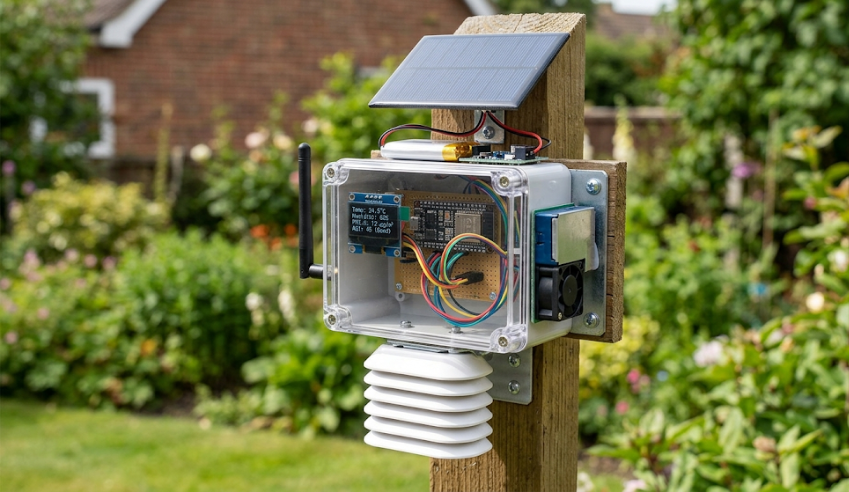
Beyond being educational projects, modern DIY environmental monitoring systems are now becoming foundational infrastructure for precision agriculture, smart buildings, industrial IoT, disaster management, and environmental research.
What Is an Environmental Monitoring Hardware Station?
An environmental monitoring station is a hardware system designed to measure and track environmental conditions continuously.
The station typically includes:
- Sensors
- Microcontroller or embedded processor
- Power system
- Communication module
- Data storage
- Cloud connectivity
The collected data can be:
- Displayed locally
- Stored in databases
- Sent to cloud dashboards
- Used for automation
- Analyzed using AI models
DIY systems allow complete customization depending on application requirements.
Why DIY Environmental Monitoring Matters
DIY environmental systems provide several advantages:
1. Low Cost
Commercial industrial systems can be extremely expensive. DIY solutions reduce costs dramatically.
2. Customization
Users can select:
- Specific sensors
- Communication methods
- Power systems
- Data visualization platforms
3. Educational Value
Excellent for learning:
- Embedded systems
- IoT development
- Sensor integration
- Data analytics
4. Real-World Applications
DIY stations can be deployed in:
- Farms
- Greenhouses
- Smart homes
- Factories
- Research labs
- Weather stations
Core Components of a DIY Environmental Monitoring Station
1. Microcontroller or Processing Unit
The microcontroller acts as the brain of the system.
Popular options include:
| Controller | Advantages |
| ESP32 | WiFi + Bluetooth + low cost |
| Arduino Uno | Beginner friendly |
| Raspberry Pi | Advanced processing |
| STM32 | Industrial-grade performance |
| ESP8266 | Ultra-low-cost IoT |
Among these, the ESP32 is one of the most popular choices because it combines:
- Wireless connectivity
- Low power consumption
- Dual-core processing
- Strong community support
2. Environmental Sensors
Sensors determine the capabilities of the station.
Temperature and Humidity Sensors
Common choices:
- DHT11
- DHT22
- SHT31
- BME280
Applications:
- Weather monitoring
- Greenhouses
- HVAC systems
Air Quality Sensors
Used to monitor pollution and indoor air quality.
Popular sensors:
- MQ135
- CCS811
- PMS5003
- SDS011
These can measure:
- CO2
- VOCs
- PM2.5 particles
- Smoke
- Harmful gases
Soil Moisture Sensors
Essential for agriculture and smart irrigation systems.
Types:
- Resistive sensors
- Capacitive sensors
Capacitive sensors are preferred due to:
- Better durability
- Reduced corrosion
Light Sensors
Measure sunlight or indoor lighting.
Examples:
- LDR
- BH1750
- TSL2561
Applications:
- Smart lighting
- Solar tracking
- Agriculture
Pressure Sensors
Monitor atmospheric pressure.
Popular options:
- BMP280
- BME280
Useful for:
- Weather prediction
- Altitude monitoring
Noise Sensors
Monitor environmental sound levels.
Applications:
- Urban monitoring
- Industrial safety
- Smart cities
3. Communication Modules
Environmental stations often need remote connectivity.
WiFi
Advantages:
- Easy cloud integration
- Fast data transfer
Best for:
- Smart homes
- Indoor monitoring
LoRaWAN
Advantages:
- Long-range communication
- Low power usage
Best for:
- Farms
- Rural monitoring
- Large outdoor deployments
Bluetooth Low Energy (BLE)
Advantages:
- Very low power
- Mobile integration
Best for:
- Portable devices
- Short-range monitoring
NB-IoT and Cellular
Advantages:
- Wide coverage
- Independent operation
Best for:
- Remote deployments
- Industrial systems
4. Power System Design
Power management is critical for reliable operation.
Battery-Powered Systems
Common batteries:
- Li-ion
- LiPo
- 18650 cells
Advantages:
- Portable
- Off-grid capable
Solar-Powered Systems
Very popular for outdoor monitoring.
Components:
- Solar panel
- Charge controller
- Battery system
Benefits:
- Sustainable operation
- Remote deployment capability
5. Data Display and Visualization
Data can be displayed locally using:
- LCD displays
- OLED displays
- E-paper screens
Cloud dashboards provide advanced analytics.
Popular platforms:
- Blynk
- ThingsBoard
- Grafana
- ThingSpeak
- AWS IoT
- Azure IoT
Building the DIY Environmental Monitoring Station
Step 1: Define Monitoring Goals
Determine:
- What parameters to measure
- Indoor or outdoor deployment
- Required communication range
- Power constraints
Step 2: Select Hardware
Example setup:
| Component | Example |
| MCU | ESP32 |
| Temperature Sensor | BME280 |
| Air Quality Sensor | MQ135 |
| Soil Sensor | Capacitive Moisture Sensor |
| Display | OLED SSD1306 |
| Connectivity | LoRaWAN |
| Power | Solar + Li-ion Battery |
Step 3: Design Circuit
The hardware design includes:
- Sensor interfaces
- Voltage regulation
- Power management
- Communication modules
PCB design tools:
- KiCad
- Altium
- Eagle
Step 4: Develop Firmware
Firmware responsibilities:
- Sensor data acquisition
- Data filtering
- Communication handling
- Power optimization
- OTA updates
Common languages:
- Embedded C
- Arduino Framework
- MicroPython
Step 5: Cloud Integration
The system sends data to cloud platforms using:
- MQTT
- HTTP APIs
- WebSockets
Cloud features:
- Real-time dashboards
- Alerts
- Historical analytics
- AI predictions
Smart Features for Advanced DIY Stations
Modern DIY monitoring systems increasingly include AI and automation.
1. AI-Based Environmental Prediction
Machine learning can predict:
- Weather changes
- Soil dryness
- Air quality deterioration
2. Automated Irrigation Systems
The station can automatically:
- Activate pumps
- Control valves
- Optimize water usage
3. Edge AI Processing
Edge AI enables local analysis without cloud dependence.
Examples:
- Pollution anomaly detection
- Predictive maintenance
- Fire risk detection
4. Real-Time Alerts
Notifications via:
- Mobile apps
- SMS
- Telegram bots
Challenges in DIY Environmental Monitoring
Sensor Accuracy
Low-cost sensors often:
- Drift over time
- Require calibration
- Have environmental limitations
Power Optimization
Outdoor systems must minimize power usage through:
- Deep sleep modes
- Efficient communication
- Smart sampling intervals
Weather Protection
Outdoor deployments require:
- Waterproof enclosures
- UV-resistant materials
- Ventilation protection
Connectivity Reliability
Remote areas may experience:
- Weak signals
- Packet loss
- Connectivity interruptions
LoRaWAN and mesh networks help solve this issue.
Applications of Environmental Monitoring Stations
Smart Agriculture
Monitor:
- Soil moisture
- Temperature
- Humidity
- Irrigation needs
Smart Cities
Track:
- Air pollution
- Noise levels
- Urban heat islands
Industrial Safety
Monitor:
- Toxic gases
- Temperature anomalies
- Dust levels
Research and Education
Used in:
- Schools
- Universities
- Environmental studies
Home Automation
Monitor:
- Indoor air quality
- Temperature
- Humidity
Control:
- Fans
- Air purifiers
- HVAC systems
Future Trends
Environmental monitoring systems are evolving rapidly.
AI-Powered Monitoring
Future systems will use AI for:
- Predictive analytics
- Automated optimization
- Intelligent decision-making
TinyML Integration
TinyML allows machine learning directly on microcontrollers.
Benefits:
- Faster analysis
- Lower cloud dependence
- Improved privacy
Mesh IoT Networks
Large sensor networks will increasingly use:
- LoRa mesh
- Zigbee mesh
- Matter protocols
Energy Harvesting
Future systems may use:
- Solar
- Vibration energy
- Thermal energy harvesting
for battery-free operation.
Environmental Digital Twins
Real-world environmental data may eventually feed into:
- Smart city simulations
- Agricultural optimization models
- Climate analytics platforms
Why DIY Environmental Monitoring Is Important
DIY environmental monitoring projects are no longer just hobby experiments. They represent the democratization of intelligent sensing infrastructure.
Affordable hardware and open-source ecosystems now allow individuals and startups to build systems previously limited to large industrial organizations.
These projects help engineers learn:
- Embedded systems
- IoT architecture
- Sensor integration
- Cloud connectivity
- AI analytics
- Sustainable engineering
As the world becomes increasingly data-driven, environmental intelligence will become critical across agriculture, urban planning, healthcare, climate science, and industrial automation.
Final Thoughts
A DIY environmental monitoring hardware station represents the perfect intersection of:
- Embedded systems
- IoT
- Sensors
- Cloud computing
- AI
- Sustainability
From simple weather stations to intelligent agricultural networks, these systems demonstrate how modern hardware engineering can transform raw environmental data into meaningful real-world intelligence.
As hardware becomes smarter, cheaper, and more connected, environmental monitoring will evolve from isolated sensing devices into intelligent autonomous ecosystems capable of understanding, predicting, and optimizing the physical world around us.