
Quantum computing represents one of the most transformative technological revolutions of the 21st century. Promising breakthroughs in cryptography, drug discovery, material science, logistics optimization, and artificial intelligence, quantum computers aim to solve problems that are practically impossible for classical systems. However, behind the futuristic algorithms and qubits lies one of the most extreme engineering challenges ever attempted: maintaining hardware at temperatures colder than outer space.
Why Quantum Computers Need Extreme Cold
Traditional computers use bits that exist as either:
- 0
- 1
Quantum computers use qubits, which can exist in:
- 0
- 1
- Both simultaneously (superposition)
Qubits also exploit:
- Entanglement
- Quantum interference
These quantum states are incredibly fragile.
Even tiny disturbances from:
- Heat
- Electromagnetic radiation
- Vibrations
- Cosmic rays
- Electrical noise
can destroy quantum coherence, causing computational errors.
To reduce thermal energy and environmental interference, most quantum systems operate near absolute zero:
- 0 Kelvin
- −273.15°C
Typical superconducting quantum computers run at:
- 10–20 millikelvin
This is colder than deep space.
The Role of Cryogenic Hardware
Cryogenic hardware creates and maintains these ultra-cold environments while supporting:
- Quantum processors
- Signal transmission
- Power delivery
- Measurement systems
- Error correction infrastructure
Cryogenic systems are effectively the life-support infrastructure for quantum computers.
Without cryogenics:
- Superconducting qubits fail
- Quantum coherence collapses
- Computation becomes impossible
Understanding Dilution Refrigerators
The heart of most superconducting quantum systems is the dilution refrigerator.
These refrigerators use mixtures of:
- Helium-3
- Helium-4
to achieve temperatures in the millikelvin range.
How Dilution Refrigerators Work
At extremely low temperatures:
- Helium isotopes separate into phases
- Heat transfer occurs during isotope mixing
- Continuous circulation removes thermal energy
This creates stable ultra-cold environments suitable for quantum operations.
Modern dilution refrigerators contain multiple cooling stages:
- 50K stage
- 4K stage
- 1K stage
- Millikelvin stage
Each stage progressively removes thermal energy.
Key Components of Cryogenic Quantum Hardware
1. Cryostat
The cryostat is the insulated chamber that houses quantum processors.
Functions:
- Thermal isolation
- Vacuum maintenance
- Radiation shielding
- Structural support
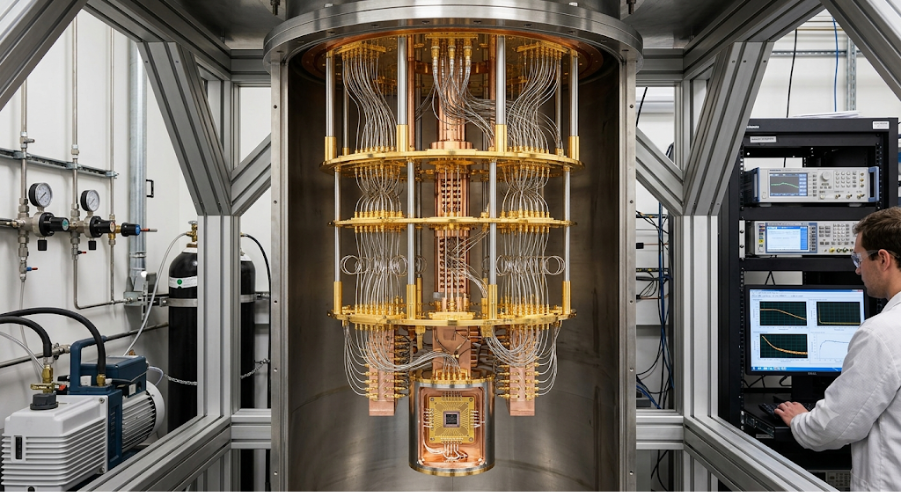
Cryostats often resemble large cylindrical structures with complex internal wiring and shielding layers.
2. Superconducting Qubits
Most leading quantum systems use superconducting circuits.
Materials commonly include:
- Aluminum
- Niobium
- Josephson junctions
At ultra-low temperatures:
- Electrical resistance disappears
- Quantum effects emerge
- Stable qubit operations become possible
3. Cryogenic Wiring
Signal transmission at millikelvin temperatures is extremely difficult.
Cryogenic cables must:
- Minimize heat leakage
- Preserve signal integrity
- Reduce electromagnetic interference
Specialized materials include:
- Superconducting niobium-titanium cables
- Stainless steel coaxial lines
- Copper thermalization stages
4. Microwave Control Electronics
Quantum operations rely heavily on microwave pulses.
Cryogenic hardware includes:
- Attenuators
- Amplifiers
- Filters
- Resonators
These components manipulate and read quantum states with extreme precision.
5. Quantum Amplifiers
Quantum signals are incredibly weak.
Cryogenic amplifiers such as:
- Josephson Parametric Amplifiers (JPAs)
- Traveling Wave Parametric Amplifiers (TWPAs)
boost signals while minimizing added noise.
The Engineering Challenges of Cryogenic Systems
Cryogenic quantum hardware pushes engineering into previously unimaginable territory.
1. Thermal Management
Even microscopic heat sources can destabilize qubits.
Major heat challenges include:
- Signal line heating
- Electrical resistance
- Radiation leakage
- Mechanical vibration
Every cable and connector becomes a thermal engineering problem.
2. Vibration Isolation
Quantum processors are highly sensitive to vibration.
Sources include:
- Building movement
- Pumps
- Cooling circulation
- Acoustic noise
Cryogenic systems use:
- Suspension platforms
- Mechanical dampers
- Isolation frames
to minimize disturbance.
3. Electromagnetic Shielding
External electromagnetic radiation can corrupt qubits.
Shielding methods include:
- Mu-metal shielding
- Superconducting shields
- RF filtering
- Faraday cages
Quantum environments require exceptionally clean electromagnetic conditions.
4. Scaling Challenges
Scaling from:
- 100 qubits
to:
- Millions of qubits
creates enormous cryogenic complexity.
Challenges include:
- Cable density
- Heat load
- Power delivery
- Physical space limitations
Modern quantum computers already contain thousands of cables.
Large-scale systems may require entirely new cryogenic architectures.
Cryogenic CMOS Electronics
One of the biggest bottlenecks in quantum computing is control electronics.
Today:
- Quantum chips operate near absolute zero
- Most control electronics remain at room temperature
This creates:
- Cable complexity
- Latency
- Thermal challenges
Cryogenic CMOS (Cryo-CMOS) aims to solve this by operating classical electronics at low temperatures.
Benefits include:
- Reduced wiring
- Faster control
- Improved scalability
- Lower thermal load
Cryo-CMOS may become essential for million-qubit quantum systems.
Materials Used in Cryogenic Quantum Systems
Cryogenic hardware depends heavily on specialized materials.
Superconducting Materials
Used for:
- Qubits
- Wiring
- Amplifiers
Examples:
- Niobium
- Aluminum
- Tantalum
Thermal Conductors
Used for:
- Heat extraction
- Thermal anchoring
Examples:
- Oxygen-free copper
- Silver
- Gold plating
Insulating Materials
Used for:
- Vacuum isolation
- Electrical separation
Examples:
- Sapphire
- PTFE
- Ceramic composites
Quantum Interconnect Challenges
Quantum scaling requires advanced interconnect technologies.
Current limitations include:
- Microwave signal congestion
- Heat leakage from cables
- Connector complexity
Emerging solutions include:
- Photonic interconnects
- Superconducting interposers
- Quantum networking links
- Cryogenic multiplexing
Liquid Helium Supply Challenges
Helium is essential for many cryogenic systems.
However:
- Helium-3 is extremely rare
- Global supply is limited
- Costs are increasing
Quantum industry growth may create significant helium demand pressures.
Researchers are exploring:
- Helium recycling
- Closed-loop systems
- Alternative cooling technologies
Quantum Error Correction and Cryogenics
Quantum error correction dramatically increases hardware requirements.
Error-corrected systems may require:
- Thousands of physical qubits
for:
- One logical qubit
This multiplies:
- Cooling demands
- Wiring complexity
- Cryogenic infrastructure size
Cryogenic engineering may ultimately determine how scalable quantum computing becomes.
Major Companies Building Cryogenic Quantum Systems
Several organizations are leading cryogenic quantum innovation.
IBM
IBM’s superconducting quantum systems use advanced dilution refrigerators and modular cryogenic infrastructure for scalable quantum processors.
Google Quantum AI
Google developed sophisticated cryogenic environments for its Sycamore quantum processors and quantum supremacy experiments.
Rigetti Computing
Rigetti focuses on integrated superconducting quantum architectures with scalable cryogenic designs.
Intel
Intel is investing heavily in:
- Cryogenic control electronics
- Silicon spin qubits
- Cryo-CMOS systems
D-Wave
D-Wave builds quantum annealing systems that rely on large-scale cryogenic infrastructure.
Emerging Cryogenic Innovations
The next generation of cryogenic hardware may include:
1. Modular Cryogenic Systems
Future systems may use:
- Distributed cooling modules
- Stackable cryogenic units
- Data-center-scale quantum refrigeration
2. Photonic Quantum Computing
Photonic systems may reduce dependence on extreme cryogenic environments.
However:
- Many photonic detectors still require cooling
3. Topological Qubits
Topological quantum systems aim to improve stability and reduce cooling sensitivity.
Microsoft is heavily researching this area.
Energy Consumption Concerns
Cryogenic systems consume enormous amounts of power.
Maintaining millikelvin temperatures requires:
- Multi-stage refrigeration
- Vacuum systems
- Continuous cooling circulation
As quantum systems scale, energy efficiency becomes increasingly important.
Researchers are exploring:
- More efficient cryocoolers
- Low-power qubit architectures
- Improved thermal insulation
Cryogenics Beyond Quantum Computing
Cryogenic hardware technologies also impact:
- Space exploration
- Particle physics
- MRI systems
- Superconducting electronics
- Deep-space sensors
- Astronomy instrumentation
Advances driven by quantum computing may accelerate innovation across multiple scientific industries.
The Future of Cryogenic Quantum Hardware
The future of quantum computing depends as much on cryogenic engineering as on quantum algorithms themselves.
Key future goals include:
- Higher qubit density
- Reduced thermal load
- Integrated cryogenic electronics
- Lower operational cost
- Better scalability
- Improved reliability
The companies that master ultra-low-temperature engineering may ultimately dominate the quantum computing industry.
Final Thoughts
Cryogenic hardware represents one of the most fascinating intersections of:
- Quantum physics
- Materials science
- Mechanical engineering
- Electronics
- Thermal engineering
While quantum computing often captures attention through algorithms and computational promises, the true technological miracle may be the hardware infrastructure operating silently at temperatures near absolute zero.
Quantum computers are not simply advanced processors. They are some of the coldest, most complex machines humanity has ever engineered.
As the quantum revolution accelerates, cryogenic hardware will remain the critical foundation enabling the next era of computation — where information is no longer limited by classical physics, but guided by the strange and powerful laws of the quantum world.