
Artificial Intelligence is no longer limited to powerful cloud servers and high-end GPUs. A new technological movement is bringing machine learning capabilities directly to tiny, low-power devices through a concept known as TinyML — the practice of running AI models on microcontrollers.
From smart wearables and industrial sensors to voice assistants and autonomous drones, microcontroller-based AI is transforming how intelligent systems operate at the edge. Instead of sending data to the cloud for processing, these devices can now analyze information locally in real time, enabling faster responses, lower latency, improved privacy, and reduced energy consumption.
As industries move toward edge intelligence and connected ecosystems, running AI on microcontrollers is becoming one of the most exciting innovations in embedded hardware design.
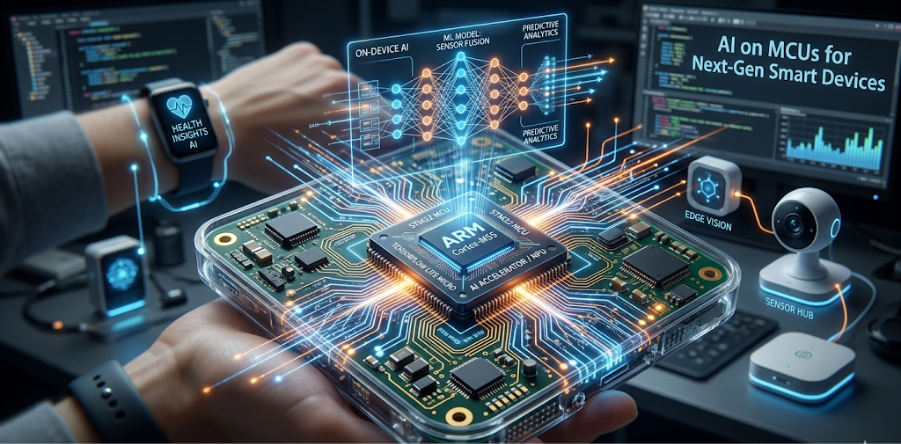
What Is a Microcontroller?
A microcontroller is a compact integrated circuit designed to perform specific tasks within embedded systems. Unlike full-scale processors used in computers and servers, microcontrollers are optimized for low power consumption, minimal memory usage, and cost efficiency.
They are commonly found in:
- Smart home devices
- Medical sensors
- Automotive systems
- Consumer electronics
- Industrial automation equipment
- IoT devices
Microcontrollers typically include:
- A processor core
- Memory (RAM and Flash)
- Input/output interfaces
- Timers and communication modules
Despite their small size and limited resources, modern microcontrollers are now capable of running lightweight AI models efficiently.
The Rise of TinyML
TinyML combines embedded systems with machine learning to bring AI capabilities to devices operating with very limited hardware resources. Traditional AI models often require large computational power and cloud infrastructure, but TinyML focuses on optimized models that can execute directly on low-power chips.
This shift enables devices to:
- Process data locally
- Operate offline
- Respond instantly
- Consume minimal energy
- Enhance user privacy
TinyML has become increasingly important as billions of connected IoT devices generate massive amounts of sensor data every day.
How AI Runs on Microcontrollers
Running AI on a microcontroller requires highly optimized machine learning models designed to fit within strict memory and power constraints.
The process usually involves:
Model Training
AI models are first trained on powerful computers or cloud systems using large datasets. Popular machine learning frameworks are used during this stage.
Model Optimization
The trained model is compressed and optimized through techniques such as:
- Quantization
- Pruning
- Weight compression
- Knowledge distillation
These methods reduce model size and computational requirements.
Deployment on Embedded Hardware
The optimized model is converted into lightweight code that runs directly on the microcontroller firmware.
Frameworks like:
- TensorFlow Lite for Microcontrollers
- TinyML toolkits
- Edge AI SDKs
help developers deploy machine learning models efficiently.
Benefits of Running AI on Microcontrollers
Ultra-Low Power Consumption
Microcontrollers consume significantly less power than traditional processors, making them ideal for battery-powered and always-on devices.
This enables:
- Smartwatches
- Wireless sensors
- Remote monitoring systems
- Environmental sensors
to operate for extended periods without frequent charging.
Real-Time Decision Making
Since data processing occurs locally, devices can make decisions instantly without depending on internet connectivity.
Applications include:
- Voice wake-word detection
- Gesture recognition
- Predictive maintenance
- Health monitoring
Improved Privacy and Security
Sending sensitive data to the cloud introduces privacy risks. Edge AI processing keeps data on the device, reducing exposure to external networks.
Reduced Cloud Dependency
Local AI inference minimizes bandwidth usage and reduces cloud infrastructure costs.
Real-World Applications
Smart Wearables
Fitness bands and health trackers use embedded AI to monitor heart rate, sleep quality, activity patterns, and health anomalies in real time.
Industrial IoT
Factories use AI-enabled sensors for predictive maintenance, anomaly detection, and equipment monitoring without requiring constant cloud communication.
Voice Recognition Systems
Microcontrollers can run lightweight speech recognition models for voice commands and wake-word detection.
Agriculture
Smart farming devices analyze soil conditions, temperature, and moisture levels using edge AI for precision agriculture.
Healthcare Devices
Portable medical equipment uses TinyML for patient monitoring, early disease detection, and emergency alerts.
Autonomous Drones
AI-powered microcontrollers help drones perform obstacle detection, navigation, and object tracking with minimal latency.
Hardware Platforms Supporting TinyML
Several companies are developing hardware platforms optimized for AI on microcontrollers.
- ARM provides Cortex-M processors widely used in embedded AI systems.
- STMicroelectronics develops low-power microcontrollers for edge AI applications.
- NXP Semiconductors offers AI-enabled embedded processing solutions.
- Espressif Systems produces popular ESP32 microcontrollers used in IoT AI projects.
- Arduino supports TinyML experimentation for developers and students.
These platforms provide efficient hardware acceleration for machine learning workloads.
Challenges of Embedded AI
Although TinyML offers enormous potential, developers still face several technical challenges.
Memory Constraints
Microcontrollers have extremely limited RAM and storage, requiring aggressive model optimization.
Processing Limitations
Complex deep learning models may exceed the computational capabilities of small embedded chips.
Power Management
Balancing AI performance with battery life remains a critical design challenge.
Model Accuracy Trade-Offs
Compressing models can sometimes reduce prediction accuracy.
Development Complexity
Deploying AI on embedded systems requires expertise in both machine learning and low-level hardware programming.
The Future of AI on Microcontrollers
As hardware becomes more efficient and AI models become more compact, TinyML is expected to expand rapidly across industries.
Future advancements may include:
- Self-learning embedded devices
- Ultra-low-power neuromorphic microcontrollers
- AI-powered smart cities
- Intelligent healthcare implants
- Autonomous edge robotics
- Battery-free AI sensors using energy harvesting
The combination of AI and embedded hardware will play a crucial role in building the next generation of intelligent connected systems.
Conclusion
Running AI on microcontrollers is transforming embedded systems by enabling intelligence directly at the edge. Through TinyML, even the smallest devices can now analyze data, recognize patterns, and make decisions in real time while consuming minimal power.
This technological shift is driving innovation across healthcare, robotics, agriculture, industrial automation, and consumer electronics. As machine learning models become more efficient and embedded hardware continues to evolve, AI-powered microcontrollers will become a foundational technology for the future of smart devices and the Internet of Things.
Tiny intelligence is proving that powerful AI does not always require massive hardware — sometimes, even the smallest chips can think intelligently.