In today’s digital era, data has become one of the most valuable assets for individuals, businesses, and governments. From cloud computing and artificial intelligence to gaming and edge devices, the demand for faster, larger, and more reliable storage solutions continues to rise. Two technologies dominate the storage industry: Hard Disk Drives (HDDs) and Solid State Drives (SSDs). While HDDs remain essential for mass storage due to affordability, SSDs are rapidly transforming the market with superior speed and efficiency.
As technology evolves, both HDDs and SSDs are undergoing major innovations to meet modern computing requirements. This article explores the emerging trends shaping the future of storage devices.
Evolution of Storage Technologies
Hard drives have been used for decades as the primary storage medium in computers and servers. Traditional HDDs store data magnetically on rotating platters, offering high capacities at relatively low costs. However, mechanical limitations restrict their speed and durability.
SSDs, on the other hand, use flash memory chips with no moving parts. This architecture enables significantly faster read/write operations, lower latency, and improved power efficiency. Over the past decade, SSD adoption has accelerated across laptops, gaming systems, enterprise servers, and cloud infrastructures.
Today, both technologies coexist, serving different purposes depending on performance, capacity, and budget requirements.
Emerging Trends in Hard Disk Drives (HDDs)
1. Increasing Storage Capacities
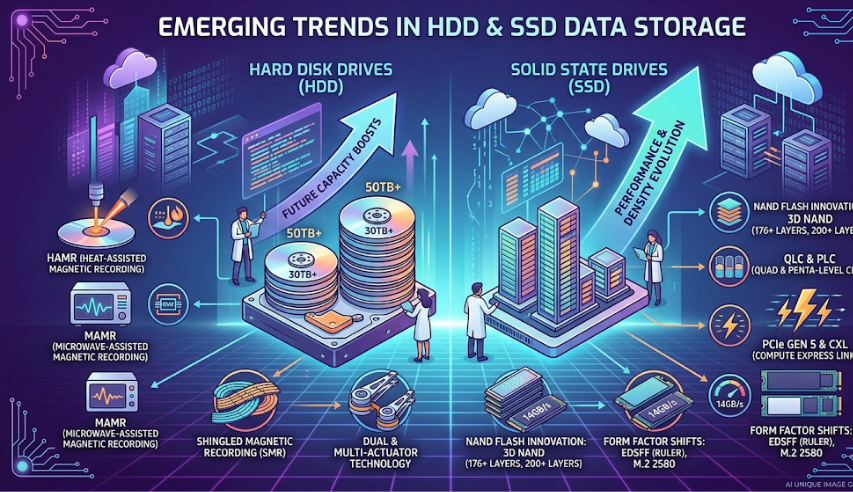
One of the most important trends in HDD development is the push toward ultra-high storage capacities. Modern enterprises generate enormous amounts of data from IoT devices, surveillance systems, and cloud applications. To address this demand, manufacturers are developing HDDs with capacities exceeding 30TB.
Technologies enabling this growth include:
- Heat-Assisted Magnetic Recording (HAMR)
- Microwave-Assisted Magnetic Recording (MAMR)
- Shingled Magnetic Recording (SMR)
These technologies improve data density, allowing more information to be stored on the same physical disk.
2. Growth of Nearline Storage
Nearline HDDs are increasingly used in data centers and cloud environments. They offer a balance between cost and performance, making them suitable for:
- Backup systems
- Archival storage
- Large-scale cloud platforms
- Video surveillance data
As cloud computing expands globally, demand for enterprise-grade HDDs continues to rise.
3. Energy-Efficient HDD Designs
Energy consumption has become a critical concern for data centers. Manufacturers are introducing HDDs with:
- Lower power usage
- Intelligent power management
- Improved thermal efficiency
Reducing energy consumption lowers operational costs and supports environmentally sustainable computing.
4. Enhanced Reliability and Durability
Modern HDDs now include advanced error correction algorithms and vibration resistance technologies. Enterprise HDDs are specifically designed for 24/7 workloads in high-demand environments such as cloud servers and AI infrastructure.
Emerging Trends in Solid State Drives (SSDs)
1. Adoption of NVMe Technology
One of the biggest advancements in SSDs is the widespread adoption of NVMe (Non-Volatile Memory Express). Unlike traditional SATA interfaces, NVMe uses PCIe lanes for significantly higher speeds.
Benefits include:
- Faster boot times
- Improved gaming performance
- Reduced application loading times
- Better multitasking capabilities
NVMe SSDs are becoming the standard in modern laptops, desktops, and enterprise servers.
2. PCIe Gen5 and Gen6 SSDs
The latest PCIe generations are dramatically increasing SSD performance. PCIe Gen5 SSDs already offer read speeds exceeding 12 GB/s, while Gen6 technology aims to push speeds even further.
These ultra-fast SSDs are particularly beneficial for:
- Artificial Intelligence workloads
- High-performance computing
- Real-time analytics
- Video editing and rendering
3. 3D NAND Technology Advancements
3D NAND technology stacks memory cells vertically, enabling greater storage density and lower production costs.
Emerging developments include:
- 200+ layer NAND architectures
- Higher endurance memory cells
- Faster write performance
- Improved reliability
This trend allows SSD manufacturers to produce high-capacity drives at increasingly affordable prices.
4. AI-Optimized Storage Solutions
Artificial Intelligence applications require extremely fast access to large datasets. SSD manufacturers are designing AI-optimized storage systems that reduce latency and accelerate machine learning workflows.
These solutions are becoming essential in:
- AI training clusters
- Autonomous vehicles
- Robotics
- Scientific simulations
HDDs vs SSDs: The Future Landscape
Although SSDs continue to dominate performance-focused applications, HDDs still maintain a strong position in large-scale storage due to cost advantages.
| Feature | HDD | SSD |
| Storage Capacity | Very High | High |
| Speed | Moderate | Extremely Fast |
| Cost per GB | Lower | Higher |
| Durability | Lower | Higher |
| Power Consumption | Higher | Lower |
| Best Use Case | Archival & Bulk Storage | Performance-Critical Tasks |
Future computing environments will likely use a hybrid storage model where:
- SSDs handle active workloads and real-time processing
- HDDs store backup, archival, and large-volume data
Impact of Cloud Computing and AI
Cloud computing and AI are significantly influencing storage innovation. Massive datasets generated by machine learning, IoT, and edge computing require storage systems that are:
- Scalable
- Fast
- Energy-efficient
- Reliable
Data centers increasingly deploy combinations of high-capacity HDDs and ultra-fast SSD arrays to balance performance and cost.
Challenges Facing Storage Technologies
Despite rapid progress, several challenges remain:
HDD Challenges
- Mechanical limitations
- Slower performance compared to SSDs
- Heat generation in dense environments
SSD Challenges
- Higher cost per gigabyte
- Limited write endurance
- Thermal management for high-speed NVMe drives
Manufacturers continue investing in research to overcome these limitations.
Conclusion
Hard Disk Drives and Solid State Drives continue to evolve rapidly to meet growing global data demands. HDDs remain valuable for affordable mass storage, while SSDs lead in speed, efficiency, and advanced computing applications. Emerging technologies such as NVMe, HAMR, 3D NAND, and AI-optimized storage are reshaping the storage landscape.
The future will not be about replacing one technology with another, but rather integrating both intelligently to create scalable, high-performance, and cost-effective storage ecosystems. As industries increasingly depend on data-driven operations, innovations in storage technology will remain at the heart of digital progress.