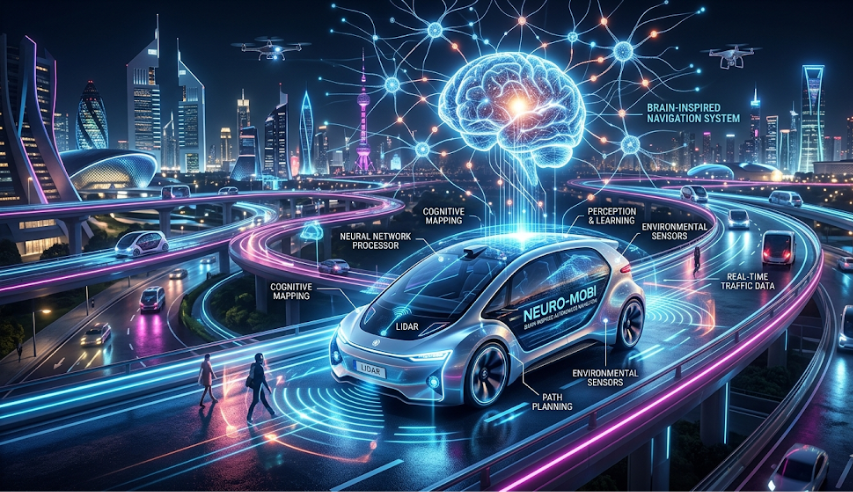
Autonomous navigation is transforming industries ranging from transportation and robotics to aerospace and logistics. Traditional AI-based navigation systems rely heavily on massive computational resources, continuous sensor processing, and cloud-based decision-making. While effective, these systems often struggle with energy efficiency, adaptability, and real-time learning in unpredictable environments.
To overcome these challenges, researchers are increasingly turning toward the human brain for inspiration. Brain-inspired autonomous navigation combines concepts from neuroscience, neuromorphic computing, cognitive intelligence, and biologically inspired learning to create machines capable of navigating the world with greater efficiency and adaptability.
This emerging field has the potential to redefine how intelligent systems move, learn, and interact with dynamic environments.
Introduction
The human brain performs navigation remarkably well despite consuming only about 20 watts of power. Humans can:
- Recognize obstacles instantly
- Adapt to changing environments
- Learn routes quickly
- Predict movement patterns
- Make decisions under uncertainty
In contrast, conventional autonomous systems require:
- High-performance GPUs
- Large energy consumption
- Massive training datasets
- Continuous cloud connectivity
Brain-inspired navigation seeks to replicate the efficiency and intelligence of biological systems using:
- Neuromorphic computing
- Spiking neural networks (SNNs)
- Event-driven perception
- Cognitive mapping
- Bio-inspired reinforcement learning
The goal is to create autonomous systems that can learn and adapt naturally while operating efficiently in real-world environments.
What Is Brain-Inspired Autonomous Navigation?
Brain-inspired autonomous navigation refers to navigation systems modeled after biological neural processes found in humans and animals.
These systems imitate:
- Neural signaling mechanisms
- Spatial memory formation
- Decision-making pathways
- Sensory integration
- Adaptive learning behavior
Unlike conventional navigation algorithms that rely on rigid programming, brain-inspired systems can:
- Learn from experience
- Adapt in real time
- Handle uncertainty
- Operate efficiently with sparse data
This approach is especially valuable for:
- Autonomous vehicles
- Mobile robots
- Drones
- Space exploration systems
- Smart industrial automation
Biological Inspiration Behind Navigation
1. Place Cells and Grid Cells
Neuroscientists discovered specialized neurons in the brain responsible for spatial awareness.
Place Cells
Located in the hippocampus, these neurons activate when an individual is in a specific location.
Grid Cells
Found in the entorhinal cortex, grid cells create coordinate-like spatial representations that help with path planning and navigation.
Applications in AI:
- Cognitive mapping
- Route memory
- Localization systems
- Spatial reasoning
2. Visual Cortex Processing
The human visual system processes dynamic scenes rapidly and efficiently.
Brain-inspired navigation systems mimic:
- Edge detection
- Motion perception
- Object recognition
- Attention mechanisms
This enables efficient environmental understanding.
3. Sensorimotor Integration
Biological organisms combine:
- Vision
- Hearing
- Touch
- Motion feedback
to make navigation decisions.
Similarly, autonomous systems integrate:
- Cameras
- LiDAR
- Radar
- IMUs
- Event sensors
for multi-modal perception.
Core Technologies in Brain-Inspired Navigation
Neuromorphic Computing
Neuromorphic hardware imitates biological neural architectures.
Examples include:
- Intel Loihi
- IBM TrueNorth
- SpiNNaker
Advantages:
- Ultra-low power consumption
- Parallel information processing
- Real-time adaptation
- Reduced latency
These chips are highly suitable for mobile autonomous systems.
Spiking Neural Networks (SNNs)
SNNs communicate using spikes similar to biological neurons.
Benefits:
- Sparse computation
- Energy efficiency
- Temporal learning capability
- Real-time sensory processing
Applications:
- Obstacle avoidance
- Motion tracking
- Event-driven navigation
Event-Based Vision Sensors
Traditional cameras process full image frames continuously.
Event cameras only capture changes in brightness.
Advantages:
- Very low latency
- High dynamic range
- Reduced data redundancy
- Efficient motion detection
This makes them ideal for:
- Fast-moving drones
- Autonomous vehicles
- Robotics
Reinforcement Learning Inspired by Biology
Biological organisms learn navigation through rewards and experience.
Brain-inspired reinforcement learning enables systems to:
- Learn optimal paths
- Adapt to obstacles
- Improve through exploration
This approach enhances autonomous decision-making in complex environments.
Architecture of a Brain-Inspired Navigation System
A typical architecture includes:
1. Sensory Perception Layer
Processes environmental data from:
- Cameras
- Event sensors
- LiDAR
- Radar
2. Neural Encoding Layer
Converts sensory information into spike-based neural representations.
3. Cognitive Mapping Module
Builds internal spatial representations similar to biological memory systems.
4. Decision-Making Network
Uses reinforcement learning and neural inference for navigation decisions.
5. Motor Control Layer
Generates movement commands for:
- Steering
- Speed control
- Direction adjustment
Applications of Brain-Inspired Autonomous Navigation
Autonomous Vehicles
Modern vehicles require:
- Real-time obstacle detection
- Fast decision-making
- Energy-efficient computing
Brain-inspired systems improve:
- Adaptive driving behavior
- Pedestrian prediction
- Traffic understanding
- Navigation in poor weather conditions
Drone Navigation
Drones often operate in highly dynamic environments.
Brain-inspired techniques help drones:
- Avoid obstacles rapidly
- Navigate indoors
- Adapt to changing conditions
- Improve flight efficiency
Robotics
Mobile robots in factories and warehouses benefit from:
- Efficient route planning
- Real-time adaptation
- Human-aware navigation
Applications include:
- Delivery robots
- Industrial automation
- Service robots
Space Exploration
Space missions require autonomous systems capable of functioning with limited communication.
Brain-inspired navigation helps:
- Planetary rovers
- Deep-space probes
- Autonomous landing systems
operate independently in uncertain terrains.
Defense and Security
Applications include:
- Autonomous surveillance
- Reconnaissance drones
- Smart defense robotics
These systems require rapid threat detection and adaptive movement strategies.
Advantages Over Traditional Navigation Systems
| Feature | Traditional AI Navigation | Brain-Inspired Navigation |
| Power Consumption | High | Low |
| Adaptability | Moderate | High |
| Learning Capability | Data-dependent | Experience-driven |
| Real-Time Processing | Limited by hardware | Efficient |
| Sensor Processing | Frame-based | Event-driven |
| Scalability | Computationally expensive | More efficient |
Challenges in Brain-Inspired Navigation
Hardware Constraints
Neuromorphic hardware is still evolving and lacks widespread commercial adoption.
Training Complexity
Training spiking neural networks remains difficult compared to conventional deep learning.
Limited Software Ecosystems
Development frameworks for neuromorphic AI are still immature.
Real-World Reliability
Ensuring safe operation in unpredictable environments remains a major challenge.
Future Trends
The future of brain-inspired navigation may include:
Cognitive Autonomous Systems
Machines capable of reasoning and contextual understanding.
Self-Learning Robots
Robots that continuously improve through experience.
Neuromorphic Edge AI
Ultra-efficient AI systems operating directly on edge devices.
Swarm Intelligence
Groups of autonomous agents cooperating like biological colonies.
Hybrid Quantum-Neuromorphic Navigation
Combining quantum-inspired optimization with neuromorphic intelligence for advanced path planning.
Conclusion
Brain-inspired autonomous navigation represents a major shift in the development of intelligent systems. By learning from the remarkable efficiency of biological brains, researchers are creating machines that can:
- Navigate more efficiently
- Adapt dynamically
- Learn continuously
- Operate with minimal energy consumption
The integration of:
- Neuromorphic computing
- Spiking neural networks
- Event-driven vision
- Cognitive intelligence
is paving the way for the next generation of autonomous technologies.
As hardware and learning algorithms continue to evolve, brain-inspired navigation may soon become the foundation for intelligent mobility across transportation, robotics, aerospace, and beyond.
The future of autonomous systems will not simply be artificial intelligence — it will be biologically inspired intelligence.