
Introduction
While many attacks aim to observe a system’s behavior, fault injection attacks take a more aggressive route—they deliberately disrupt normal hardware operation to force errors. These induced faults can bypass security checks, reveal hidden data, or compromise cryptographic systems. This technique is especially relevant in embedded systems, smart cards, and IoT devices.
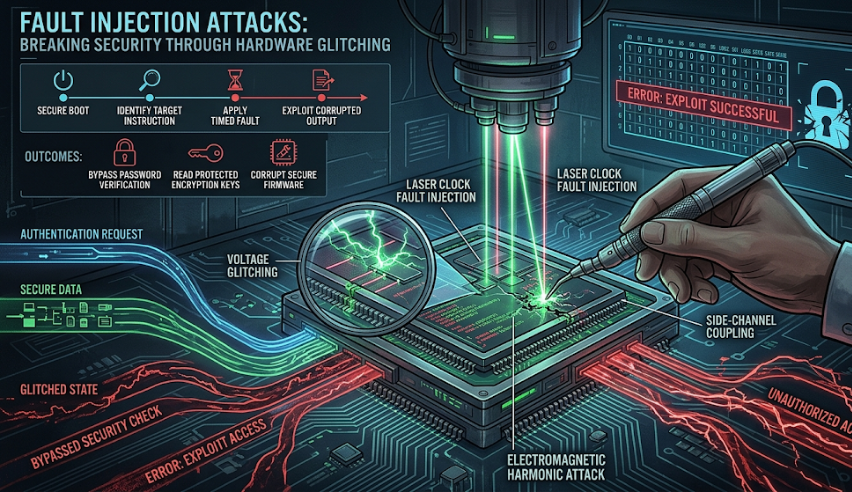
What Is Fault Injection?
Fault injection involves introducing controlled disturbances into a device while it is executing sensitive operations. The goal is to cause the system to behave incorrectly in a way that benefits the attacker.
Common targets include:
- Authentication routines
- Cryptographic computations
- Secure boot processes
Types of Fault Injection Attacks
1. Voltage Glitching
The attacker briefly lowers or spikes the supply voltage during execution.
Effect:
- Causes incorrect instruction execution
- Skips critical security checks
Example:
A password verification step might be skipped, granting unauthorized access.
2. Clock Glitching
The attacker manipulates the clock signal by speeding it up or introducing irregular pulses.
Effect:
- Disrupts instruction timing
- Causes misalignment in execution
3. Electromagnetic Fault Injection (EMFI)
A focused electromagnetic pulse is used to disturb specific regions of a chip.
Effect:
- Highly targeted faults
- Can affect registers or memory selectively
4. Laser Fault Injection
A laser beam is directed at precise نقاط on the chip.
Effect:
- Extremely precise manipulation
- Often used in advanced hardware attacks
How the Attack Works
- The attacker identifies a critical operation (e.g., key comparison)
- Injects a fault at the exact moment of execution
- Observes the incorrect output
- Repeats the process to gather useful data
Real-World Example
Consider a device verifying a PIN:
Normal flow:
- Input PIN → Compare with stored value → Grant/deny access
Under fault injection:
- A glitch skips the comparison step
- Device incorrectly grants access
In cryptographic systems:
- Faults during encryption can leak parts of the secret key
Impact on Security
Fault injection can:
- Bypass authentication mechanisms
- Extract cryptographic keys
- Break secure boot protections
- Compromise trusted hardware modules
Countermeasures
Redundant Computation
Perform critical operations multiple times and compare results.
Error Detection Codes
Use checksums or parity bits to detect corrupted data.
Timing Checks
Detect abnormal execution timing caused by glitches.
Voltage and Clock Monitoring
Trigger resets if unusual conditions are detected.
Hardware Shielding
Protect circuits from electromagnetic interference.
Challenges in Execution
- Requires precise timing and synchronization
- Needs specialized equipment
- Modern chips include built-in protections
Importance in Modern Systems
As devices become smaller and more interconnected, the attack surface for hardware-level attacks increases. Fault injection is a key concern in:
- Payment systems
- Automotive electronics
- Secure IoT devices
Key Insight
Fault injection does not break security by solving the algorithm—it breaks it by forcing the system to make mistakes.
Conclusion
Fault injection attacks highlight a critical weakness in hardware security: systems must not only be logically correct but also resilient to physical disturbances. Designing robust systems requires anticipating and defending against these intentional faults.