
As we move deeper into 2026, the global semiconductor supply chain has never been more complex—or more vulnerable. With counterfeit chips making their way into everything from medical devices to defense systems, the industry is turning to a revolutionary “zero-trust” solution: Physical Unclonable Functions (PUFs).
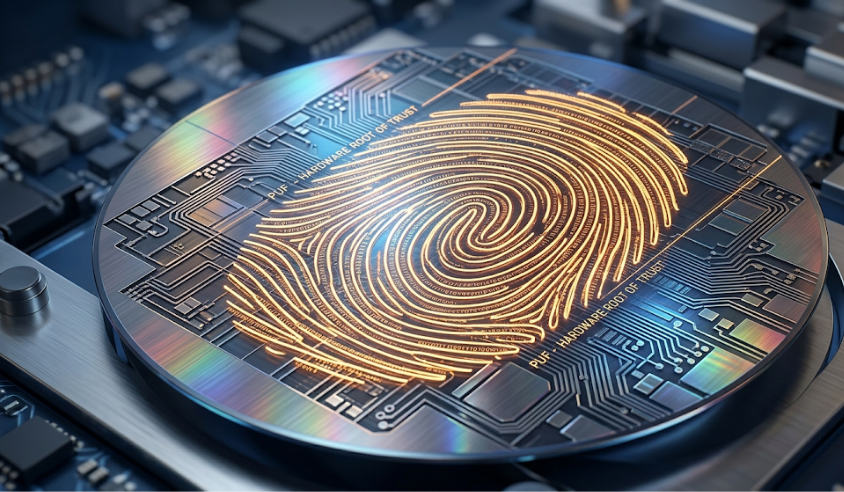
What is a Silicon Fingerprint?
In a world of mass production, we assume every chip in a batch is identical. But at the microscopic level, they aren’t.
During the manufacturing process, tiny, uncontrollable physical variations occur in the silicon. These “imperfections” are unique to every single chip, like a human fingerprint. A PUF is a hardware security primitive that harvests these unique characteristics to create a cryptographic key.
The “Ghost in the Machine” Problem
Traditional security relies on storing secret keys in non-volatile memory. The problem? If an attacker can physically probe that memory, they can clone the key and create a perfect counterfeit. Unlike traditional Secure Elements that store keys in ‘Digital Vaults,’ PUFs utilize the natural randomness of SRAM startup states or ring oscillator frequencies. This means the ‘key’ is a behavioural result of the physics of the chip, not a stored file. It is the difference between carrying a physical key
PUFs change the game because:
- The key is never “stored”: It is generated on-demand by the physical properties of the chip. When the power is cut, the key effectively disappears.
- It’s Unclonable: Even the original manufacturer cannot create two chips with the same PUF signature.
- Tamper-Evident: If an attacker tries to physically dismantle the chip to find the key, they alter the physical structure of the silicon, which changes the fingerprint and renders the key useless.
Beyond Security: A Supply Chain Revolution
For CTOs and Supply Chain Managers, PUFs aren’t just a “security feature”—they are a trust anchor. Imagine being able to verify the authenticity of a component at any point in its lifecycle—from the factory floor to a satellite in orbit—without needing to trust a third-party database. We are moving toward a future where “Hardware Root of Trust” is the standard, not the exception.
- The Economics of “Zero-Trust” Hardware Counterfeiting isn’t just a security risk; it’s a massive financial drain. Integrating PUFs at the silicon level reduces the need for expensive physical inspections and third-party audits. By automating authenticity checks, companies can significantly lower their insurance premiums and supply chain overhead.
- AI Model Integrity at the Edge In 2026, we aren’t just protecting data; we are protecting models. If an attacker swaps a legitimate AI accelerator for a counterfeit one, they could introduce “model poisoning” or backdoors at the hardware level. PUFs ensure that the AI model is running on “Known Good Hardware,” maintaining the integrity of the inference results.
- Sustainability and E-Waste Reduction Authentic hardware lasts longer and is easier to refurbish safely. By using silicon fingerprints, recyclers can verify the history and specifications of a chip, ensuring that components are reused appropriately rather than ending up in a landfill due to “unknown” origin or safety concerns.
- Regulatory Compliance (CRA and Beyond) With new regulations like the EU Cyber Resilience Act and updated NIST standards, hardware security is no longer optional. PUFs provide a standardized, measurable way to meet “security by design” requirements, making compliance audits much faster and more transparent.
- The “Silicon-to-Cloud” Path Modern PUF implementations allow for a direct, secure handshake between a physical chip and a cloud server. This creates an end-to-end encrypted tunnel that starts inside the silicon, making “Man-in-the-Middle” attacks on IoT devices nearly impossible.
Conclusion: Moving Toward a Zero-Trust Hardware Future
We are entering an era where software security alone is no longer enough. As our world becomes increasingly defined by autonomous systems, medical robotics, and Edge AI, the “atoms” of our hardware must be just as secure as the “bits” of our code.
Physical Unclonable Functions (PUFs) represent a fundamental shift in how we define identity in the digital age.